Religious Freedom Day: From Jefferson and Adams to Trump and Biden

Fresno Bee, January 14, 2024

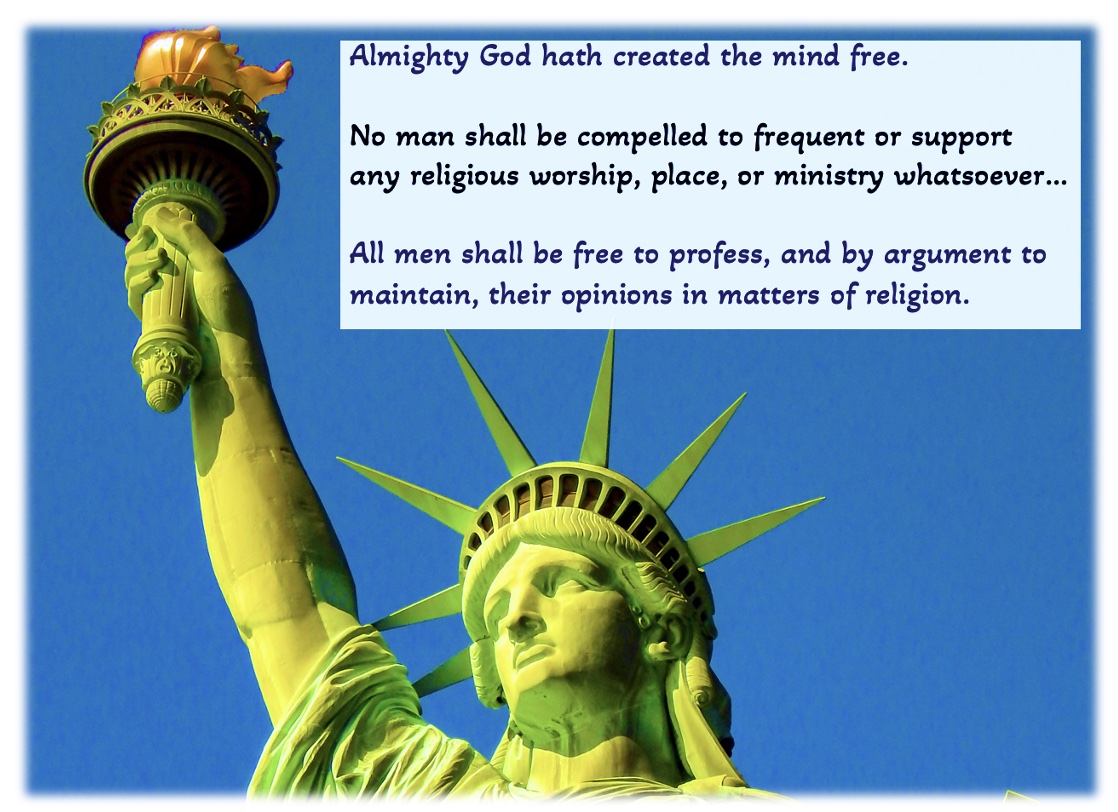
Religious Freedom Day” is January. 16. The day commemorates the Virginia Statute for Religious Freedom, which was passed into law on January 16, 1786. The law was originally drafted by Thomas Jefferson and carried forward by James Madison.

It is worth reading the whole document. It is not long. But it does contain dense prose that brings together a number of important points from theology and political philosophy. Before summarizing it, we might note how different things seem today from the time of the founding. Jefferson and Madison studied philosophy, religion, history, and politics. They spoke moderately and with reasoned arguments.

These giants are quite different from the leading Republican candidate for president, who has been talking a lot about religion. In a Christmas post, Donald Trump wrote of Joe Biden and others he calls “thugs,” “MAY THEY ROT IN HELL.” And before Christmas, in Iowa, Trump said, “Our country’s gone to hell. As soon as I get back in the Oval Office, I’ll immediately end the war on Christians … Under crooked Joe Biden, Christians and Americans of faith are being persecuted and government has been weaponized against religion like never before. And also presidents like never before.”

This Christian nationalist dog whistle fails to acknowledge that the Constitution makes persecution of any religion illegal. It fails to recognize that in our system of checks and balances, the president does not have the absolute power to declare war on religion. Trump also fails to understand that Christmas is a time of joy and love, not grievance and resentment.

Of course, Trump is free to say what he wants. Thanks to the founders’ wisdom, we have freedom of speech along with religious liberty. The Constitution’s First Amendment ensures that there can be no war on any kind of religion. It also allows Trump to damn his opponents to hell.

Now let’s consider that Virginia Statute. The law states that faith ought to be free from coercion because God created the human mind free. The government should stay out of religion because coercive state power corrupts the nature of faith.

The law notes that the men who lead churches and states are “fallible and uninspired.” It also claims that these faulty mortals have “established and maintained false religions” throughout history. Such crooked men end up warping religion when they try to impose their opinions on others.

The statute further says that “our civil rights have no dependence on our religious opinions.” This means that every person has the same civil rights, no matter what they believe (or don’t believe). Civil government exists to maintain peace and good order. Beyond that it should not go. The state does not exist to enforce religious orthodoxy.

The statute concludes by paraphrasing the philosopher John Locke, saying, “truth is great and will prevail if left to herself.” There is a suggestion here that political coercion tends to undermine truth. At the same time there is the hope that if people were left alone to develop their own consciences, truth would win out and we’d all be better off.

These are important ideas found deep in the heart of the American tradition. They also remind us of a different kind of political tone. The founders valued civility, moderation and restraint. Of course, from time to time, the founding generation engaged in heated political rhetoric. These men were human, after all. In the election of 1800, supporters of John Adams accused Thomas Jefferson of being an atheist. William Lin, a clergyman who opposed Jefferson, said the election of Jefferson would “destroy religion, introduce immorality, and loosen all the bonds of society.”

Despite that hyperbole and animosity, Adams and Jefferson eventually reconciled after their respective presidencies ended. They went on to exchange a number of letters in which they discussed religion and philosophy. These letters show that Jefferson was not an atheist. Nor was Adams an orthodox Christian. Rather, these were inquisitive minds trying to make sense of religion.

It is religious liberty that allows us to think critically about our beliefs. In the long run, wisdom is found in free and moderate discussion. And it is better to argue reasonably than to wish that your opponents should rot in hell.

Read more at: https://www.fresnobee.com/opinion/readers-opinion/article284146833.html#storylink=cpy


Is the US a Christian Nation?

Fresno Bee, January 23, 2022

In our secular society, Christianity has become an interest group vying for influence in the marketplace of ideas. It is no longer taken for granted that this is a Christian country.

Consider a recent case before the U.S. Supreme Court, involving a Christian group that wanted to raise its flag outside city hall in Boston. The court is considering whether this would be an endorsement of Christianity by the city, or whether the flag is merely the private expression of Christian citizens.

Christian Flag SCOTUS Blog

If the Christian group wins the case, its victory will mean only that the group has the right to express its religious beliefs in a public forum. They must take turns along with advocates of LGBT rights, BLM protesters, and other groups who want to fly their flags. No one is arguing here that the state ought to reserve a privileged place for Christian symbols and beliefs.

American secularism is grounded in the First Amendment to the Constitution. The First Amendment’s “establishment clause” prevents government entities from endorsing any faith. Its “free expression clause” permits individual citizens to express their own religious (or non-religious) beliefs.

Clarity about this is important, given the shifting religious identification of American citizens and the threat of religious violence. Our system allows people with diverse religious and non-religious beliefs to peacefully coexist. And it prevents the government from oppressing religious minorities.

Some people continue to maintain that America is a Christian nation. A recent report on NPR quoted a minister at a “patriot church” in Tennessee, who said, “You know why there’s churches everywhere and not mosques? Because we’re a Christian nation.”

But the First Amendment and our shifting demography point in another direction. In a report published at the end of 2021, the Pew Research Center indicates that the Christian population has continued to decline. Only 63% of Americans identify as Christian. Non-Christian religions (Jews, Muslims, Sikhs, Hindus, etc.) account for another 6% of the population. And even among the faithful, religious belief is often lukewarm. Fewer than half of Americans report that they pray daily. Only about 40% say that religion is very important in their lives.

The fastest growing group in our country is the “nones,” those who answer “none of the above” when asked about their religious affiliation. The “nones” have nearly doubled since 2007, when Pew began tracking the data. Nearly one in three Americans (29%) are “nones.” This includes some atheists (4%) and agnostics (5%). But many of the non-religious simply do not identify with traditional religious categories.

It is true that at one point in our history, Christianity was the dominant faith. But even that claim needs qualification. Many of the founders had unorthodox views. George Washington attended church infrequently. When he did go, he refused to take communion. Thomas Jefferson admired Jesus, but was skeptical of the Bible’s miracles. John Adams claimed that the Christian view of the trinity was absurd. And America is the home of alternative Christian faiths such as Mormonism, Adventism, and Christian Science.

Critics will also argue, as Frederick Douglass did, that a nation founded on slavery could hardly be called “Christian.” Douglass argued against “the corrupt, slaveholding, women-whipping, cradle-plundering, partial and hypocritical Christianity of this land.” He said, “I can see no reason, but the most deceitful one, for calling the religion of this land Christianity.”

Elizabeth Cady Stanton said something similar. She thought that Christianity contributed to the oppression of women. She worked with a team of feminists at the end of the 19th century to rewrite the Bible. The result was “The Woman’s Bible,” which thoroughly revised the Bible’s patriarchal and misogynistic texts.

And so it goes. We disagree about what Christianity means. A growing number of us no longer identify as Christian. And Christian groups must vie time on the flagpole along with other interest groups.

This is the reality of our secular system, operating under the First Amendment. Under our Constitution, religious liberty is valued while the government is prevented from endorsing any specific religion. In this country we are free to argue about the meaning of the Bible. We are also free to gather round the flagpole and argue about history and the role of religion in our public life.

Americans Disagree About the Afterlife

That’s why we need religious liberty…

Fresno Bee, November 28, 2021

Most Americans believe there is life after death. A recent survey from the Pew Center reports more than 80% of Americans believe in some form of afterlife. Sixty-one percent believe in traditional accounts of heaven or hell. Others believe in some alternative, such as reincarnation. Only 17% do not believe in an afterlife.

The headline for this report focuses on political differences. Republicans are more likely to believe in a traditional idea of heaven and hell than Democrats. Our polarization seems to extend beyond this world.

One disagreement concerns who gets into heaven. A third of Americans believe that the path to heaven is through “one true faith” (a belief that is more common among Republicans). But many Americans are open-minded about this. A majority of us think that believers of “many religions” can gain eternal life.

Of course, opinion polls are not theology. These questions run deep and the answers are shrouded in mystery. These are things to ponder in the glow of firelight on cold and foggy winter nights. Even the theologians disagree. Some claim the “narrow gate” to heaven is reserved for believers. Others believe in “universal salvation,” which is the idea that everyone goes to heaven.

And what part of you will survive? Some say your body will be resurrected. Others think the soul lives on. Others suggest that even though you die, it is the memory of you that lives on in the mind of God.

Debates about the afterlife are ancient. Socrates said death was either a dreamless sleep or a journey to another world where good is rewarded and evil is punished. In either case, a good person has nothing to fear in death. If death is a dreamless sleep, then we won’t suffer from being dead. And if the religious stories about the afterlife are true, good people will be rewarded.

Plato believed in reincarnation. He suggested that the virtues we develop in this life help us choose our next life wisely. Plato’s elaborate scheme of transmigrating souls was rejected by materialistic philosophers such as Epicurus. Epicurus taught that death really is the end. He suggested that we should stop worrying about the afterlife and focus on happiness in this life.

Christianity rejected Epicurean philosophy by insisting on the importance of resurrection and the idea of divine judgment. One worry is that without the promise of heaven and the threat of hell, we may lack the motivation to be good. There is also the need for consolation in the face of suffering and evil.

Some good people suffer and die miserable deaths. And some evil people get away with murder. The universe does not seem fair if good folks go unrewarded and evil people don’t get punished. Immortality and divine judgment appear to resolve this discrepancy.

As we ponder these issues, it might help to know that Americans have often disagreed about them. One famous disagreement is that between John Adams and Thomas Jefferson.

Jefferson most likely did not believe in personal immortality. Jefferson was a materialist and a deist who was sympathetic to Epicurean philosophy. He seemed to believe that personality was situated in the brain and that the soul disappeared at death. Jefferson also suggested in a letter to Adams that Plato’s account of immortality was “nonsense” produced by Plato’s “foggy mind.”

But Adams believed otherwise. His belief in the immortality of the soul was central to his religious faith. In a letter to Jefferson, Adams said, “If I did not believe in a future state I should believe in no God.” In another letter, Adams said, “A future state will set all right. Without the supposition of a future state, I can make nothing of this universe, but a chaos.”

And so it goes. Adams believed that the afterlife gives meaning to this life. Jefferson thought such ideas were nonsensical.

This leads us, in conclusion, to the need for religious liberty and freedom of thought. Great minds disagree about immortality. And so do we. These questions are not answerable in this life. This means that we should be free to disagree. At some point, we will each confront this mystery directly. In the meantime, let’s leave each alone to ponder the imponderable.

American Civilization and Its Discontents

Fresno Bee, July 4, 2020

Americans are dissatisfied, and that is good. Discontent is the lifeblood of democracy.

A recent poll from Politico concludes that 75% of Americans think the country is on the wrong track.  Another recent poll from the Pew Center found that only 17% of Americans are “proud” of the country.  When asked how they feel about the state of the country, 71% said “angry,” 66% said “fearful.”  Only 46% are “hopeful.”  Pew reports that only 12% of Americans say they are satisfied with the country.

These numbers indicate a low point for the American spirit.  But they also show that Americans are not stupid.  It is smart to be dissatisfied when there is a pandemic, economic collapse, confused leadership, and racial injustice.  It is surprising that anyone is satisfied with the country today.

The United States is a land of dissatisfaction.  People come here because they don’t like the old country.  The early Americans were not satisfied with British colonial rule.  The Civil War and the civil rights movement were expressions of deep dissatisfaction.  Donald Trump rode to power on a wave of discontent. 

And the waves roll on.  This nation is a changing multitude.  We have too much liberty to remain united for long.  America is anti-abortion protesters and Black Lives Matter marchers.  It is the anarchists of Seattle and the law and order crowd in Washington, DC.  Our divisions and our discontent are signs of the vitality of our democracy.  In a dull and dying country, no one has the energy to be fed up and people lack the right to express their unhappiness.  But in a vibrant and free country, the yearning for change is loud and proud.

Some dream of bland homogeneity.  They want an America that looks like what they see in the mirror.  They dream perhaps of resting in peace.  But life is a bubbling, boiling confusion.  There never was homogeneity on this vast continent.  The native tribes of pre-Columbian times were diverse.  For five hundred years, new generations of immigrants have brought different cultures, religions, and ideas.

The thing that unites us is our freedom to criticize and our right to think for ourselves.  Liberty creates difference.  The more freedom, the more divergence.  From creative liberty and diversity of experience emerges energy and enthusiasm.  Let’s embrace the fact that to be an American means to be cranky and critical, argumentative and evolving. 

The idea of productive discontent is central to the American myth.  The Fourth of July commemorates this process.  This nation was born out of the destruction of the old.  We celebrate it by blowing things up!  We hope that from the fireworks, something better will emerge.

The Declaration of Independence can be read as the expression of the complaints of a youthful spirit.  It’s timeless words about self-evident truths give way to an extended diatribe against old King George, who is described as a mean and tyrannical father figure.   

Thomas Jefferson was only 33 years old when he worked on the Declaration.  And while the Declaration described the King as an absolute tyrant seeking to impose an absolute despotism over the colonies, not everyone on the committee agreed.  John Adams was an older man.  He thought the accusation of tyranny was too personal and sounded like “scolding.” 

A decade later, Jefferson said, “I hold it that a little rebellion now and then is a good thing, and as necessary in the political world as storms in the physical.”  This physical analogy is enlightening.  Storm clouds build as the atmosphere heats up.  There is thunder and lightning, rain and hail.  But this clears the air and waters the crops. 

This idea, that a little rebellion is a good thing, seems uniquely American.  This is the spirit of youth and rock and roll.  It is the creative destruction of the capitalist economy.  It spurs innovation in technology and scientific revolutions. 

The simmering dissatisfaction of the present will boil over and give shape to something new.  Of course, there are dangers.  Lightning can kill and flash floods can wash away things we love.  But that’s life.  We never really rest in peace until the day is done or freedom is extinguished.  Liberty creates discontent.  But from dissatisfaction, creative innovation develops, as today’s storms nurture tomorrow’s fruit.

Impeachment, The Constitution, and Civics

Is the United States heading for an impeachment crisis?

Fresno Bee, September 10, 2016


Democracy is both inspiring and appalling. This year in California we will vote on initiatives involving the death penalty, firearms, taxes and health care. We also will vote on whether marijuana should be legal and whether porn actors should wear condoms.

There is no guarantee that voting will produce wise and virtuous outcomes. Porn addicts and potheads will cast votes alongside priests and police officers.

The national race does not inspire confidence in the electoral process. The primaries have given us two flawed candidates for president. Each accuses the other of mendacity and incompetence. With this level of animosity before the election, dysfunction likely will follow. Some commentators have suggested that there will be an impeachment crisis in the next few years, no matter who gets elected president.

Democracy can produce good outcomes. Smart and sincere voters can elect virtuous officials who are dedicated to the common good. But the fact of diversity means that we will disagree about what we mean by virtue and the common good. And so democracy also gives us gripes, grievances and gridlock.

THE PRESENT ELECTION PROVIDES A WONDERFUL TEACHABLE MOMENT. CIVICS EDUCATION INCLUDES A DISCUSSION OF THE VIRTUES AND VICES OF DEMOCRACY AS WELL AS ANALYSIS OF THE STRUCTURE AND HISTORY OF THE CONSTITUTION.

Philosophers have often criticized democracy. Plato warned that democracy can quickly turn to tyranny, as the people elect tyrants who make populist promises while plotting to take advantage.

John Adams, our second president, shared Plato’s worry. He warned about the dangers of direct democracy. He said: “Remember democracy never lasts long. It soon wastes, exhausts, and murders itself. There never was a democracy yet, that did not commit suicide.”

The framers of the U.S. Constitution tried to remedy the flaws of democracy by giving us mixed government with a separation of powers. That idea goes all the way back to the ancient Greeks. A mixed government is not very efficient. But it aims to prevent tyranny by frustrating the machinations of those who lust for power.

Another remedy focuses on educating citizens. This idea was dear to Thomas Jefferson. In a letter to James Madison in 1787, Jefferson wrote that education of the common people is the best way to secure liberty.

A similar argument is made in a forthcoming book by educational and moral theorists Nel Noddings and Laurie Brooks. The book “Teaching Controversial Issues” maintains that critical thinking and moral education are essential for democracy.

NO NATION IS PERFECT.

The authors argue that democratic schools should encourage critical thinking rather than blind obedience. We need to give young people the tools to analyze and evaluate controversial topics, while inspiring them to remain committed to the common good. The goal “is to develop thoughtful, well-informed citizens for a participatory democracy.”

The present election provides a wonderful teachable moment. Civics education includes a discussion of the virtues and vices of democracy as well as analysis of the structure and history of the Constitution.

It is easy and fun to celebrate the myths of uncritical patriotism. But the truth is more complicated. No nation is perfect. There are no utopias. The flaws in political systems reflect flaws in human nature. People are not perfect. Nor are the systems we construct.

On Sept. 17, 1787, when Benjamin Franklin made a motion to approve the Constitution, he acknowledged that there was no perfect constitution. Human beings always bring with them “their prejudices, their passions, their errors of opinion, their local interests, and their selfish views.” So no human constitution can ever be perfect.

But rather than leaving us discouraged, this should invigorate us. There is work to be done to improve the world. In the end, we get the democracy we deserve. We build the world we live in with our questions and criticism as well as our votes.

Read more here: http://www.fresnobee.com/living/liv-columns-blogs/andrew-fiala/article100862147.html#storylink=cpy