“Tighten Up!” Self-Control and the Covid Finish Line

Fresno Bee, April 18, 2021

As more people get vaccinated and coronavirus restrictions ease up, public health officials are worried that we will ditch our masks and let down our guard. It is not yet time to celebrate. When you see the finish line, breathe deep and bear down.

Virtues such as patience, fortitude, and endurance are often ignored in a culture of instant gratification. Consumerism feeds the frenzy of appetite. Despite COVID-19 restrictions, we have not generally adopted a Spartan lifestyle. Instead, we have embraced DoorDash, Netflix, and the drive-thru window. Pornography consumption increased under COVID, as did alcoholism and obesity.

A recent survey reports that more than 60% of Americans gained weight while living under lockdown. The average weight gain was 29 pounds. This is worrying since obesity is an important factor in COVID-19 mortality.

Our obesity problem indicates the role that social systems play in supporting good (or bad) habits. Self-control is important. But social circumstances matter. The American Academy of Pediatrics cautions that COVID-related disruptions in school can increase obesity in children, as kids spend more time on screens, exercise less, and eat more unhealthy foods.

Social support helps develop the crucial ability to delay gratification. Delayed gratification is a sign of moral maturity and a key to living well.

The famous Stanford “marshmallow experiment” showed that children who could resist the temptation of immediate gratification ended up with better life outcomes. That experiment forms the basis of a book by Walter Mischel who claims that self-control is “the engine of success.” Critics have pointed out that self-control is linked to class, race, and other social determinants. The children of well-educated families are better at delaying gratification. And affluence may mitigate the negative outcomes of a lack of impulse control.

The question of self-control is as old as the Greeks. Aristotle connected self-regulation with happiness. Pleasure seduces us into making bad choices. Virtue helps us resist the siren-song of unbridled appetite.

Aristotle was puzzled by weakness of will. Why do some people have the ability to control their appetites while others do not? And how come we lose this ability when asleep, drunk, or overcome by strong emotions?

Aristotle compared weak-willed people to beasts. But unlike the beasts, we ought to know better. And we can train ourselves in self-control. Education and social support networks provide the solution. Good education and good friends support good habits.

The ancient Stoics developed this idea into an elaborate system of training in virtue and self-mastery. One important technique is to develop critical thinking. If you really understand what’s good for you, you will do the right thing. And if you really understood what was bad for you, you would avoid it.

But knowledge must be supplemented by habit. Stoic spiritual training also included physical austerities designed to accustom the self to hardship. The Greek root of our word “austerity” also means “bitterness.” The Stoics systematically embraced bitterness. They exposed themselves to cold and to heat. They fasted and abstained from sex. They exercised in the gymnasium and slept on hard beds. And they constantly reminded themselves of illness, grief and death.

Patience, fortitude, and endurance were key virtues for the Stoics. These are important values for living well. But these are not the only values that matter. Sometimes, it is wise to loosen up and enjoy life. Austerity can indeed be bitter. Asceticism needs to be balanced with sweetness and joy.

The Stoics also enjoyed pleasure, but in moderation. The founder of Stoicism, Zeno, was known as a sour-faced and reserved man. But like Socrates, he drank wine occasionally — although he did not get drunk.

There is a time and place for everything. At some point, our masks will come off and we’ll raise a glass at the local watering hole. But Stoic endurance is especially important as the finish line comes into view.

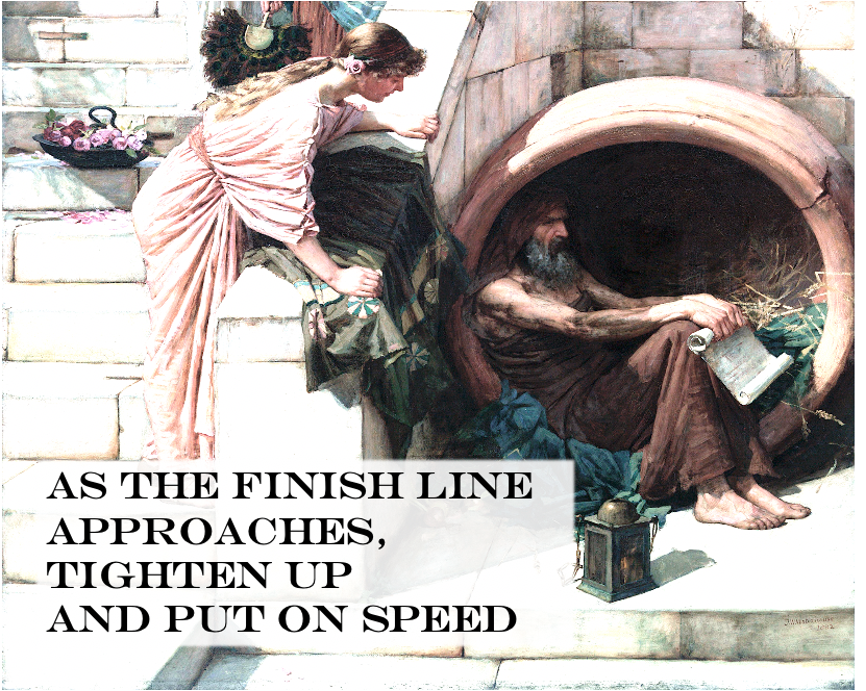
When the philosopher Diogenes was an old man, his friends invited him to rest and take it easy. He thought that was terrible advice. He said that the end of the race is no time to go slack. Rather, as the finish line approaches, we ought to tighten up and put on speed.

Waning Religion and Our Epicurean Moment

Epicurus

Religious membership in the U.S. has dropped below 50% for the first time, according to a recent Gallup Poll.  Some Americans continue to believe in the supernatural.  A 2020 survey indicates that half of Americans believe in ghost and demons.  But it is remarkable that today fewer than half of Americans belong to an organized religion. 

This new data confirms other surveys indicating secularization.  The Pew Center has documented the rapid growth of “the nones” (those who do not claim to belong to a specific religion) and the decline in church attendance. 

Some pundits worry this indicates a cultural malfunction.  Dennis Prager says, “When Judeo-Christian principles are abandoned, evil eventually ensues.”  Shloto Byrnes says that the West is suffering from a “Godless delusion,” arguing that “to be human has meant to be religious throughout history.”  And Shadi Hamid suggests that secularism fuels political extremism. 

These hyperbolic concerns are misguided and misleading.  Many societies have done quite well without Judeo-Christian values.  It is not true that human beings have always been religious in the contemporary sense, or that we need to be.  And rational humanism actually offers an antidote for extremism. 

The Covid-19 crisis provides a great example.  Prayer and miracles will not solve this crisis.  Scientific medicine provides vaccines, prevention protocols, and treatments for infection.  When people get sick these days, they go to the doctor instead of the shaman. 

Scientific naturalism is ubiquitous.  To predict the weather, we consult meteorologists instead of astrologists.  Earthquakes and volcanoes don’t appear to us as the work of mercurial deities who need appeasing.  Reason and humanism provide us with useful advice that improves health and happiness.

And despite what Byrnes says, humanism has a long history.  It made a strong appearance 2,500 years ago in the philosophy of Epicurus.  The Epicurean philosophy aimed to cure the anxiety caused by religious superstition.  Epicurus offered thoroughly naturalistic explanations of earthquakes, lightning, and the like.  The Epicureans taught that happiness was easily obtain by focusing on friendship and virtue in a world emptied of the supernatural. 

The Epicurean philosophy was popular in the ancient world.  But Stoic and Christian authors vilified Epicurean naturalism.  Epicurus’s name was falsely associated with licentiousness and shameless hedonism.  This caricature is unfair to a school that emphasized modesty, frugality, and friendship—and the deliberate avoidance of political extremism.

As a result of persecution, however, few of Epicurus’s original writings exist.  We do know that Epicurus defended an early version of atomism based in a naturalistic view of the world.  His views are remarkably modern. 

Epicurus taught that the cosmos was made up of atoms moving in the void.  He held out the possibility that in the infinite space and time of the universe, there were other worlds that resulted from the same natural processes that produced our world. 

Epicurus said that the soul was merely a combination of certain kinds of atoms.  When the body died, the soul dissipated.  There was no life after death.  If there were gods, they were not concerned about human life.  Religious myths and superstitions caused anxiety by making us worry about the whims of the gods and life after death.  In order to cure that anxiety, a better understanding of nature helps.

Epicureanism also provided an antidote to extremism.  Religious zealots sometimes end up trying to silence the advocates of reasonable naturalism.  They can also fall prey to outrageous conspiracy theories. But rather than engage these zealots in the streets, the Epicureans advised living unobtrusively.  Political tumult results in unhappiness.  The Epicureans tried to avoid that by retreating to private communities, where friendship, reason, and happiness could be cultivated. 

It seems that now is a good time for an Epicurean renewal.  Religion is waning. And while some zealots are succumbing to extremism, most of us are rediscovering the importance of science, reason, and restraint.

The Covid lockdown has also encouraged us to find happiness in simple things.  While extremism and violence has erupted in the streets, we are re-learning the wisdom of living simply and with social distance.  This is an Epicurean moment: a time to rediscover the wisdom of naturalism, a time to turn away from superstition, and a time to cultivate modesty, simplicity, and friendship.

Compassion and Suffering: Tears and Laughter

Fresno Bee, April 4, 2021

Pope Francis once said that compassion is the language of God. Let’s seek it this Easter

Compassion is celebrated by most of the world’s moral traditions. Compassion is the source of human connection. Some think it even goes beyond that. Pope Francis once said that compassion is the language of God. But philosophers worry that compassion is too passive, subjective and melancholic.

The Dalai Lama is an important voice of compassion. He explains that as compassion grows, we develop “both genuine sympathy for others’ suffering and the will to help remove their pain.” Compassion is more than passively feeling the other’s pain. It is also an active response that wants to alleviate suffering.

Buddhist teachings about compassion are often oriented around suffering. A colleague of the Dalai Lama’s, Thupten Jinpa, explains, “At its core, compassion is a response to the inevitable reality of our human condition— our experience of pain and sorrow.”

This is obviously important in a world that includes far too much pain. If we were all more concerned with the suffering of others, the world would be a better place. And while this focus on suffering can seem gloomy, the Buddhists connect compassion with tranquility and happiness. The Dalai Lama says, “The more we care for the happiness of others, the greater our own sense of well-being becomes.”

This may seem paradoxical. But it is only a paradox if compassion is understood as shared suffering. Melancholic compassion is only half of the story. Compassion is also at play in laughter and love-making. Compassion shares joy as well as tears.

To keep compassion too tightly bound to suffering and grief is like having Good Friday without Easter. The point of the Easter story is not to wallow in the darkness, but to re-emerge into the light.

Compassion shares “passion” or emotional experience with others. Our passions are not only negative. Grief, mourning, and despair are certainly important emotions. But wonder and delight are also powerful experiences. Compassion moves us to share the passions of the other person, in sadness and in joy.

Compassion feels good because we are social beings. The receptiveness of compassion is wired into our brains by evolution. As social beings, we enjoy sharing in play, poetry, music, and in the rituals of social life. We do better when we do things in common. Compassionate activity overcomes loneliness and despair. It also allows us to share in playful fun.

One recipe for happiness is found here: if you want to be happy, hang out with happy people who are doing happy things. Happiness — like sadness — is contagious.

Compassion is only melancholic when it is confused with pity. Pity dwells in the negative. We don’t pity people who are doing well. Pity is reserved for the suffering.

The philosopher Immanuel Kant warned against pity. Compassionate pity can “infect” us with the suffering of others, he said. If I suffer because another person is suffering, the result is simply more suffering.

Compassion is better understood as a natural urge to help those who suffer. And while this urge can lead us to act, Kant thought it was insufficient. Sometimes our compassionate urges prevent us from doing our duty. This occurs, for example, when mercy prevents us from punishing those who deserve to be punished. Kant thought that compassion had to be guided by justice.

A similar problem holds for the famous Golden Rule. Love of the neighbor is important. But this does not mean you ought to give the neighbor anything he wants. Love without justice is blind. But justice without mercy is cruel.

A further problem occurs when compassion becomes intrusive. Sometimes we want companionship in our suffering. We cry better (and laugh better) in the company of friends. But sometimes, we simply want to be left alone.

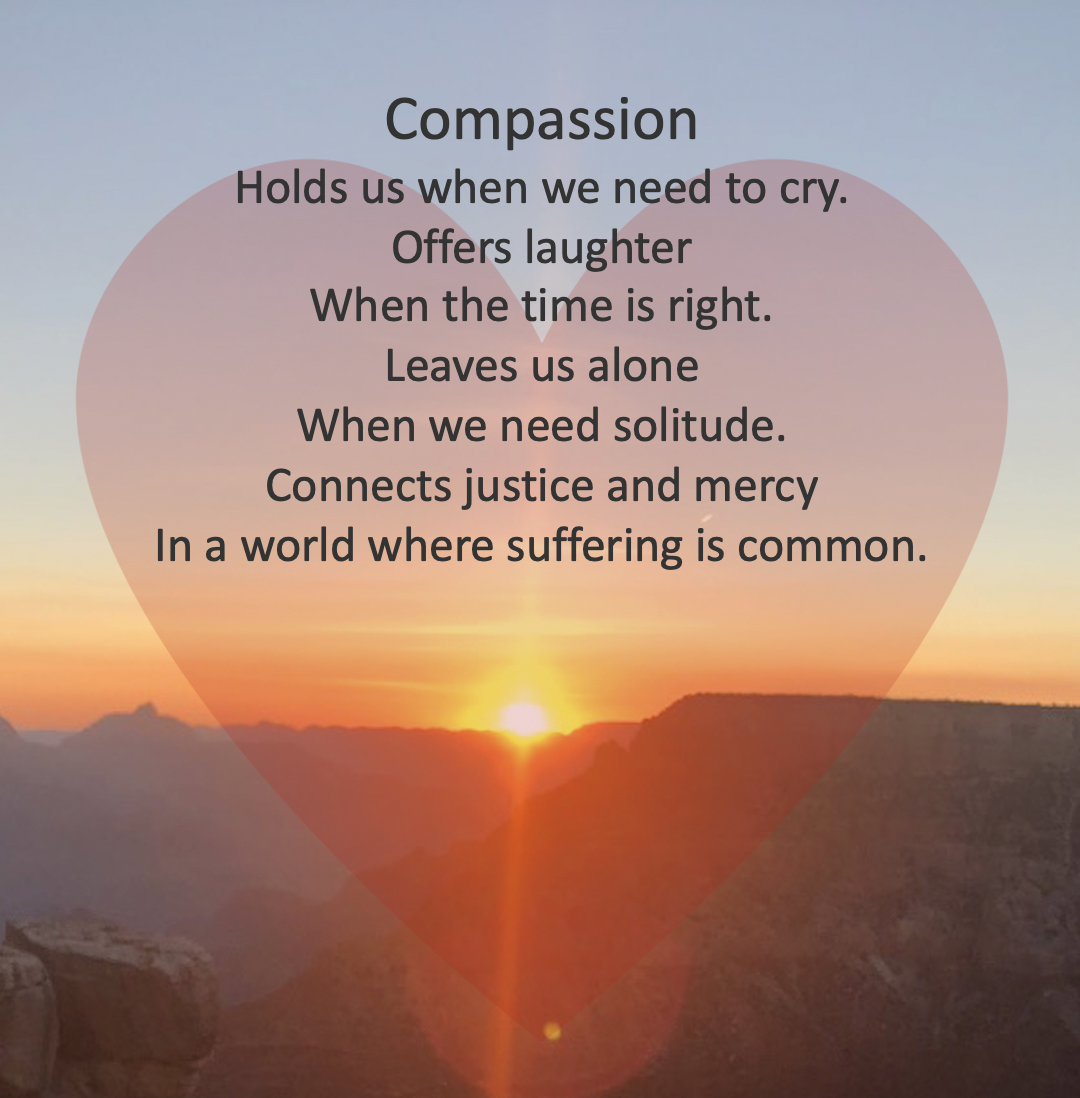
Of course, compassionate people understand all of this. Truly compassionate people have a knack for knowing what is needed. They hold us when we need to cry. They offer laughter when the time is right. They leave us alone when we need solitude. And they try to connect justice and mercy in a world where suffering is common.

Wolves, Dogs, and Civilization

A wolf has appeared in Central California for the first time in a hundred years. He left a pack in Oregon, wandered 500 miles south, passed Yosemite and ended up in the Central Valley. The scientists tracking him are keeping his location a secret. But apparently, he is somewhere out in the fields of Fresno county.

This is a great story about the resilience of nature and the conflict between the wild and the domesticated. Wolves once roamed across this region, as did the grizzly bear, who adorns our state flag. Coyotes and condors, bears and wolves figured prominently in native Californian myths.

The last California wolf was killed in 1924, about the same time that the California grizzly was exterminated. But wild nature has a way of pushing back. Civilization won’t last forever. On the borderlands, wild critters are waiting to return. Civilization is a man-made raft floating on a wild sea.

Wolves touch a primal reservoir of meaning.  Civilization revolves around the ambivalence of the canine—which reflects our own dual nature. Dogs and wolves are symbolic brothers, whose difference marks the border between domestication and wildness. 

The civilizing urge struggles against the wilderness. Real wolves are killed by hunters and farmers. Education domesticates the wolf within. 

Plato described education as taming the inner beast. Aristotle extended this in his account of beastly humans and barbarians. Colonialism and slavery can be traced back to Aristotle’s idea that civilized humans were entitled to hunt and enslave the beastly other.

The wolf often shows up in European culture, as a symbol of the wilderness on the edge of civilization.  Consider an image from Euripides drama, The Bacchae, which is a play about the wild other. In the play, the female worshippers of Dionysus nurse wolf cubs with their own mother’s milk.

The Greek god Apollo was known to manifest himself as a wolf. Homer called Apollo “the wolf-born god.” Legends held that Apollo was himself nursed by a wolf. A similar tale is told about Romulus and Remus, the mythic founders of Rome, who were suckled by a mother wolf.

These stories point toward the mysterious emergence of civilization from out of the wild.  There is only a subtle difference between the wild, unruly wolf and the loyal, domesticated dog.

The wolf-dog divide is found in Plato’s Republic. Plato described the guardians and philosopher-kings of his ideal city as faithful watchdogs. They are loyal to friends, fierce toward foes, and curious about sniffing out the truth. But Plato warns that watch-dogs can turn feral and run amok. We need to guard the guard-dogs (as I discussed in a recent column).

Plato described tyrant as wild beasts. He said that tyrants have a taste for human flesh. The tyrant is “transformed from a man into a wolf.”

This Platonic metaphor resonates through the history of European culture. The Bible warns of wolves in sheep’s clothing (Matthew 7:15). Political philosophers worry that “man is a wolf to man” (homo homini lupus est), as Hobbes did in his argument against “the state of nature.” Wolves and werewolves haunt us in horror films and fairytales.

But does this focus on domestication cause us to overreact? What do we miss when there are no wolves, when everything is domesticated—even our souls?

I love dogs. But in their domesticated cuteness, they lack the edge of ferocity and power that makes the wolf, the grizzly, and the mountain lion so inspiring.  What do we lack when we stay home with the dogs instead of running with the wolves?

There is something unsettling about the presence of a wolf in Central California. This demands that we think the limits of domestication. What was lost as civilization wrested the land from its native inhabitants? And what might the future hold?

We are not the masters of the earth we suppose ourselves to be. This land once belonged to bears, wolves, and lions. The rivers held salmon. Great flocks of birds crowded the wetlands. People lived here, long before European culture arrived. One wonders how long our concrete cities and cultivated fields will last.

How long will it take for wild things to return? And what are we missing when no longer hear the howl of the wolf?

Guarding the Guardians through Vigilance, Leadership, and Professional Ethics

Fresno Bee, March 21, 2021

Who guards the guardians? This age-old question points to a fundamental problem in social life. Powerful institutions can be corrupted by bad actors. Oversight depends upon the virtue and vigilance of those who guard the guardians.

Oversight systems should clarify shared values, shed light on misdeeds, and take action to remove bad actors. Of course, this can become problematic, when partisans and cronies engage in cover-ups or refuse to remove the bad apples. Sycophants create elaborate defensive maneuvers. Bureaucratic procedures impede investigations. And sometimes the bad guys skate away.

This happens in the halls of justice, beneath the academic ivy, and behind the stained-glass curtain. Bad cops get away with murder. Perverted priests are shuffled about. Terrible teachers receive tenure. Lawyers and doctors do dumb and dangerous things. And corrupt politicians get pardoned.

Stories of failed oversight can produce deep cynicism. We are rightly appalled by moral failures in churches, schools and governments. It is frightening when the sheepdogs go bad and start preying upon the sheep.

Some cynics choose to trust no one in authority. But radical suspicion is dangerous and dysfunctional. If you suspect that every doctor is a lying cheat, you’ll ignore legitimate medical advice. If you think that all politicians are corrupt, you’ll stop voting. If you are wary of cops and teachers and other authorities, you’ll end up living in an outlaw limbo.

The cynics remind us that trust has to be earned. But trust is rational, much of the time. We make a leap of faith about the sanity and skill of other drivers, every time we get behind the wheel. Usually this works out well enough.

And despite cover-ups, failures, and delays, oversight systems can work. But they only work when leaders lead with integrity and when the rest of us demand accountability.

There are reassuring stories. This week in Fresno, the chief of police and the mayor (who is the former chief) spoke out against racist cops in the police department. The chief, Paco Balderrama, said, “Fair and impartial policing are extremely important in our society. There is no place in our police ranks for any biased, racist, or anti-Semitic views.”

Or consider the growing outrage about the governor of New York. Instead of circling the wagons to defend Andrew Cuomo against charges he sexually harassed multiple women, leading New York Democrats called for him to resign.

This is how oversight ought to work. Allegations of wrongdoing must be taken seriously. Leaders must articulate fundamental values. They must demonstrate their concern for ethics and the truth — in words and action.

This seems simple and obvious. But problems remain. Those who best guard the guardians are also those who possess the requisite expertise and experience to do that job. This often makes them part of a small, tight-knit fraternity. It is easy to give friends and colleagues the benefit of the doubt. And in politics especially, there are self-interested reasons for covering-up wrongdoing.

Plato proposed an ideal solution. He wanted only the wisest and most virtuous people to serve as guardians. But this solution requires another leap of faith. Philosopher-kings will be tempted to abuse their power. And who will hold them accountable or remove them when they become tyrannical? Plato left that unexplained.

The modern American solution points in a different direction. Instead of concentrating power in the hands of a small group of guardians, we spread the oversight power in a more democratic fashion. This is our celebrated system of checks and balances, intended to prevent bad actors from consolidating power.

This clunky system prevents tyranny. But it does not necessarily work to regulate doctors, teachers, and other non-elected authorities.

This is where professional ethics comes in, along with external oversight and legal liability. Professions are mostly self-regulating. Doctors supervise other doctors. Professors certify other professors. And so on. Much depends on the virtue and wisdom of the professionals themselves. But external auditors and lawsuits also shed light.

At the end of the day, in a democratic country, oversight depends upon what “we, the people” demand. Who guards the guardians? Well, we do — in our professional lives and in the voting booth. Cynicism won’t improve the world. Only virtue and vigilance can do that.