Is it Better to Die or to Pass Away?

Whispered euphemisms obscure the difficult finality of death.  When people die, they are gone forever.  This is tragic and true.  But it’s better to confront hard truths than to sweeten them up with fragrant words.

A couple of months ago, we had our dog euthanized.  He had been sick for a while.  During the last few days, he suffered terribly.  The polite way to speak of this is to say, in the passive voice, “our dog was put to sleep.” 

This may be suitable for parents breaking sad news to children.  But adults should be honest and forthright among themselves.  More than one person has said, “I’m sorry your dog passed away.”  They are trying to be compassionate.  But the dog did not gently “pass away.”  He was suffering and we asked the vet to kill him. 

This was not easy.  But it was the right decision.  It was very sad.  But the dog was better off dead.  It sounds cold to say it.  But it is true.

Euthanasia is Greek-based jargon that avoids the old-fashioned phrase, “mercy killing.”  Euthanasia seems less blunt.  But “mercy killing” honestly admits that this is a kind of killing.   

One problem is that killing seems evil.  But killing is not absolutely wrong.  It is not wrong when it comes from a place of compassion and respect.  It is more honest to admit this than to confuse ourselves with euphemisms. 

Death is veiled by euphemisms.  Consider phrases like “passed away,” “passed on,” or simply “passed.”  There is a kind of cloying phoniness here.  Indeed, “passing” connotes a kind of fakery.  We use this verb to describe what happened when counterfeit money is passed or when someone passes themselves off as someone or something else.

“Passing on” makes death out to be a transition to some other state.  The Bible teaches that this form of life passes away (see 1 Corinthians 7:31) and that “there shall be no more death, neither sorrow, nor crying, neither shall there be any more pain: for the former things are passed away” (Revelation 21:4).

“Passing” is also passive.  We pass footballs and kidney stones.  The object passed is passive in the process.  To say that a person passed away takes away agency.  To my ears, it sounds more respectful to say “he died” than that “he passed away.”  It is nobler to imagine dying as something we do—our last and final act—than to imagine being passed around by fate or the gods. 

If we must speak this way, I suppose “passed away” is preferable to “passed on.”  To say that Jane Doe “passed on” assumes she went somewhere else.  That might be true.  But we don’t know where Jane has gone.  She may be in a worse place or a ghost trapped in limbo. This spookiness can freak you out.  The idea of “passing away” is simpler.  It tells us that Jane is gone without asking us to speculate about where she went.

Sometimes this expression is shortened and people simply say, “Jane Doe passed.”  This phrase seems to require an object like a kidney stone.  And it is ambiguous.  To say Jane passed might mean that she got a C on an exam.  One recent newspaper article used the expression twice to refer to two different deceased persons.  The author is trying to be polite.  But the phrasing is annoying.  Jane Doe is dead.  Let’s not beat around the bush.

For some, there is a taboo or phobia involved in saying words like “dead” and “death.”  Maybe folks fear that these words will somehow conjure up the Grim Reaper.  But honesty is the best antidote for fear.  It is the whispers, the speculation, and the innuendo that causes the shadows to grow.  Dying is a part of life.  Everyone we know will do it someday—including you and me. 

Sometimes it is even better to be dead, as in the case of my dear suffering dog.  It is better to affirm our mortality than to pretend that we merely pass away.  It is better to shed light on death than to pass over it with euphemisms that obscure its sadness and its finality. 
The Poison of the Big Lie

Fresno Bee, May 16, 2021

The “big lie” is destroying our country. When Liz Cheney was deposed from GOP leadership, she said, “we cannot both embrace the big lie and the Constitution.” Cheney was referring to the lie that the 2020 election was stolen from Trump.

Trump sees things differently. In early May, Trump proclaimed, “The Fraudulent Presidential Election of 2020 will be, from this day forth, known as THE BIG LIE!” Cheney responded, “The 2020 presidential election was not stolen. Anyone who claims it was is spreading THE BIG LIE, turning their back on the rule of law, and poisoning our democratic system.”

Unfortunately, this venom is already wreaking havoc. Half of Republicans believe that Biden was not legitimately elected. And this past week, 124 retired generals and admirals signed a letter claiming that a “tyrannical government” of socialists and Marxists has taken over. The letter also maligns the Supreme Court for ignoring “irregularities” in the 2020 election.TOP

Who should we believe? In asking this question we wander in a toxic fog. Who can we trust when the authorities and “we, the people” are so divided?

Big political lies have a long lineage. Plato suggested that the masses should be fed lies to maintain social order. Hitler said that “the primitive simplicity” of the masses leaves them susceptible to big lies. The big lie festers in the mind. You don’t have to fully believe it for it to work. Big lies throw us off balance. The authorities take advantage of our disorientation.

Big tangled webs of lies are found everywhere: in states, churches, families and businesses. Ordinary people have a difficult time sorting out the truth about pedophile priests and party purges. Some turn away in disgust. Others simply fall in line with a shrug and a sigh. This happens in families and businesses where people smile and wave despite the skeletons in the closet.

Vaclav Havel, the dissident who became president of Czechoslovakia, explained that people can live their entire lives within a network of lies. Communist regimes were based upon layers of falsehood that no one believed.

In Czechoslovakia, on Havel’s telling, individuals went through the motions. Silent conformity was sufficient for the “thick crust of lies” to endure. But this veneer is shattered when enough people simply live in truth. This is not heroic truth-telling. Rather, it is what happens when people stop saluting, stop repeating the mantras, and simply ignore political nonsense.

Of course, those in power cannot tolerate this. In the old days, the powerful would imprison non-conformists and kill truth-tellers. But in the age of advertising, confusion suffices. Propaganda baffles us, while the powerful pick our pockets.

Distrust and confusion are disastrous for democracy. When each party accuses the other of lying about the legitimacy of elections, we reach an impasse. We must either pick a side or throw up our hands in despair. Each option is inadequate.

If we pick a side — even the side that is objectively true — this means we must believe that the other side is malicious, devious, and untrustworthy. Democrats applaud Cheney, believing that Trump and his minions are big fat liars. But Republicans view Cheney as a traitor. They think that the Democrats are devious devils who stole the election. This polarization prevents cooperation. It is not possible to cooperate with a party that does not play by the rules or tell the truth.

And if we do not pick a side but, rather, retreat in despair and cynicism? Well, this also destroys democracy. All of this lie-mongering is leading many to conclude that the entire political class is a viper’s nest of hissing liars.

Nothing is more corrosive of democracy than cynical despair. Why vote if elections are rigged? Why pay taxes if tyrannical usurpers are in office? Why bother to go through the motions if the whole system is a crust of lies?

These are the frightening questions that arise in a country that is falling apart. The truth is that no political community lasts forever. Athens collapsed, as did Czechoslovakia. No family, church, or business can endure without confronting the skeletons in the closet. And no democracy can endure when each party accuses the other of lying about democracy itself.

On Motherly Love

Motherly love is neglected in ethics.  The Golden Rule speaks of brotherly love.  It says, “love your neighbor as yourself.”  But we might also say: “love your neighbor as a mother loves her children.” 

Brotherly love creates solidarity and respect.  Motherly love is a more active process of nurture and care.  A mother’s love is specific.  It concerns itself with your unique well-being.  Brotherly love spreads widely and grows thin.  Motherly love is intense: it responds to your needs and encourages you to fulfill your potential.  Brotherly love is universal and abstract.  Motherly love is for real people with concrete needs.

Motherly love involves labor. To live well is to participate in the labor of mothering: to give birth, to nurture, and to care.  We all do this.  The poet is a mother.  So too is the musician, scientist, and farmer.  Anyone who gestates, nurtures, and grows things is a mother.

Patriarchal metaphors confuse us.  We speak of founding fathers.  We imagine an artist imposing his will on the world.  We see the farmer as inserting his seed and extracting the fruit.  But art, politics, and agriculture require nurturing care.

We also conceive of God as a father who begets a son.  This patriarchal metaphor limits our imagination.  Divine creativity is not masculine imposition.  Rather, it is an unfolding from within.  It makes sense to say that God gives birth to the world. 

A hidden account of the importance of motherly love can be found in ancient philosophy.

When Pythagoras descended into a cave seeking wisdom, he was nurtured there by his mother.  She was the only person he communicated with from his dark retreat.  When he emerged from his cave, he began teaching about reincarnation.  This symbolic re-birth—the emergence from a cave—shows up Plato’s allegory of the cave as well as in the Christian Easter story. 

Pythagoras’s theory of reincarnation allowed that he had once been a woman.  So it is no surprise that he brought women into his school.  His wife, Theano, and his daughter, Damo, were among his most important disciples. 

Socrates also spoke of mothering.   He described himself as a midwife who helps others give birth to the wisdom that is within them.  That process is guided by love, conceived in motherly terms. 

The source of Socratic midwifery was a mystical woman named Diotima.  She taught Socrates the mysteries of motherly love.  Diotima said, “All of us are pregnant, Socrates, both in body and in soul, and, as soon as we come to a certain age, we naturally desire to give birth.”

These ideas gestated and evolved for centuries until Plotinus offered a grand synthesis.  He invoked female energies in his theology.  The god of love, Eros, is the child of Aphrodite.  Thus the creative energy of the universe comes from the goddess.  And in one pregnant passage, Plotinus suggests that Aphrodite is identical with the cosmos itself, which is a process of the unfolding of motherly love.

These metaphors are fascinating.  But we must be careful.  In a patriarchal world, women are often reduced to their capacity to be mothers.  A deeper vision of the power of motherly love calls patriarchy into question.  The ancient thinkers hinted that mothering was fundamental.  This vision empowered women as it did in the Pythagorean school.  And it is inclusive: it is for women and men, poets and philosophers.

Contemporary authors have also made this point.  Hannah Arendt focused on “natality” as “the capacity to begin something anew.”  And Nel Noddings calls our attention to what she calls “the maternal factor.”  Patriarchy ignores the amazing organic capacity of the female body.  The life of the species flows through mother’s bodies.  But motherly love is not merely about bodies: natality and maternity are spiritual metaphors.

Mothering is the compassionate heart of ethics.  It is available to every human being who has been mothered and cared for.  Brotherly love is fine.  But a higher love models itself on a mother’s love for her children. This is a love that is careful, graceful, and nurturing.  Motherly love is fundamental.  It may even be the pregnant power of the universe itself.

Reason, Prayer, and Secularism

Fresno Bee, May 2, 2021

Prayer and reason will each enjoy the spotlight this week. The National Day of Prayer unfolds on May 6. The National Day of Reason follows on May 7.

The National Day of Prayer began in the 1950s when Christianity was taken for granted as the American religion. The idea evolved to be more inclusive. In the 1980s Ronald Reagan said in a Day of Prayer proclamation, “Our land today is more diverse than ever, our citizens come from nearly every nation on Earth, and the variety of religious traditions that have found welcome here has never been greater.”

This growing diversity includes nonreligious people. Nonreligion is quickly spreading. According to a 2019 poll, 65% of Americans are Christian, while 26% of Americans are not religious. Other religions (Jews, Muslims, Buddhists, Hindus) make up the rest. A more recent Gallup poll reported that fewer than half of Americans belong to an organized religion.

As nonreligion grows, humanists have become more assertive. The National Day of Reason is a response to reactionary religiosity. A congressional resolution supporting the idea maintains that reason is essential for cultivating democracy, justice and peace. It condemns “irrationality, magical and conspiratorial thinking, and disbelief in science.”

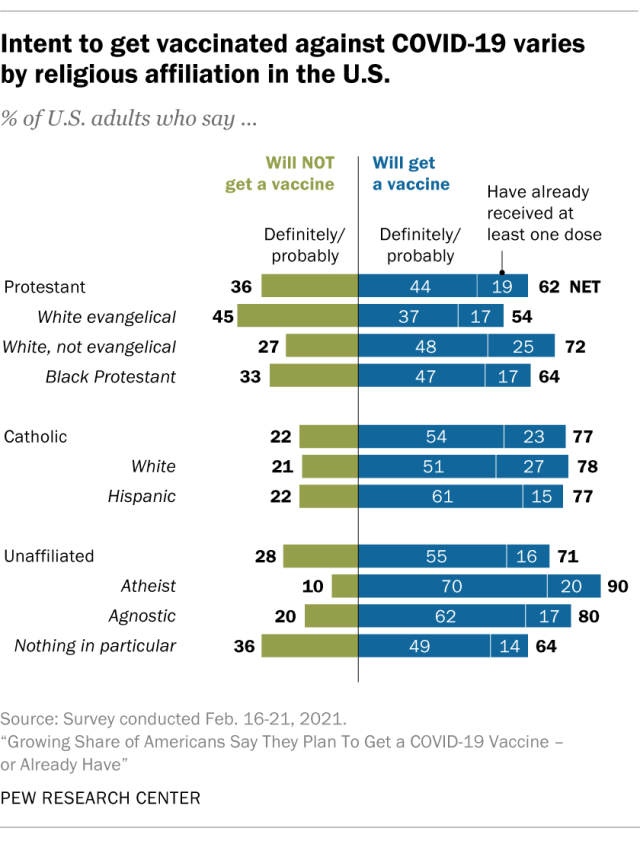
The conflict with science is important. Vaccine skepticism is common among some Christian faiths. Atheists are much more likely than evangelical Christians to get COVID-19 vaccinations.

Other forms of polarization trace the religion/nonreligion divide. Republicans are more religious than Democrats. Midwestern and Southern states are more religious than coastal states. Younger people are less religious than older people. More educated people also tend to be less religious.

Faith and reason can co-exist. But the modern scientific world view creates significant challenges for traditional religious belief.

Science teaches that our sun is one star among billions and that the Earth is 4.5 billion years old. Darwinian biology explains how life evolved, including dinosaurs. Medical science is a powerful tool for saving lives. Neuroscience provides a non-spiritual explanation of consciousness. And so on.

Religious texts and dogmas are disconnected from the growing body of knowledge we call science. Religion is, of course, more than an explanatory system. It is also about community and shared meaning. But increased diversity makes this more complicated. Which tradition should we choose? As nonreligion grows, it becomes easier to pick “none of the above.”

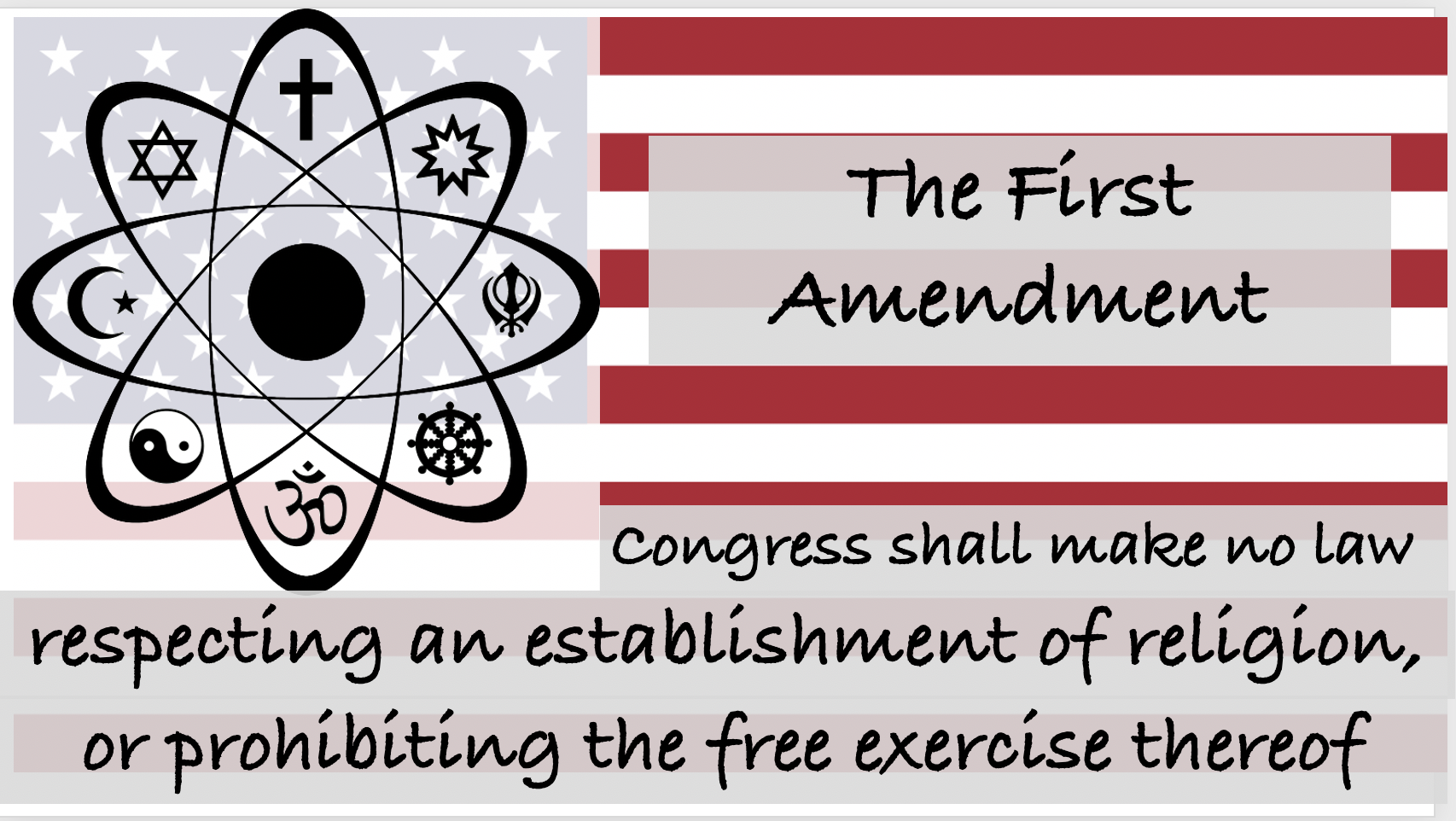
As more people choose this option, social conflict will follow. To manage these conflicts, we need a robust secular system of government such as is provided by the First Amendment. Secularism allows diversity to flourish. In the bad old days, atheists and heretics were burned. Today they are coming out of the closet.

This is probably not what the Founders imagined. American secularism was originally about Christian liberty. Early Americans were concerned with the repression of Christian dissent in the Old World. Americans also engaged in religious persecution. Mormons were driven out. Indigenous people were killed and converted.

As American secularism grew more inclusive, it reflected the best values of this country. We value nonconformity, innovation, and imagination. Reason and science are also deeply American.

Creative freedom is a powerful force. But liberty means different things to different people. The National Day of Reason proclamation quotes James Madison as saying that knowledge is the best guardian of liberty. The National Day of Prayer website quotes the apostle Paul in saying that liberty is grounded in God.

Is liberty a gift of the Creator, or is it the product of social and political evolution? We’ll continue to disagree about the metaphysics of freedom. But despite our differences, religious and nonreligious people share an interest in secularism. It is freedom of thought and religion that allows us to argue and think about those disagreements.

The one thing we might all agree on is the idea that the state should stay out of these arguments. It would be wrong for the state to impose either religion or nonreligion. Individuals also ought to learn to leave each other alone to think for ourselves.

This creates challenges, as with vaccine skepticism. But those challenges are worth it. In a free country, prayer and reason should each have their day in the sun.

Atheism and Diversity: How Big is the Non-Religious Rainbow?

The growth of non-religion will create a significant source of polarization.  Many Americans are leaving religion behind (as I discussed previously). This will exacerbate social conflict, as we sort ourselves into religious and non-religious camps.  

Consider, for example, polling data that shows that atheists are more likely to get a Covid-19 vaccine than evangelical Christians.  90% of atheists say they will get vaccinated, while only 54% of white evangelicals will do so.

This makes sense: atheists tend to trust science and medicine, while evangelicals do not. A similar result has been found with regard to climate change: atheists tend to be more engaged and alarmed about climate change than Christians who read the Bible literally.

But let’s be careful about overgeneralizing.  Atheism can be as fragmented as the rest of society. Religion also contains a multitude. 

And yet, the tendency to oversimplify is common. Theists sometimes simplistically dismiss atheism as the work of the devil.  Atheists also dismiss theism in simplistic terms.  But when it comes to religion and non-religion, complexity is the rule.  Oversimplification obscures much that is important and interesting. It also prevents us from finding common ground.

Consider a recent skirmish among atheists.  Richard Dawkins, a prominent atheist, posted a tweet appearing to disparage transgender people.  Some atheists were appalled.  The American Humanist Association publicly disavowed Dawkins and retroactively withdrew a “Humanist of the Year” award they gave him in 1996.  Other prominent atheists leapt to Dawkins’ defense including Daniel Dennett, Sam Harris, and Steven Pinker.  This provoked further backlash among atheists, with some accusing contemporary atheism of being a bastion of white male privilege. 

This reminds us that atheism is not a monolith.  Like everyone else, atheists have intersectional identities.  Atheists can be Black or white, straight or gay, trans or cis, rich or poor.  The same is true, of course, for religious people.  Some religions embrace LGBTQ people.  Others do not.  Some religions embrace science, medicine, and Covid-19 vaccines.  Others do not.

Generalizations about religion and non-religion are only vague approximations.  Consider, for example, how atheism is colored by the religion that it rejects.  It makes sense to ask whether a nonbeliever is a Christian atheist, a Muslim atheist, a Sikh atheist, a Jewish atheist, and so on.  Some atheists want to avoid this complexity and state that they do not believe in any God or gods at all.  But the binary logic of God or no God oversimplifies. It also helps to know which God and which tradition.

One could reject Christian or Muslim dogma, for example, while remaining culturally attached to Christianity or Islam.  A culturally Christian atheist could enjoy the hymns and rituals of Christian holidays while also turning to the Bible for spiritual insight.  Or an atheist with Muslim roots could fast during Ramadan.  Things become even more complicated when religious identity is connected to ethnic identity—as in Judaism or in the diverse indigenous religions of the world.

Scholars have also pointed out that self-identification as an atheist depends on social privilege.  Member of racial and ethnic minorities are less likely to publicly identify as atheist.  This is not simply a matter of what people believe.  It is also connected to the social need to be more (or less) closely identify with a religious tradition. White men may find it easier to affirm atheism than Black women or members of native American tribes. 

These issues are intriguing and they will likely become more complicated and intense as non-religion grows.  As more people leave religion behind, the diversity of the non-religious will grow. 

Celebrating diversity among nonbelievers may in turn lead more people to leave religion behind, especially those who self-identify in nontraditional ways.  One worry about this possibility, however, is that it may leave religious congregations more homogeneous than they already are, further increasing polarization. 

Perhaps there will be some convergence among the non-religious.  The fact that 90% of atheists plan to get vaccinated points in that direction.  But despite convergence around science, increasing diversity will pose a challenge for the broad community of non-belief. 

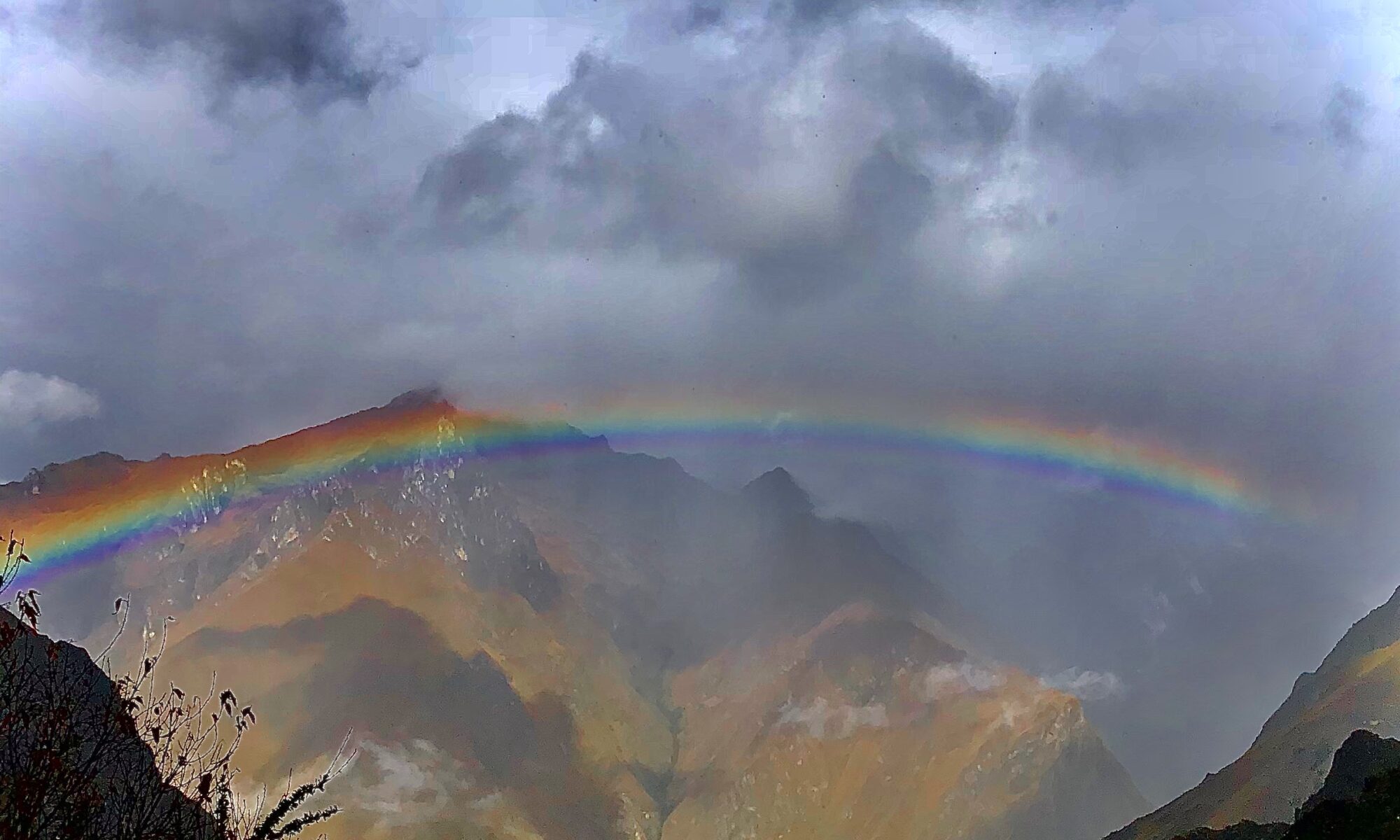
We find ourselves in the middle of an unprecedented experiment in secularization.  Let’s keep our minds and hearts open. Let’s try to resist increased polarization and avoid oversimplifying the complex rainbow of human experience.