
Pacifism, Isolationism, and Just War: Ukraine, Russia, and Impending Hostilities

Fresno Bee, January 30, 2022

Should we go to war with Russia over Ukraine? A recent poll indicates that only 15% of Americans support that idea. The American public seems more sympathetic these days to isolationism and even pacifism.

Pacifists and isolationists oppose foreign wars, but for different reasons. The isolationist asks, “What’s in it for me?” The pacifist asks whether violence ever really solves anything. To the pacifist, isolationism looks cynical and callous. To the isolationist, pacifism looks naïve and utopian.

But isolationism and pacifism often converge. Consider Tucker Carlson’s opposition to a war against Russia. The Fox News firebrand is more of an isolationist than he is a pacifist. He recently said, “We’re really going to fight a war over some corrupt Eastern European country that is strategically irrelevant to us? With everything else that’s going on right now in our own country? No normal person would ever want to do anything like that.”

Carlson is also an opportunist. He may simply be trying to score political points by opposing Biden’s saber-rattling. But he gives voice to a reasonable reluctance about foreign wars. Isolationism is increasingly popular among Trumpian conservatives.

In his comments, Carlson also suggested that a war against Russia primarily serves the interests of the defense contractors who profit from war. This is the kind of argument that is often made by pacifists, who have long been critical of the military-industrial complex.

But the pacifist case against war is not only about profit and self-interest. Rather, pacifists ask whether violence and war ever really solve social and political problems. They believe that nonviolent solutions are better at producing lasting and stable peace.

Recent wars tend to support pacifist conclusions about the futility of war. American wars in Iraq and Afghanistan resulted in significant suffering for civilians and soldiers. These wars have not left the world better off.

Now, there is a moral argument in favor of war against Russia. The just-war theory teaches that war can be used as a response to aggression. This is connected to an international norm known as “the responsibility to protect” (R2P) which holds that there is a global responsibility to protect people against aggression, ethnic cleansing, genocide and war crimes.

But the Ukrainian crisis is complicated. Western powers warn against Russian aggression. Russia maintains that the West is behaving aggressively by expanding NATO into Eastern Europe. The Russians even appealed to the R2P doctrine to defend their invasion of Crimea in 2014, claiming that Russian sympathizers in Crimea were being oppressed. Critics claimed that this was a cynical employment of R2P, used by Russia as cover for its aggression.

And so it goes. Arguments about war are difficult and complex. Pacifists wonder whether there is not a better way. Isolationists will ask what’s in it for us. And just-war theorists argue about who has a responsibility to do what.

The gravity and the complexity of this issue require careful, critical thought. If American soldiers are going to be sent into harm’s way, our country ought to be engaged in deep moral reflection. The Congress ought to be debating this and voting on it, as the Founders intended when they stipulated that declarations of war ought to come from the peoples’ representatives.

Unfortunately, congressional declarations of war have given way to unilateral decisions about war made by the executive branch. At the same time, the dysfunction in Washington, D.C. and the polarization of our country make sincere debate nearly impossible.

It is not clear how to fix our political morass. But the good news is that in our country the citizens remain free to debate the morality of war. This is not true in Russia, where dissent is prohibited. Nor is it true in Ukraine, where war-resisters have been jailed.

Let’s make good use of our freedom. Our soldiers deserve that from us. We must think carefully about the morality of war before we ask our sons and daughters to kill and die on our behalf. To honor the troops, as the saying goes, means that we should listen carefully to the pacifists, the isolationists, and the just-war theorists. Now is the time for reasonable debate, before the howling of the dogs of war drowns out critical thought.


Is the US a Christian Nation?

Fresno Bee, January 23, 2022

In our secular society, Christianity has become an interest group vying for influence in the marketplace of ideas. It is no longer taken for granted that this is a Christian country.

Consider a recent case before the U.S. Supreme Court, involving a Christian group that wanted to raise its flag outside city hall in Boston. The court is considering whether this would be an endorsement of Christianity by the city, or whether the flag is merely the private expression of Christian citizens.

Christian Flag SCOTUS Blog

If the Christian group wins the case, its victory will mean only that the group has the right to express its religious beliefs in a public forum. They must take turns along with advocates of LGBT rights, BLM protesters, and other groups who want to fly their flags. No one is arguing here that the state ought to reserve a privileged place for Christian symbols and beliefs.

American secularism is grounded in the First Amendment to the Constitution. The First Amendment’s “establishment clause” prevents government entities from endorsing any faith. Its “free expression clause” permits individual citizens to express their own religious (or non-religious) beliefs.

Clarity about this is important, given the shifting religious identification of American citizens and the threat of religious violence. Our system allows people with diverse religious and non-religious beliefs to peacefully coexist. And it prevents the government from oppressing religious minorities.

Some people continue to maintain that America is a Christian nation. A recent report on NPR quoted a minister at a “patriot church” in Tennessee, who said, “You know why there’s churches everywhere and not mosques? Because we’re a Christian nation.”

But the First Amendment and our shifting demography point in another direction. In a report published at the end of 2021, the Pew Research Center indicates that the Christian population has continued to decline. Only 63% of Americans identify as Christian. Non-Christian religions (Jews, Muslims, Sikhs, Hindus, etc.) account for another 6% of the population. And even among the faithful, religious belief is often lukewarm. Fewer than half of Americans report that they pray daily. Only about 40% say that religion is very important in their lives.

The fastest growing group in our country is the “nones,” those who answer “none of the above” when asked about their religious affiliation. The “nones” have nearly doubled since 2007, when Pew began tracking the data. Nearly one in three Americans (29%) are “nones.” This includes some atheists (4%) and agnostics (5%). But many of the non-religious simply do not identify with traditional religious categories.

It is true that at one point in our history, Christianity was the dominant faith. But even that claim needs qualification. Many of the founders had unorthodox views. George Washington attended church infrequently. When he did go, he refused to take communion. Thomas Jefferson admired Jesus, but was skeptical of the Bible’s miracles. John Adams claimed that the Christian view of the trinity was absurd. And America is the home of alternative Christian faiths such as Mormonism, Adventism, and Christian Science.

Critics will also argue, as Frederick Douglass did, that a nation founded on slavery could hardly be called “Christian.” Douglass argued against “the corrupt, slaveholding, women-whipping, cradle-plundering, partial and hypocritical Christianity of this land.” He said, “I can see no reason, but the most deceitful one, for calling the religion of this land Christianity.”

Elizabeth Cady Stanton said something similar. She thought that Christianity contributed to the oppression of women. She worked with a team of feminists at the end of the 19th century to rewrite the Bible. The result was “The Woman’s Bible,” which thoroughly revised the Bible’s patriarchal and misogynistic texts.

And so it goes. We disagree about what Christianity means. A growing number of us no longer identify as Christian. And Christian groups must vie time on the flagpole along with other interest groups.

This is the reality of our secular system, operating under the First Amendment. Under our Constitution, religious liberty is valued while the government is prevented from endorsing any specific religion. In this country we are free to argue about the meaning of the Bible. We are also free to gather round the flagpole and argue about history and the role of religion in our public life.

On the Importance of Looking Up

The new Netflix film “Don’t Look Up” has a lot of people talking.  It is a black comedy, starring Leonardo DiCaprio, Meryl Streep, and Jennifer Lawrence. It’s about corporate greed, bureaucratic incompetence, and the apocalypse.  Its bleak conclusion gets you thinking about the dangers of power, narcissism, and willful ignorance. 

The movie’s fans see it as a cautionary allegory about climate change, science denial, and clueless amateurs running the government.  Some worry that its gloomy ending may encourage despair.  Others hope it will be a call to action. 

Reviews of the film reflect our polarization.  Conservatives claim it is another example of Hollywood preaching a liberal gospel.  One critic in the National Review suggested it is the worst film of 2021.  He lambasted is as a “better-than-you comedy” that “reveals the nastiness of liberals.”  Another critic in the Washington Examiner said it was a “lazy anti-Trump comedy.” 

More subtle criticism came from New York Magazine, where a sympathetic commentator accused the film of oversimplifying the climate crisis.  He said liberals “need to stop telling themselves self-flattering fairy tales.”

I suppose the point is that we are all in this together.  Narcissism and stupidity cross party lines.  Hollywood is part of the problem.  The film seems to recognize this.  It shows how the cult of celebrity corrupts everyone, even the neurotic scientist played by DiCaprio. 

At any rate, this is an allegory, not a documentary.  Allegories simplify reality. They tell memorable stories that get people talking.  In this regard, the film succeeds.  It provokes conversations about life, death, politics, and American culture. 

This conversation should extend to the very idea of “looking up.”  The film’s title calls to mind Plato’s famous “allegory of the cave.”  In Plato story, we are prisoners chained in a cave.  We are not permitted to turn around and see reality.  Even when we are set free, most of us refuse to turn around. Plato suggests the masses would go so far as to kill truth-tellers and educators, who like Socrates are trying to get us to look up.

Plato’s allegory is about willful ignorance. Plato warns that most people don’t want to know the truth.  We deliberately choose not to look up.  We are happy with our illusions.  We don’t want to confront reality.  We keep our heads down, preferring slavery over enlightenment.

In the film, this idea becomes the slogan of the political party led by Streep’s character, President Orleans.  The party encourages people not to look up at the comet hurtling toward earth.  This is a parody of our culture’s struggle with science denial, “fake news,” and “alternative facts.”  It also implies authoritarianism.  “Don’t look up” also means “mind your own business” and don’t criticize the elites.

The philosophical solution to all of this is the pursuit of wisdom.  We ought to look up.  It won’t be easy or comfortable.  We may discover things that confuse us or make us unhappy.  But it is better to live in the light than in the darkness.

One of the questions raised by the film is whether you would want to know how and when you are going to die.  The scientists in the film know the exact time of the apocalypse.  And there is a supercomputer using big data to predict how people will die. 

What would you do with this knowledge?  Would knowledge of your death cause despair?  Would you prefer to remain in ignorance about your death?

A modest hopeful appears toward the end of the film when DiCaprio’s character responds to knowledge of his death by changing his life.  He refutes the computer’s prediction about his death, thereby reclaiming some modest dignity.

This is the kind of dignity that knowledge provides.  When we look up and confront reality, we can take charge of how we live and how we die.  To live in ignorance is to live as a prisoner.  The truth sets us free. 

Knowing the truth won’t change the indifferent reality of the cosmos.  Knowing the truth won’t stop a comet or cure you of Covid.  But knowledge allows us to live responsibly and, if necessary, to die with dignity.  It is tempting in a crisis to bury our heads in the sand.  But wisdom is only available to those who look up.

January 6: American Democracy and the Challenge of Tyranny

Fresno Bee, January 9, 2022

The American political system remains in crisis, one year after the Jan. 6 riot. A recent poll shows that 40% of Americans believe that the 2020 election was illegitimate. The same poll indicates that a majority of us fear the future will bring more political violence.

This is alarming. But polarization and distrust are par for the course in the American system. This dysfunction is a feature of the system, and not a bug. Conflict was hard-wired into a system that was set up to safeguard against tyranny.

I explore this idea in more detail in my forthcoming book, “Tyranny from Plato to Trump.” The American founders were focused on preventing tyranny. They were less interested in efficiency than in preventing the consolidation of power.

The question of whether our system is working depends upon what we think this system is supposed to be doing. If we think the government is supposed to respond to the will of the majority, we will be disappointed. But if we think that the American system is intended to prevent tyranny, then the virtue of its dysfunctional design becomes apparent.

The problem of tyranny is an ancient one. In the ancient world, political power was often consolidated in the hands of a strongman. Sophocles warned against the hubris of Oedipus. Plato warned that tyrants were predators who preyed upon their own people.

The American founders studied ancient philosophy and literature. They accused the British king of behaving tyrannically. When they set up the American system of government, they were interested in preventing tyranny by establishing the Constitution’s separation of powers. James Madison defined tyranny as the “accumulation of all powers” in the “same hands.” The solution is a system in which divided powers limit each other. As Madison put it, “Ambition must be made to counteract ambition.”

The good news about the American system is that its checks and balances worked to prevent Donald Trump from consolidating power. Local officials refused to comply with Trump’s effort to overturn the 2020 election. The House impeached the lame duck president. The courts provided independent confirmation of the integrity of the election. Members of Congress certified the election, led by Vice President Mike Pence. And when the Capitol was assaulted by an angry mob, those insurrectionists were arrested, put on trial and convicted.

All of this is part of a slow and messy process. This is the way the American system is designed to work. It moves slowly and incrementally. It is not easy for a strongman to take control in this system and purge his enemies. Nor is it easy for democratic majorities to enact radical change. There is too much friction built into the system for quick and radical solutions.

Some people don’t like this sluggish system. Some long for a nimble system that can react quickly to emergencies. A number of people even seem to desire a savior who would ride to the rescue with a flaming sword.

But the people’s desire for a savior can be exploited by would-be tyrants. In response to emergencies, the people are often willing to sacrifice ethics in the name of expedience.

History teaches us that there are no saviors. It shows us that when power is concentrated, corruption is sure to follow. Atrocities occur when reaction outpaces rationality.

The U.S. Constitution is not perfect. It was flawed at the start, since it permitted slavery. A civil war was fought to eliminate that peculiar form of tyranny. Other corrections and improvements followed.

It took centuries to improve this system. More work remains to be done. One obvious problem is the inordinate power of small states. Citizens of small states such as Wyoming and Rhode Island have much more representational power than citizens of California. And citizens of Washington, D.C. and Puerto Rico have no real representation.

We ought to continue to improve the system. But this is tedious work. Progress will be slow in coming. And there will be no perfect result.

This will bother those who dream of utopia. But utopias do not exist. The human condition does not permit perfection. There are no political saviors. And the dream of a savior can easily become a tyrannical nightmare.

New Year’s Resolution: Live as an Adult

We live in a childish age.  This is an era of immediate gratification, temper tantrums, and short attention spans.  It’s time to grow up.  Here’s an idea for a new year’s resolution: let’s live like adults.

This is an ancient resolution.  In the Second Century, the philosopher Epictetus said “Grow up!  Stop behaving like a child.”  Now is the time to get serious.  “The Olympic games are now,” he said.  Stop procrastinating and start living a good life. 

But it is easy to mope and whine like spoiled children.  We are childish when we expect the world to satisfy our wishes.  The truth is that reality does not conform to your egoistic expectations.

It is difficult to be an adult.  There are bills to pay and work to be done.  There are battles to be fought and losses to be endured.  Adults understand that life is difficult and that it takes hard work.  Adults do their duty.  They avoid self-indulgence and ingratitude. 

Adults also understand that nothing lasts forever.  They prepare for death, realizing that everyone dies and that the world imposes significant limits upon what we can achieve.

The word adult has an intriguing etymology.  It comes from a Latin word for growth, related to the word adolescence.  An adolescent is one who is growing.  An adult has completed that process. 

To be an adult is to be ripe and mature.  Fruit also ripens.  Each creature has its own path of maturation and completion.  The playful puppy becomes a dog who hunts, defends, and stays loyal to its pack.  The sapling grows through several seasons until it produces flowers and fruit.

To be mature is to have reached the final stage of development.  It implies a sense of completion and fulfillment.  Maturity depends on what we take as the essence of the thing that is ripening. 

In our culture, we tend to think that the human essence is defined by liberty and license.  They key coming-of-age milestones in our culture are about the freedom to consume.  At age 21, we gain the freedom to drink alcohol, smoke pot (in California anyway), and gamble.  There are other milestones.  At 16, you can drive a car.  At 18, you can vote. 

It is a sad world in which the entry into adulthood is marked by your ability to buy beer.  Perhaps this is why we often fail to grow up.  In our culture, too many adults are focused on consumption, sensual indulgence, and self-satisfaction.

The philosophical tradition has a different notion of the human essence.  This idea holds that to be fully human is to develop wisdom and virtue.  Adolescents are not yet virtuous or wise.  But adults have ripened to the point at which wisdom and virtue are possible.  This is not about liberty and consumption.  Rather, it is about self-restraint and obedience to the moral law.  Adults know how to control their bodily urges.  They also understand that there are duties and obligations that must be fulfilled. 

At what age does wisdom and virtue become possible? 

Plato suggested that at around age 50 people had the capacity to rule themselves (and others) wisely.  The U.S. Constitution holds that you have to be 25 to run for the House, 30 to run for Senate, and 35 to run for President.

Of course, age is merely a number on a calendar.  Some young people are wiser than their parents.  And some old people are foolish.  The point is to grow up. 

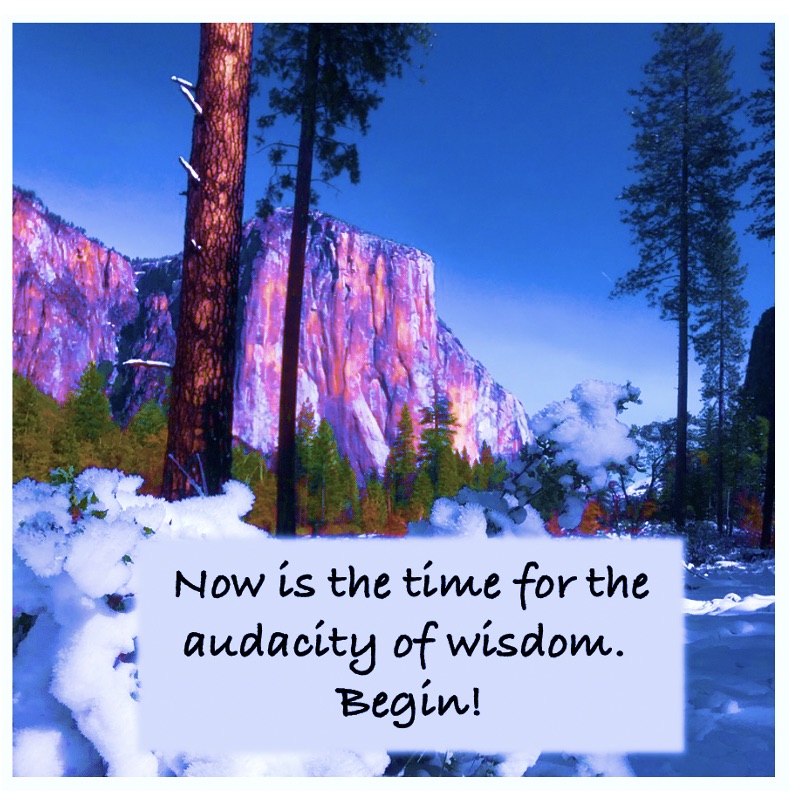
The poet Horace once said: “To begin is only half the battle.  Now is the time for the audacity of wisdom.  Begin!” Horace was referring to a timid animal standing beside a river, waiting for the water to stop flowing for its chance to cross.  We might picture this as a juvenile, waiting for its chance to jump into the flow of life.

But the river stands still for no one.  The point is to take the plunge and get going.

So here is a philosophical new year’s resolution: let’s resolve to be adults.  That means we should be audacious in the pursuit of wisdom.  We should overcome childish self-indulgence.  And we should get to work on being good.