Stoned or Straight? Let Adults Decide for Themselves

Fresno Bee, January 24, 2020

Fresno may soon join the rest of California in making cannabis commercially available. So let’s reconsider the morality of marijuana.

The basic argument for legalization — apart from generating revenue through taxation and reducing prison time for drug users — is libertarian. The legalization of marijuana is part of a rising tide of libertarianism with regard to issues such as abortion, physician assisted suicide, pornography, and gay marriage. Libertarians allow adults to do whatever they want, as long as they are not harming others.

Marijuana use can harm others: through second-hand smoke, driving under the influence, and so on. Libertarians should want to find ways to minimize those harms. But for the most part libertarians want to leave people alone, even if this means allowing people to make their own mistakes.

Paternalists disagree. Paternalists want to prevent people from harming themselves. They worry that people are not virtuous enough to choose well. They think people can be profoundly mistaken about what is good for them — and should be prevented from misusing their liberty. Libertarians reject this as nosy and intrusive.

The libertarian argument has prevailed in California with regard to marijuana legalization. But the question still remains as to whether cannabis consumption is a wise use of freedom or a mistake. Said differently, is there anything wrong with getting high?

The natural law tradition provides an argument against getting high. The Catholic Church teaches that recreational drug use is a “grave offense” that “inflicts very grave damage on human health and life.”

This argument has been made in philosophical terms by Robert P. George and Patrick Lee, who argue that recreational drug use is an abuse of the body. Their critique of drugs is connected with a conservative sexual ethic. They suggest an analogy between masturbation and drug use. These authors say that when people masturbate or get high, the body is used as an instrument to be manipulated in order to obtain pleasure. They say that masturbators and drug users express “contempt” for their bodies.

Hedonists see things differently. The hedonist’s goal is to maximize pleasure and minimize pain. This means that hedonists will want to avoid the downside of getting high. If marijuana leads to a hangover or addiction, that’s a problem. But defenders of marijuana often argue that marijuana has less of a downside than alcohol.

The comparison with booze often arises in discussions of pot. If wine is fine, what’s wrong with weed? Lee and George allow alcohol use. They say it is OK, if used as a social lubricant to enhance social interactions. But there is a difference, they argue, between social drinking and getting drunk.

Of course, the same thing could be said for cannabis. Some sad stoners may hide out alone in darkened rooms. But marijuana is also a social drug. And there is a cannabis culture that includes Bob Marley, Snoop Dogg and Willie Nelson.

This reminds us that culture matters. Alcohol is the drug of choice for mainstream culture, which takes the consumption of beer and wine for granted. But marijuana is (or was until recently) counter cultural, a drug for Rastafarians, rappers and hippie cowboys. A cultural analysis of marijuana shows how competing views of the drug reflect our thinking about race, culture, and class.

This cultural divide cuts into our thinking about consciousness. Authors such as Dr. Andrew Weil have discussed the difference between the stoned and the straight mind. Philosophers, scientists, lawyers, and mathematicians celebrate rational thought, logic, and problem-solving. Cultures and careers that value quick wit and critical thinking will tend to emphasize sobriety and what Weil calls “straight” thinking.

But artists and mystics view things differently. Cannabis has been used to free up artistic creativity and stimulate mystical experience. For the artist or mystic, there is value in in the stoned mind. Instead of logic and calculation, mysticism values intuition, sensuality, and creative insight.

These differences in culture, religion and consciousness run deep. That’s why the libertarian solution is best. We’re going to disagree about the morality of marijuana. But as long as harm to others can be minimized, adults should be allowed to decide for themselves whether they want to get stoned or stay straight.
MLK and the Moral Need for Enlightenment

Fresno Bee, January 19, 2020

We have a moral obligation to educate and enlighten ourselves. Love and duty are blind without education. This is a theme we find in the life and writing of Martin Luther King Jr.

King was a Christian minister whose nonviolent work for racial justice was inspired by Jesus and Gandhi. But he was also a scholar. He studied sociology, philosophy and theology.

King’s model of thoughtful activism provides an antidote for a culture of quick tweets and silly memes. Our attention spans are short. We skate across the surface of things. King reminds us of the power of the slow and serious study of the humanities. Social change begins with change of heart and also with a change of mind.

So here’s a proposal for Martin Luther King Day: read something! King’s “Letter from Birmingham Jail” is a good place to start. King shows there how Socrates and Jesus inspired him to engage in civil disobedience.

If you want to know more about King’s philosophical influences, read his “Pilgrimage to Nonviolence,” where he explains his philosophy and theology of love. King says there, “All life is interrelated. All humanity is involved in a single process, and all men are brothers.”

This idea did not pop into King’s mind unformed. He discovered it through an intellectual pilgrimage through the history of philosophy. King’s ideas, and his activism, grew out of a broad understanding of the world’s traditions.

King routinely warns against intellectual and spiritual blindness. In his book, “Strength to Love,” King said it is “not badness but blindness” that causes evil in the world. It was ignorance that led people to crucify Christ and to execute Socrates. The root of racism, hate, and violence is “sincere ignorance and conscientious stupidity.”

King concludes that we have a “moral responsibility to be intelligent.” And he argues — with a nod to the existentialist philosophers he studied — that moral blindness is a result of a tragic misuse of freedom.

Racists and haters often make a conscious choice to be dumb. Every human being has the capacity to think critically, inquire into truth, and gain enlightenment. But people choose not to exercise this capacity because they are focused on defending their own selfish interests and narrow points of view.

Liberation from ignorance is difficult. It causes anxiety. It is difficult to question authority and stand up for justice. The solution for the anxiety of emancipation is a courageous commitment to truth. We need the courage to think for ourselves and, as King puts it, to “courageously do battle for truth.”

King suggests that the Christian faith provides the ultimate solution. He rejects the idea that human reason and science alone can eliminate hatred and injustice. He says, “Man by his own power can never cast evil from the world.” He says that humanistic hope is based upon an illusion about the inherent goodness of things.

King was, after all, a Christian pastor. In the background of his thinking is the problem of sin and the need for a savior. King tells us that he found the strength to persevere against threats and violence with the help of God.

This pushes us toward further reflection. Are we good enough to save ourselves? Or do we need divine assistance?

In order to answer those questions, we need to embrace the difficulty of thinking and the complexity of faith. A lot of people would like to ignore these sorts of questions. They would prefer to ignore the question of why racism persists, whether violence can be justified, and whether the arc of the universe really does bend in the direction of justice.

But lazy indifference is not helpful. Faith without thought is flimsy. And wisdom is not possible without fear and trembling.

King said, “Rarely do we find men who willingly engage in hard, solid thinking. There is an almost universal quest for easy answers and half-baked solutions. Nothing pains some people more than having to think.”

So how do we honor Dr. King? We honor him by working for social justice. But we also honor him by avoiding half-baked solutions and easy answers. In short, we honor him by taking up the task of thinking.

Wrong to Bomb Cultural Targets: Trump Threatens War Crimes against Iran

Fresno Bee, January 12, 2020

It is good that tensions with Iran have cooled for the moment. But the heated rhetoric of the past week shows a moral deficit in our thinking about war.

The president threatened to destroy cultural targets in Iran if it retaliated for the assassination of Iranian Gen. Qassem Soleimani. President Trump threatened, in his words, “disproportionate” violence in response to Iranian retaliation. He explained, “They’re allowed to kill our people. They’re allowed to torture and maim our people. They’re allowed to use roadside bombs and blow up our people. And we’re not allowed to touch their cultural sites? It doesn’t work that way.”

But morality does indeed work that way. The enemy is not “allowed” to do these things. We should rightly condemn them for it. And we must understand that it is immoral to return evil for evil.

Proportionality is key. The law of retaliation says you may demand eye for eye, and life for life. But justice says you can cannot demand more. To threaten disproportionate violence and escalation is immoral.

A higher, more humane morality goes beyond retaliation. Humanitarian morality calls upon us to give mercy to our enemies with the goal of restoring peace.

So-called “realists” reject this. They say anything goes in war, so long as it is effective and you can get away with it. But the “just war theory” developed over the past millennia, which calls for moral restraint in war.

The just war theory has roots in ancient Greek, Roman, and Christian sources. These ideas are woven into contemporary international treaties and conventions governing the laws of war. These ideas were used by Americans to prosecute war crimes after the Second World War. Until recently, the United States was a leading proponent of these ideas.

The just war theory prohibits disproportionate violence. It seeks to avoid the escalation of tit-for-tat reprisals. It prohibits torture and abuse of prisoners. It rejects deliberate attacks on innocent civilians and on cultural heritage sites.

Realists reject all of this. They see war as a matter of power. If you win, you do what you want. And if you lose, well, judgment does not matter to the dead.

The realist view of war is immoral and too narrow. All wars end. Soldiers return to civilian life. Communities are rebuilt. And history will render judgment after war.

Thousands of years ago, the Greek historian Polybius condemned the wanton destruction of temples and statues in a war led by Philip V. The historian said this was how frenzied tyrants fight. Good men do not make war with the goal of destruction and annihilation, he said. Rather, good men wage war in order to reform evil and create justice. Tyrants are ruthless and cruel. Good rulers earn people’s love with humanity and beneficence.

Future historians will judge our country’s actions as either tyrannical or benevolent. But judgment also occurs in the short-term among soldiers and those who love them. When soldiers are asked to behave immorally, they suffer from moral injury.

The soldiers who would be asked to carry out immoral orders are our students, friends, and loved ones. These are human beings with consciences. It would be wrong to ask them to violate morality by delivering disproportional harm or by destroying cultural heritage sites. Soldiers come home from war. We should want them to come home whole and morally intact.

It would, of course, be better if there were no wars at all. But an important step in the direction of peace is to understand the need for moral restraint in war. As Augustine said in a passage quoted with approval by Thomas Aquinas, “we go to war that we may have peace. Be peaceful, therefore, in warring, so that you may vanquish those whom you war against, and bring them to the prosperity of peace.”

Moral restraint in war helps to create a just and lasting peace. Cruelty creates hatred, enmity, and escalating violence. Tyrants ignore this to their peril. So let’s encourage our leaders to learn the lessons of the just war theory. And let’s hope they cherish the moral integrity of the soldiers they command and that they consider the judgment that history will render.

Seeking wisdom in dark times

Fresno Bee, January 5, 2020

This past year, things got foggy. We were confused by fake news and conspiracy theories. We had a hard time seeing beyond partisan division. A kind of spiritual darkness – racism, hate, greed, and anger – lurked in the shadows. Let’s hope that in 2020, we can see more clearly and spread more light.

The goal of the Western philosophical tradition is enlightenment. Immanuel Kant, the great German thinker, said that we should “dare to be wise.” Enlightenment requires us to have the courage to think for ourselves.

Enlightenment is not simply another word for knowledge. Knowledge grew in amazing ways during the past decade. But it is not clear that we are more enlightened.

We have probed into deep space and into the subatomic realm. We know how to edit DNA and make clones. We have discovered planets orbiting distant suns. Human spacecraft visited Pluto and left the solar system. We have learned more about evolution and the history of life. We also understand the perilous impact of human development on the climate and our planet’s ecosystem.

SEEKING WISDOM

But what good is all of this knowledge without a moral compass and an engaged wisdom? Wisdom situates knowledge within a larger context. Ethical insight leads us to do good with our knowledge.

Philosophers have long worried about knowledge that lacks ethics and wisdom. Bertrand Russell, one of the great philosophers of the 20th century, warned that knowledge without “comprehensive vision” is dangerous. Knowledge of atomic energy created the threat of nuclear weapons. Knowledge of power and propaganda creates the threat of authoritarian politics.

Russell defined wisdom as emancipation from the tyranny of here and now. This gives us a clue about how wisdom is to be found. To be wise is to look up, look around, and look within.

For two and a half millennia, philosophers have called upon us to seek wisdom by seeing things more clearly. Plato suggested that most people are slaves to darkness. We sit in dark caves, he said, looking at flickering images. These images confuse us about reality. We don’t know how to distinguish right from wrong or how to live well. If we could leave the darkness of the cave and see the light, Plato said, we would be good and happy, just and wise.

Plato knew nothing of television, the internet, virtual reality and artificial intelligence. But what he said about life in the cave of ignorance is appropriate to our century. We passively consume images. Our thumbs move across screens. Our eyes flit across the page. Algorithms collect data about us, generating more images for us to consume. Our minds are washed by waves of infotainment. Our bodies grow soft. Confined within silos of information, the human spirit becomes warped. And the social world grows more divided.

One crucial solution is to clean the lenses of perception by learning to think critically about the images that surround us. But clear vision is useless if we look in the wrong direction. Sharp-sighted sociopaths and keen-eyed kleptocrats are very good at manipulating images and seeing how to hurt and take advantage.

We also need to look in the right direction. We need to look up from our screens and take a look around. Most importantly we need to look within. It is self-knowledge that helps us see how bias, prejudice and self-interest cloud good judgment and narrow our point of view.

JESUS’ PARABLE OF THE GOOD SAMARITAN

Narrowed vision is a common human problem. A hint about this is found in Jesus’ parable of the Good Samaritan. Several people walked past a needy man. Either they looked at him but did not see him, or they saw him but quickly looked away. The hero of the story saw the man’s need. He did not look away. And he took action to make things better.

That’s what enlightened insight looks like. Clear vision helps us see reality as it is. But wisdom should also lead to action. To be wise is to see things clearly, to see them wholly, and to see what needs to be done.

So let’s seize the new year as an opportunity to gain wisdom and seek enlightenment. This is a challenge for this year, this decade, and for a lifetime.

The Tough and the Tender-Hearted: Trump, Jesus, and Socrates

Fresno Bee, December 22, 2020

President Trump has a steely spine. He is feisty and pugnacious. Some people admire him for his toughness. But toughness is not the only thing that matters. There is also a need for a more tender-hearted morality.

Trump is a paradigmatic tough guy. The title of Trump’s 2011 book is “Time to Get Tough.” He explained that to fix America “we’ve got to be smart and get tough.” Earlier this year Trump bragged that all of the tough guys are on his side: the police, the military, and the bikers. And in a famous tweet from 2105 he said, “When somebody challenges you unfairly, fight back, be brutal, be tough, don’t take it. It is always important to WIN!”

Trump’s recent letter to House Speaker Nancy Pelosi is a great example of how tough guys operate. A softer man would have apologized, resigned, or attempted to negotiate a compromise. But Trump expressed no remorse or interest in reconciliation. Indeed, he touted his toughness in the letter, saying “I have been far tougher on Russia than President Obama ever even thought to be.”

The letter is scathing and belligerent. He accuses the Democrats of staging a partisan coup. He says the Democrats view democracy as their enemy and are “declaring open war on American Democracy.” He even suggests that Pelosi has weaponized religion, suggesting that she prays for his demise.

Some people admire truculent tough guys. Pop culture is full of them. Americans love movies about cowboys, soldiers, gangsters and cops. We like Robert De Niro, Clint Eastwood and Samuel L. Jackson.

History is also full of tough guys. Plato described a tough guy named Thrasymachus, whose name literally means “bold fighter.” Thrasymachus defined morality simply as helping friends and harming enemies.

That’s how tough guys view the world: divided between friends and enemies. They reward loyalty and show no mercy to their rivals. For tough guys, the essence of morality is power, since power allows you to help your friends and punish your enemies.

The tough world view is self-reinforcing. You assume that your enemies are waiting to pounce and that your allies may sell you out. The solution is to be relentless toward friends and enemies alike. But that causes friction and animosity, which increases the need for further toughness.

In a tough world, even loyal comrades are temporary. The assumption is that people only do favors looking for something in return. This is a world of cronies and accomplices, vendettas and possible violence. It is the world we see in Shakespeare and Sophocles, as well as in Hollywood.

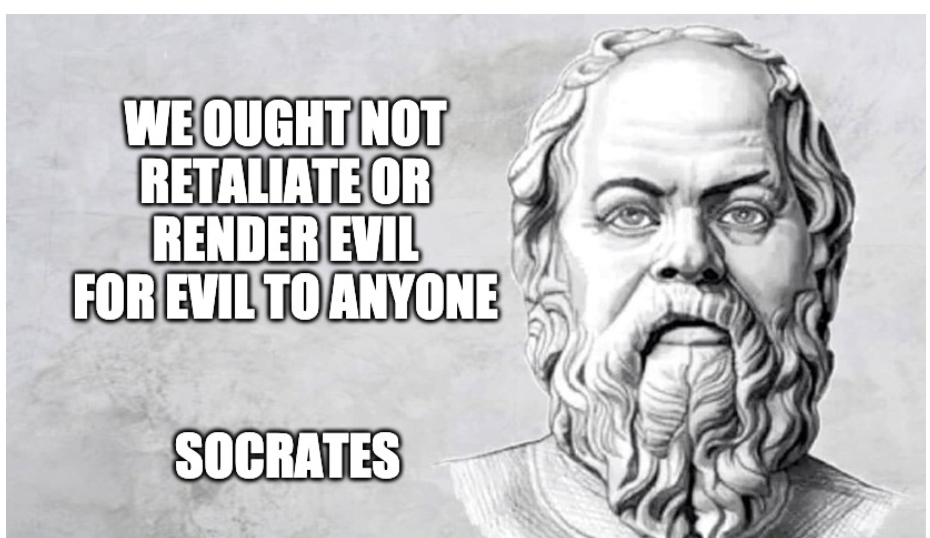
Philosophy and religion provide a critique of toughness. A more tender-hearted morality is espoused by Socrates, who argued against Thrasymachus’s hard-hearted worldview. Socrates said, “we ought not retaliate or render evil for evil to anyone.”

Jesus said something similar. But Jesus went a step further in his advocacy of love. Not only are we to love our neighbors, we are even supposed to love our enemies.

Tender-hearted morality looks beyond the distinction between friend and enemy. It judges things impartially. It sees dignity and worth in all persons. It respects everyone equally. It forgives and shows mercy. It wants to transform enmity into community.

Tender-hearted morality elevates love above power. It thinks that gentle kindness is superior to tough-minded ferocity. Instead of seeking favors, soft hearts give without expectation of payback. Instead of a loyalty and revenge, tenderness calls for hospitality and compassion.

Tough guys will see tenderness as foolish. Softness shows weakness and vulnerability. In a tough world, enemies will exploit weakness. Those enemies must be defeated. And the cronies and accomplices must be kept loyal. The tough cannot yield. They cannot admit wrongdoing. They cannot offer mercy or seek forgiveness.

The logic of toughness is understandable. But unyielding Scrooges and gritty Grinches inhabit a dark and lonely place. The antidote is to soften up your spine and open up your heart. The Christmas message calls us toward charity and joy. Instead of winning and fighting back, this is a time of giving and forgiving. It is a season that encourages us to set aside the love of power and recall the power of love.