Rebellion, Fantasy, and Nihilism

Fresno Bee, January 10, 2021

The mob’s attack on the Capitol was a juvenile outburst of rebellion doomed to fail.

What we witnessed on Wednesday was a juvenile outburst of rebellion. A motley mob stormed the Capitol without a plan or strategy. The violence was disorganized. This was a desultory insurgency instigated by a leader who lives in a fantasy world, where ranting and raving masquerade as thinking.

The image of Shakespeare’s King Lear comes to mind. As Shakespeare put it, nothing comes of nothing. This shambolic coup offers a warning about nihilism and a lesson about power and rebellion.

There is in the human soul an impulse toward anarchy. We bridle against restraint. We want the world to conform to our own image. This impulse is often destructive and nihilistic.

The rebel is a toddler angry at his parents. He is an adolescent lashing out at the world. Rebellion can do short-term damage. But the rebel’s ferocity is feckless. Juvenile rebellion cannot effect lasting change.

The rebel paints the world in black and white, leaving no room for compromise. He has no desire to build because he is focused on burning things down. He has no strategy because in his fantasy, the world should revolve around

The rebel fails to understand that this is a world of highly organized systems of power. There really is a deep state. It cannot be transformed by random outbursts of violence or emotion.

Power is tightly woven in complex webs involving political bureaucracies, transnational corporations, educational institutions, religious traditions, and so on. Political change in the modern world requires strategy based in this reality. This is slow and complex work. Random protest is toothless in the face of the bureaucratic state and institutionalized power.

The would-be revolutionaries of the 21st century — on the left and on the right — are deluded if they think this system can be opposed by disorganized explosions of anger. In the long run, the cops and the courts will win every time.

Political change requires an organized, fact-based approach to the world that avoids wishful thinking. Almost always this involves compromise and working to find common ground in a shared conception of the world. Most of what the party of Trump has done since the November election has been futile because it is based on the fantasy that Trump actually won the election. Lies have limited power. They eventually run aground on reality.

Juvenile rebellion is prideful and angry. Sometimes it is simply thrill-seeking. Other times it is a violent convulsion of despair. Almost always it is based in an unrealistic view of self and world. This leaves the juvenile rebel strangely susceptible to lies, conspiracy theories, and authoritarian politics.

The rebel feels that the world ought to satisfy his desires. When it does not, he gloms onto a savior or hero who makes him feel powerful. The rebel seeks out lies that feed his ego. This can evolve into a cul-de-sac of conspiracy, where the truth gives way to a reflection of the rebel’s own self-image.

Most rebels grow up and grow out of this nihilism. When rebellion comes of age, it mellows and deepens to discover a larger truth. A good explanation of this is found in Albert Camus’s book “The Rebel.” Camus describes how rebellion becomes nihilism. From nihilism, totalitarianism can emerge. Those who believe in nothing are susceptible to anything. But if we keep growing and looking for reality, rebellion can give birth to solidarity, justice, love, generosity, and wisdom.

The impulse of rebellion will always be with us. But it must be educated and sublimated. Artists and entrepreneurs nurture the spark of anarchy. So too do religious mystics and scientific geniuses. The creative imagination smashes barriers. But it does not destroy for the sake of destruction. Rather, it aims to build something out of nothing.

The energy of anarchy is youthful and exuberant. Without guidance this energy circulates in nothingness. When rebellion remains stupid, it is merely destructive. But when the spirit of rebellion is informed by truth, there is hope for justice, compassion, and wisdom. For this to happen you need a strategy that accepts reality. Instead of ranting into the storm with King Lear, you need to harness the wind and put it to work.

Beyond Self-Care: Cultivating an Active and Engaged Self

Self-care is a common theme for 2021.  One wellness website said: “focus on yourself this New Year’s Eve” and “indulge in these self-care strategies as you enter 2021.”  The article recommended “allowing yourself to indulge in a night of luxurious me-time.”

This is not a bad idea.  A little self-care is fine from time to time.  But self-indulgence is occasional.  It is not a way of life.  We need something larger and less transitory.  Self-care should become self-cultivation. 

The self is not an infant we care for or a set of appetites to be indulged.  The self is a dynamic system that seeks fruitful activity.  The adult self is a growing and changing, goal-oriented being.  The self thrives when it is challenged; it prospers when it produces lasting goods such as love, art, science, virtue, and wisdom.

The pampering indulgence of self-care is aimed at stressed out people.  Self-care is an antidote to the rat race and a response to the tragedies and suffering of 2020.  But “me-time” should not climax in onanistic withdrawal.  2021 will require the active intelligence of an engaged self.

There is some wisdom in self-care.  The self-care movement often affirms modesty and mindfulness.  This affirmation of simple pleasure is useful for those who are wound up tight by our cranky, competitive culture.  It is OK to unwind on occasion.  Drink some wine.  Soak in a tub.  Take it easy.

Sometimes the self-care movement offers clichéd common sense about hygiene and mindfulness.  Yes, we should drink more water, be present, and take walks in nature.  But this often becomes sappy, self-indulgent pampering—an apology for sleeping late or over-eating.  And self-care is often merely a marketing ploy for spas, lotions, and chocolate. 

The self-care movement is quite broad. On the one hand, it includes the discipline of yoga.  As one yoga website puts it, “Yoga is a great form of self-care.”  On the other hand, self-care is about… well, something else you do with your hand.  An article in The Oprah Magazine celebrates masturbation as part of a “self-care routine.”  The author reports that some evenings she even cares for herself twice!

There is nothing wrong with pleasure.  But moderation is essential.  And pleasure is not an end in itself.  Happiness and morality often require us to forego pleasure.  Work, discipline, and focus are essential for the self to thrive.  Stress and anxiety are essential parts of a creative and ambitious life.  When other people are suffering, self-care is selfish.  Justice and compassion impel us beyond self-care toward care for others.

This discussion can be traced back to the conflict between Epicureans, Stoics, and Christians.  Epicurus suggested we should live modestly, avoid controversy, and enjoy simple pleasures.  The Stoics rejected this.  They emphasized strenuous duty, while claiming that pleasure makes us soft.  Christians also rejected Epicureanism, focused as they were on suffering, death, and resurrection.  Epicurean self-care is too sensual for Stoics and too secular for Christians. 

Ideally, we would weave these ideas together by connecting self-care with self-cultivation.

Care is rooted in a kind of worry.  A care-free person has no worries.  When we care for something, we worry about it.  The problem of self-care is that it is a kind of worrying about the self.  It can be onanistic and self-absorbed. 

Cultivation is much more affirmative and dynamic.  When we cultivate something, we grow it.  Cultivation is related to “culture.”  Culture is a dynamic process that is the result of labor, interaction, and imagination. 

Human beings are not only focused on pleasure and relaxation.  We are also concerned with love, justice, courage, compassion, knowledge, art, and wisdom.  When we are absorbed in fulfilling activities, the self fades away.  The self-oriented path of indulgence is limited in comparison with the self-less activity of inspiration, insight, and interconnection. 

So here is what I propose for the new year.  Instead of retreating to the bathtub, let’s put our hands to work.  Learn.  Teach.  Create.  Make music.  Do science.  Love your neighbor.  Fight for justice.  Pursue wisdom.  These are the goods of a fully human life.  The challenge of 2021—and of life in general—is to cultivate a self that loses itself in inspired and engaged activity. 

Vigilance, Patience and Hope: The Drive Toward Enlightenment

Fresno Bee, December 27, 2020

On the longest night of the year, we drove through the fog looking for starlight. Other people had the same idea of driving uphill to see the conjunction of Jupiter and Saturn. In a parking lot in Prather, carloads of masked stargazers emerged from the fog and looked toward the heavens, seeking the Christmas star.

We are all looking for inspiration these days. If you rise above the fog, there are wonders to be found.

The last time the planets lined up like this was 800 years ago. The stars move at their own pace. We must learn to wait and keep our eyes open. The philosopher Marcus Aurelius said that stargazing washes away the filth of the earth. The cosmos teaches patience and perseverance.

This was a star-crossed year. Disease killed people and jobs. Our democracy teetered on the brink of disaster. Let’s drink a toast to all we’ve lost and endured. Let’s also learn from the light that shined in the darkness. If there is wisdom in the gloom, it comes from the values of the Enlightenment. It was science and law that prevented 2020 from being darker than it was.

When the Black Death hit Europe in the Dark Ages, astrologers blamed it on a triple conjunction of Jupiter, Saturn, and Mars. We know much more today about the stars and about disease. We know how to prevent contagion and predict the weather. We peer into the molecular basis of life and into the depths of space. We build vaccines and satellites. Let’s give thanks to the scientists who shed light.

One of the wonders of 2020 was the growth of virtual reality. Satellites, computers, and cell phones kept us connected in the gloom. Without these technologies, social distancing would have been impossible. Let’s give a shout out to the wizards of Silicon Valley.

Telecommunication transformed the field of education. Difficulties remain, including educational inequity and a digital divide. But students are learning in ways that could not have been imagined last year. Hurray for the educators — and the students and parents — who pioneered a new model of teaching and learning.

Our civic values were challenged in unprecedented ways. The year began with impeachment. It ended with outrageous falsehoods about a stolen election. This was a year of protests and anger. We are more polarized than ever. Racial animosity afflicts us. There is corruption in the halls of power.

But citizens enlightened ourselves about history and the Constitution. And ethical professionals held back the darkness. Lawyers and judges remained committed to their code of ethics. Soldiers, cops, and firefighters did their duty. Business leaders supported justice and the common good. Nameless bureaucrats served with honor and integrity. Enlightenment depends upon the good work of citizens and civil servants.

As this pestilential year comes to a close, what should we resolve for the future?

I propose we need to affirm the value of vigilance. “Eternal vigilance is the price of liberty,” they say. This is common sense for those who drive through fog. We must be mindful and alert. Watchful care is the key to enlightenment.

Vigilance is the moral of Albert Camus’s novel, “The Plague.” That book is an allegory about the plague of totalitarianism in the 20th century. Camus noted that plagues stimulate enlightenment by opening our eyes. We must learn “a vigilance that must never falter.” The good man, Camus said, “is the man who has the fewest lapses of attention.”

The stewards of civilization must be watchful, as we drive toward the light. New diseases are waiting to infect us. A random sneeze can start a pandemic. Tyrants and crooks wait to take advantage. Indifference leads to disaster.

Enlightenment is not something that just happens. Our scientific and technological prowess is the result of centuries of cultural evolution. Our legal system has a similar heritage. And the work of education is never done.

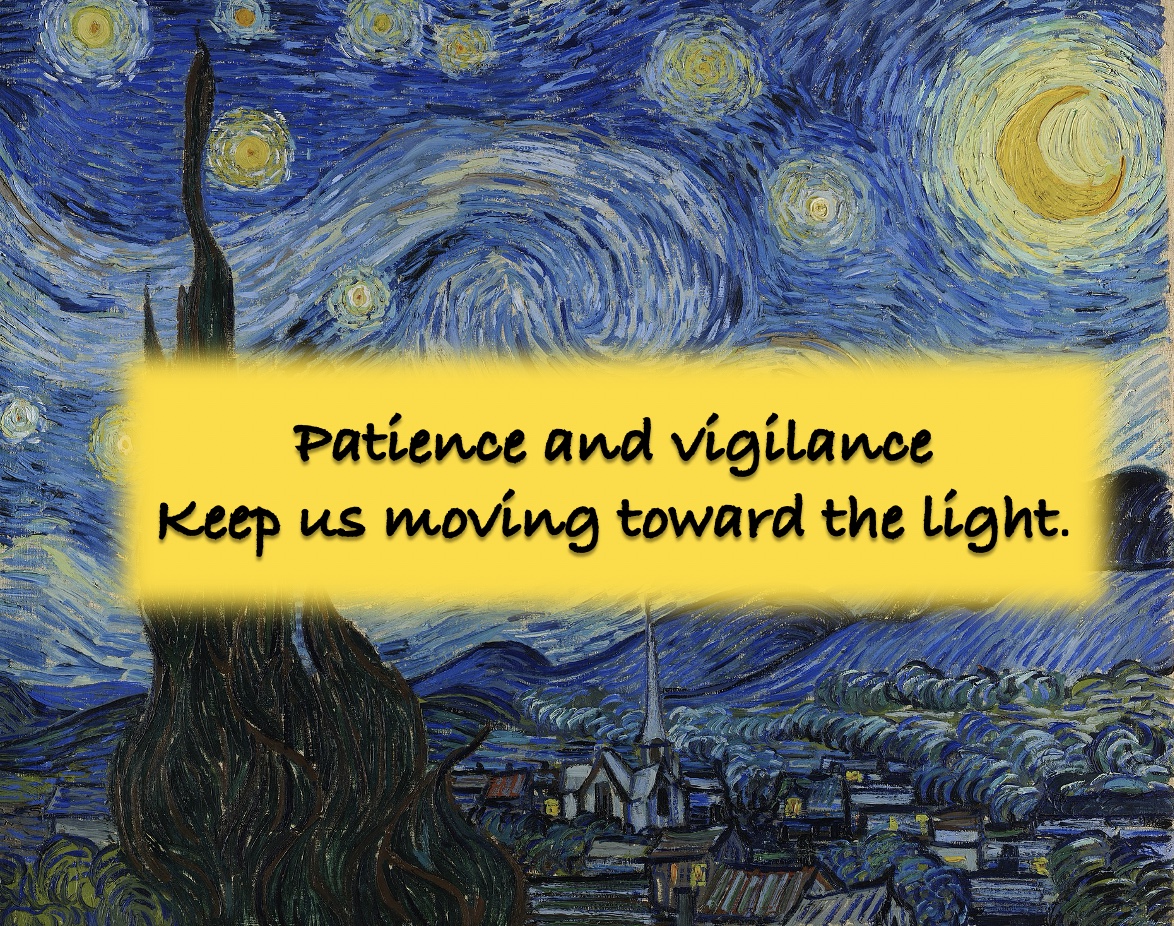
On sunny days, it’s easy to let your guard down. When the fog comes, it is easy to lose hope. But there are stars above the haze. Good and decent people live nearby. Science and reason provide hope in the darkness. Patience and vigilance keep us moving toward the light.

This is Not the Worst Year Ever

Time magazine declared 2020 “the worst year ever.”  That’s obviously not true.  In the 1850’s, millions were held in slavery.  In the 1860’s, over 600,000 Americans died in the war that freed those slaves.  One hundred years ago, the Spanish flu killed 675,000 Americans, while women struggled to gain the right to vote.  Our current troubles are minor in comparison.   

Time magazine’s hyperbolic headline can be forgiven as a ploy to sell magazines.  But people succumb to hyperbole.  We tend to magnify present suffering.  And that can impede critical thinking.   

History is not one story, it is many.  When historians look back on 2020, they will see failure that caused unnecessary suffering.  But they will also witness ingenuity that mitigated harm.  We should learn from our successes—and from our failures. 

Some of what we suffered in 2020 was the result of human greed, ignorance, and pride.  The Covid-19 death toll was made worse by selfishness, ignorance, and lack of leadership.  The fires in California were the terrifying result of human-caused climate change.  The social divisions and racial tensions of 2020 are the result of systematic stupidity and political polarization. 

But human intelligence prevented things from being even worse.  Health care systems evolved.  A vaccine was developed.  There were government bailouts.  School teachers invented online learning.  Firefighters demonstrated heroism.  And Americans educated themselves about racism and the American Constitution. 

Life includes both tragedy and triumph.  We fail.  We suffer.  We learn.  And we grow.

Resilience is a process of growth and development.  Resilient people generally avoid absolutism and hyperbole, which cause despair.  Defeatism undermines the spirit of invention, discovery, and growth. 

Consider a recent essay by Chris Hedges on cultural despair.  Hedges warns that despair can fuel the wish for magical solutions that can turn into fascism.  I’m sympathetic to his critique.  But Hedges’ assessment is itself dispiriting.  Hedges gives voice to despair.  And this leads him to conclude that reform is impossible.  He concludes that we are faced with a choice between tyranny and revolution. 

Hedges’ dilemma is typical of despair.  We tend to dwell on the darkness without noticing the light.  But history is more complicated than a stark choice between tyranny and revolution.  And there is no such thing as “the worst year ever.” 

Evaluation is relative and evolving.  Some people fell in love in 2020.  Others died.  Some families had children.  Some experienced divorce.  Some people began new careers.  Others lost jobs.  Art was created and scientific discoveries were made.  But businesses failed and crimes were committee.  For some people, 2020 was a great year.  For others, it was miserable. 

And yes, there was Donald Trump.  But there were also movements of social protest.  The Constitution was tested.  But the system worked.  Polarization increased.  But decent people sought common ground.

We must resist oversimplifying when we judge.  These are not the best of times.  Nor are they the worst of times.

Some new age advocates of mindfulness celebrate “non-judgmental awareness.”  There is value in this.  But non-judgmental presence is only a tool and a mood.  We need to judge things.  Judging helps us learn, invent, and improve.  But we need to be judicious in judging—moderate and prudent. 

We can learn a lot from acceptance and gratitude.  The mind can be sharpened by quietness and presence.  Thinking and learning require judgment and discrimination.  If we practice pure acceptance, we will never learn anything. 

If we are overly judgmental and hyperbolic in our judgments, we will also fail to learn.  We have to see what works—and what doesn’t.  We must also remain open to the new and the different.  We must be creative and inventive in our response to the world.

To say that this was the worst year ever is a kind of cop out.  It is a shoulder shrug and a sigh.  Shrugs and sighs are OK—for a moment.  Then it’s time to roll up our sleeves and get back to work.  Instead of dwelling on what went wrong, let’s learn from our mistakes.  We can also learn from our successes.  And with some luck and a lot of labor, the next year may be better than the last.

Democracy is like Santa Claus. It only exists if we believe it does.

Fresno Bee, December 13, 2020

Democracy is like Santa Claus. It only exists if we believe it does. Many Americans would like to say, “Yes Virginia, there was a legitimate election.” But the Scrooges are saying, “Bah, humbug.”

A number of Americans believe that the election was stolen. One poll reports that half of Republicans believe Trump “rightfully won” the election. Another poll found that 62% of Republicans say it’s “very likely” that the election was stolen by Democrats.

This means that when Joe Biden is inaugurated, many will view him as a shopping mall Santa, sitting on a throne of lies.

We are at a dangerous crossroads. If what the president says is true, the Democrats have stolen our republic. If what the president says if false, then he is the Grinch hijacking our democracy.

It is difficult to tell how serious this is. It is one thing to say you don’t believe in Santa. It is another thing to stop celebrating Christmas.

We’ll see how this cookie crumbles after the Electoral College votes and someone is inaugurated. Will the nonbelievers choose to act on their disbelief? If so, let’s hope that their actions are nonviolent. To protest non-violently is the nonbelievers right, grounded in the First Amendment. But violence is extra-constitutional and revolutionary.

Nonbelievers might stop paying taxes, for example. Of course, tax resisters will be prosecuted. But that is the point. Nonviolent protesters go to jail to protest a corrupt system.

I am not advocating this. I happen to believe the state election officials, the courts, and other experts who concluded that the election was legitimate. But this whole system is based upon faith.

Like Christmas, democracy is a ritual and a pageant. At some point we make a leap of faith and choose to play along. People have a right to stop playing along. But there are consequences.

One famous defense of playing along begins by saying, “Yes, Virginia, there is a Santa Claus.” Francis P. Church said that Virginia and her 8-year-old friends had been “affected by the skepticism of a skeptical age.” He defended the importance of “childlike faith” in magic, poetry, fantasy and romance.

Government also involves fantasy and faith. A flag is a piece of cloth. A law is merely words on a page. These things come alive when we believe in them.

Francis Church wrote that the best things are those we cannot see. He spoke of Santa Claus as a metaphor for the hidden wonders of the world — for love and beauty, meaning and transcendence.

He could as well have been talking about democracy. Like Christmas, democracy exists in the minds of men and women. It only exists when we play along. When people stop playing along, the fantasy ends. If enough people stop playing along, the whole thing collapses.

Perhaps skepticism is warranted in this skeptical age. We know that there really is no Santa Claus. And as the partisans squabble, it is increasingly difficult to believe in the idea of America. Maybe it is time to wake up from the dream of e pluribus unum.

But it’s worth asking what we would wake up to, if we stopped playing along. If we give up on the dream of democracy, what would replace it? If we stop believing in America, then what?

Christmas is a good time to think about what we believe.

Do we believe in country more than party?

Do we have faith in democracy or not?

Christmas is also a time of transformation.

After the Grinch stole Christmas, he was surprised. The Grinch thought that if he stole the tree and the presents, the Whos of Whoville would have nothing to celebrate. But they came together and sang anyway. And the Grinch’s heart grew.

The Grinch learned that Christmas doesn’t come from a store. He learned that Christmas “means a little bit more.”

When we wake up from this nightmare winter, will we learn something similar?

The future looks bleak. But this is also a season of hope.

So let’s hope that if there are protests, they remain nonviolent.

Let’s hope that we can sing in harmony again.

And let’s hope that the Scrooges and Grinches will decide to play along.