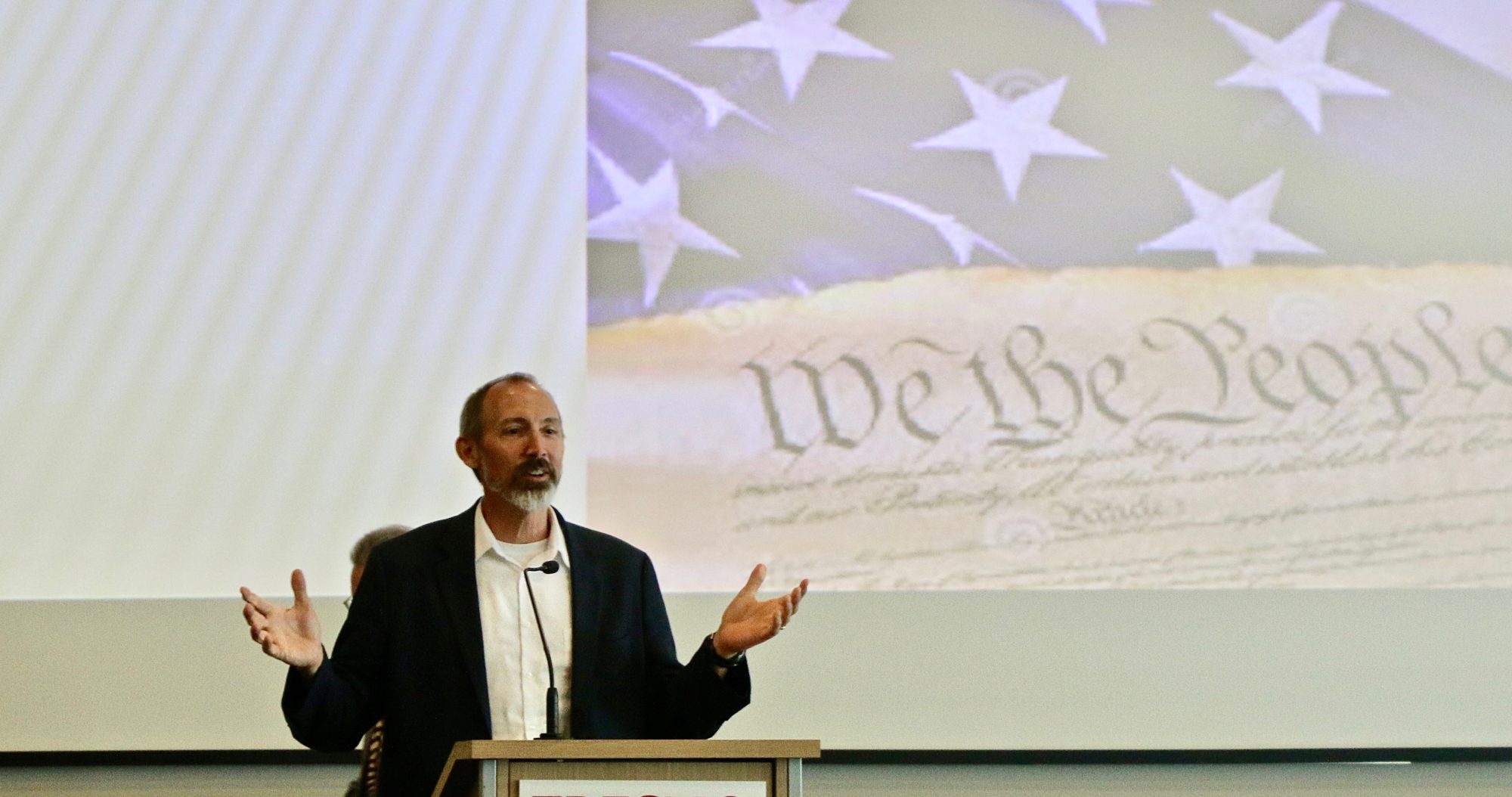


Trump’s federal crackdowns risk eroding peaceful assembly rights
Now is a crucial time to think about our basic rights. Among the rights listed in the First Amendment are the rights to peacefully assemble, and to petition the government for a redress of grievances. The right to petition and assemble allows us to gather in protests, marches and demonstrations.
It is antithetical to the idea of liberty to prevent people from gathering in public. But the right to assembly has often been at risk. Recent crackdowns against protest and dissent risk violating that right, as well as freedom of speech.
At a recent roundtable discussion of “antifa” and anti-U.S. Immigration and Customs Enforcement protests, President Donald Trump celebrated his ban on flag burning, saying, “we took the freedom of speech away.” A Supreme Court precedent from the 1980s, however, allows flag burning. Trump’s policy is justified by appealing to an issue involving the right to assemble. He explained, “When they burn a flag, it agitates and irritates crowds, I’ve never seen anything like it, on both sides, and you end up with riots. So, we’re going on that basis.”
The right of peaceful assembly is not a right to rampage. The government can stop riots as a matter of public safety. But the threat of a riot can be used as a pretext for violating people’s rights.
The tension between liberty and public safety is real. We saw this during the COVID pandemic, when public gatherings were limited. National guard deployments could be justified in terms of public safety. If there really were riots, the right to assembly could be curtailed.
But this depends on the facts on the ground. And as a federal judge recently ruled, the president’s claims about protecting what he calls “war ravaged” cities is “untethered to the facts.”
Legal authorities should protect both protesters and counter-protesters, who each have a right to protest. But the presence of troops and the threat of arrest can have a chilling effect on ordinary citizens who are scared away from assembling. Hina Shamsi, director of the American Civil Liberties Union National Security Project, said of these deployments: “It risks chilling the rights to speak and to assemble. In other words, that very fundamental American right to protest.”
The right to peacefully assemble has been called a “forgotten freedom.” This right may seem so obvious that it is almost not worth thinking about. The right to assembly is about what we do with our bodies, where we gather and how we associate with other people. To limit this fundamental right to move our bodies and occupy space without good reason is tyrannical.
The American founders understood this, which was why they ratified the First Amendment. In the background was the case of William Penn, the founder of Pennsylvania. As a young man, Penn was arrested in England for meeting in public with other Quakers. England had banned such “conventicles” in an attempt to harass dissenters.
This reminds us that the right to assemble is related to religious liberty (religion is a communal practice that involves public gatherings). The right to assemble is also important for political parties, social clubs, labor unions, and other gatherings of people.
This right has often been understood in relation to freedom of association, thought and expression. Freedom of assembly and association are linked with science and education. The advance of knowledge depends upon freedom of speech and of the press. Knowledge also develops socially. To learn wisdom, we must be able to meet and argue with other people. In the digital era, it is not only bodies that gather in public but also minds who should be free to meet together in cyberspace.
In his last speech, Martin Luther King Jr. addressed the attempt by the government to prevent protests during the Civil Rights movement. He remarked that liberty is routinely stifled in China, Russia and other totalitarian countries. But in the U.S., we have freedom of speech, press and assembly. King said, “the greatness of America is the right to protest for right.” The rights to assemble, speak and petition are an important part of what makes American great.
Read more at: https://www.fresnobee.com/opinion/readers-opinion/article312530253.html#storylink=cpy