Religion, Non-Religion, and the Pandemic

Fresno Bee, May 17, 2020

The divide between religious and non-religious people is highlighted by the pandemic. At a recent “Freedom Rally” in Fresno, a woman said she was not afraid of the virus. If she gets sick or infects someone else, she said, it is “all part of God’s plan.”

This represents a dispiriting theology. It is not God’s will that people die from this disease. Scientists know how to stop its spread. It makes no sense to ignore science and blame God.

The conflict between faith and science rages on. Some turn to prayer. May 14 was an international day of prayer, celebrated by Pope Francis and Muslim leaders. Two months ago, President Trump declared March 15 as a national day to “pray for God’s healing hand to be placed on the people of our Nation.” May 7 was another National Day of Prayer. At the May 7 event at the White House, no one wore a mask, including the choir.

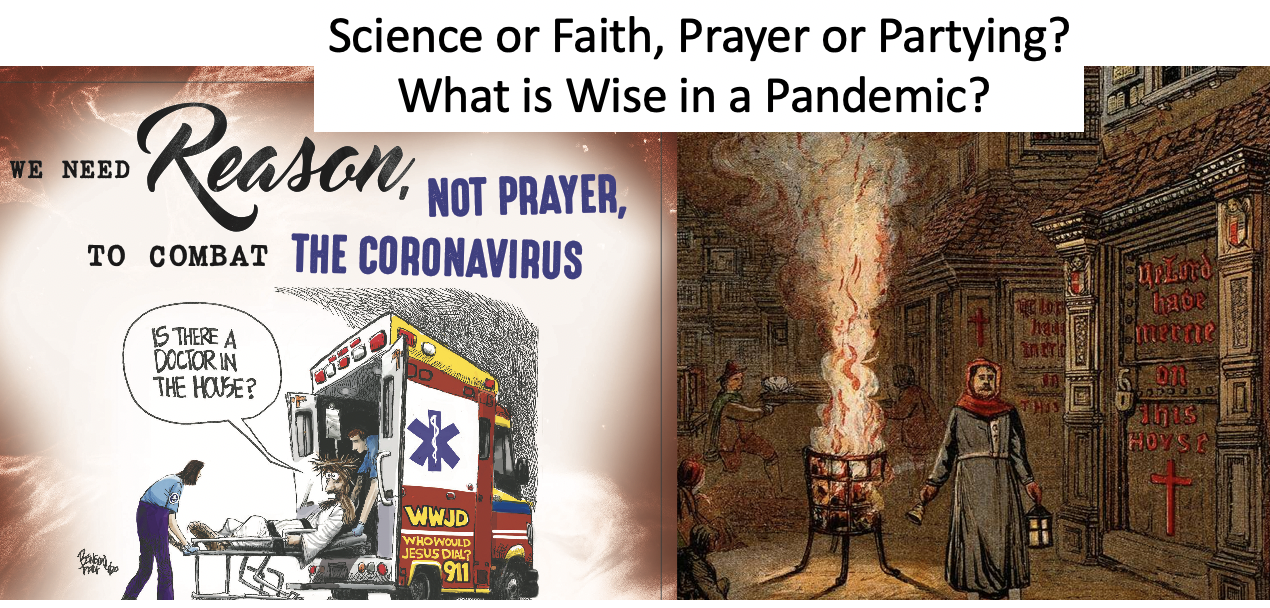
In response to all of this praying, the Freedom From Religion Foundation declared May 7 as a National Day of Reason. They claim the National Day of Prayer is unconstitutional. They argue, “irrationality, magical thinking, and superstition have undermined the national effort to combat the COVID-19 pandemic.”

Pandemics have often prompted religious turmoil. In ancient Athens, a terrible plague turned people away from religion. The historian Thucydides reported that at first the Athenians asked the gods for help. But when prayer had no effect, the people saw the futility of religion.

As the disease spread, general lawlessness broke out. People expected to die soon, so they focused on enjoying themselves in the present moment. They gave up on honor and were not worried about punishment for crime. Thucydides explained that there was no longer any fear of the gods or of the laws.

Something similar occurred during the Black Death. The Italian poet Boccaccio recounts that people made merry and drank themselves silly, since death appeared inevitable. People generally disregarded “the reverend authority of the laws, both human and divine.”

The good news is that our pandemic is less severe. The Athenian plague killed one-third of the population. The Black Death killed over half of Europe. Things are better today thanks to modern science. We know how to prevent and treat the bubonic plague. Scientists also know how to prevent COVID-19.

But will faith wane in this crisis as it did in Athens and Italy? When prayer proved ineffective, some people gave up on religion — but not all. Religion is resilient, as recent data show. The Pew Center reports that the COVID-crisis has strengthened the faith of people who were already religious.

But the pandemic has not driven the nonreligious back to religion. Indeed, a growing religious exodus is already well underway. A fourth of all Americans are not religious and a third of those under 40 are nonreligious.

Religion can’t compare to science when it comes to understanding disease. But a religious attitude may be useful for creating solidarity and compassion. History shows that in a pandemic people may selfishly focus on short-term pleasure. But the turn to selfish individualism undermines cooperation and helps the disease to spread.

If religion encourages people to cooperate, care for the suffering, and work to prevent disease, then science and religion can work together. A carefree attitude of partying like there is no tomorrow will undermine cooperation. But the same is true when religious people refuse to cooperate in the name of religious liberty.

In a free country, of course we have the right to pray or to party. But we should be smart about exercising our rights. We can party safely and with social distance. We can also pray, while loving our neighbors and wearing masks.

Thucydides once said that good sense is undermined by haste, passion, and a narrow mind. We do better when we broaden our perspective and think more carefully about science, history, and ethics. We also need a more sophisticated theology that does not blame God for human failure. We must think about the impact that our choices have on others. We should acknowledge that science actually works to save lives. And whether we pray or party, let’s do it wisely.

Religion and Education

Are education and religious liberty mutually exclusive?

Fresno Bee, May 5, 2017

College education generally makes us less religious, according to a new study from the Pew Research Center. Educated Christians are more likely to go to church on a weekly basis than uneducated Christians. But college graduates are less likely to say religion is “very important” in their lives.

College graduates are also more likely to be atheists. Fifteen percent of those with advanced degrees do not believe in God, while only 6 percent of noncollege grads are atheists. Meanwhile, 42 percent of those without college education think that religious scriptures should be taken literally, compared with 14 percent of those with college degrees.

Science education make religious fundamentalism difficult to sustain. The Earth is a speck among hundreds of billions of stars. Our species evolved long after the dinosaurs went extinct. The land was once covered by ice powerful enough to carve out Yosemite Valley. None of this is recorded in ancient scriptures, which teach that the gods have a special interest in this planet and in human beings. 

HISTORY AND ANTHROPOLOGY ALSO CHALLENGE RELIGIOUS FUNDAMENTALISM.

Traditional accounts of the soul are also being explained away. Biomedical science locates consciousness in the brain. And evil is explained in neurological or psychological terms instead of as a matter of demonic possession.

History and anthropology also challenge religious fundamentalism. The ancient Chinese or the Aztecs never heard of the Christian scriptures. Nor do Christian scriptures mention these ancient civilizations. This makes simplistic declarations about God difficult to understand. When we say “In God We Trust” in our diverse world, which God are we are talking about: Jehovah, Allah, or Quetzalcoatl?

Even within the Christian tradition there are disputes about God and revelation. Mormons, who comprise about 2 percent of the American population, believe that the Book of Mormon is a holy Christian scripture. Other Christians claim this is false.

Scriptural interpretation has evolved over time. The book of Joshua explains that God held the sun still in the sky in order to allow Joshua’s troops to slaughter their enemies. But after Galileo debunked the geocentric model underlying this story, it has been subject to reinterpretation.

Others have questioned the morality of a God whose miraculous power is used to slaughter an enemy. Evolving moral standards have led many Christians to reinterpret scriptures that contain morally problematic passages about slavery, the subordination of women, homosexuality, polygamy, divorce, and so on.

Religious belief has often been flexible and subject to reformation and reinterpretation. Religions evolve to take in new information and reflect new norms. We make sense of ancient texts in light of modern ideas.

Atheists may view all of this as an argument against religion in general. And indeed, a quarter of Americans have left religion behind – either affirming atheism or simply giving up on organized religion.

But religions are persistent. The diversity and flexibility of religious belief is a key to this persistence. Religions that don’t adapt go the way of the dinosaur. No one worships Zeus or Quetzalcoatl any more. But Christianity thrives because of the variety of Christian denominations. There are over 200 different versions of Christianity in the US. You can pick an interpretation that suits your preferences.

LIBERTY ALSO ALLOWS PEOPLE TO CHANGE RELIGIONS.
INDEED, ABOUT A THIRD OF AMERICANS CHANGE THEIR RELIGIOUS AFFILIATION.

Religious liberty thus helps religion to persist. Liberty allows for innovation and development. Liberty also allows people to change religions. Indeed, about a third of Americans change their religious affiliation.

In the free marketplace of religious ideas, religions sell themselves to people and reflect changing tastes. Catholics no longer say Mass in Latin. Protestants have embraced pop music. And Western faiths have incorporated meditation, yoga and other spiritual practices from Eastern traditions.

In the modern democratic and capitalist world, we value educated and informed choice. We want informed consent in health care, in financial transactions and in elections. We should also value informed choice when it comes to declarations of faith. In a democratic culture, we ought to learn about other faiths and shop around. We also ought to leave each other alone to pursue the religious quest in our own way.

Things may have seemed simpler when a common piety was enforced on the uneducated masses. Freedom and science do undermine traditional religious conformity. But modern democratic people have faith in the power of education and religious liberty to make this a better world.

http://www.fresnobee.com/living/liv-columns-blogs/andrew-fiala/article148835959.html

Wishful thinking at Christmas

At Christmas, maybe a little wishful thinking is OK

Fresno Bee, December 24, 2016

Much of life depends upon voluntary suspension of disbelief. We often set truth and reality aside to play in the fields of fantasy.

Perhaps we are too gullible. Fake news floods our screens. We are awash in bunkum and balderdash. Major dictionaries picked “surreal” and “post-truth” as words of the year for 2016.

Science and logic help us distinguish fact from fiction. But this problem is psychological. We enjoy our humbug. Sensational hoaxes are much more fun than reality. And the will to believe provides us with wonder and joy.

In 1897, the New York Sun famously declared, “Yes, Virginia, there is a Santa Claus.” The editor – with the fantastic name Frances Pharcellus Church – explained, “The most real things in the world are those that neither children nor men can see. Did you ever see fairies dancing on the lawn?”

“Of course not,” he said. “But that’s no proof that they are not there. Nobody can conceive or imagine all the wonders there are unseen and unseeable in the world.”

Mr. Church concluded that faith, fancy, poetry, love and romance reveal the beauty and glory of the world. These things, like Santa Claus himself, are “real and abiding.”

This inspiring essay would fail a critical-thinking class. Lack of proof is not proof. Wishful thinking does not make things true. Imagined wonders are not real just because we want them to be.

A LIFE OF PURE, UNADULTERATED REALITY WOULD BE DISMAL AND DULL.
THE COSMOS CARES LITTLE FOR OUR HAPPINESS. BUT THIS EMPTY UNIVERSE ALSO CONTAINS CHRISTMAS.

And yet, we do not live by truth alone. We love our illusions. We are fascinated by fables and fantasy. Poetry transports us. Music moves us. The unreal worlds of television, film and literature fill our empty hours.

A life of pure, unadulterated reality would be dismal and dull. The cosmos cares little for our happiness. But this empty universe also contains Christmas.

The miracle of birth cannot be reduced to mere biology. Love, beauty and joy transcend material reality. Generosity and forgiveness can break long cycles of violence and hatred. But these wonders cannot be enjoyed unless we believe in them.

On Christmas Eve, the will to believe takes center stage. Christmas stories hinge upon the crisis of faith of an incredulous child. Belief in the unbelievable empowers Santa and his sleigh. Credulity is the ticket to the Christmas wonderland.

The same is true of art. Music is merely sound and rhythm. Poetry is scribbles on a page. Films are flickering, two-dimensional images. We must allow ourselves to be enchanted by these things. And when we give in to the illusion, we encounter meaning that transcends the material world.

Religion and politics also require suspension of disbelief. Bread and wine are transformed. Flags and insignia are not mere cloth. We encounter the sacred and sublime through a leap of faith.

It is easy to dismiss this as humbug. A cynical Scrooge will complain that love is hormonal, justice is power, and truth is the echo of a lie well told. Critical reason bursts the bubbles of the false and fantastic.

THE CHALLENGE IS TO STEER A MIDDLE COURSE. WE NEED TO KEEP WONDER AND HOPE ALIVE.
BUT WE ALSO NEED TO KEEP OUR HANDS ON OUR WALLETS.

But we do not live by reason alone. Poets and playwrights know this, as do shysters and charlatans. And therein lies a significant problem. Like other artists, the con artist plays upon our credulity. He sells us a pack of lies, which we gladly pay for.

The challenge is to steer a middle course. We need to keep wonder and hope alive. But we also need to keep our hands on our wallets.

There are times when it is appropriate to set reality aside and celebrate the play of the imagination. Christmas is surely one of those times. We sing the songs and tell the tales, weaving a fantasy that glows in the child’s wondering eyes. F.P. Church rightly celebrates “the glad heart of childhood.”

We cannot live every day as if it were Christmas. The adult world includes violence, hatred, stupidity and ignorance. Sober thought, grounded in reality, is the cure for these maladies.

But despair is also a problem. Wonder and hope are often in short supply. And cynicism pinches our hearts.

So yes, Virginia, we need to believe in Santa. Tomorrow we’ll be back to battling bull. But today we play with the fairies, creating a world of generosity and love for our children to enjoy.

http://www.fresnobee.com/living/liv-columns-blogs/andrew-fiala/article122726694.html

Marijuana Morality

Proposition 64: Discerning the pros and cons of legalized marijuana

Fresno Bee, October 28, 2016

There are difficult questions to confront in thinking about Proposition 64. If the polls are right, the pot proposition will likely pass. And if it passes, we will need to think carefully about the morality of marijuana.

Libertarians argue that adults should be free to get high. Gary Johnson, the Libertarian presidential candidate, has long advocated marijuana reform.

Others oppose intoxication on principle. This view is often based in religion. Mormons, Mennonites and Muslims – as well as Buddhists and Baptists – generally oppose alcohol and other intoxicants. Religious folks tend to think that drug-induced rapture is a false idol leading to immoral behavior.

But some traditions do use drugs to achieve ecstasy and insight. An ancient proverb states “in vino veritas,” in wine there is truth. Uninhibited drunks may speak the truth and some find enlightenment in their cups.

William James, the great American philosopher, explained, “Sobriety diminishes, discriminates and says no; drunkenness expands, unites and says yes. It is, in fact, the great exciter of the Yes function in man. … It makes him, for the moment, one with truth.”

James described the “ontological intuition” disclosed by various drugs. That’s fancy language for the sense of wonder and harmony that some drugs elicit. Marijuana often has been associated with spirituality and higher consciousness – by Rastafarians, Indian mystics, Sufis and hippies.

SOBER THOUGHT AND RATIONAL DISCERNMENT ARE IMPORTANT GOODS – OFTEN IN SHORT SUPPLY.
BUT MAN DOES NOT LIVE BY SOBRIETY ALONE. WE ALSO NEED ESCAPES AND RELAXATIONS.

Puritanical types argue that chemical nirvana is cheap and phony. It is debatable whether any drug can put you in touch with God. But there is no denying that human beings pursue altered states of consciousness.

Sober thought and rational discernment are important goods – often in short supply. But man does not live by sobriety alone. We also need escapes and relaxations.

In our culture, alcohol is the drug of choice. A glass of wine at dinner is part of haute cuisine. Art and music often are enjoyed with wine or a cocktail. And beer goes with sports. Libertarians argue for expanding our choices.

But the freedom to alter consciousness runs up against our responsibility to others. Do we want stoned parents – or drunk parents, for that matter – raising children? Impaired driving is an important concern. Drunken drivers kill about 28 people per day. Marijuana legalization likely will increase traffic fatalities.

7ac6746876d20bac10c7ec9c5c7b510d664e5843e8d57a14e4a2f2751c0a1440The National Organization for the Reform of Marijuana Laws offers a different opinion. NORML suggests that stoned drivers are aware of their impairment and slow down, focusing more on driving. They claim that drunken drivers are more reckless than stoned drivers.

This is an unlikely story. And even if it is true, legal pot will cause traffic snarls as would-be Cheeches and Chongs creep along in the fast lane. There is no denying that stoned drivers will cause accidents.

A Libertarian will reply that despite drunken driving, alcohol remains legal. From this point of view, what is needed is regulation and education, not prohibition. Self-driving cars and better public transportation also would help.

IF MARIJUANA BECOMES LEGAL IN CALIFORNIA, AS IS LIKELY,
IT IS STILL WORTH ASKING WHETHER DECENT AND RESPONSIBLE PEOPLE SHOULD PARTAKE.
WE WILL NEED SOCIAL NORMS TO GUIDE APPROPRIATE POT BEHAVIOR – A GUIDEBOOK OF MARIJUANA MANNERS.

If marijuana becomes legal in California, as is likely, it is still worth asking whether decent and responsible people should partake. We will need social norms to guide appropriate pot behavior – a guidebook of marijuana manners.

Our culture – our economy, our educational system and our democratic process – is based upon the presumption of sobriety and rationality. Intoxicated workers, teachers and voters are dangerous. If weed is legalized, decent people should only use it in moderation and at appropriate times.

We have a system of social norms governing alcohol. The cocktail hour begins only after work. Responsible drinkers drink moderately, imbibing one or two drinks a day – and not every day. They recognize that alcoholism is a risk. And they understand that drunken driving is wrong.

We do not have a similar system of social norms governing pot use. Stoner culture is often excessive and irresponsible. Snoop Dogg is not a role model.

If pot is legalized, we will need moral guidance on basic questions of where, when and how much. Moderate marijuana use has not been addressed in the mainstream. If Propositon 64 passes, we will need someone other than Cheech, Chong or Snoop to give us advice.

This is probably a lot for a stoned voter to keep in mind. And that may be a reason for further skepticism about whether legalizing pot is good for our democracy.

Read more here: http://www.fresnobee.com/living/liv-columns-blogs/andrew-fiala/article111071077.html#storylink=cpy

Celebrating the Virtue of Secularism

Is secularism a danger or an opportunity?

Fresno Bee, May 28, 2016

  • Secularism allows religious and nonreligious people to coexist
  • Science, reason and secularism foster innovation and technology
  • Secularism and godless communism are not the same thing

Nonbelievers are coming out of the closet. The number of admitted atheists and agnostics in the U.S. has nearly doubled in recent years – from 4 percent of the population in 2007 to 7 percent in 2014. Roughly one-fourth of Americans do not have a religious affiliation. In England, non-religious folk now outnumber Christians.

This is seen as a sign of a robust secular system in which nonbelievers are free to express themselves. But some view secularism as a danger. The Rev. Franklin Graham recently complained, “Secularism and communism are one and the same. Secularism is godless. Secularism is taking over our country.” Pope Francis has warned that secularism “has produced a growing deterioration of ethics, a weakening of the sense of personal and collective sin, and a steady increase in relativism.”

Franklin Graham-Prayer RallySecularism is not relativism. Secularism is a political system grounded on basic principles of liberty and toleration. These principles allow for a free choice of religious belief – or disbelief. But secular principles are not weak or relative. Secular political life rests upon fundamental claims about the human right to freedom of conscience.

Graham is right that secularism has taken over our country. Secularism became the law of the land when the First Amendment was ratified in 1791. In the subsequent two centuries, we have worked out the details of a political system in which the law states, “Congress shall make no law respecting an establishment of religion, or prohibiting the free exercise thereof.”

Graham is wrong to suggest that secularism is necessarily godless or to equate it with communism. Communist governments sought to eradicate religion. But our secular system protects the freedom to worship God, so long as religion does not become entangled with political power.

SECULARISM … CELEBRATES THE FACT THAT IN A FREE SOCIETY
THE FAITHFUL AND THE FAITHLESS CAN WORK TOGETHER.

God-fearing people should support secularism, since secularism allows them to pursue their faith in their own way. Public religious power is curtailed in our system. But individual citizens are free to practice any faith they want – or no faith at all.

NDR_slide2016-2Robust secularism does allow non-religious people to be more vocal. Rationalists and agnostics are finding their voices. One example was the recent call for a “National Day of Reason” on May 5. The Day of Reason idea was initiated by a congressman from Silicon Valley, Rep. Mike Honda, as a response to the National Day of Prayer. In defense of the idea, Honda explained that the success of Silicon Valley was based on “the scientific method and the application of reason.”

Honda has a point. The innovative spirit and technological prowess of Silicon Valley is related to our secular system. Many of the scientists and engineers in Silicon Valley are immigrants who come from diverse religious traditions but who share the common language of science. It is difficult to imagine the same sort of entrepreneurial efflorescence and technological prowess developing in non-secular nations such as Saudi Arabia.

Atheists are more vocal under robust secularism. They are displaying growing social power. An atheist donor gave the University of Miami a $2.2 million endowment for the study of atheism, humanism and secular ethics. The donor, Louis J. Appignani, stated that he wanted to “eliminate discrimination against atheists.”

OUR SECULAR SYSTEM PROTECTS THE FREEDOM TO WORSHIP GOD,
SO LONG AS RELIGION DOES NOT BECOME ENTANGLED WITH POLITICAL POWER.

That’s an important cause in a country where several states have constitutional language preventing atheists from holding office. For example, the Constitution of Tennessee stipulates, “No person who denies the being of God, or a future state of rewards and punishment, shall hold any office in the civil department of this state.” Laws like this remain on the books in Tennessee and seven other states, even though the U.S. Supreme Court ruled over 50 years ago that such laws violate the secular spirit of the Constitution.

Atheists obviously benefit from an inclusive secular society. But the same is true for a wide variety of faiths that have been discriminated against in the past and which suffer discrimination today.

Secularism is opposed to discrimination. It allows for the peaceful coexistence of diverse religious and non-religious people. The fear that secularism is relativist or communistic is misplaced. Secularism rests on the bedrock of liberty. It permits religion and non-religion to flourish. And it celebrates the fact that in a free society the faithful and the faithless can work together, as they do in places like Silicon Valley.

Read more here: http://www.fresnobee.com/living/liv-columns-blogs/andrew-fiala/article80280257.html#storylink=cpy