Truth Endures

Fresno Bee, August 11, 2025

In times like these, it is important to remember that truth endures. Despite lies and cover-ups, there are facts. Yes, there are secret files, information silos and political attacks on science and history. But truth persists despite the conspiratorial mania of the present moment.

As Winston Smith, the protagonist of George Orwell’s “1984,” put it, “If you clung to the truth even against the whole world, you were not mad.” It isn’t easy to cling to truth in a world where truth is assaulted and expertise is devalued. In this idiotic environment, bad news is dismissed as fake news and scientific reason is denigrated as ideological.

We might consider Robert F. Kennedy Jr.’s anti-vax obsession here. Or we could discuss the Trump administration’s attack on climate science.

A telling example is found in President Donald Trump’s firing of Erika McEntarfer, the head of the Bureau of Labor Statistics. Trump claimed she was a “Biden appointee” who “faked the jobs numbers before the election to try and boost Kamala’s chances of victory.” On Truth Social, Trump explained, “In my opinion, today’s Jobs Numbers were RIGGED in order to make the Republicans, and ME, look bad.”

In Trump’s telling, everything that makes him look bad — or that he does not like — is rigged, fake and even treasonous. Last month, Trump accused Barack Obama of “treason” for supposedly rigging elections in 2016 and in 2020. In May Trump said that members of the Biden administration committed “TREASON” (in typical Trumpian all-caps), as “treasonous thugs” supposedly took over Biden’s presidency as the former president’s capacities declined.

It is easy to ignore these scandalous charges since the Trumpian firehose of gibberish is constantly gushing. But if we take these charges seriously, they present us with a very ugly dilemma. Either one of America’s ruling parties is treasonous or the other is unhinged. If Trump’s accusations are true, the Democratic Party establishment should be arrested and imprisoned. If what Trump says is false, the Republican Party establishment is mired in conspiratorial claptrap.

Some folks may roll their eyes and try to ignore all of this. One way to preserve your sanity in the face of madness is to keep your head down. But indifference is a step away from complicity. Good, honest people cannot remain indifferent to the truth.

And at the end of the day, there are facts: Either the globe is warming or it isn’t. Either vaccines are safe and effective or they are not. Either the economy is waning or waxing. Scientific reasoning can deliver the truth. Political meddling muddies the water.

Philosophers have affirmed the value of truth for millennia. Plato said, “Truth is the beginning of every good thing.” To live well, Plato said, you must be a “partaker of the truth.” More recently, English philosopher Bernard Williams said that if we “lose sense of the value of truth… we may well lose everything.”

The partakers and defenders of truth are often lonely voices howling in the wilderness. This is especially true when indifference and complicity are common. And let’s face it, human beings are easily deceived. Naïve dupes happily succumb to deceptive appearances. Charlatans and con-men prey upon our credulity. And some people devote their entire lives to lies, or to lying.

To remedy this, society has developed resources to defend the truth. Oaths and rituals are designed to ensure truth-telling and promise-keeping. Our institutions celebrate the virtues of honesty and sincerity. Scholars enforce academic integrity. Legal systems require sworn testimony. We punish plagiarists, liars and perjurers.

But as Orwell warned, unscrupulous political powers can use these institutions and procedures in defense of lies. Power divorced from truth is dangerous. Despite attempting to cling to truth, Winston, the main character of Orwell’s novel, is eventually tortured and broken. He succumbs to the madness. He accepts whatever lie “the Ministry of Truth” proclaims. In the end, he learns to love Big Brother.

The moral of Orwell’s story is about the ongoing need for truth-telling, and courageous resistance to lies. This isn’t easy. History is littered with the broken bodies of those who dared to speak truth to power. But in the long run, the truth endures. And it is nobler to defend the truth than to acquiesce to a lie.

Read more at: https://www.fresnobee.com/opinion/readers-opinion/article311622581.html#storylink=cpy

Motherhood and Choice: Keeping our Eyes Wide Open

Fresno Bee, May 11, 2025

Motherhood should be a choice…

Motherhood can be wonderful and joyous when it is freely chosen and fully supported. As we celebrate mothers, we should acknowledge that motherhood occurs in various ways in the modern world. We should also consider whether we want the government meddling with sex, reproduction and the family.

Such meddling is an old problem: Plato imagined the state controlling procreation — his goal was to produce better offspring through eugenic breeding of human beings. His student, Aristotle, suggested that deformed children should not be allowed to live and that abortion could be required in the interest of population control.

If those ancient proposals sound appalling to modern ears, that’s because we typically embrace sexual and reproductive freedom. We want to be able to choose who we have sex with, as well as whether and when we reproduce.

Freedom of choice for mothers is a relatively new development: For most of human history, motherhood was under patriarchal control. The innovations of the modern world have changed all of that.

During the past 200 years, the human population has boomed from 1 billion to 8 billion people. At the same time, sexual and reproductive freedom were unleashed. Better birth control technology allows for sex without reproduction. Liberal divorce laws, the demise of the stigma against unwed mothering and LGBTQ rights have changed the cultural paradigm.

We are still sorting out the implications of these changes. And the culture war about motherhood is not yet over.

The rapid increase in population has led some to worry about the carrying capacity of the earth. Those concerns are exacerbated by climate change, immigration crises and ongoing social and political turmoil. A growing population may make these things worse.

But some folks are now worrying about declining populations in developed countries such as the U.S. global population will likely continue to grow to above 10 billion people in the next 50 years. But in those parts of the world where sexual and procreative freedom are firmly established, birth rates are falling below replacement levels.

These declining birth rates have prompted the Trump administration to advance a pro-natal agenda. At the annual March for Life in January of this year, Vice President J.D. Vance said, “I want more babies in the United States of America.” At the same time, Vance criticized “a culture of radical individualism.”

Vance invokes a broad critique of those modern developments that include women’s liberation, the sexual revolution and abortion rights. He is concerned that people are enjoying their freedom while ignoring what he called “the joys of family life.”

The pro-natal agenda has led the Trump administration to consider policies to promote childbirth, including a $5,000 incentive for making babies. In support of the idea, one conservative commentator, Michael Knowles, has encouraged Americans to get busy making babies. In a YouTube video, Knowles said, “Close your eyes and think of America. Do your patriotic duty. Make America great again. You gotta have babies. OK? It’s your marital duty. It’s your patriotic duty…. Close your eyes and think of America, and maybe you get five thousand bucks.”

Critics have pointed out that $5,000 is hardly enough to support motherhood in an economy that includes high costs for health care, childcare and housing. Libertarians and feminists alike may also wonder whether it is a good idea to view procreation as a patriotic and marital duty.

We should be nervous when government officials start meddling with sex and the family. The government can offer incentives and support for families and children without becoming coercive, but the slippery slope of governmental coercion is an ancient problem we ought to avoid. And to suggest we close our eyes and make babies as a patriotic duty is truly bizarre.

If motherhood is an important good, it should be chosen with eyes wide open, for its own sake and not because of some political program. Vance is right about the joys of family life: Loving families are wonderful. But reproduction is not the only joy that matters. In a world with more than 8 billion people, it might be appropriate to have fewer kids. More importantly, in a free country, we must be allowed to pursue familial joy on our own terms.

Read more at: https://www.fresnobee.com/opinion/article305999296.html#storylink=cpy

Trumpian Eroticism and the Politics of Passion

Fresno Bee, March 9, 2025

How Donald Trump and Elon Musk inspire passions feared by America’s Founding Fathers

American politics has become deeply erotic. Often, this manifests as love — as when Elon Musk recently tweeted, “I love Trump, as much as a straight man can love another man.” In his recent address to Congress, President Donald Trump said: “People love our country again, it is very simple.” He extolled the “faith, love and spirit” of the American people, who “will never let anything happen to our beloved country.”

To say that Trump is an erotic leader does not mean he is “sexy.” Rather, the point is that he provokes. Trump inflames the emotions — whether you love him or hate him. He is the kind of person about whom it is nearly impossible to remain indifferent. He arouses rather than enlightens.

The erotic element shows up in various ways. Fealty and devotion of the Muskian sort are obviously forms of love. Nepotism and cronyism are erotic ways of distributing power to faithful friends and family members. In such arrangements, it does not matter whether things are fair or reasonable, nor does it matter whether people are good. Rather, what matters is love and connection.

Trump is making American politics a game of seduction and power — a spectacle driven by passion. Part of this is public performance. As Trump was berating Ukrainian President Volodymyr Zelenskyy the other day, he said, “This is going to be great television.” The play of passion is enthralling and compelling: you can’t look away.

In a comment on the Zelenskyy episode, Canadian novelist Stephen Marche suggested we are witnessing “rule by performers,” and what he calls “histriocracy,” the rule of the “histrionic,” — the melodramatic, theatrical or emotional. Indeed, Trump is a master of spectacles, and he knows how to keep us watching.

The erotic art of arousal can be useful in business and in politics. But it is quite different from a more sober-minded or rational approach to the world.

The distinction between the erotic and the rational is as old as Plato, who worried that unbridled eros (sexual love or desire) would destroy a good city, and that passion would undermine justice. He warned that when eros rules a city (or a soul), it is like being drunk or mad. The rule of the erotic leads to lawlessness, frenzy and tyranny. Plato hoped rationality could control the passions, but he knew that eros was a powerful force.

Sober-minded folks view political discourse as an earnest discussion of justice, virtue and truth. Rational politics is sincere, honest and moderate. In the Platonic government, careful thinkers would deliberate using logical arguments that rest upon a bedrock of first principles and unassailable truths.

Passionate politics is different. It values histrionic performances that elicit emotional responses. Here, the participants seduce and cajole with the goal of achieving popular acclaim — which is, after all, a kind of love. The erotic approach rejects sedate sincerity in favor of impassioned public displays of power and affection. Erotic politics is more interested in glory than in goodness, and it encourages inspiring fantasy rather than dull deliberation.

Political eros is chaotic and unreasonable. Sometimes, it even becomes vulgar and obscene. The risk that passion will become excessive is part of what makes it exciting and fun. That’s why sober-minded rationalists don’t understand its allure and worry that the excitement of eros will lead to dangerous excess.

John Adams once warned about the “overbearing popularity” of “great men.” He said, “Ambition is one of the more ungovernable passions of the human heart. The love of power is insatiable and uncontrollable.”

Adams and the other Founding Fathers created a system of checks and balances to restrain the erotic element. Rationalists like Adams think that laws should rule, rather than love. They view passionate personalities as dangerous, and in need of restraint.

Eroticism sees such sober rationalism as boring and shallow. Typically, devoted lovers remain enamored of their charismatic champion — despite their flaws and lawlessness — and because of his passion. Indeed, those flaws may make this figure more beloved.

In erotic politics, people are wedded to the person of the leader, warts and all. This astounds sober-minded defenders of virtue and the rule of law. But in erotic politics, it makes perfect sense to remain devoted to the beloved, since love is love, no matter what.

Read more at: https://www.fresnobee.com/opinion/readers-opinion/article301565739.html#storylink=cpy

The Power of Naming

Fresno Bee, Feb, 23, 2025

If Trump can rename the Gulf of Mexico, why can’t a trans person adopt a new name and pronoun?

Philosophers have long wondered about the nature of names.  Is there any essential way that words connect to the world?  Or are names merely arbitrary conventions made up for personal or political purposes? 

Donald Trump’s magical sharpie directs our attention to this perennial problem.  Trump’s signature on Executive Order 14172 (“Restoring Names That Honor American Greatness”), apparently suffices to rename things.  He turned Alaska’s Denali back into Mt. McKinley.  And he imposed a previously unheard-of name, “Gulf of America,” on the waters east of Mexico. 

In response, Mexico has threatened to sue.  And Americans are left wondering.  What is the true name of these things?  And who gets to decide? 

Most philosophers think names are merely conventional, and that there are no “true names.”  But mystics suggest that the true name of a thing provides a direct connection between word and object.  As one of Plato’s characters suggests, a thing’s true name is given by the gods.

A version of the “true name” idea can be found in Trump’s executive order about gender identity, which is named, in part, “Restoring Biological Truth To the Federal Government.”  The Order states that there has been an “ongoing and purposeful attack against the ordinary and longstanding use and understanding of biological and scientific terms.”  It states that “gender ideology” has resulted in “invalidating the true and biological category of ‘woman’.” 

But according to “ordinary and longstanding use and understanding,” the Gulf of Mexico is the name of the body of water in question. If the president can rename it by fiat, why can’t a person adopt a preferred pronoun or gender category in the same manner?

Naming is often about power, privilege and control. A biblical myth says that God gave Adam the power to name things along with dominion over the world. He who bestows names also owns and dominates them.

There is a kind of royal or religious prerogative in naming, christening and dubbing. Elaborate ceremonies are required to establish names and titles, and make subsequent changes. We see this in weddings, christenings and other rituals.

When power shifts, things are often renamed. The renaming is part of the point of acquiring power. The conqueror, after all, has the right to name what he has conquered.

Sometimes names are overtly practical. A “computer” computes and an “automobile” propels itself. A “bicycle” has two wheels, while a “tricycle” has three. Utilitarian and prosaic names function like “true names,” directly expressing the meaning of things.

But naming is often arbitrary and even whimsical. Elon Musk changed “Twitter” to “X,” which is also the name of one of his sons. Congressman Earl “Buddy” Carter has (absurdly) proposed renaming Greenland as “Red, White and Blueland.”

Some names have deep significance, as when a child is named after a departed loved one. Others inspire and edify. But other names are silly or insulting (as in the effort to rename Greenland).

Behind the words, of course, is the thing itself. This point was immortalized by Shakespeare, who asked, “What’s in a name? That which we call a rose, by any other name would smell as sweet.” Juliet’s love for Romeo is more substantial than their parents’ feud about names, titles and power. Juliet begs Romeo to refuse and deny his family name so that it will no longer be an obstacle to their relationship. Romeo responds by announcing he will be newly baptized under the name of “love.”

This angsty teenage romance reveals something deep and true: Authentic things — love, beauty and self-identity — exist beyond names. Disputes about names are contrived by the powerful to control, dominate and limit. But the names shouldn’t matter as much as the thing itself in all of its raw truth and natural glory.

Plato wondered whether we have direct access to the “real existence” of “things without names.” Perhaps we do. For swimmers in the seas east of Mexico, the name of the gulf they’re in is likely irrelevant. When Juliet and Romeo die in each other’s arms, their loving embrace transcends their family names.

But the history of the world is a struggle for the power of naming. That struggle begs us to consider what is true, what is real and who has the authority to name things.

Read more at: https://www.fresnobee.com/opinion/readers-opinion/article300673459.html#storylink=cpy

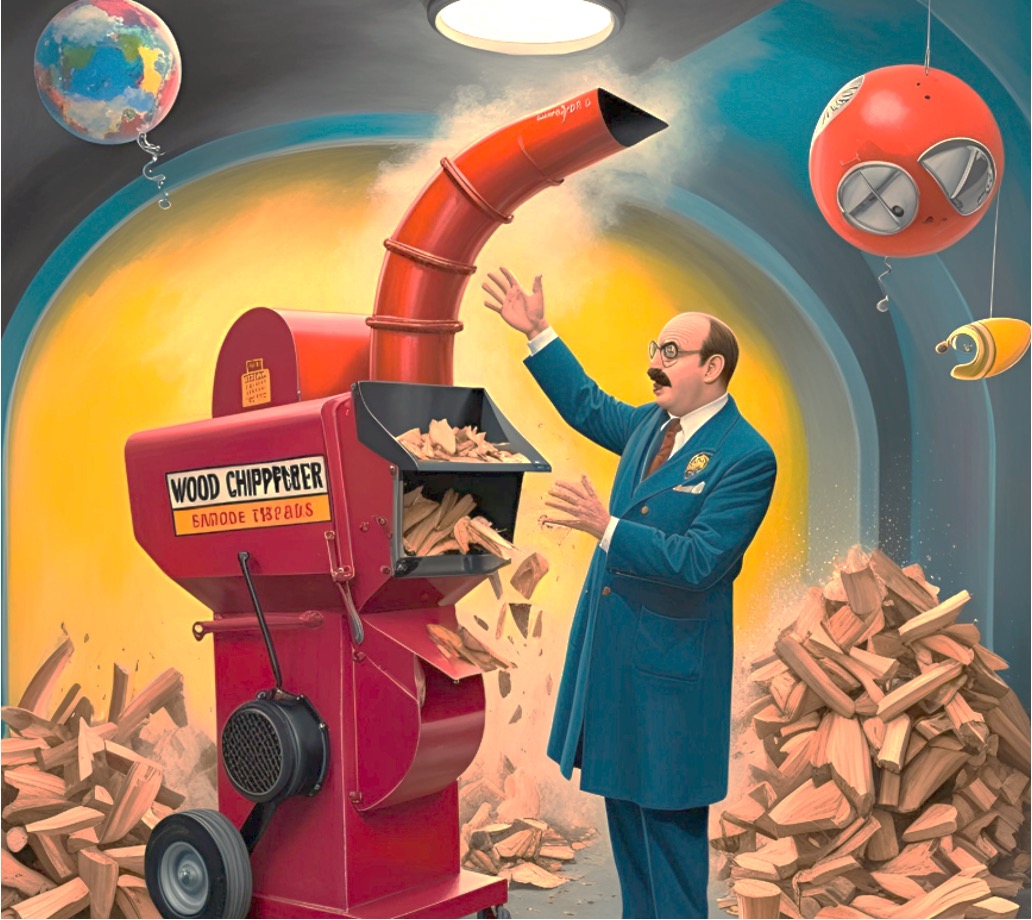
Musk and Strangelove: Should we stop worrying and love the wood chipper?

Fresno Bee, Feb. 9, 2025

Should we worry about Elon Musk’s mandate to overhaul the government?  Musk is the world’s richest man.  He runs multiple companies.  Despite this workload, he has spare time for the Department of Government Efficiency.  He said this week that “DOGE is the wood chipper for bureaucracy.” 

Some may think Musk’s mandate should have been revoked after the strange Nazi salute incident.  But Musk gave nearly $300 million to Donald Trump’s campaign.  And the President likes him.  “Elon is doing a good job,” according to Trump, who also said, “He’s a smart guy. Very smart.”

This almost seems like some elaborate parody.  That old movie, “Dr. Strangelove,” comes to mind.  Dr. Strangelove was an expert consultant whose arm would spontaneously extend in a Nazi salute.  He had a bizarre plan to repopulate the earth after nuclear doomsday.  The satirical lesson of the film was to “stop worrying and learn to love the bomb.” 

Should we stop worrying?  When Joe Biden left office, he worried about oligarchy and technocracy.  In his farewell speech, he said, “Today, an oligarchy is taking shape in America of extreme wealth, power and influence that literally threatens our entire democracy.”  He further warned against, “a tech-industrial complex that could pose real dangers for our country.” 

Biden, of course, assumed that democracy is valuable in itself.  But is it?  Democracy is unstable and inefficient.  Congressional logjams and partisan bickering make it difficult to get things done.  Elections disrupt the status quo.  And we, the people disagree about what is valuable and true. 

Oligarchic technocrats may think that smart efficiency experts armed with artificial intelligence can do a better job than seasoned bureaucrats and elected officials.  The problem is that we fundamentally disagree about who is smart, and what kind of expertise is valuable.  And as we are seeing, wealth buys access for cronies and kooks, while creating a facade of intelligence.

These are the fatal flaws of so-called “epistocracy,” which is a fancy word meaning “rule of experts.”  This idea goes back to Plato, who thought that the ideal society would be ruled by a wise and virtuous philosopher-king.  But there are no wise and benevolent kings.  We disagree about what counts as wisdom and virtue.  And rich oligarchs are good at pretending to care.

Jason Brennan, a professor at Georgetown University, has defended epistocracy, arguing that democracy fails because it empowers ignorant, disengaged “hobbits” and reckless, ideological “hooligans.” Brennan explains that in a democracy we put our fate “in the hands of ignorant, misinformed, irrational, biased, and sometimes immoral decision makers.”  Brennan’s solution is “rule of the knowers.” 

Expertise is obviously valuable.  We want experienced pilots to fly our planes, and smart dentists to fix our teeth.  But expertise in one domain does not necessarily transfer to another.  We don’t want dentists to fly our planes, or pilots to fill our teeth. 

Nor are experts politically or morally neutral.  Experts are mere mortals.  They have values, interests, and biases.  Smart people disagree about all kinds of things.  And sometimes even smart people do dumb things.

That’s why there ought to be checks and balances.  As James Madison said, “If men were angels, no government would be necessary. If angels were to govern men, neither external nor internal controls on government would be necessary.”  The system of checks and balances is designed for a world of hobbits, hooligans, and cronies.

Moreover, the government is not a business, an airplane, or a dentist’s office.  The law is not a machine to be tinkered with by engineers or a system to be hacked by technocratic geeks.  Rather, the legal system expresses and defends fundamental values.  It is itself the result of historical struggles for justice.  Democratic government ought to reflect the will of the people, as expressed through elections that authorize elected leaders to make decisions on our behalf and in the name of the common good. 

Biden’s warning of doomsday for democracy is worth revisiting.  But by the time Dr. Strangelove takes center stage, it may already be too late.  One hopes that our system of checks and balances is resilient enough to survive the chainsaw.  If not, we may have no choice than to stop worrying and learn to love the wood chipper.