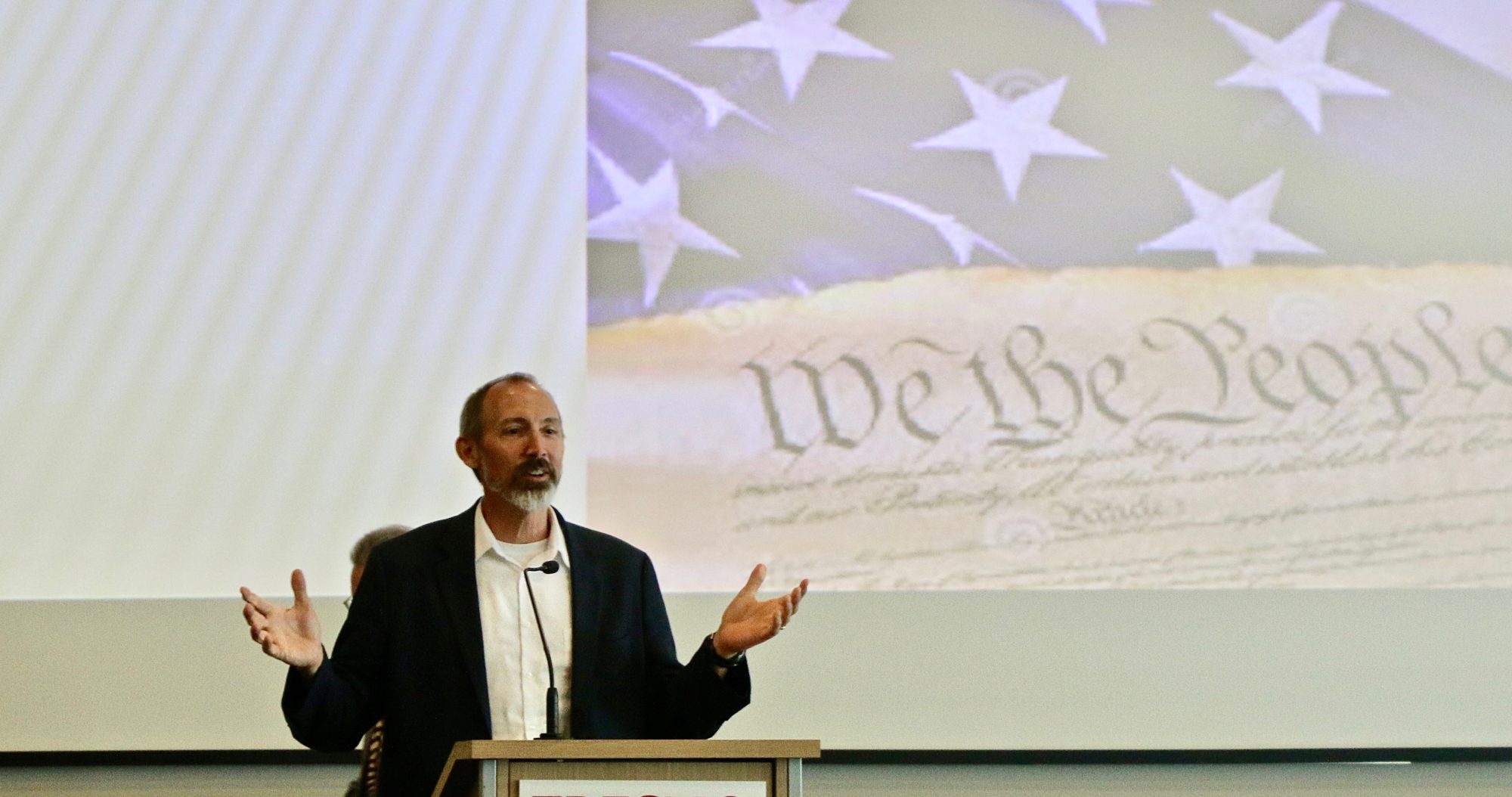
Enlightenment Values and Education

Ignorance is Not a Virtue

Fresno Bee, May 20, 2016

  • Ignorance, enlightenment are political issues
  • American universities are committed to enlightenment values
  • Democracies flourish when citizens are enlightened

Obama at Rutgers graduation- Ignorance is not a virtuePresident Barack Obama defended Enlightenment values recently in a commencement address at Rutgers University. Obama described the American founders as Enlightenment thinkers who opposed “superstition and sectarianism.” He concluded, “In politics and in life, ignorance is not a virtue.”

This caused a minor flurry of commentary. Many took this to be an attack on Donald Trump, which it probably was. Trump tweeted that it was Obama who was ignorant. And so it goes in an era when even university commencements are politicized.

But universities are not politically neutral. They are bastions of enlightenment. They proclaim enlightenment values in their Latin mottos. The Rutgers motto says, “Sun of righteousness shine upon the West.” Fresno State’s motto says, “Receive the light and give it forth.” The University of California’s motto is “Let there be light.”

WE CURE OUR MORAL BLINDNESS THROUGH FREE INQUIRY AND RATIONAL ARGUMENT.

The enlightenment ideal is politically progressive. Defenders of the enlightenment believe that knowledge makes the world better. And they know that knowledge rests upon freedom of thought.

The great Enlightenment thinkers were liberals in the broad historical sense of the term. They advocated liberty, equality and justice – and in some cases, political revolution.

Enlightenment thinkers believed that tyranny and injustice could be overcome when the light of reason is allowed to shine. Thomas Jefferson wrote, “Enlighten the people generally, and tyranny and oppression will vanish like evil spirits at the dawn of day.”

The German philosopher Immanuel Kant used a Latin phrase as the motto of enlightenment: sapere aude. This is a command: “dare to know!” Enlightenment rests upon a set of such imperatives. Speak truth to power. Be audacious in pursuit of wisdom. Follow the light, wherever it leads.

Some critics claim that this is a bunch of Eurocentric nonsense. They reject Enlightenment values as the oppressive ideology of colonizers and slaveholders. It is true that the heroes of the Enlightenment were white European men. They were wrong about a lot of things, including slavery.

We all have blind spots. But enlightenment provides a solution. Enlightenment requires self-criticism. We cure our moral blindness through free inquiry and rational argument.

Other critics reject reason as a solution to the human problem. Some believe that faith and feeling are more important than argument and inquiry. Others fear that liberal education is irreligious indoctrination. Some even think that science is an ideological temptation.

But blind faith is willful ignorance. Good ideas do not need protection from criticism. Rational critique strengthens good ideas and helps us avoid bad ones.

Martin Luther King once said, “Nothing in the world is more dangerous than sincere ignorance and conscientious stupidity.” Immoral people often plead ignorance, when they are caught doing something wrong. Others turn a blind eye to injustice.

Voluntary ignorance is negligent and recklessly indifferent. Knowledge generates responsibility. Mature people accept the obligations that knowledge creates. Moral people also shine a light on their failures. They admit their mistakes and work to correct them.

Some people are proud of their prejudices. Others wear bigotry as a badge of honor. The ignoramus relishes his own stupidity.

Such bovine complacency is the opposite of enlightenment. Conformity and obedience are easy. But cud-chewing contentment is beneath the dignity of human being. And docile herds are susceptible to the whims of the demagogues. Fanatics manipulate superstition, while tyrants prey upon a compliant populace.

CUD-CHEWING CONTENTMENT IS BENEATH THE DIGNITY OF HUMAN BEING.

Enlightenment is not easy. It is hard to think for yourself. Some claim that ignorance is bliss. But ignorance is not bliss – it is merely the path of least resistance.

To claim that ignorance is bliss is to deny our innate inquisitiveness. We are born ignorant. But we have a thirst for knowledge.

Education feeds off of curiosity. It questions everything and stimulates further inquiry. A good education arouses our mental energies. A great education leaves us with burning questions.

Laziness, cowardice and self-interest occasionally get in the way. It is easy to rest comfortably in our misconceptions. No one is completely wise or perfectly moral. Dark spots of ignorance remain within each of us. But the solution is obvious: more enlightenment and less stupidity.

Our schools and universities are a product of the Enlightenment, as is our republic. Democracies flourish under conditions of enlightenment. They falter when ignorance grows. They thrive when citizens dare to be wise.

Read more here: http://www.fresnobee.com/living/liv-columns-blogs/andrew-fiala/article78862672.html#storylink=cpy

Racism and Growth Mindset

Fighting racism with faith in the future

Fresno Bee, March 20, 2015

It’s disappointing to see that racism still exists: in fraternity houses, in Ferguson’s police department and in Fresno’s schools. But most of us are outraged by recent racism. And this gives us a reason to hope. Racism is not inevitable. Racists are bred, not born.

A key to making progress on any issue is the belief that it is possible to make progress. If you don’t believe that improvement is possible, you won’t work to make things better.static1.squarespace

Research done by psychologist Carol Dweck demonstrates the importance of affirming that progress is possible. People who have a “growth mindset” believe that since growth is possible, their effort matters. On the other hand, those who believe that talent and intelligence are fixed — something you are born with — give up more easily.

I recently spent the day with Eduardo Briceño, CEO of Mindset Works, a business that is putting Dweck’s research into practice. Briceño had a number of examples of the importance of the growth mindset. Educators, for example, clearly believe that growth happens. The point of education, after all, is to help children grow.

One of Briceño’s most astounding examples comes from the Middle East. Israelis and Palestinians who have a growth mindset are more willing to compromise, less distrustful of one another and more hopeful about peace. The reverse is also true. Those who believe that character is fixed are less willing to compromise. If you believe that people can’t change, and that members of certain groups have fixed traits, then there is little hope for peace and progress.

Racism is connected to the fixed mindset. Racial prejudice is based upon assumptions about the “fixed” traits of members of racial groups. But racial identity is not destiny. Nor are racists destined to be racist. One way to break the stranglehold of prejudice is to remind ourselves that our identities and attitudes are not permanently fixed.

Some of this research sounds too good to be true. Cynics argue that human nature is not really that malleable. The cynical realist shrugs, thinking that recent racism is yet another chapter of the same old story of man’s inhumanity to man. The more things change, the more they stay the same.

But cynicism is defeatism. It rests on the same kind of fixed mindset as racism.

Sure there are limitations to growth. Racism is not the simple result of a bad mindset. Racism is also the result of struggle over scarce resources, demographic pressures, corrupt institutions, media stereotypes and so on.

It is important to recognize the depth of racism. But that shouldn’t stop us from working to make progress. Rather, realism about racism set the agenda for the work we must do to build the world we want.

Racism won’t go away over night. But it is important to see that we have made progress. Outrage about racism is a hopeful sign. As are the institutional responses that we’ve seen in Ferguson and elsewhere. We are slowly growing a better future.

The philosopher William James once explained, “faith in a fact can help create the fact.” When we believe that change is possible, change is more likely to occur. James imagines standing on a mountain pass, confronting a leap across a chasm. If you have faith that you can make the leap, you will jump farther. But defeatism will undermine you. A defeatist will jump weakly or not at all, either falling into the abyss or failing to reach the summit.

Martin Luther King Jr. also emphasized faith in the future. He believed that the universe was on the side of justice. But King also said, “progress never rolls in on wheels of inevitability.” Rather, progress comes through “tireless efforts” to combat the cynical forces of social stagnation. King clearly had a growth mindset.

Racists and cynics believe that the world is fixed. But that’s false. The world is always changing. So there is work to be done. There is always a new generation being born, who have yet to be corrupted by pernicious ideas. Like weeds in the garden, racism and cynicism occasionally crop up. So let’s get to work, pulling weeds, planting better seeds and growing a better world.

Read more here: http://www.fresnobee.com/2015/03/20/4438246_andrew-fiala-on-ethics-fighting.html?rh=1#storylink=cpy


Individual Conscience and the Common Good

When conscience and common good collide

Andrew Fiala, Fresno Bee, February 6, 2015

There is no easy way to reconcile individual conscience and the common good. The argument about the measles vaccine makes this clear. Some have refused vaccination, despite the dangers this creates for public health._55524133_friedrichwandererabovetheseaoffogoriginal

Similar disputes play themselves out in a variety of contexts: Ebola quarantines, eminent domain, and the like. During the past half-century, exceptions have been carved out for individual conscience with regard to military service and a variety of other issues. Last year, the U.S. Supreme Court granted a corporation, Hobby Lobby, an exemption to federal insurance laws requiring contraception coverage, based upon a claim of conscience.

Society demands that individuals should serve the greater good and conform to the norms of social life. The risk of allowing conscientious refusal is significant, as we are seeing in the current measles outbreak. Those who are not vaccinated put themselves and others at risk.

But individuals (and apparently even corporations) can refuse to comply. The advocates of conscience might quote Shakespeare, “To thine own self be true.” Or they may assert with Emerson that nothing is sacred but the integrity of your own mind.

Human beings are fundamentally conflicted. We are social animals. But we are also individual persons. Each of us views our own life as special, unique and infinitely valuable. And yet, each of us is merely a replaceable member of the herd, subject to biological forces that flow through our bodies and affect the whole.

Human life is fractured by this irreconcilable rift. Life is lived in the first-person: you are the hero of your own drama. And yet from the outside, each of us is merely a bit player in a much larger story. You will be entirely forgotten in four or five generations. And yet, this life is the only one you’ve got.

Your own death is one of the most important events in your biography — the final, defining moment of your life. But from the perspective of the species, your measly life is inconsequential. Nature will digest your flesh. The planet will not notice your departure. But for you and your loved ones, your departure to the undiscovered country will be an infinite loss.

Our heroes have often been conscientious refusers: Socrates, Jesus, Martin Luther King. But refusal antagonizes the herd. It is not surprising that these heroes were killed. Occasionally the moment is ripe for a refuser to make a difference, especially when the herd is obviously wrong. But most of the time, the tidal movements of society and nature sweep individuals along, and away.

Some individualists claim that individuals should never submit to society’s demands. On the other hand, collectivists claim that social welfare always trumps the right of conscience. At one end is lonely egoism. At the other end is totalitarianism.

Neither solution is acceptable for those of us committed to a democratic social life. Individuals should not lose themselves completely in the herd. Nor should we live in defiance of society. To be human is to suffer in the middle. The tragedy of being human is that we are pulled in multiple directions by opposing forces and conflicting duties.

Religion appears to offer one sort of resolution. An omnipotent God can hold all of this together in his benevolent hands. God is big enough to love each of us infinitely, while also understanding the substance of the common good. But the mystery of divine omnipotence gives us little to go on. We live this side of paradise, without access to divine omniscience.

Does God want us to vaccinate our children, to provide contraception, or to serve in the military? Religious people disagree about the answer to those questions. Every act of conscience is a leap of faith.

Another solution appeals to science. Scientists understand how vaccinations help prevent epidemics. But science can’t tell us how to live in the first-person or how to balance our values, duties, and commitments. Individuals must still interpret the data and apply it to their own lives.

There is no way around this dilemma. Claims of individual conscience can cause outbreaks of measles. But each measly individual also has a claim on infinite value. And a democratic society of conscientious individuals is as dangerous as it is inspiring.

Read more here: http://www.fresnobee.com/2015/02/06/4367159_fiala-on-ethics-when-conscience.html?rh=1#storylink=cpy


There’s still a long road ahead to find peace

Fresno Bee, September 20, 2014

Thirty years ago the United Nations declared Sept. 21 as an International Day of Peace. We’ve still got a long way to go.

dove-peace-14.png

Human beings are the most violent animals on the planet. No other species kills its own members in large numbers on a regular basis. And yet, no other species reflects upon its own behavior or loves itself as much as we do. Hope for peace can be found in our capacity for reason and our ability to love.

Quite a few people claim that love provides the path to peace. Bumper sticker wisdom proclaims, “No love, no peace — know love, know peace.” Martin Luther King explained that love cuts through evil and hate. He said, “Love is the only creative, redemptive, transforming power in the universe.” Love moves us to sacrifice and care for others. It connects us to each other in a way that should promote harmony and peace.

But love without reason is blind. Love usually stops at the front door: we love our family but not our neighbors. Sometimes we do “love our neighbors.” But love rarely extends beyond borders. We may love those who share our ethnic, national or religious identity. But it is difficult to love humanity as a whole.

The best teachers of love want to extend it broadly, even maintaining that we ought to love our enemies. That is a radical idea, which may be impossible for mere mortals. But reason does tell us to extend love in a universal direction. A moment’s thought tells us that we are all members of the same species, despite our differences. Reason tells us that racial and ethnocentric biases are unjustified. It points toward an impartial and universal point of view.

We might supplement King’s enthusiasm for love, then, by claiming that reason is also a creative and transformative power in the universe. Reason’s virtue is its demand for objectivity and justification. Reason directs us away from nepotism, ethnic chauvinism, jingoistic patriotism, narcissistic pride and other malfunctions of love.

If we admit that love without reason is blind, we should also admit that reason without love is heartless. Warmongers often make cold-blooded arguments to support their violence. The same is true for murderers, torturers and the rest of violent humanity. Explanations and rationalizations have been employed in defense of all sorts of brutality.

Some arguments in defense of violence are better than others. But things go horribly wrong when callous arguments and cold rationalizations ignore the common beating heart of human experience, which is love. The tragedy of reason is its tendency to become cruelly inhuman and unloving.

A further difficulty is that violence is often justified in the name of love. Reason tells us that we ought to defend those we love against our enemies. But those enemies are also motivated by love and by arguments of their own. All human beings love their families, friends and ideals. Even the suicidal terrorist thinks that he’s justified. The deepest difficulty of violence is that it can be fueled by love and reason — the very things that should prevent violence.

The good news is that many of us are increasingly skeptical of traditional justifications of violence. Domestic violence, for example, would have gone unremarked upon in previous generations. Recent outrage about highly publicized cases of domestic violence is a sign of progress. There is similar outrage about war crimes and military aggression around the world. A growing number of us believe that violence is an irrational remnant of the youth of humanity.

To make further progress we have to link the objectivity and impartiality of reason with the passionate motivation and empathic connection of love. We need universal and reasonable love; and we need benevolent and compassionate reason. We need to love better and think more carefully.

Violence — like hatred, stupidity and ignorance — is easy. Thinking and loving are harder. It takes persistence and patience to love, to think and to build peace. Humanity has slowly worked its way toward a global society, through millennia of horrors. We are making slow progress. But piles of corpses and oceans of tears litter the way. The hard work of the next 30 years — and the next millennium — is to make ourselves more loving, more reasonable and more peaceful.

Read more here: http://www.fresnobee.com/2014/09/19/4133666/theres-still-a-long-road-ahead.html#storylink=cpy


Recent Nobel winners echo King’s wise words

Recent Nobel winners echo King’s wise words

Fresno Bee, January 14, 2012

Martin Luther King was awarded the Nobel Peace Prize in 1964.  In December of 2011, the Peace Prize was awarded to three women: Ellen Johnson Sirleaf, the President of Liberia; Leyma Gbowee, a peace activist from Liberia; and Tawakkol Karman, a leader of the Yemeni version of the Arab Spring.  These women represent the power of women’s movements for peace in Africa and the Middle East.  In their Nobel Prize speeches, they each cited Martin Luther King as a source of hope and inspiration.

Gbowee’s speech recounted the terror of war in Liberia, which included rape and sexual abuse.  Despite the horrors she had witnessed, she remained hopeful that nonviolence can improve things.  She quoted King’s words: “Violence never brings permanent peace. It solves no social problem; it merely creates new and more complicated ones.”

Sirleaf spoke of the need for continued expansion of democracy and women’s rights.  She said, “I urge my sisters, and my brothers, not to be afraid. Be not afraid to denounce injustice, though you may be outnumbered. Be not afraid to seek peace, even if your voice may be small. Be not afraid to demand peace.”  And she cited King’s optimistic idea that “The arc of the moral universe is long, but it bends toward justice.”

Karman is the youngest person, and the first Arab woman, to be awarded the Peace Prize.  In her speech she said that King’s idea of “the art of living in harmony” remains the most important thing we need to master. She expressed her hope as follow: “Mankind’s feeling of responsibility to create a decent life and make it worth living with dignity has always been stronger than the will to kill life. Despite great battles, the survival of the human race is the clearest expression of mankind’s yearning for reconstruction, not for destruction, for progress, not for regression and death.” Despite obstacles in Yemen and elsewhere, she foresees  “a humane, prosperous and generous history full of love and fraternity.”

The spirit of hope in the face of violence and injustice is central to King’s message.  In his last sermon in Memphis on April 3, 1968, he acknowledged the threats against him.  But he explained that the struggle for justice was more important than his own life.  King concluded: “Like anybody, I would like to live a long life. Longevity has its place. But I’m not concerned about that now. I just want to do God’s will.”  He was killed the next day at age 39.

In that last sermon, he explained how moral courage works by retelling the story of the Good Samaritan.  In Jesus’ original parable, two people—a priest and a Levite—walk past a wounded man on the road to Jericho.  Only the Samaritan stops and helps.

King suggests that the first two men were too afraid to stop.  The road to Jericho was dangerous—a prime place to be ambushed.  The priest and the Levite may have been concerned about their own safety, possibly worrying that the injured man was faking it in order to take advantage.

King explains that they may have thought, “If I stop to help this man, what will happen to me?”  But the Samaritan reversed the question: “If I do not stop to help this man, what will happen to him?”

This reversal is the key.  When we stop asking, “what will happen to me?” and start asking, “what will happen to him?” our perspective is changed. Suspicion is replaced by care.  Fear is transformed into hope.  And self-interest becomes compassion.

It is hazardous to help others and to speak out against injustice.  Evil dictators crush resistance; and bad guys do take advantage.  But people who risk doing good, tend to experience the world in a hopeful, optimistic way.

In his own Nobel Prize speech, King admitted that “those who pioneer in the struggle for peace and freedom will still face uncomfortable jail terms and painful threats of death.”  But in the end King says that it is possible to see “a tunnel of hope through the dark mountain of despair.”  The fact that this message is being shared in places like Yemen and Liberia is good reason to remain hopeful.