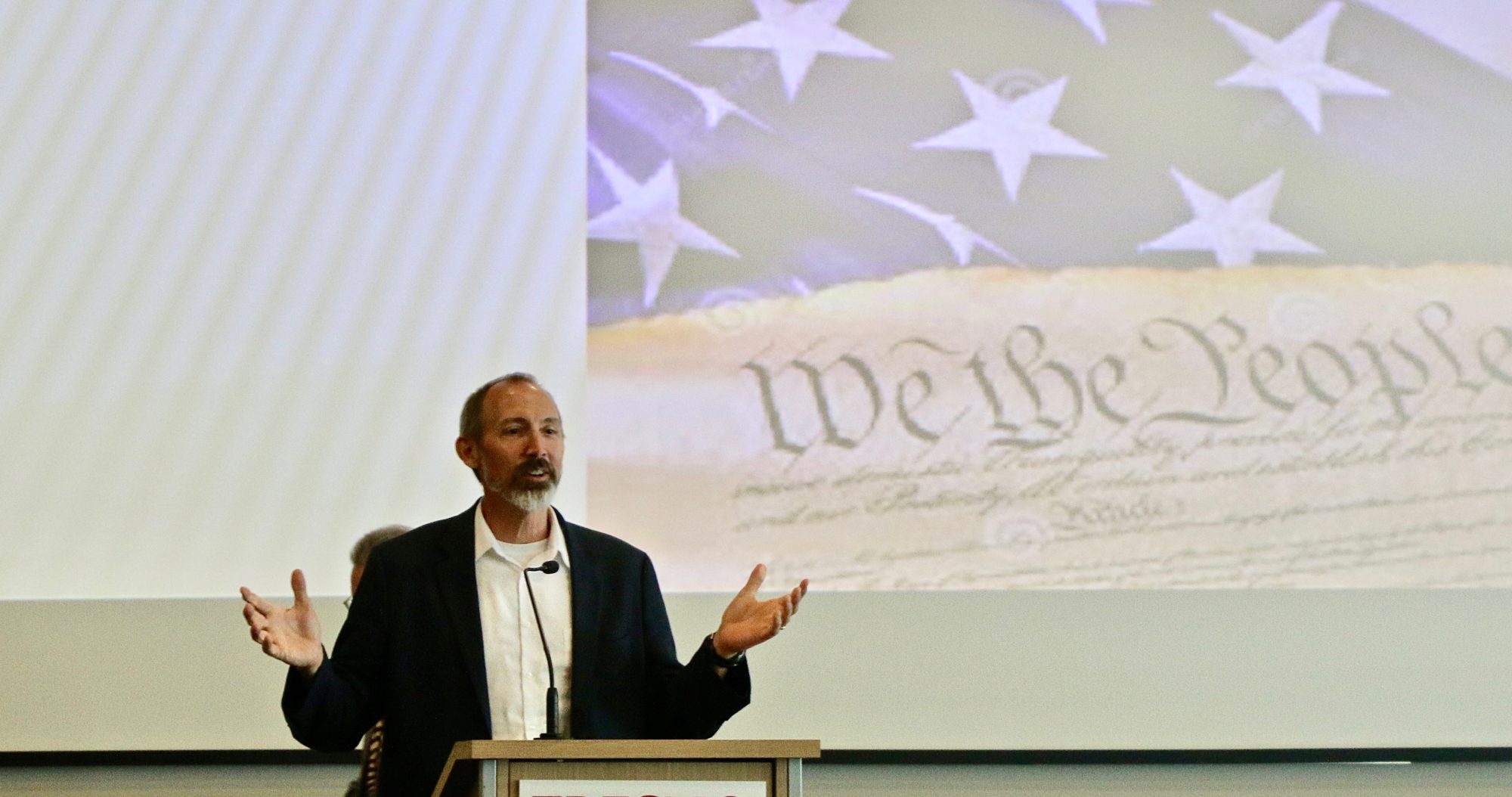


The American Constitution wisely limits the law in ways that prevent authoritarianism. These limits are reflected in the separation of powers, and in the fundamental rights and liberties set forth in the First Amendment and other Constitutional amendments. The First Amendment protects freedom of religion, freedom of speech, and of the press, as well as the right to assemble and petition the government.
These rights are increasingly at risk. A federal judge, William G. Young, argued in a recent ruling that the Trump Administration is engaged in a “full-throated assault on the First Amendment.” The case involved the question of whether the government can deport noncitizens for exercising their right to freedom of speech. The result of the Administration’s efforts, according to the judge, has been to “chill” the exercise of basic rights.
Adding to this chilling effect are Trumpian lawsuits against newspapers and the threat that broadcasters could lose their licenses if they cross the President. The President even suggested that it is “illegal” for reporters to write negative stories.
This week, when the President suggested using American cities as “training grounds” for American troops, he warned military leaders of an “invasion” by “the enemy from within.” He also attacked the press as “sleazebags” and “really corrupt.” Trump has often referred to the press “the enemy of the people.”
In this chilly environment it might seem wise to keep your mouth shut. But if we remain silent, the chill will deepen. Now is the time to speak up in defense of the Constitution and our basic rights.
One important part of this task is to recall that the liberties we enjoy today were not always ours. The background condition for understanding American liberty is the bad old world of medieval authoritarianism, when heretics were burned, books were banned, and freethinkers were censored.
As we all learned in school (or should have), the American colonists often came here to escape persecution in the old world. But there was also censorship and persecution in the new world. Benjamin Franklin’s brother, James, was jailed in 1722 by authorities in Massachusetts for publishing a controversial newspaper. While his brother was in jail, Benjamin took over, publishing the following famous remark, “Without freedom of thought, there can be no such thing as wisdom; and no such thing as public liberty, without freedom of speech.”
This point is a common one made by modern philosophers, who assert that liberty is needed for progress and enlightenment. John Stuart Mill said that attempts to limit freedom of speech and of the press are “noxious” and “illegitimate.” The attempt to silence people ends up “robbing the human race” of the opportunity to argue and think.
Even after the Constitution was ratified Americans struggled with the temptation to censor. The Alien and Sedition Acts of the 1790’s punished those who questioned the government. One congressman, Matthew Lyon, of Vermont, was jailed for criticizing President John Adams in a newspaper he printed. Lyon had said that President Adams had “an unbounded thirst for ridiculous pomp.”
During this time, Thomas Jefferson worried that his mail would be intercepted and his political ideas would be punished. He said in a letter, “the circumstances of the times are against my writing fully & freely.” He added, “I know not which mortifies me most, that I should fear to write what I think, or my country bear such a state of things.”
The chilling effect of censorship makes us think twice about expressing our opinions, thus undermining our liberty and stifling debate. If someone with Jefferson’s stature was afraid to write candidly in a private letter, ordinary people will likely also fear to express themselves freely.
History shows that bad ideas do not last forever. James Franklin was released from jail. Benjamin Franklin went on to play a vital role in the Revolution. Matthew Lyon was re-elected to Congress while imprisoned. After John Adams was voted out, his Federalist party eventually disappeared. The Sedition Act expired when Thomas Jefferson took office.
Progress can and does happen. Bad laws can be repealed. Bad leaders can be voted out. And wisdom can replace stupidity. But this can only happen if we are free to express ourselves.
Read more: https://www.fresnobee.com/opinion/readers-opinion/article312355327.html