Interfaith Understanding, Peace, and Justice

Fear and prejudice breed ignorance about religion

Fresno Bee, April 9, 2016

  • Ignorance about religion is a problem
  • Fresno’s 19th annual Interfaith Scholar Weekend attempts to bridge gaps
  • Peace and justice result from education, dialogue and interreligious education

Education about religion leads to peace and justice. But religion education is not easy. Fear and prejudice get in the way. We are afraid to examine our own assumptions. And we are often ignorant about religion.

Stephen Prothero spoke about religious ignorance last month at Fresno’s Town Hall Lecture Series. Prothero is a religion scholar from Boston University who is the author of a widely used “religious literacy” test and a book explaining the need for education about religion.

We know very little about religion, including our own religions. Prothero explains, “Nearly two-thirds of Americans believe that the Bible holds the answers to all or most of life’s basic questions, yet only half of American adults can name even one of the four gospels, and most Americans cannot name the first book of the Bible.”

d601cc7fdde819c4f5c5fa91f7bb25b0Prothero inspires us to learn more about religion. This weekend, there is an opportunity to do so. Fresno’s annual Interfaith Scholar Weekend features a famous religion scholar speaking at a Sikh gurdwara in Selma on Friday night, a Jewish synagogue in Fresno on Saturday and the Unitarian Universalist Church in Clovis on Sunday.

Jim Grant, chair of the Interfaith Scholar Weekend committee, described the event as a chance to explore religious meaning by “joining with diverse others in diverse settings.” Grant said that there is something amazing about “being exposed to experiences that are foreign but which resonate with our spiritual yearnings.”

Grant suggested that we all have a common spiritual yearning. Human beings look for meaning and purpose. We value community, love, peace and justice. And we benefit from education.

Grant also is director of the Social Justice Ministry for the Roman Catholic Diocese of Fresno. He pointed out that interreligious dialogue and education about religion are dear to the heart of the Catholic tradition. He explained that Pope Francis began 2016 with a prayer that “sincere dialogue among men and women of different faiths may produce the fruits of peace and justice.”

The Interfaith Scholar Weekend has existed since 1998. The weekend typically involves Jewish, Muslim or Christian scholarship and communities. This year is the first time Sikhism has been featured. Grant noted the growing importance of the Sikh religion in the Central Valley. He expressed thanks for the enthusiastic support of the local Sikh community.

This year’s invited scholar is Professor Nikky-Guninder Kaur Singh from Colby College. Singh is the author of an important and accessible introduction to Sikhism. She explains that Sikh monotheism focuses on the oneness of God, which encompasses everything, including diverse religious traditions. She writes: “Everybody is welcome to perceive that One in their own way.” She explains that this has the potential to end conflicts over our interpretations of God.

This vision of oneness is inspiring, as is the pope’s idea that interreligious dialogue may produce peace and justice. When we listen to one another, we avoid violence and condemnation. When we open our minds to inquiry, we realize how little we know and how much there is to learn. Through listening and learning, we forge friendships that transcend our differences and discover all that we share in common.

PEOPLE UNDERSTAND VERY LITTLE ABOUT THEIR OWN RELIGIOUS TRADITIONS. WE KNOW EVEN LESS ABOUT OTHER PEOPLE’S BELIEFS.

But we often fail to engage in sincere dialogue. Perhaps we are afraid. Perhaps we are too busy. Perhaps we just don’t care. Or perhaps we have grown accustomed to a culture in which insults pass for arguments and ignorance is viewed as a virtue.

Whatever the reason, the result is disheartening. People understand very little about their own religious traditions. We know even less about other people’s beliefs. We are also often ignorant about the First Amendment and the importance of religious liberty in a pluralistic democracy.

The Sikh scriptures begin with the assertion of one God and one truth, which is beyond fear and hatred. The Catholic pope urges us to talk to one another about our religious differences in order to produce peace and justice. And here in Fresno, a growing interfaith community is actively engaging in the kind of inquiry that is needed to cure hate, prevent prejudice, overcome ignorance and build a better world.

Religious Liberty in the American Political Campaigns

Fresno Bee, March 13, 2016

  • Religious liberty is a key value for all Americans
  • Data on religious affiliations point toward the need for secularism
  • As presidential candidates use religious rhetoric, it’s important to keep sight of core American value

Many Americans want a president of their own religious persuasion. The Pew Center reportsthat 41 percent of Democrats and 64 percent of Republicans say it is “important for a president to share their religious beliefs.” Given this demand for confessional conformity, it’s no wonder that politicians weave religious language into their campaign rhetoric.US NEWS CAMPAIGN-EVANGELICALS 2 LA

Nor is it any wonder that our political parties are sorted by religion. Republicans tend to be openly evangelical. Democrats tend to be more ecumenical.

Bernie Sanders provided a good example of Democrat inclusivism in the debate Sunday in Flint, Michigan. In response to the God question, Sanders said, “when we talk about God whether it is Christianity, or Judaism, or Islam, or Buddhism, what we are talking about is what all religions hold dear.” Hillary Clinton said she prays regularly. She explained, “I pray for the will of God to be known that we can know it and to the best of our limited ability, try to follow it and fulfill it.”

Republican evangelism is more forceful. Ted Cruz once said, “Any president who doesn’t begin every day on his knees isn’t fit to be commander in chief of this country.” Ben Carson went further, suggesting that a Muslim could not be president.

Perhaps the only one who breaks the mold is Donald Trump, who seems to lack the religious literacy of most Republicans and the religious sensitivity of most Democrats. But Trump still talks religion. He has suggested, for example, that Obama feels more comfortable in a mosque than in a Christian church.

All of this religious talk may come as a surprise to those who think that the U.S. is a secular country. In a more secular country, politicians would avoid speaking of religion. French secularism seems to point in that direction.

But in the U.S., religion remains important. Many Americans don’t like atheism, for example. According to the Pew Center, more Americans are willing to support a Muslim than an atheist for president. A sign of American anti-atheism is that there is only one representative in Congress who is not religiously “affiliated.” There are 2 Muslims, 2 Buddhists, 1 Hindu, 1 Unitarian and 28 Jews. The rest are Christians of various sorts.

IN A PLURALISTIC DEMOCRACY A CANDIDATE’S RELIGIOUS RHETORIC IS LESS IMPORTANT THAN THE COMMITMENT TO PROTECTING EVERY PERSON’S RIGHT TO RELIGIOUS LIBERTY.

Maybe someday a candidate will refuse to answer the God question on constitutional grounds. Such an unlikely candidate would point out that her religious beliefs are no one’s business but her own. She might add that privacy and freedom are essential for genuine religiosity. She might suggest that political sound bites produce clichés that float on the surface of genuine soulful religious reflection.

Our imagined secular candidate might point out that in a diverse religious society, politicians serve all of the people – not merely some of the people. And she might remind us that partisan religious squabbling further polarizes us.

We continue to play politics according to a script that ignores the fact of our ever-increasing religious diversity. In addition to about 6 percent of Americans who are not Christian, more than 22 percent of the population is not affiliated with any religion.

But it is still difficult to imagine a president who does not routinely say some version of “God bless America” at the end of every speech. Presidents didn’t always use that phrase, of course. Ronald Reagan added it to the standard script for political speeches during the culture wars of the 1980s.

Religious clichés and ritual religious affirmations do not necessarily have any deep religious significance. Politicized discussions of religion often seem to be more about polling than piety. And so despite all of this religious rhetoric, we are quick to question the authenticity of the religious affirmation of candidates we don’t like.

But how would any of us know what transpires in the soul of a stranger? It is hard enough to figure out your own spiritual commitments. Half of Americans change their religious affiliation at least once.

That’s why the Constitution is important. Other people’s religious beliefs are none of our business. Religious liberty includes the freedom to change religions. There is no religious litmus test for office. And in a pluralistic democracy a candidate’s religious rhetoric is less important than the commitment to protecting every person’s right to religious liberty.

Read more here: http://www.fresnobee.com/living/liv-columns-blogs/andrew-fiala/article65550027.html#storylink=cpy

Religious Pluralism

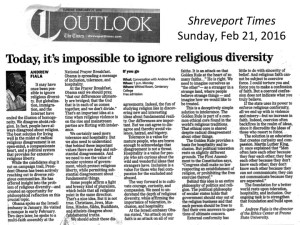
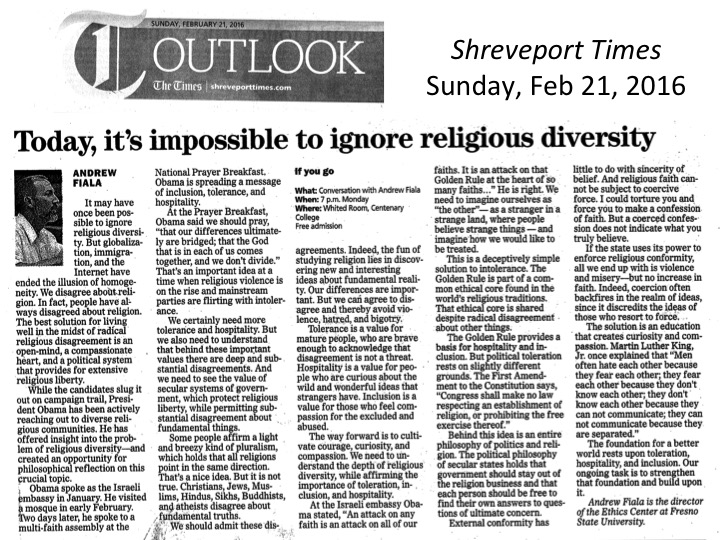
Today, It’s Impossible to Ignore Religious Diversity

Shreveport Times, Sunday Feb. 21, 2016

It may have once been possible to ignore religious diversity. But globalization, immigration, and the Internet have ended the illusion of homogeneity. We disagree about religion. In fact, people have always disagreed about religion. The best solution for living well in the midst of radical religious disagreement is an open-mind, a compassionate heart, and a political system that provides for extensive religious liberty.

FialaShreveOpEdWhile the candidates slug it out on campaign trail, President Obama has been actively reaching out to diverse religious communities. He has offered insight into the problem of religious diversity—and created an opportunity for philosophical reflection on this crucial topic.

Obama spoke as the Israeli embassy in January. He visited a mosque in early February. Two days later, he spoke to a multi-faith assembly at the National Prayer Breakfast. Obama is spreading a message of inclusion, tolerance, and hospitality.

At the Prayer Breakfast, Obama said we should pray, “that our differences ultimately are bridged; that the God that is in each of us comes together, and we don’t divide.” That’s an important idea at a time when religious violence is on the rise and mainstream parties are flirting with intolerance.

We certainly need more tolerance and hospitality. But we also need to understand that behind these important values there are deep and substantial disagreements. And we need to see the value of secular systems of government, which protect religious liberty, while permitting substantial disagreement about fundamental things.

Some people affirm a light and breezy kind of pluralism, which holds that all religions point in the same direction. That’s a nice idea. But it is not true. Christians, Jews, Muslims, Hindus, Sikhs, Buddhists, and atheists disagree about fundamental truths.

We should admit these disagreements. Indeed, the fun of studying religion lies in discovering new and interesting ideas about fundamental reality. Our differences are important. But we can agree to disagree and thereby avoid violence, hatred, and bigotry.

Tolerance is a value for mature people, who are brave enough to acknowledge that disagreement is not a threat. Hospitality is a value for people who are curious about the wild and wonderful ideas that strangers have. Inclusion is a value for those who feel compassion for the excluded and abused.

The way forward is to cultivate courage, curiosity, and compassion. We need to understand the depth of religious diversity, while affirming the importance of toleration, inclusion, and hospitality.

At the Israeli embassy Obama stated, “An attack on any faith is an attack on all of our faiths.  It is an attack on that Golden Rule at the heart of so many faiths…” He is right. We need to imagine ourselves as “the other”—as a stranger in a strange land, where people believe strange things—and imagine how we would like to be treated.

This is a deceptively simple solution to intolerance. The Golden Rule is part of a common ethical core found in the world’s religious traditions. That ethical core is shared despite radical disagreement about other things.

The Golden Rule provides a basis for hospitality and inclusion. But political toleration rests on slightly different grounds. The First Amendment to the Constitution says, “Congress shall make no law respecting an establishment of religion, or prohibiting the free exercise thereof.”

Behind this idea is an entire philosophy of politics and religion. The political philosophy of secular states holds that government should stay out of the religion business and that each person should be free to find their own answers to questions of ultimate concern. Related to this is a conception of religion, which holds that religion is something private and internal to persons.

External conformity has little to do with sincerity of belief. And religious faith cannot be subject to coercive force. I could torture you and force you to make a confession of faith. But a coerced confession does not indicate what you truly believe.

If the state uses its power to enforce religious conformity, all we end up with is violence and misery—but no increase in faith. Indeed, coercion often backfires in the realm of ideas, since it discredits the ideas of those who resort to force.

At the National Prayer Breakfast Obama pointed out that “fear does funny things.” Fear, he said, can lead us to lash out against people who are different. And it can erode the bonds of community. When we are fearful we resort to coercion. We want to destroy the thing we fear and we learn to hate.

The solution is an education that creates curiosity and compassion. Martin Luther King, Jr. once explained that “Men often hate each other because they fear each other; they fear each other because they don’t know each other; they don’t know each other because they can not communicate; they can not communicate because they are separated.”

King is right. The more you know, the less you hate. The foundation for a better world rests upon toleration, hospitality, and inclusion. Our ongoing task is to strengthen that foundation and build upon it—in our schools and institutions, and in our hearts and minds.


Peace and Love at Christmas

Embrace the Deeper Meaning of Christmas

Fresno Bee, December 12, 2014

The state of Texas recently passed a law making it legal to say “Merry Christmas” in schools. The law grows out of a misguided worry that secular schools should not even mention Christmas. Some even fear that there is a secular war against Christmas.

Peace, Love, Joy, Christmas

The Reverend Franklin Graham, for example, recently wrote: “The war on Christmas is a war on Christ and His followers. It’s the hatred of our culture for the exclusive claims that Christ made.” This dispute is not surprising given the history of religious conflict and ongoing divisions in our diverse culture.

It might help to recall that disputes about Christmas have a deep history. There is no consensus about Christmas, even among Christians. Eastern traditions celebrate Christmas on January 6. The manger scenes we see around Christmas take liberties with the story. Jesus was most likely born in a cave, not in a stable. The animals are also a later addition, not found in the Bible. The Gospels themselves contain different stories.

This is not surprising for people who study religion. Religions and religious stories evolve over time. This helps us gain some perspective on the so-called war on Christmas. Christmas and Christianity itself has never been just one thing.

But the point of Christmas, it seems to me, is to find a way to look beyond our disputes. We celebrate peace, love, hope and joy during the Christmas season. It would be great to focus on those shared valued and leave the divisiveness for the rest of the year.

In our diverse world, not everyone accepts the exclusive theology behind Mr. Graham’s interpretation of Christmas. But we can all benefit from peace and love, joy and hope. Indeed, it is those values that allow us to coexist despite our deep theological differences.

You don’t need to take the nativity story literally to understand values celebrated at Christmas. We can all understand the dramatic moment when Mary and Joseph are turned away from the inn. You don’t have to be a Christian to understand that this story shows us the need for hospitality and that giving birth is momentous joyous and mysterious.

In some sense, Christmas has already become a secular holiday. It is a regular part of our yearly round of holiday closures and vacation scheduling. We all know that “winter break” coincides with Christmas. Charles Haynes, a scholar at the First Amendment Center, made this point in a recent essay discussing the difficulty of managing religious holidays in our multi-religious culture. His solution is to be equitable, hospitable and respectful of our differences.

I corresponded with Mr. Haynes about this. He pointed out that schools should be free to teach about Christmas, while also teaching about other holidays in an academic fashion. Such teaching might include historic debates over the meaning of Christmas among Christians themselves. The colonial Puritans, for example, banned Christmas because they viewed its pagan elements as un-Christian.

While Christmas is inextricably linked to a celebration of the birth of Christ, the holiday is much more than that — it includes Santa and his reindeer, jingle bells and evergreen trees. These later additions have no connection to the Bible story. Christmas has evolved to be a secular — and universally accessible — celebration of joy, peace, love and hope.

The First Amendment guarantees that conservative Christians like Mr. Graham have a right to point out that Christmas originates in stories about the birth of Christ. Atheists also have a right to argue against Christmas and Christianity, if they like. But the Christmas spirit is more inclusive and welcoming than any exclusive religious or anti-religious diatribe. The values of Christmas encourage us to be warmer, gentler, kinder and more friendly. Inclusivity, hospitality, peace and love are important values for all of us.

The deep and universal message of Christmas is the hope that in an inhospitable world, we might find a peace, love and refuge. You don’t have to be a Christian to understand that. Christians layer theology onto the nativity scene, directing hope beyond this world. But the magic of Christmas is found here on earth in the joyous love of mothers and in the peaceful and hopeful faces of children, who have not yet been hardened by the world and its divisions.

Religious Freedom

Fiala on ethics: Religious freedom ideal is heart of democracy

By Andrew Fiala, Fresno Bee April 20, 2013

“Congress shall make no law respecting an establishment of religion, or prohibiting the free exercise thereof.” The first 16 words of the First Amendment represent the heart of our democratic system, according to Charles Haynes, a senior scholar from the First Amendment Center in Washington, D.C.

Haynes gave a workshop on civic education and religious liberty at Fresno State on April 13, which happens to be Thomas Jefferson’s birthday. Haynes argued that the First Amendment represents a progressive step in world history. In other parts of the world, people kill each other over religious differences. Here, the worst that happens is that people go to court.

No system of government is perfect. But the First Amendment idea is a useful innovation. Unfortunately, not everyone agrees.

According to a poll by the Huffington Post conducted in early April, one-third of adults favor establishing Christianity as the official state religion in their own state. Thirty-two percent said they would favor a constitutional amendment making Christianity the official religion of the U.S.

In North Carolina this month, state legislators introduced a resolution stating that the Constitution does not prohibit the state of North Carolina from establishing a state religion. These legislators read the First Amendment as a narrow restriction on the federal government, which does not apply to state governments. Apparently they ignore the Fourteenth Amendment and legal precedents that extend basic rights to the states.

Thomas Jefferson may be turning in his grave. When he died, Jefferson wanted to be remembered for three of his most important projects: the Declaration of Independence, the University of Virginia and the Virginia Statute for Religious Freedom.

In the Virginia Statute, Jefferson explained that God created human beings with free minds and that He does not use coercion to force us to believe. Jefferson also noted that political and religious leaders are fallible and uninspired men. For those reasons, religious belief should not be enforced, restrained, burdened or molested.

Moreover, Jefferson held “that truth is great and will prevail if left to herself.” He adopted that idea from the philosopher John Locke, who had argued that “the truth certainly would do well enough if she were once left to shift for herself.”

Not everyone is content to leave the truth alone to fend for herself. Some continue to think that religious truth needs to be propped up and defended by political power, by hierarchical institutions and by coercive laws.

Those who think that religious belief needs legal supports may be worried that humanity is easily corrupted. Some may fear that if religious truth were not backed up by state power, irreligion would triumph. Wouldn’t people ignore religion, if the law were indifferent to religion?

But if religious beliefs can only prevail when bolstered by coercive legal institutions, this may show us something lacking in those beliefs. It would be odd to say that we need the state to enforce ideas about gravity or mathematics. Those ideas can indeed defend themselves in a free and open marketplace of ideas.

But what about religious ideas? Jefferson thought that true beliefs would prevail in an open forum. It may be that only weak or false beliefs need to be defended by political compulsion.

The authors of the First Amendment were not directly concerned with setting up a marketplace of ideas. Rather, they wanted to prevent domination by one religion over others. As James Madison wondered, “Who does not see that the same authority, which can establish Christianity, in exclusion of all other Religions, may establish with the same ease any particular sect of Christians, in exclusion of all other Sects?”

Those who want to establish a state religion ignore the ugly history of religious violence that ensues when diverse religions vie for political power. The solution is to prevent any religion from obtaining political power.

As a birthday gift to Thomas Jefferson, we might reflect on the importance of the ideal of religious liberty. We might also reflect on the connection between religious freedom and Jefferson’s beloved University of Virginia.

For truth to prevail, people need to be properly educated about the history of religious violence, about political philosophy and about the progressive import of those sixteen monumental words.