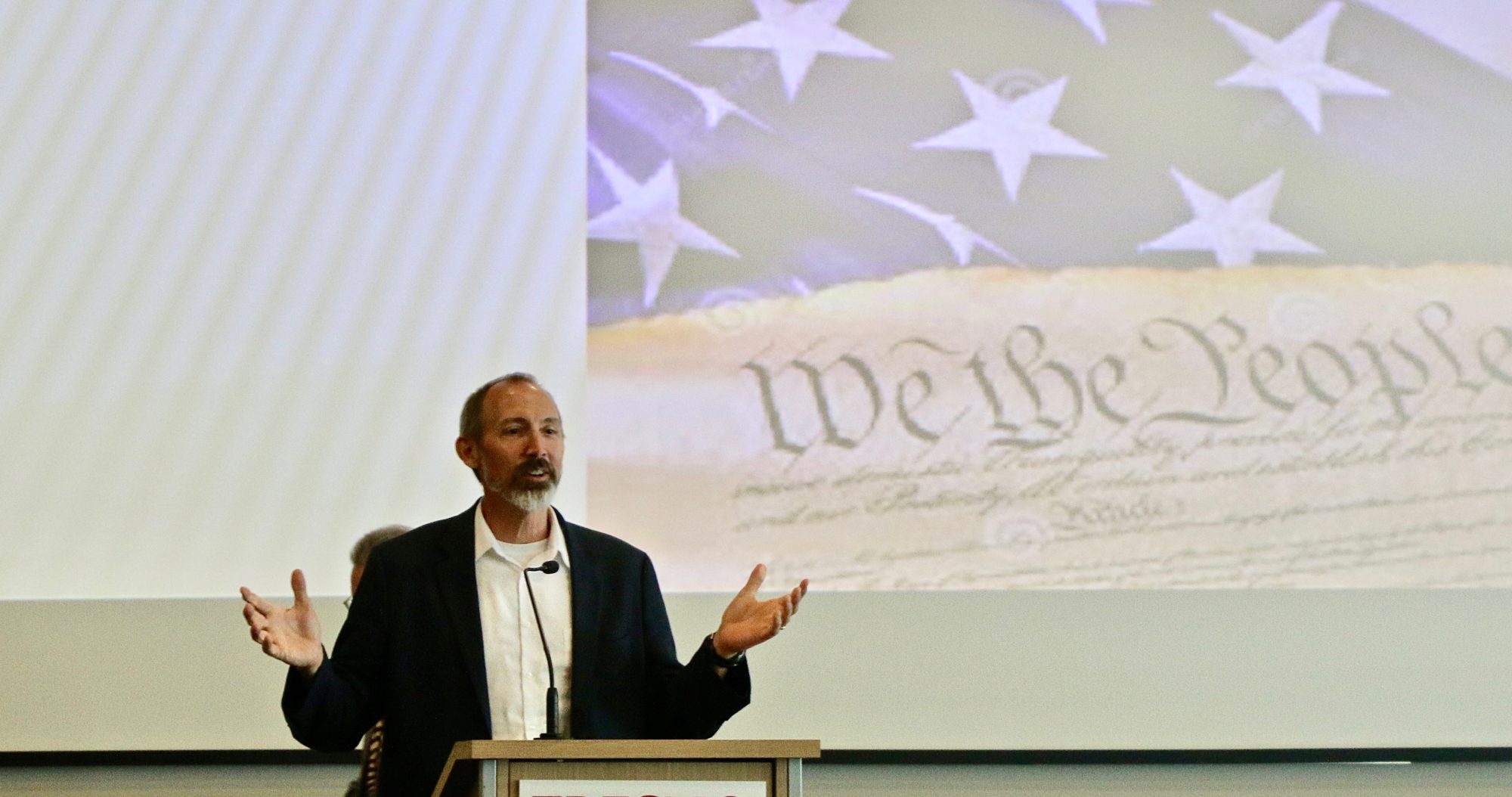
Good Citizenship Takes Commitment

Citizenship and The Constitution

Fresno Bee, September 4, 2015


No one is born a citizen. Our Constitution allows so-called “birthright citizenship.” But no one is born understanding the Constitution. Real citizenship requires active commitment to the values of the community.

That’s why civic education is important. Some states have instituted mandatory civics test, requiring high school students to score 60% on the U.S. Citizenship test, the same score required for immigrants to qualify for U.S. citizenship.

In California, State Superintendent of Schools Tom Torlakson and Chief Justice of the California Supreme Court Tani Cantil-Sakauye are leading a new civic education initiative. The chief justice explains, “The strength of our democratic institutions relies on the public’s understanding of those institutions.” Civic Education Partnerships have been created in six counties, including Fresno.

Of course, knowledge about the Constitution is not sufficient. Citizenship is deeper than factual knowledge. It includes a set of values and active commitments. Can those values and commitments be created by education?

I talked about this with John Minkler, a retired educator who is one of the leaders in Fresno County’s Civic Education Partnership. Minkler’s passion for civics is evident from a bumper sticker on his car that reads, “E Pluribus Unum.” Minkler points out that we carry this motto in our pockets every day. Take a look at your coins. They proclaim, E Pluribus Unum – “out of many, one.”

This is the basic idea behind the social contract: we join together to form a community. Individuals reap benefits from belonging to the community. We also have obligations to participate in the life of the community.

Minkler worries, however, that the social contract has eroded. One problem is materialistic individualism. We are often more focused on self-interest than the common good. A related problem is an educational system that focuses on test results and obedience rather than engaged citizenship.

Many have become disillusioned with political life. Young people are especially cynical. Studies show that millennials are less politically aware and committed than older adults. They vote less and don’t trust the political system.

Critical scrutiny of our system is wise. Democratic government requires vigilant citizens. But cynical disengagement is self-defeating. If you believe you can’t change things, then you will not work to change them. And then – lo and behold – things don’t change!

Minkler explains that citizenship develops from involvement in the community, which teaches that individual commitment matters. Minkler has long been an advocate of service-learning. He says that service-learning helps disengaged kids develop the spark of citizenship, as they discover that their effort and commitment actually matters.

Teachers and schools already have a difficult task of developing college- and career-ready graduates. Creating good citizens is yet another difficult task. We can’t expect the schools to do this alone. That’s why the idea of a Civic Education Partnership is important. In Fresno County, the Civic Education Partnership includes educational leaders, business and community leaders, as well as members of the legal profession.

To support this effort, the Ethics Center at Fresno State is co-sponsoring a Constitution Day event at Fresno State on Sept. 17. In case you forgot, Sept. 17 is the anniversary of the signing of the Constitution. Around the country, that day is celebrated as Constitution and Citizenship Day.

The event at Fresno State will focus on the question of how civic education connects youths to our constitutional system. Speakers will include former Assemblyman Juan Arambula, Fresno City Council Member Esmeralda Soria, Lorenzo Rios, CEO of Clovis Veterans Memorial District, Justice Rosendo Peña, Jr. from the California Fifth District Court of Appeal, Deborah Nankivell, CEO of the Fresno Business Council, and Minkler.

Citizenship involves understanding the Constitution and the basic principles of democratic government. It also requires commitment and engagement. Communities are not abstract ideas created on paper documents. They are living entities in which diverse individuals work together within a framework of common values. No community is perfect. But communities are improved when citizens understand their rights and responsibilities, and when individuals actively participate in the shared life of “we, the people.”

Read more here: http://www.fresnobee.com/living/article34140597.html#storylink=cpy

A Philosopher’s Back To School Advice

Advice for making the most out of school

Fresno Bee, August 21, 2015

  • Back-to-school is a time to reflect on education
  • Philosophical advice to students emphasizes curiosity, courage and compassion
  • Education requires effort, virtue and a passion for wisdom and justice


To my sons and my students, as we head off to school, here’s a philosopher’s perspective on education.

No one can learn on your behalf. Learning is an activity. It requires effort. You must actively seek the light.

Intelligence, virtue, and happiness are not genetic. No one is born smart, kind, or happy. Everyone has the potential to improve – or to fail. But improvement is up to you. Be systematic in your studies. Cultivate a disciplined work ethic. And nurture your passion for learning.

Develop curiosity, courage, and compassion. Curiosity opens the door to new ideas. Courage follows those ideas. Compassion allows you to understand why others choose differently.

Education is supposed to be difficult. It is easy to fill your cup with trivial knowledge. But opening your mind to the ocean of wisdom is a lifelong task.

Listen carefully and question everything, including your need for certainty. Don’t believe everything you read or hear. Test dogma and inquire into common sense. Distrust those who want blind obedience. Ignore those who offer cheap grace and easy enlightenment.

Challenge authority; but remember that rebellion and doubt are tools, not destinations. Cynics are unhappy and friendless. Healthy skepticism is modest. It must be balanced with a sustained commitment to what is true and good.

Find mentors – teachers, coaches, and friends – who inspire you. The best teachers and coaches encourage without indoctrinating. They increase vitality by arousing our thirst for excellence.

Teachers are not entertainers or playmates. They criticize and evaluate. It’s not easy to receive criticism. But criticism helps us improve. Learn from your failures and work harder next time.

Be proud of your accomplishments. But don’t rest on your laurels. Celebrate what you’ve achieved today. Tomorrow there will be new challenges.

Cheer for other people’s success. Friendly competition invigorates. It makes everyone better.

Choose your friends wisely. Find friends who are smarter and more virtuous than you are. Good friends energize and uplift. They support your best efforts and console you when you fail.

Bad friends undermine you and reinforce bad habits. Avoid them. But be gentle with bad people. Some are wicked. But most are misguided and unhappy. Be prudent about social relations. But never lose faith in humanity.

Avoid gossip, rudeness, and disrespect. Be careful and courteous when asserting your own opinions. Think before you speak. But always say what’s on your mind. Avoid know-it-alls; and don’t become one. Remember: no one – not even you – can possibly know it all.

There are no shortcuts for learning to live well. Cheats and liars occasionally succeed. But they cannot succeed forever, since they lack what they pretend to have.

There are no “do-overs” in life. Misdeeds can never be undone. Happiness depends on knowing that that you deserve to be happy. A clear conscience is a necessary condition for a happy life.

Of course you will make mistakes. We all do. Forgive others and forgive yourself. But hold yourself to a higher standard. You are, after all, in control of your own life.

You are not, however, in control other people’s behavior. Help when called upon. But allow others to live as they see fit.

You will be homesick at times. Nothing good lasts forever. You will eventually say good-bye to everyone you love. Grief is a part of life. It is relieved by doing good works, making new friends, and rebuilding what is lost.

Find a cause worthy of your loyalty and stick with. A meaningful life is thick with loyalties and commitments.

Fight against injustice. But avoid rage, which burns without building. Justice also requires kindness, patience, and a creative imagination.

Educational institutions can alienate and frustrate. Bureaucratic authority is often ridiculous. But you are a person, not a number. Don’t become a cog. Demand respect and give it to others.

Life is more important than school. Don’t neglect your health. Exercise and eat well. Make time for love, leisure, and laughter. Create spaces of solitude and seek out spiritual experience.

And remember that education is a privilege. Some people don’t have the chance to go to school. Show gratitude for this opportunity by filling your cup, opening your mind, and creating a good life. And share what you’ve learned with others who are seeking the light.

Read more here: http://www.fresnobee.com/living/religion/article31837581.html#storylink=cpy


Education and Democratic Citizenship

Education should encourage us to ask critical question

August 23, 2013

Teachers and students return to school anticipating the discovery of new ideas and the creation of new relationships. Empty gradebooks and notebooks promise transformation. But what should we hope for, as we send our kids back to school?

I heard at least one speech this week that emphasized that education is a way to make money. We celebrate the cash value of staying in school and going on to college. But emphasizing the money is a fairly superficial way to sell school to kids and their parents.

The focus on money ignores a key lesson of a good education, which is that money is not the most important thing in life. Sure, some money is needed for a decent life. But a good education should encourage us to ask critical questions about what we value. How much money is enough? How should resources be distributed? What’s an honorable way to make a living? And what’s the value of a culture that worships the almighty dollar?

Another idea about the value of education focuses on teaching kids to use tools and master the basic skills of reading, writing and arithmetic. Mastery of those skills is essential for people who live in a culture that requires basic literacy and numeracy. Computer technology skills are also becoming essential for life in our culture.

But it’s not enough to teach kids how to use tools. We also have to encourage them to think about what those tools should be used for. Ethical tool use begins with understanding the difference between the tool and its uses. A hammer can build. But it can also destroy. Words and ideas can uplift and empower. But they can also fuel violence and hate.

Our culture is often confused about tools. We fetishize our tools, imbuing them with mysterious power, allowing them to control us and the way we think. The emphasis on computers and online technology is a sign of this problem. Technology is not a panacea. It can be misused and backfire. Reading on computer screens is often more superficial than reading on the printed page. Computers make it easier to cheat and plagiarize. And electronic communication often lacks the depth and care of face-to-face conversations.

A good education helps us sort out the difference between those things that have value in themselves (love, beauty, truth, other people, etc.) and those things that do not (money, tools, computers, etc.). A good education helps us understand the relative value of different technologies and methods of communication. A good education empowers us to use these technologies for appropriate ends.

This process of understanding, assessing and prioritizing values is centrally important for citizens in a democracy. Democratic government is another tool that must be judiciously employed. Democracy can be abused by unscrupulous politicians who take advantage of a gullible citizenry. Democracy becomes dangerous when citizens are unethical and uncritical.

Human beings are not born knowing how to govern themselves. We are dependent for much of our childhoods. Our passions and instincts often rule over us, leaving us unable to properly govern ourselves. We are easily seduced and distracted. It takes long practice to learn how to pay attention, get your work done and do the right thing. A good education teaches us how to free our minds and control our behaviors so that we might govern ourselves.

Democratic citizens must learn to question authority, evaluate conventional wisdom, discuss values and deliberate about ideas. Citizens need to understand their rights. They also need to develop the wisdom and virtue so that they might exercise their rights responsibly.

Human beings are not born understanding ethics or politics. Most children do have an innate capacity for truth-telling, compassion and love. But children can also be selfish, close-minded and mean. They can bully others and show undue respect for authority and power. Ethical judgment and democratic values must be taught.

Every fall we entrust our educators with the awesome job of cultivating the next generation. I wish them luck on this difficult and crucial task. We hope that our kids end up with fruitful careers and that they learn to read, write and compute. But mostly I hope that they learn to be critical and virtuous democratic citizens.

Read more here: http://www.fresnobee.com/2013/08/23/3458110/education-should-encourage-us.html#storylink=cpy


Dan Brown’s ‘Inferno’ raises ethical questions

Dan Brown’s ‘Inferno’ raises ethical questions, reminds us to appreciate the humanities

June 14, 2013

Would you be willing to destroy half of humanity in order to save the human species from going extinct? Would it be acceptable to involuntarily sterilize people in an effort to prevent overpopulation? Those are the central questions of Dan Brown’s new novel, “Inferno.”

Brown’s novel is fun summer reading that poses troubling ethical questions. It is also a reminder of the value of the humanities. The villains in Brown’s novels are zealots. In “The Da Vinci Code” the bad guys were religious fanatics. In this novel, the villains are mad scientists. The hero is a tweedy humanities professor who loves art and poetry.

While “Inferno” isn’t great literature, it inspires appreciation for art, poetry, philosophy and history. It celebrates the skills learned in the humanities: to learn to read carefully, to think broadly and deeply and to understand the symbols and cultural artifacts that surround us.

Brown’s villains are coldly inhumane: They think population control can be justified by simple mathematics. There are too many people, so something must be done. This idea is rooted in Machiavelli, the Renaissance theorist who warned that teeming population would inevitably be purged. Terrorists are often Machiavellian in thinking that the end justifies the means. Machiavellian idealists treat human beings as things to be manipulated and quantities to be calculated rather than as persons to be valued and loved.

Study in the humanities teaches us to be wary of Machiavellian schemes. Philosophers have long warned that nothing straight can be constructed from the crooked timber of humanity. We are not wise enough or virtuous enough to engineer reality or impose final solutions.

The humanities remind us that uncritical certainty is linked to hubris. Human beings achieve moments of profound insight and sparkling beauty. But these moments do not last forever. Indeed, they are often undone by the zealots and idealists who insist that they know how to save humankind from itself.

Brown’s novel is set in Italy. It celebrates the art of the Renaissance. Great art reminds us of the power of human genius. But history warns us against taking ourselves too seriously. Before the Renaissance, the Greeks and Romans also created luminous works of genius. The cycles repeat. Saviors come and go. Civilizations rise and fall. Each generation is plagued by its own narcissism, thinking that its creative genius is unique and unprecedented.

But historical awareness should make us wary of that sort of narcissism. A sense of history should make us modest in assessing the value of our own ideals. It should also inspire skepticism toward those who propound simple technological solutions to complex human problems.

So what can we do about the population problem? A solution requires something more than science and technology. Purely technical solutions — such as forced sterilization — would work on a population of rodents or insects. But human beings are not pests to be controlled. We inhabit a world of spirit and ideas. We hope, we dream; and we create art, literature and philosophy. We also love.

Brown’s “Inferno” borrows its title from Dante Alighieri’s famous poem about hell. Dante was a romantic whose poetry was inspired by Beatrice, a beautiful woman he loved from afar. Dante recounts that his love for Beatrice kindled a flame of charity that moved him to forgive everyone, including his enemies. Love transforms us, making us ethical and inspiring work of creative genius.

The population problem is driven by sex. Machiavellian technologists may argue that sex should be subjected to mathematical control. But the humane solution is to find a way to transform sex into love — to broaden and sublimate the sex drive in ways made possible by art, literature, religion and philosophy.

People need to be educated and empowered to control their own bodies and reproductive lives. But we also need to be reminded that there is more to life than mating and reproducing.

Technology without humanity can easily become heartless. The study of the humanities cures that sort of spiritual sterility. And it reminds us to beware of zealots offering quick fixes for deeply human problems. The humanities won’t save the world. But they remind us about those works of love, genius and beauty that make humankind worth saving.

Is college becoming mass-produced?

Fiala on ethics: Is college becoming mass-produced?

By Andrew Fiala

Fresno Bee, Friday, May. 17, 2013 | 05:44 PM

Soon enough, everyone will have access to the latest classes coming out of Harvard or Stanford. Massive open online courses, or MOOCs, can provide students around the world with lectures delivered by leading scholars at top universities. The democratic promise of Ivy League education for everyone is enticing.

But there has been some backlash. Last week, professors in the philosophy department at San Jose State wrote an open letter opposing MOOCs. They worry that administrators “are beginning a process of replacing faculty with cheap online education.” No doubt it would be cheaper to use prefabricated mass-produced courses than to hire real professors.

Some critics worry that online education in general is the problem. Face-to-face communication is important in the Internet age. Something mysterious happens in classrooms as students and teachers think together. Face-to-face encounters give students good practice at listening, talking and thinking in community with others. And caring relationships between teachers and students develop best in a face-to-face world.

But computer technology is not all bad. Videotaped lectures, like textbooks, are useful tools for disseminating information. And serious thinking can happen in online discussion forums. Online discussions are especially useful for shy or disabled students.

The bigger problem with MOOCs is the idea that college education is another commodity to be mass-produced. MOOCs are “massive.” A recent New Yorker article reports that a humanities MOOC at Harvard has more than 30,000 “students.” A MOOC on artificial intelligence had 160,000 “students.”

The issue of scale is significant. At some point the “student” becomes an anonymous unit to be processed, a number rather than a person with a name. Mass education treats students as spectators and consumers rather than as participants in a community of inquiry.

Mass-production generally centralizes authority and standardizes its products. But education should focus on cultivating human persons and celebrating their individuality. It should not be a mechanical process of stamping out graduates.

Decades ago, social critics such as Max Horkheimer and Theodor Adorno warned that “the culture industry” would create standardization and monopoly. They worried that centralized production of films, music, literature and art would turn culture into a product to be marketed and sold.

MOOCs represent another step in the mass production of culture. Mass produced culture makes all kinds of stuff easily available. Mass quantities of consumer goods can be purchased at big box stores. We can attend mega-churches and read mass media news stories. And now the sages on stages at the big universities are coming to the masses.

Mass culture is fast and efficient. It requires little effort to fill our minds with the latest stuff. Our tastes, our behaviors, even our thoughts are standardized and homogenized, assisted by search engine algorithms, which help us find what we want from among the available products.

Mostly, we like it that way. Standardized mass culture creates regularity, predictability and comfortable conformity. We can order the same food in the same restaurant chain in any city in America. We can watch the same TV shows or read the same news, while sitting in standardized hotel rooms across the country.

Everyone discusses the same celebrity gossip, reads the same bestselling novels and watches the same blockbuster films. We are all concerned about the same scandals and crises. The more of us there are, the more alike we all become. Massive online education appears as an inevitable part of the cultural matrix.

The downside is the loss of idiosyncratic points of view, local differences and diversity of perspectives. There are no more sages hiding on mountaintops, waiting to deliver wisdom to intrepid explorers. Instead, the sage appears to everyone who can click a mouse.

MOOCs bring those mountaintop gurus down to the people. But the mass production of education carries the risk of destroying the mysterious human connection between teachers and students. The most meaningful moments in education often occur when the sage becomes a caring mentor, asking how things appear from the perspective of the student. Can a MOOC do that?

Mass education can effectively disseminate information. But no Harvard genius can replace a responsive and responsible teacher, who is present on campus and in the community and who cares about students enough to learn their names.