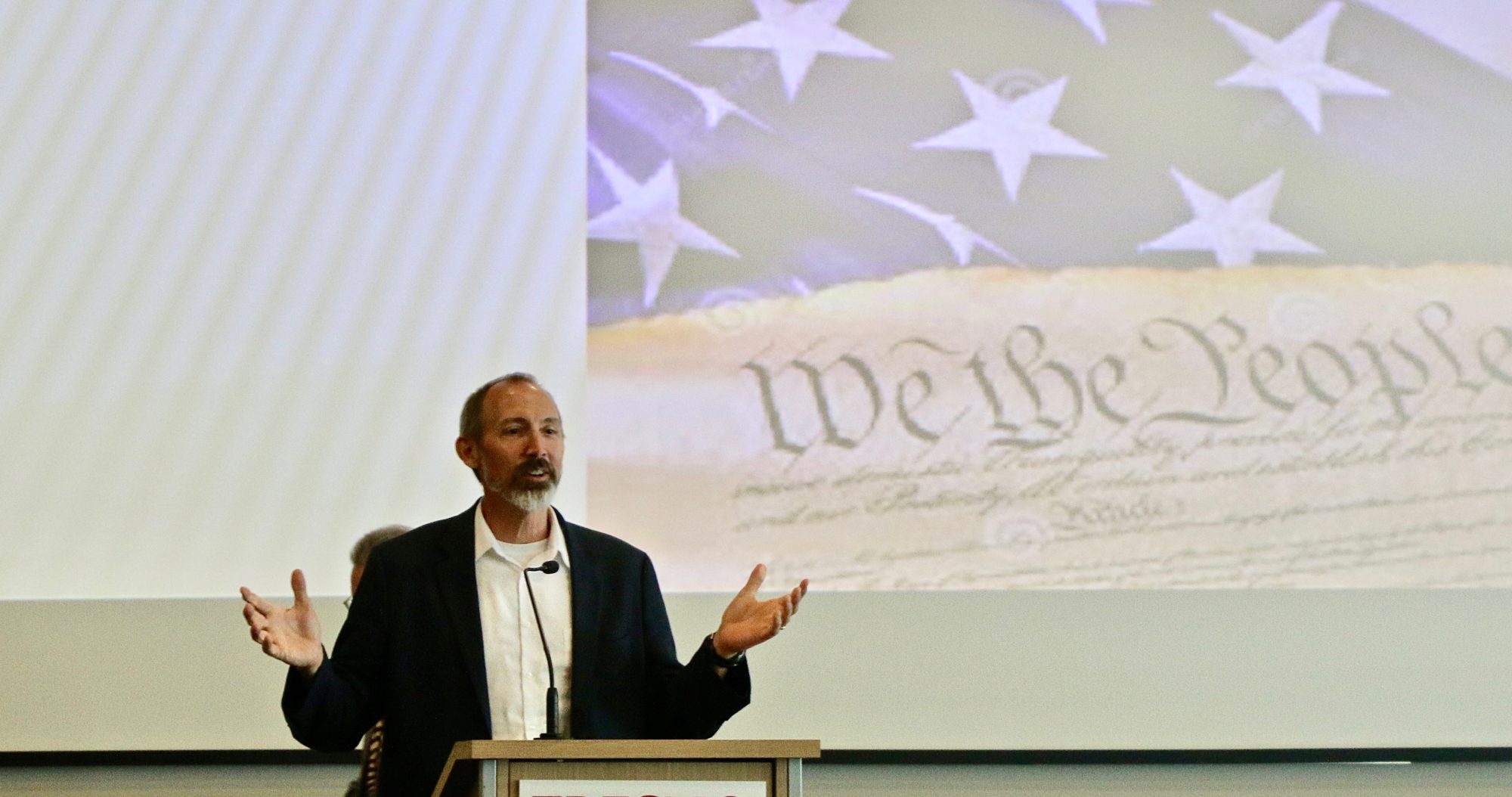
Freedom of Speech and Press

Fresno Bee, Oct 5, 2025

The American Constitution wisely limits the law in ways that prevent authoritarianism.  These limits are reflected in the separation of powers, and in the fundamental rights and liberties set forth in the First Amendment and other Constitutional amendments.  The First Amendment protects freedom of religion, freedom of speech, and of the press, as well as the right to assemble and petition the government.

These rights are increasingly at risk.  A federal judge, William G. Young, argued in a recent ruling that the Trump Administration is engaged in a “full-throated assault on the First Amendment.”  The case involved the question of whether the government can deport noncitizens for exercising their right to freedom of speech.  The result of the Administration’s efforts, according to the judge, has been to “chill” the exercise of basic rights. 

Adding to this chilling effect are Trumpian lawsuits against newspapers and the threat that broadcasters could lose their licenses if they cross the President.  The President even suggested that it is “illegal” for reporters to write negative stories. 

This week, when the President suggested using American cities as “training grounds” for American troops, he warned military leaders of an “invasion” by “the enemy from within.”  He also attacked the press as “sleazebags” and “really corrupt.”  Trump has often referred to the press “the enemy of the people.”

  In this chilly environment it might seem wise to keep your mouth shut.  But if we remain silent, the chill will deepen.  Now is the time to speak up in defense of the Constitution and our basic rights.

One important part of this task is to recall that the liberties we enjoy today were not always ours.  The background condition for understanding American liberty is the bad old world of medieval authoritarianism, when heretics were burned, books were banned, and freethinkers were censored. 

As we all learned in school (or should have), the American colonists often came here to escape persecution in the old world.  But there was also censorship and persecution in the new world.  Benjamin Franklin’s brother, James, was jailed in 1722 by authorities in Massachusetts for publishing a controversial newspaper.  While his brother was in jail, Benjamin took over, publishing the following famous remark, “Without freedom of thought, there can be no such thing as wisdom; and no such thing as public liberty, without freedom of speech.” 

This point is a common one made by modern philosophers, who assert that liberty is needed for progress and enlightenment.  John Stuart Mill said that attempts to limit freedom of speech and of the press are “noxious” and “illegitimate.”  The attempt to silence people ends up “robbing the human race” of the opportunity to argue and think.

Even after the Constitution was ratified Americans struggled with the temptation to censor.  The Alien and Sedition Acts of the 1790’s punished those who questioned the government.  One congressman, Matthew Lyon, of Vermont, was jailed for criticizing President John Adams in a newspaper he printed.  Lyon had said that President Adams had “an unbounded thirst for ridiculous pomp.”

During this time, Thomas Jefferson worried that his mail would be intercepted and his political ideas would be punished.  He said in a letter, “the circumstances of the times are against my writing fully & freely.”  He added, “I know not which mortifies me most, that I should fear to write what I think, or my country bear such a state of things.” 

The chilling effect of censorship makes us think twice about expressing our opinions, thus undermining our liberty and stifling debate.  If someone with Jefferson’s stature was afraid to write candidly in a private letter, ordinary people will likely also fear to express themselves freely. 

History shows that bad ideas do not last forever.  James Franklin was released from jail.  Benjamin Franklin went on to play a vital role in the Revolution.  Matthew Lyon was re-elected to Congress while imprisoned.  After John Adams was voted out, his Federalist party eventually disappeared.  The Sedition Act expired when Thomas Jefferson took office. 

Progress can and does happen.  Bad laws can be repealed. Bad leaders can be voted out. And wisdom can replace stupidity.  But this can only happen if we are free to express ourselves.

Read more: https://www.fresnobee.com/opinion/readers-opinion/article312355327.html

On Making a Graceful Exit

Fresno Bee, November 15, 2020

The political news reminds us of the wisdom of graceful exits.  Businesses need succession plans.  Individuals ought to prepare advance medical directives.  It is wise to learn to depart with dignity.  That means not clinging or lingering until the bitter end.    

In show business they say, “leave them wanting more.”  It is better for the show to end with an empty spotlight than to offer another encore to a thinning crowd.  How you exit determines how you are remembered. 

Knowing when to quit requires modesty, self-knowledge, and self-control.  Those who refuse to leave are greedy, narcissistic, and embarrassing.  The aging quarterback hanging on for another season is sad.  The scandal-ridden bureaucrat who refuses to resign lacks a sense of shame.  And the autocrat who clings to power is dangerous. 

Sages and saints have extolled the virtue of finishing well.  Saint Paul said, “the time of my departure is at hand.  I have fought the good fight.  I have finished the race.  I have kept the faith.”  Paul expresses a kind of heroic resignation.  Do your best.  Stay strong.  And when the day is done, put out the light.

Socrates said something similar.  When he was sentenced to death, Socrates responded calmly and with dignity.  He said simply, “The hour of departure has arrived, and we go our separate ways.”  He didn’t rant or rave.  Nor did he challenge the legitimacy of the jury’s vote. 

The Stoic philosopher Epictetus pictured life as a naval cruise.  Sometimes your ship visits port and you get shore leave.  But when the captain says it’s time to sail, you must depart.  You can board the ship in a dignified manner.  Or you can be bound like a sheep and thrown on board.  The choice of a noble departure is up to you.

Those who cling often have a delusional self-image that is out of touch with reality.  Some people think they are the life of the party.  Others think they are the smartest person in the room.  Obnoxious boors ignore the yawns and eye-rolls of the crowd.  They are blind to the feedback of the world. 

Clingers often view themselves as irreplaceable and indispensable.  “She can’t live without me,” the clingy boyfriend says.  “They’ll never win without me,” the grizzled quarterback tells himself.  And the aging diva says, “my audience needs me.”

This is rationalization and projection.  The washed-up quarterback can’t imagine life without the team.  The clingy boyfriend can’t live without her.  And the aging diva needs the adoring crowd.

In reality, everyone can be replaced.  In fact, there are usually dozens of talented people waiting in the wings.  One of the problems of those who cling is that they don’t make room for other talent to shine.

Good parents, coaches, and mentors know when to get out of the way.  The same is true of good bosses.  A great pleasure of coaching and parenting occurs when you realize that the kids are alright without you.  If you’ve done your job, you are no longer necessary. 

Clinginess can be easily confused with loyalty and tenacity.  But loyalty and tenacity require moderation.  Too much loyalty is blind allegiance.  An excess of tenacity is mule-headed stubbornness.  The challenge of life is to learn to hold tightly until the moment when it is wise to let go. 

Benjamin Franklin said that fish and houseguests start to stink after a few days.  But we lose track of the time.  Clueless guests don’t notice that the party is over and the hosts are dozing off.  We often fail to notice that the expiration date has passed until the stench is overwhelming.

We need to learn to read the crowd.  When the audience starts yawning, it’s time to wrap things up.  When the crowd is grumbling and groaning, it is already too late.  It is better to leave early than to leave a lingering stench. 

We also need to keep better track of time and to learn modesty.  Our days are numbered.  We each play only a minor part in the drama of the world.  Our role is important but limited.  Our time on the stage is short.  Make the most of it.  And then depart with dignity.

Impeachment, The Constitution, and Civics

Is the United States heading for an impeachment crisis?

Fresno Bee, September 10, 2016


Democracy is both inspiring and appalling. This year in California we will vote on initiatives involving the death penalty, firearms, taxes and health care. We also will vote on whether marijuana should be legal and whether porn actors should wear condoms.

There is no guarantee that voting will produce wise and virtuous outcomes. Porn addicts and potheads will cast votes alongside priests and police officers.

The national race does not inspire confidence in the electoral process. The primaries have given us two flawed candidates for president. Each accuses the other of mendacity and incompetence. With this level of animosity before the election, dysfunction likely will follow. Some commentators have suggested that there will be an impeachment crisis in the next few years, no matter who gets elected president.

Democracy can produce good outcomes. Smart and sincere voters can elect virtuous officials who are dedicated to the common good. But the fact of diversity means that we will disagree about what we mean by virtue and the common good. And so democracy also gives us gripes, grievances and gridlock.

THE PRESENT ELECTION PROVIDES A WONDERFUL TEACHABLE MOMENT. CIVICS EDUCATION INCLUDES A DISCUSSION OF THE VIRTUES AND VICES OF DEMOCRACY AS WELL AS ANALYSIS OF THE STRUCTURE AND HISTORY OF THE CONSTITUTION.

Philosophers have often criticized democracy. Plato warned that democracy can quickly turn to tyranny, as the people elect tyrants who make populist promises while plotting to take advantage.

John Adams, our second president, shared Plato’s worry. He warned about the dangers of direct democracy. He said: “Remember democracy never lasts long. It soon wastes, exhausts, and murders itself. There never was a democracy yet, that did not commit suicide.”

The framers of the U.S. Constitution tried to remedy the flaws of democracy by giving us mixed government with a separation of powers. That idea goes all the way back to the ancient Greeks. A mixed government is not very efficient. But it aims to prevent tyranny by frustrating the machinations of those who lust for power.

Another remedy focuses on educating citizens. This idea was dear to Thomas Jefferson. In a letter to James Madison in 1787, Jefferson wrote that education of the common people is the best way to secure liberty.

A similar argument is made in a forthcoming book by educational and moral theorists Nel Noddings and Laurie Brooks. The book “Teaching Controversial Issues” maintains that critical thinking and moral education are essential for democracy.

NO NATION IS PERFECT.

The authors argue that democratic schools should encourage critical thinking rather than blind obedience. We need to give young people the tools to analyze and evaluate controversial topics, while inspiring them to remain committed to the common good. The goal “is to develop thoughtful, well-informed citizens for a participatory democracy.”

The present election provides a wonderful teachable moment. Civics education includes a discussion of the virtues and vices of democracy as well as analysis of the structure and history of the Constitution.

It is easy and fun to celebrate the myths of uncritical patriotism. But the truth is more complicated. No nation is perfect. There are no utopias. The flaws in political systems reflect flaws in human nature. People are not perfect. Nor are the systems we construct.

On Sept. 17, 1787, when Benjamin Franklin made a motion to approve the Constitution, he acknowledged that there was no perfect constitution. Human beings always bring with them “their prejudices, their passions, their errors of opinion, their local interests, and their selfish views.” So no human constitution can ever be perfect.

But rather than leaving us discouraged, this should invigorate us. There is work to be done to improve the world. In the end, we get the democracy we deserve. We build the world we live in with our questions and criticism as well as our votes.

Read more here: http://www.fresnobee.com/living/liv-columns-blogs/andrew-fiala/article100862147.html#storylink=cpy