Conspiracy Theories and Intellectual Black Holes

Fresno Bee, Sept. 7, 2025

Conspiracy theories are everywhere. Before Labor Day, the internet buzzed with the rumor that President Donald Trump was dead. He proved his existence by showing up at a press conference, where he called the rumor of his demise “fake news.”

Yet Trump has trafficked in fake news himself: At the end of May, the president shared a conspiracy theory on Truth Social claiming that former President Joe Biden had been executed in 2020 and replaced by a robotic clone.

One wonders why people get caught up in this nonsense. Perhaps we are bored, or maybe we are paranoid. But conspiracy theories have a strange pull upon us. We can be sucked into the orbit of what some philosophers call a “black hole” of knowledge and information.

The solution is simple: It involves critical thinking and calmness of soul. Stay calm, be smart and avoid intellectual black holes.

Conspiracy theories are the result of a process in which the search for meaning runs aground on a world that is often strange and inexplicable. Wishful thinking satisfies our desire for things to make sense. Communities of gullible people reinforce outlandish ideas. This process is aggravated by secrecy, distrust, isolation, polarization and suspicion.

When powerful forces act behind closed doors, we suspect conspiracy.

As alienation grows and cynicism spreads, it is natural to think that something sneaky is going on. This is exacerbated by an information ecosystem that is full of misinformation and nonsense, and it’s made worse by interested parties who profit by feeding our delusions.

Our innate curiosity and desire to make sense stimulates conspiratorial speculation. We want to know how and why things work. When the answers aren’t obvious, we invent them. When the facts displease us, we construct alternatives. The search for meaning can lead into internet rabbit holes.

No one is entirely immune to this process — we all long for explanations of the inexplicable. Wishful thinking feels good, and it’s fun to speculate about hidden forces guiding the world.

This is how superstition works. Fear of black cats and broken mirrors is similar to a fear of secret governmental forces. Those who see ghosts and demons will likely see other mysterious powers pulling political strings. The desire to explain suffering, evil and death leads people to postulate sin, karma and other magical mechanisms as drivers of the world.

But it is not true that everything happens for a reason — there are no masterminds pulling the strings. Human beings are usually more incompetent than omnipotent. The world is indifferent to our desire to make meaning. Sometimes things work out well, other times, they fall apart. Events occur without any explanation other than probability, coincidence and random chance.

The philosophical cure for conspiracies is well known, and involves wisdom and moderation. We need better thinking and greater emotional control. A soul in turmoil cannot think clearly, nor is it possible to see the truth when you are stuck in the orbit of a black hole of baloney.

It would be wonderful if we could create a society in which distrust, alienation, disinformation and polarization were not so pervasive. But that ideal is beyond our reach. Freedom of speech and of the press are important values, whose side-effects are rumors, gossip and nonsense.

The real solution is education: We can benefit from training in critical thinking and emotional regulation. In wondering whether some conspiracy is true, we need to ask ourselves what it would take to know it, and whether other explanations are more plausible.

We should also monitor our intake of information. Knowing that intellectual black holes exist can help us avoid them. It is useful to understand that interested parties prey upon gullible minds. In the end, we are each responsible for thinking better and for slowing the spread of hogwash that pollutes the information ecosystem.

Read more at: https://www.fresnobee.com/opinion/readers-opinion/article311973215.html#storylink=cpy
Alienation, Marxism, Trump, and Harris

Fresno Bee, August 31, 2024

Labor Day is a good time to reflect on ethics and the economy. Honest, hard-working people should be able to earn enough money to live decent lives. There is something corrupt about wealth that is divorced from work. And rich people don’t deserve more social and political power than the working class.

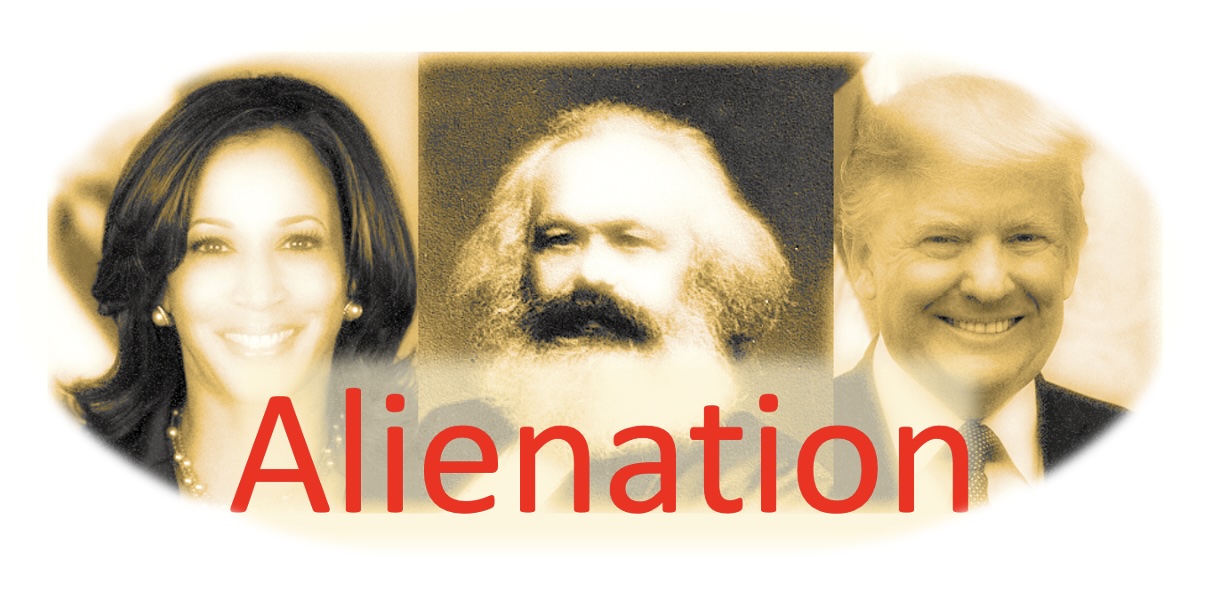
These common sense ideas might sound socialist. Unfortunately, the mere mention of the “s-word” or Karl Marx can provoke outrage. Socialism and Marxism are anathema to many Americans, having become terms of insult in our culture wars. And, recently, Donald Trump has repeatedly accused Kamala Harris of being a Marxist — he calls her “comrade Kamala.” “We’re not ready for a communist president, okay?” Trump recently said of Harris.

This is ridiculous. Harris is a mainstream liberal proposing moderate help for consumers on housing, health care and food costs — proposals that are popular among voters. Harris even seems to agree with Trump about eliminating taxes on tips.

Harris is not proposing a communist revolution that would abolish capitalism or centralize production in the hands of the proletariat. And yet she is absurdly accused of being a Marxist.

The accusation is occasionally linked to an insinuation about her estranged father, Donald J. Harris, a former Stanford economics professor who did, in fact, publish work on Marx.

But this kind of ad hominem and innuendo is silly. It’s as bad as the argument made against Trump regarding the fact that he inherited his wealth from his racist father. What matters is a candidate’s current views and policy proposals — not something dredged up out of their biography, over which they have no control.

At any rate, one wishes there were a candidate who addressed alienation and inequality head on. This would ring a bell for many Americans who feel that the economy is rigged against them, and who are disenchanted with the whole social and political system.

Notably, alienation is a Marxist idea. A young Marx coined the term “alienated labor” in the 1840s to describe how labor produces surplus profit that goes into the capitalist’s pocket. Marx says this empowers the wealthy, while impoverishing the worker.

Things have changed for the better in the past centuries. Economic regulations prevent the kind of exploitation and miserable conditions that afflicted workers in the 19th century. But the general concept of alienation remains useful: Drudgery, poverty and inequality remain problems, and people are disillusioned with politics and the economy.

The Harris Poll’s “alienation index” has tracked this for decades. A majority of Americans report a deep sense of alienation when asked whether elites care about them or whether the rich get richer while the poor get poorer.

Hard-working people often can’t afford adequate housing or other basic goods. The working poor lead precarious lives, earning low wages doing unpleasant and dangerous jobs. They find themselves in debt, unable to get ahead or even imagine retirement. An accident or health crisis can throw them into homelessness.

Meanwhile, some lucky stiffs inherit wealth or otherwise hit the jackpot. The truly wealthy put their money to work in the stock market, earning millions without breaking a sweat. The wealthy are able to pull strings and gain access to a world of luxury and power that the poor can only imagine.

This difference of life prospects and social power produces instability and resentment. Different classes of people inhabit different economic and political realities. When social classes are estranged from each other, they grow suspicious. The wealthy pull away from the masses, retreating into gated communities and luxurious clubhouses. And those on the bottom are alienated from the system itself. They give up on voting or caring, since they think the whole thing is rigged by the rich at the expense of the poor.

To name alienation is to echo Marx. This is not to say that Marx was right about everything or that a communist revolution is needed, but alienation remains a significant social problem. Too many workers live precariously. The average Joe resents the fat cats in first class, and lots of people distrust the system. These are profound and perennial issues. Our leaders need to address these problems. And they might even learn something from reading Marx.

Read more at: https://www.fresnobee.com/opinion/readers-opinion/article291660565.html#storylink=cpy

The Wisdom of WTF

Sometimes you just have to say “WTF.”  In an imperfect world there is wisdom in a shrug of indifference.   

I’ve been thinking about this when considering student responses to a scandal that recently rocked my university involving the Chancellor of the California State University, who was our former President.  What’s remarkable is that most of my students don’t seem to care.  When I discussed this in class, most shrugged it off.

Some may think those students are callous and clueless.  But I’m not so sure.  A shrug is a strategy of self-preservation in a world of alienation.  To say “WTF” is to express disbelief at how stupid things are.  Sometimes it is an outburst of anger.  Sometimes it is a cry of despair.  Almost always it is an expression of alienation.

The world is too big for us to comprehend.  The forces that buffet us are beyond our control.  The omnipresence of alienation poses a challenge for the human spirit.

One of my mentors, the philosopher John Lachs, describes this in a recent book as the peculiar unhappiness of the modern world:

Huge institutions surround and engulf us: we feel powerless to influence their course… We are lost in their bowels and experience much social life as a sort of homelessness.  The devastating sense of the meaninglessness of what we do and of our own unimportance moves us alternately to shoulder-shrugging indifference and to personal despair. 

An obvious solution is to reform our institutions and make them more friendly and transparent.  But even that work is mostly beyond our control.  It also helps to understand that alienation is, as Lachs puts it, “the cost of comfort.”  Even though we are alienated, the modern world provides us with previously unimaginable health, wealth, and power.

And so we take the good with the bad.  And on occasion we sigh and say, “WTF.” 

Outrages abound.  Powerful leaders make huge mistakes.  Democracies elect buffoons.  Ecosystems are in crisis.  War is on the horizon.  Poverty continues.  And the pandemic plods along.

We fret and fume about all of this.  And our anxiety increases.  There is mostly nothing any individual can do solve these problems.  So there is wisdom learning to say “WTF.”

Alienation has a long history.  Karl Marx thought capitalism was built upon alienation.  The existentialist of the 20th Century saw it everywhere.  Human beings do not feel at home in the world.  We are estranged from one another and even from ourselves. 

Alienation is a common theme in literature and film.  In The Catcher in the Rye, Holden Caulfield thinks everyone around him is phony.  In The Matrix Morpheus tells Neo, “You are a slave.  Like everyone else you were born into bondage. Into a prison that you cannot taste or see or touch. A prison for your mind.” 

Alienation appears when we are stuck in traffic.  We experience it when prices rise and paychecks shrink.  It occurs when we work on our tax returns.  The world’s systems are indifferent to us.  We are cogs in a machine over which we have no control.

Alienation gives birth to resentment and anger.  It is part of the discontent fueling “the great resignation” (as I discussed in a recent column).  It fuels suicide and addiction. 

It even helps explain conspiracy theories.  The conspiracy believer is trying to make sense of a world that makes no sense.

And so instead of beating your head against the wall, learn to shrug it off.  We say “WTF” because we know we deserve better; but also, because we know there’s not much we can do about any of this.

Sometimes “WTF” is a cynical abdication of responsibility.  Imagine, for example, saying “WTF” as you jump off a cliff.  So we must be careful not to let “WTF” give rise to nihilism.

To avoid that we should recognize solidarity in the shrug of indifference.  You and I both know that the world is out of joint.  But at least we’re in this together.  The process of making meaning often begins when we look at our neighbor and say “WTF.”  From there we can begin to make things better, one shrug at a time.