Civic Education

Teachers are the core of our union

Fresno Bee, March 5, 2016

  • Character and civic education is essential for our democracy
  • American schools are unique
  • Character education conference will be held Thursday

Caring and creative educators cultivate the next generation of democratic citizens. It is not easy to transform a child into a compassionate and engaged citizen. But no task is more important. The future of our democracy depends upon the work done in our schools.

20061025_Elections

Teachers are charged with providing instruction in academic subjects. Moral and civic education seems different. Morality appears to be both more pervasive and more personal than reading, writing or arithmetic. Perhaps we think that morality and citizenship will somehow take care of themselves.

Morality and civic engagement lie in the background of every other educational endeavor. Cheating and dishonesty make learning impossible. Poor citizenship undermines discipline. And bullies destroy trust in community.

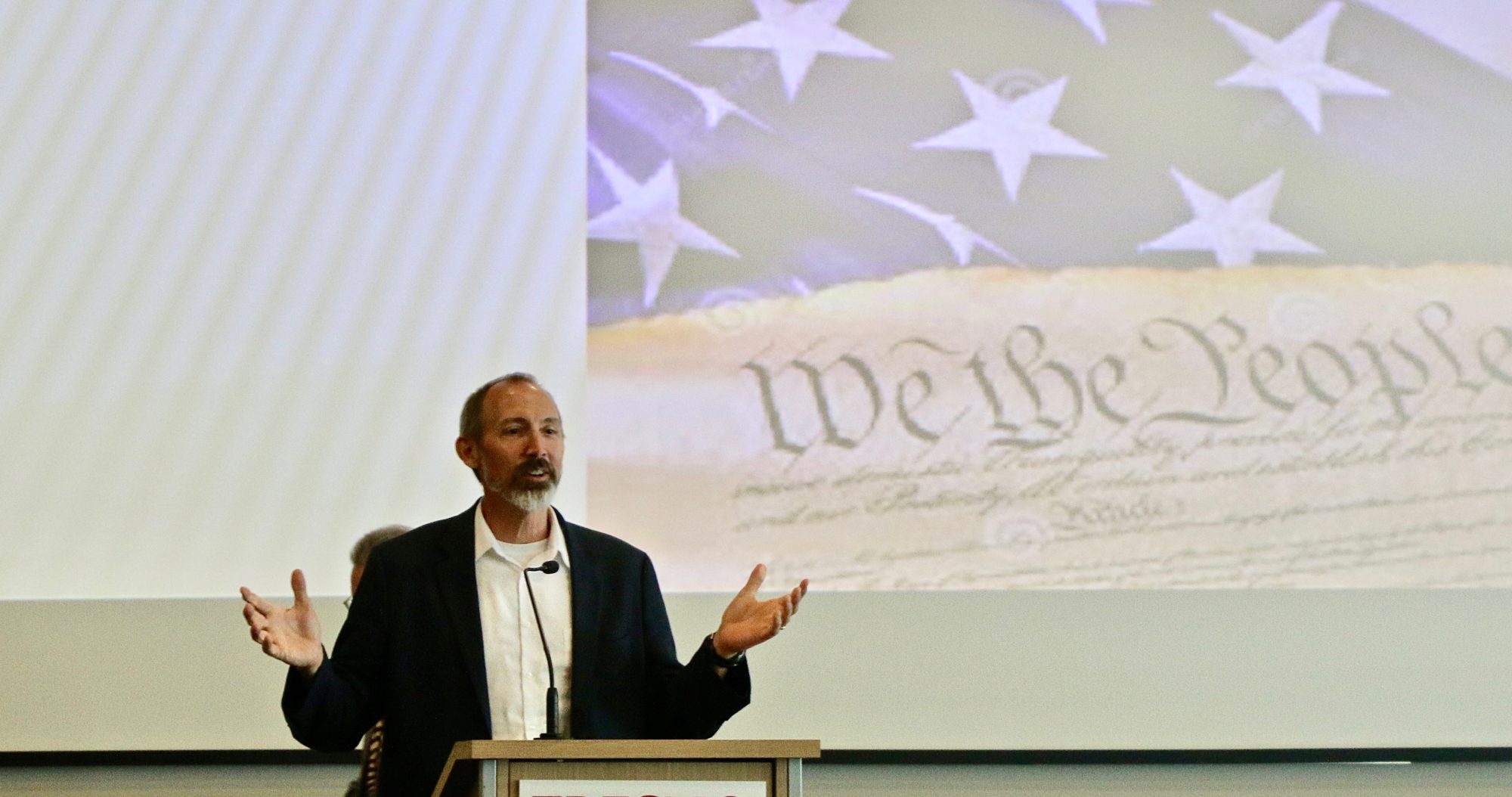
I spoke about character and civic education with my colleague, Dr. Jacques Benninga, the director of Fresno State’s Bonner Center. Benninga is a nationally recognized leader in the field of character education. His vision of character and civic education is informed by decades of research and experience – and a great passion for American democracy.

Benninga maintains that American schools have a unique obligation to prepare children to become democratic citizens. He explains that schools have a “fundamental role to play in a constitutional, democratic republic.” He believes that teachers are guides and role models for civic life.

Benninga points to occasional headlines about bad teachers to make his point. We hold teachers to a higher standard. We are rightly appalled when a teacher makes a moral mistake or breaks the law.

The good news is that most educators live up to a high moral standard. Benninga is forthright in his praise for teachers. He says, “most teachers are outstanding individuals who are caring, fair and respect kids. They do the hard work of making schools wonderful.”

Benninga has a lot of data to support this generalization. Since 1988, he has been giving awards to schools that have outstanding programs in civic and character education. Benninga has evaluated hundreds of schools in Fresno, Kings, Madera and Tulare counties.

Exemplary schools receive an award at the Bonner Center’s annual character education conference for teaching credential students from Fresno State and Fresno Pacific University. This year the conference will be held Thursday at the Fresno Convention Center.

The conference will feature Renee Gomez, Fresno County’s teacher of the year, and Lisa Butts, Kings County’s teacher of the year. The keynote address will be given by Michelle Herczog, former president of the National Council for the Social Studies. Herczog’s speech is titled “Why We Must Prepare Students for College, Career, AND Civic Life.”

IF YOU KNOW A TEACHER, THANK THEM FOR THEIR EFFORTS.

The need for such preparation is obvious. We are not born ready for college, prepared for a career or ready to participate in democratic society. Good education imparts academic and vocational skills and encourages moral development and citizenship.

Educators know what works in terms of character and civic education. Moral and character lessons should be infused within the curriculum, across subject matter. Students should be provided with opportunities for moral action – through service projects on campus and in the community.

Benninga points out that schools provide laboratories for democratic action, in the simple act of voting for student council. Benninga suggests that this is a unique aspect of American schools. It is hard to imagine, for example, democratically elected student councils in North Korea.

We take our democratic and morally engaged schools for granted. Americans have grown up practicing democracy at school. We learned honesty, integrity, fairness and care from our teachers and other significant adults. We practiced tolerance, respect, patience and hospitality in school. Our moral and democratic habits are the result of the diligent work of the previous generation of educators.

Through my collaborations with the Bonner Center, I have visited a number of exemplary schools. I have been impressed by caring teachers who are hard at work in the classroom. I’m hopeful that our democracy will flourish as a result of their labor.

If you know a teacher, thank them for their efforts. And ask them what they are doing to educate the next generation of citizens. You’ll be inspired to learn about the unheralded service that teachers perform daily in support of our democracy.

Read more here: http://www.fresnobee.com/living/liv-columns-blogs/andrew-fiala/article64025332.html#storylink=cpy

Civility and the Presidential Campaign

When it comes to civility, do as we say, not as we do

Fresno Bee, February 26, 2016

  • We all benefit from common courtesy
  • Civility is not innate; pop culture and political life undermine it
  • First Amendment freedom should be accompanied by considerate speech

Civility is a great and fragile good. Liberty allows our lips to flap. Common courtesy causes us to keep our mouths shut. Some bristle at the idea of political correctness. But without civility, political life becomes a fistfight.IMG_APTOPIX_GOP_2016_Tru_4_1_6L7ASOFI_L199078247

Donald Trump recently said he would like to punch a protester in the face. Trump extolled “the old days” when a protester like that would be “carried out on a stretcher.” At an earlier rally, Trump repeated an obscene insult directed at Ted Cruz.

Opponents of Trump also use inflammatory rhetoric. More than one pundit has called Trump a fascist. The Fresno State student newspaper even ran a picture withTrump’s face imposed on Hitler’s body in front of the White House.

Political rhetoric often generates more heat than light. But we seem to be rounding a corner, where vulgarity and vitriol trump reasonable argument.

In some parts of the world, politics quickly becomes pugilistic. Fistfights have broken out in legislatures in Japan, Ukraine and elsewhere.

We like to think of ourselves as more evolved. But without civility, are we any better than Kosovo, where legislators set off tear gas bombs in parliament?

Civil and honest speech are essential for democratic life. But civility is not innate. It takes a lot of effort to teach kids to keep their mouths clean, their hands to themselves, and their minds focused on truth.

Pop culture and political life undermine these lessons. Fists and foul language are not normal or acceptable. Crude, rude and obnoxious behavior remains rare and exceptional. Most of the time, most people don’t exchange insults or threaten violence. Profanity and violence are not permitted in schools or in business meetings.

Our schools work hard to curtail bullying and create safe and civil places for children to thrive. Businesses require anti-harassment training. These lessons in political correctness work. Most of us behave civilly most of the time. Those who misbehave get suspended, fired, sued or jailed.

Fear of punishment is not the only thing guiding civil behavior. Most people don’t view life as a competition. We don’t use words as trump cards. We don’t focus on winning. Rather, we exchange ideas.

Civil people engage in dialogue in order to build community and seek understanding. Civil dialogue requires self-restraint and an open mind. An old saying says that we have two ears and one mouth because we ought to listen twice as much as we talk.

BULLIES WANT AN AUDIENCE. BLOWHARDS ONLY BLOW WHEN SOMEONE IS LISTENING. THE BEST RESPONSE IS OFTEN AVOIDANCE. MOST PEOPLE HAVE LEARNED TO IGNORE THEIR ORNERY UNCLE, CRANKY COLLEAGUE OR NOISOME NEIGHBOR.

The First Amendment guarantees freedom of speech, including the right to be offensive. But civil people do not say everything that is on our minds. We learn to hold our tongues out of respect for decorum. This may sound old-fashioned and uptight. But tact and discretion are useful skills.

One kindergarten cliché has a kernel of truth: “If you don’t have something nice to say, don’t say anything at all.” A more advanced lesson teaches us to speak low, speak slow, but always speak the truth.

Civil discourse is a fragile fruit, easily destroyed by hot air. One obnoxious boor can ruin a picnic, a party or a political season. Bullies and blowhards infect families, school and the workplace. They rarely stop talking long enough to listen. If they do pose a question, it is usually only to catch their breath in order to continue their harangue.

Bullies want an audience. Blowhards only blow when someone is listening. The best response is often avoidance. Most people have learned to ignore their ornery uncle, cranky colleague or noisome neighbor.

When avoidance is impossible, we can invoke the basic rules of the kindergarten classroom: don’t threaten violence, don’t call people names, tell the truth and be kind to strangers. A more advanced lesson teaches that civility keeps the peace, protects freedom, shows respect for humanity and helps us discover the truth.

Donald Trump has hinted that he can be more civil and play nice. He said that he would be “more presidential” when the time comes. That’s good news. Let’s hope the time comes soon. But until that happens, we should remind our kids that what they are seeing and hearing in the world of politics is behavior that would not be permitted in the boardroom or on the playground.

Read more here: http://www.fresnobee.com/living/liv-columns-blogs/andrew-fiala/article62657502.html#storylink=cpy

Religious Pluralism

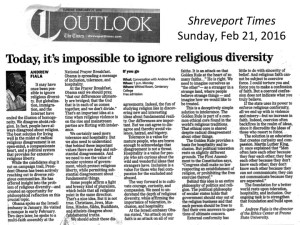
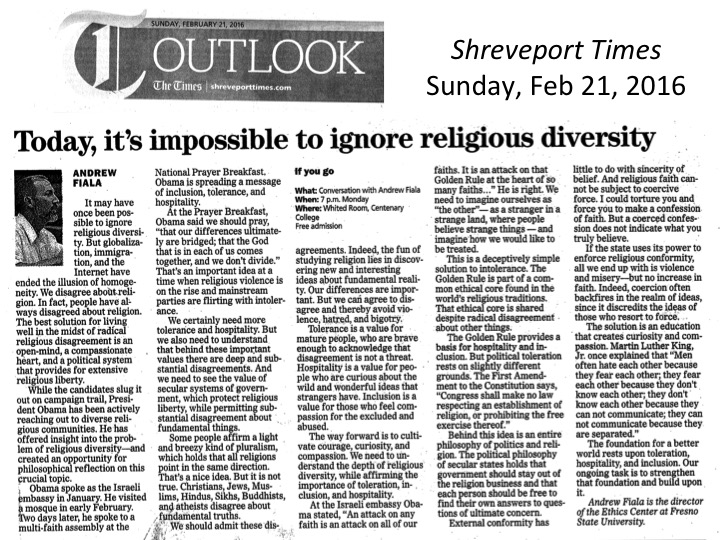
Today, It’s Impossible to Ignore Religious Diversity

Shreveport Times, Sunday Feb. 21, 2016

It may have once been possible to ignore religious diversity. But globalization, immigration, and the Internet have ended the illusion of homogeneity. We disagree about religion. In fact, people have always disagreed about religion. The best solution for living well in the midst of radical religious disagreement is an open-mind, a compassionate heart, and a political system that provides for extensive religious liberty.

FialaShreveOpEdWhile the candidates slug it out on campaign trail, President Obama has been actively reaching out to diverse religious communities. He has offered insight into the problem of religious diversity—and created an opportunity for philosophical reflection on this crucial topic.

Obama spoke as the Israeli embassy in January. He visited a mosque in early February. Two days later, he spoke to a multi-faith assembly at the National Prayer Breakfast. Obama is spreading a message of inclusion, tolerance, and hospitality.

At the Prayer Breakfast, Obama said we should pray, “that our differences ultimately are bridged; that the God that is in each of us comes together, and we don’t divide.” That’s an important idea at a time when religious violence is on the rise and mainstream parties are flirting with intolerance.

We certainly need more tolerance and hospitality. But we also need to understand that behind these important values there are deep and substantial disagreements. And we need to see the value of secular systems of government, which protect religious liberty, while permitting substantial disagreement about fundamental things.

Some people affirm a light and breezy kind of pluralism, which holds that all religions point in the same direction. That’s a nice idea. But it is not true. Christians, Jews, Muslims, Hindus, Sikhs, Buddhists, and atheists disagree about fundamental truths.

We should admit these disagreements. Indeed, the fun of studying religion lies in discovering new and interesting ideas about fundamental reality. Our differences are important. But we can agree to disagree and thereby avoid violence, hatred, and bigotry.

Tolerance is a value for mature people, who are brave enough to acknowledge that disagreement is not a threat. Hospitality is a value for people who are curious about the wild and wonderful ideas that strangers have. Inclusion is a value for those who feel compassion for the excluded and abused.

The way forward is to cultivate courage, curiosity, and compassion. We need to understand the depth of religious diversity, while affirming the importance of toleration, inclusion, and hospitality.

At the Israeli embassy Obama stated, “An attack on any faith is an attack on all of our faiths.  It is an attack on that Golden Rule at the heart of so many faiths…” He is right. We need to imagine ourselves as “the other”—as a stranger in a strange land, where people believe strange things—and imagine how we would like to be treated.

This is a deceptively simple solution to intolerance. The Golden Rule is part of a common ethical core found in the world’s religious traditions. That ethical core is shared despite radical disagreement about other things.

The Golden Rule provides a basis for hospitality and inclusion. But political toleration rests on slightly different grounds. The First Amendment to the Constitution says, “Congress shall make no law respecting an establishment of religion, or prohibiting the free exercise thereof.”

Behind this idea is an entire philosophy of politics and religion. The political philosophy of secular states holds that government should stay out of the religion business and that each person should be free to find their own answers to questions of ultimate concern. Related to this is a conception of religion, which holds that religion is something private and internal to persons.

External conformity has little to do with sincerity of belief. And religious faith cannot be subject to coercive force. I could torture you and force you to make a confession of faith. But a coerced confession does not indicate what you truly believe.

If the state uses its power to enforce religious conformity, all we end up with is violence and misery—but no increase in faith. Indeed, coercion often backfires in the realm of ideas, since it discredits the ideas of those who resort to force.

At the National Prayer Breakfast Obama pointed out that “fear does funny things.” Fear, he said, can lead us to lash out against people who are different. And it can erode the bonds of community. When we are fearful we resort to coercion. We want to destroy the thing we fear and we learn to hate.

The solution is an education that creates curiosity and compassion. Martin Luther King, Jr. once explained that “Men often hate each other because they fear each other; they fear each other because they don’t know each other; they don’t know each other because they can not communicate; they can not communicate because they are separated.”

King is right. The more you know, the less you hate. The foundation for a better world rests upon toleration, hospitality, and inclusion. Our ongoing task is to strengthen that foundation and build upon it—in our schools and institutions, and in our hearts and minds.


How old is too old or too young?

Reproduction, Sex, and Ethics