Music At Glacier Point

In  moments of musical beauty, anger melts, hatred dissolves, peace dawns

Fresno Bee, August 27, 2016

WITHOUT HOPEFUL SPLASHES OF JOY, LIFE WOULD BE DULL AND MEANINGLESS.

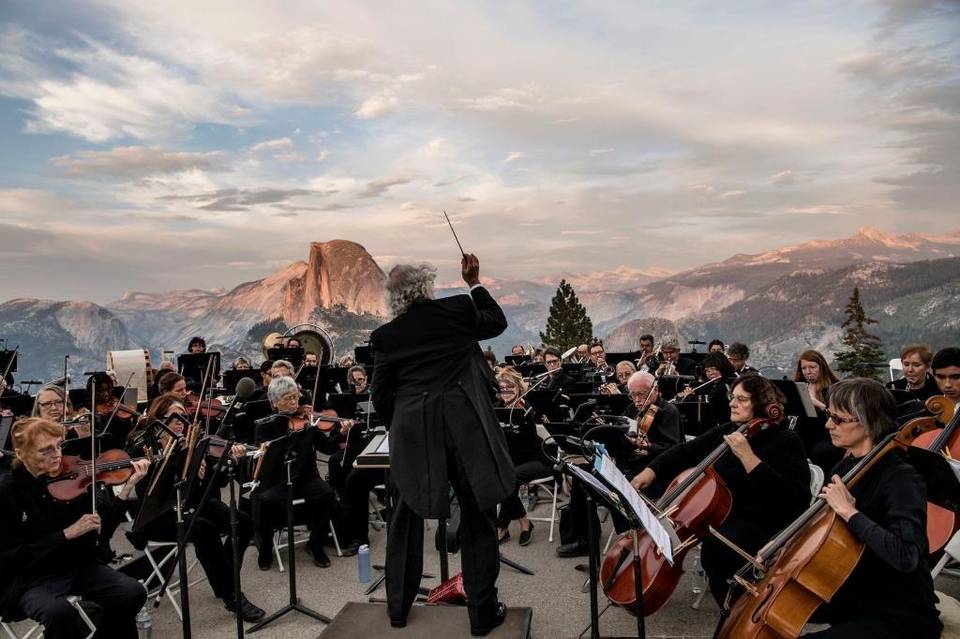
Last Sunday, the Mariposa Symphony Orchestra performed at Glacier Point in Yosemite National Park. Perched on the edge of a cliff, the orchestra played original pieces composed in honor of Yosemite and the centennial of the National Park Service.

As Half Dome blushed in the setting sun, Yosemite’s granite gorges resounded with song. At dusk, a bat danced above the bassoons. After the last echo faded, a shooting star flashed into view. It quickly vanished into darkness.

img_0469-1Beauty is fleeting. It shines and echoes for a moment. Then it is gone. Youthful brilliance becomes old age. Summer sun gives way to winter winds. Music always returns into silence.

The fragility of beauty is a reminder of mortality. But beauty also soothes and reassures. Wonder and joy arouse our better angels. Natural splendor and human art make life worth living.

The concert at Glacier Point honored the 100th anniversary of the National Park Service, whose work conserves the wild wonders of our continent. Some Park Service employees also play in the Mariposa orchestra. How cool for those rangers to serenade the park they love.

The arts and Yosemite

One might think it odd to stage a symphony at Glacier Point. But according to Yosemite spokesman Scott Gediman, “From the signing of the Yosemite Grant to the present day, the arts have played a significant role in the creation and continued interest in preserving these public places.”

Yosemite sparkles in Ansel Adams’ photos. It is illuminated by John Muir’s prose. Yosemite has a new artistic champion in Les Marsden, the conductor of the Mariposa orchestra.

Marsden composed a complex cycle of four pieces to honor Yosemite and the Park Service. Marsden’s compositions are classically American, reminiscent of Aaron Copland. The music told the history of the national parks. It imitated wind, water, fire and animal life.

As Marsden’s dynamic baton came to rest and the music faded into silence, you could hear crickets chirping and birds singing. I was struck by the thought that human art is a response to nature’s call. The human imagination swells in the presence of Half Dome. Birdsong tickles our ears. Thunder quickens the heart. And Yosemite Falls provokes laughter and shouts.

WITHOUT HOPEFUL SPLASHES OF JOY, LIFE WOULD BE DULL AND MEANINGLESS.

Poetry, painting and music reflect the wonders of the world. Human art transcends matter. Without the soaring responsiveness of the human spirit the earth would be quiet and dull.

John Muir said, “Everybody needs beauty as well as bread, places to play in and pray in, where nature may heal and give strength to body and soul alike.” Muir explained that gardens and parks satisfy our “natural beauty-hunger.” We plant flowers, tend our gardens, and visit parks looking for inspiration and consolation.

Muir claimed that natural beauty comforts “nerve-shaken, over-civilized people.” For Muir, mountain parks are “fountains of life.” Their sublime wonder stirs the spirit.

Fountains of life

Art and music are also fountains of life. The arts encourage us to savor the world.

One of my colleagues, Thomas Loewenheim, the conductor of the Fresno State SymphonyOrchestra, has confessed his hope that music provides a path toward peace. I think he is right. Music, beauty, art and nature encourage us to transcend our petty differences. They lift us beyond ourselves and bring us together in awe, reverence and delight.

Stand on Glacier Point. Immerse yourself in poetry. Fill your lungs with song. Dig your fingers into the soil. Smell the wonder of flowers. Or simply listen to the birds. The aesthetic mood encourages us to breathe more deeply – to listen, see and feel.

In moments of beauty, anger melts, hatred dissolves and peace dawns. Winter storms will come to the high country. Fires will burn the hills. And madmen rage in the lowlands. But peace is found in beauty. And hope is found in the fragments of color, song, granite and water that we carry in our hearts.

Without hopeful splashes of joy, life would be dull and meaningless. Hallelujah for Yosemite. Hurray for Marsden and the Mariposa symphony.

And thank goodness for the men and women of the Park Service, whose work has preserved nature’s wonders for 100 years. Here’s hoping that the artists, rangers and natural wonders of our world will continue to inspire and console for another century.

Read more here: http://www.fresnobee.com/living/liv-columns-blogs/andrew-fiala/article98045307.html#storylink=cpy

For the Love of Teaching

Teachers truly love a very tough profession

Fresno Bee, August 20, 2016


34344c9935257c1be6c213aa5443ea6fTeachers love to teach. Ideas thrill us. We share the excitement of our students’ achievements. We enjoy helping people master skills and understand concepts. And we believe that our efforts give birth to a better world.

Like any worthwhile activity, teaching is stressful and difficult. It is intimidating to face a college lecture hall full of hundreds of students. It is tough to keep high school kids engaged. It isn’t easy to nurture elementary school kids every day of the week.

There is high turnover among beginning teachers. In Los Angeles, according to a recent report, 40 to 50 percent of K-12 teachers leave the classroom within five years. Teacher shortages are a problem in Fresno and across the country. The long-term solution is for society to value teachers. Teachers should also spread the good news of the joy of teaching.

Not everyone is cut out to be a teacher. Teaching is a craft that is learned through sweat and tears. When I taught high school, I was overwhelmed with insecurity. My first years in the college classroom were filled with anxiety and doubt. More than 20 years later, I still fret and worry.

Teachers need compassion, organizational skills and intense focus. Teaching depends upon mastery of the subject matter, quick wit and the ability to improvise. It also requires an ethical commitment to the well-being of those we teach.

Great teachers facilitate a metamorphosis of the mind. Jeremiah Conway, a philosophy professor in Maine, describes this as a kind of magic. In a book entitled “The Alchemy of Teaching,” he explains, “Teaching is fundamentally about human transformation.” He concludes, “Participating in such transformation is one of the great delights and responsibilities of teaching.”

Parents certainly don’t want just anyone molding our children’s minds. We want ethically grounded teachers who love our children and understand their fragility. We want teachers who take their responsibilities seriously.

TEACHING IS A NOBLE AND NECESSARY PROFESSION.

Transformative teaching is not mere instruction. Its goal is not obedient compliance or mechanical repetition. Rather, transformative teaching aims to conjure something new into existence – knowledge, virtue and love of learning.

The model for transformative teaching is Socrates. Socrates described himself as a midwife who facilitated a magical birthing process. When teaching works, young people grow into full-fledged human beings.

Low wages, heavy workloads and external pressures can kill the joy of teaching. Institutional constraints can reduce teaching to mere instruction. The move to computerized instruction presumes that computer programs can do much of the work.

Some skills can be taught by mechanized instruction. But personal transformation and moral growth are properly facilitated by human interaction. We learn art from inspired artists. We learn the scientific method from devoted scientists. We learn good sportsmanship from decent coaches. We learn to love history by listening to passionate historians. And we learn how to be human from mentors who represent the best of humanity.

In order to recruit the next generation of teachers, society needs to celebrate the smart, devoted, and moral human beings who fill our classrooms. Teachers are among the most important workers in our nation. They transmit the knowledge, skills, and values of our civilization. Teaching is a noble and necessary profession.

We also need to explain the joy of teaching. Successful teachers find meaning and delight in teaching. Teachers often feel called to teach. But inspiration is momentary. Teachers are lifelong learners who work to hone their craft. That effort is sustained by a sense of responsibility toward students and the community.

Teachers are often quiet about their love of teaching. Perhaps we are reluctant to admit that we’ve found meaningful work in a world of drudgery. We are not comfortable these days talking about work as a calling or vocation. But where your talent and joy provide a service to the world, that’s where you are summoned.

Not everyone has the talent or demeanor to be a teacher. Some give up or burn out. But most teachers love to teach.

Each new school year begins as a great romance. We get butterflies. We obsess about lesson plans. We dream of books, experiments and ideas to be shared. We happily greet our students, humbled by our responsibility. And we hope that through our efforts a better future will be born.

Read more here: http://www.fresnobee.com/living/liv-columns-blogs/andrew-fiala/article96554047.html#storylink=cpy


The Olympics, Inequality, and the Spirit of Sport

Inequities sometimes overwhelm the Olympic ideal

Fresno Bee, August 13, 2016


The most important moral message of the Olympics is found in the spirit of the swimmers in the outside lanes and the runners at the back of the back. They get no glory. But they give it their all.

U.S. swimmer Missy Franklin, left, cries as she’s comforted by teammate Maya Dirado after Franklin failed to qualify in the semifinals of the women’s 200 backstroke at the Olympic Aquatics Stadium in Rio de Janeiro, Brazil, on Thursday, Aug. 11, 2016

Almost everyone runs at the back of the pack. There is only one Michael Phelps. The rest of us could quit, cheat or complain – but we don’t. We – the decent majority of weekend warriors and ordinary mortals – discover joy in effort and honor in doing our best.

They say practice makes perfect. But no one is perfect. There is always room for improvement. We are never done practicing. Life is ongoing exertion. The key is to learn to love our labors.

This message is often lost in our focus on medal counts and the achievements of extraordinary Olympians such as Phelps. But the glory of victory is only a small part of the Olympics. The more important message is that the people of the world can play fairly together.

The inventor of the Games, Pierre de Coubertin, imagined a new philosophy called “Olympism” that promoted world peace through international sport. He wanted to create international solidarity through friendly competition.

With roots in Greek myth, Olympism is a philosophy of life that seeks harmony of body, will, mind and world. It demands respect for universal ethical principles. And it celebrates “the joy of effort.”

The Olympic charter states, “The goal of Olympism is to place sport at the service of the harmonious development of humankind, with a view to promoting a peaceful society concerned with the preservation of human dignity.”

Controversies surrounding the Rio Olympics make this seem like a dream. Doping scandals and polluted water are the tip of the iceberg. In addition to athletic greatness, the Olympics disclose social dysfunction, greed, injustice and inequality.

In one symbolic scene, protesters halted the Olympic torch procession. Police used tear gas and rubber bullets to clear a path for the torch. The poor and suffering masses want dignity, not gold medals.

Indeed, the daily medal count discloses global inequality. The globe’s athletic powerhouses are also its economic giants. Victory depends upon economic opportunity in addition to talent and tenacity.

The world’s poorest nations have few athletes. They rarely win. Some impoverished athletes abandon their homelands to compete for other nations. Rich countries such as Bahrain and Qatar import athletes from poor African nations.

Another problem is commercialism and greed. Olympic profits are not fairly shared. NBC expects hundreds of millions of dollars in ad revenue from the Rio Games. The athletes do not get a share in these profits.

The president of the IOC earns more than $250,000 a year. American coaches and sports directors earn even more. The executive director of USA swimming earns $837,000 per year. American swimmers earn a maximum stipend of $42,000. Athletes in less-popular sports and in poorer countries get much less.

Such is the world we live in. It would be nice if sports could solve our problems. But our athletic endeavors reflect the realities of a world that is afflicted by inequality, injustice, conflict and greed.

And yet, the masses continue to run, practice and strive. The vast majority of decent people do not cheat, quit or complain. Instead, we lace up our shoes and get to work. We enter the race, understanding that we have no chance of winning. But we keep on running.

The basic decency and tenacity of the vast majority is the most hopeful aspect of the human spirit. Most of us honor effort and fair play. We find joy in practice. And we strive to do our best.

Olympism imagines sport as a solution to global conflict. This is an inspiring vision. But sport is not a panacea. Athletes are human beings. And sporting events are human creations. They reflect who we are.

The problems exposed in Rio indicate that there is much work to be done in the world to eliminate injustice, inequality and other social problems. There is always work to be done.

Life is ongoing practice, sweat and tears. We don’t work because we expect to win. Rather, our efforts define our identities and give us joy, even in defeat.

Read more here: http://www.fresnobee.com/living/liv-columns-blogs/andrew-fiala/article95304872.html#storylink=cpy

Ancient wisdom and climate change

Maybe it’s time to learn from our past

Fresno Bee, August 6, 2016

Clean energy is a good idea. It is smart to believe in science. But we also need a dose of ancient wisdom. Ancient traditions teach that a simple life is best. The climate crisis is a symptom of a spiritual malady that has been with us since ancient times: unbridled desire.

According to NASA, the first half of 2016 was “the planet’s warmest half-year on record.” The warmest previous years were 2015 and 2014. The Earth’s atmosphere is more than 1 degree Celsius warmer than it was a century ago. Polar ice is melting. Sea level is nearly 3 inches higher than 25 years ago.

And yet we go about our business, unable or unwilling to change our collision course with climate calamity.

Some are in denial. Donald Trump has described climate change as “expletive.” He has claimed that it is a hoax foisted upon the world by the Chinese. His running mate Mike Pence has called climate change a myth. Trump wants to cancel the recent Paris climate agreement.

Others admit the climate crisis, while imagining high-tech solutions. At the Democratic National Convention, Hillary Clintondeclared, “I believe in science.” She said, “I believe that climate change is real and that we can save our planet while creating millions of good-paying, clean energy jobs.”

A CLIMATE-FRIENDLY LIFE WOULD BE SIMPLE. 

Clean energy is a good idea. It is smart to believe in science. But we also need a dose of ancient wisdom. Ancient traditions teach that a simple life is best. The climate crisis is a symptom of a spiritual malady that has been with us since ancient times: unbridled desire.

Ancient sages teach that happiness and virtue are found in restraint and self-control. Desire is a flame that easily burns out of control. Materialism distracts us from higher goods. Tranquility and joy are found in peaceful harmony.

The Buddhists aimed to control desire. The Taoists sought harmony in simplicity. Jesus warned against greed and wealth. And the ancient Greeks praised modesty, moderation and temperance.

But we crave the goods of carbon culture: cars, planes and cheap plastic goods. We like air-conditioned houses, stocked refrigerators and weekend getaways. Billions of poor people dream of joining the American middle class in our relentless pursuit of happiness.

I thought about this as I watched shooting stars blaze across the sky on a recent night in the Sierra. The stars were amazing. So too is our hubris and hypocrisy. I spewed carbon on my drive to the mountains, contributing to the climate crisis.

Such is our predicament. Our daily choices contribute to the problem. It is difficult to imagine living otherwise. The habits of affluence fuel our economy and inflame our desires.

Something’s got to give. Or we’ve got to give something up.

WHAT ARE YOU WILLING TO DO TO COOL THE PLANET AND SIMPLIFY YOUR LIFE?

Conan-Arnold PosesOne interesting suggestion comes from Arnold Schwarzenegger. Schwarzenegger has become a spokesman for meat-free meals as a cure for climate change. In a public service announcement he says, “less meat, less heat, more life.”

Schwarzenegger’s advertisement was made to support the Chinese government in its plan to reduce meat consumption as a response to climate change. Meat consumption creates more carbon emissions than a plant-based diet. Locally grown foods also produce fewer emissions.

All of our consumption habits have environmental impacts. Coffee is shipped across the globe. Coffee culture creates vast piles of disposable cups. Beer and soda also have an impact. Energy is used to refrigerate and transport it. There are ecological costs in manufacturing and recycling cans and bottles.

Even our hygiene habits have climate impacts. Hot showers produce carbon emissions. So do our hair and clothes dryers. And so on.

A climate-friendly life would be simple. We would take fewer showers, air-dry our clothes, take few long trips, and rarely eat meat. We would walk or bike to work, drink mostly water, and generally curtail consumption.

This is how most people lived before electricity and fossil fuels. The nights were darker then. The stars provided entertainment and inspiration. We rarely see those stars today.

A simple life is unimaginable in the era of unrepentant indulgence. Our lights and gizmos blaze at all hours. There is no space for silence or stargazing.

Studying the ancients reminds us of the value of simplicity. Of course we need science. But we also need to understand that burning carbon cannot create virtue or happiness.

It’s a hopeful sign that Arnold Schwarzenegger has become an advocate for climate-friendly behavior. If Conan the Barbarian is giving up meat, what are you willing to do to cool the planet and simplify your life?

Read more here: http://www.fresnobee.com/living/liv-columns-blogs/andrew-fiala/article93860892.html#storylink=cpy

Political Life vs. Living Well

Take a break from bitter politics – go fishing

Fresno Bee, July 29, 2016

After two weeks of political conventions we need a break from hype, hyperbole and hyperventilation. We need to go fishing. Catch our breath. And clear our heads.

Here’s some of what we witnessed in the past two weeks.

At the Republican convention, delegates chanted “lock her up,” when Hillary Clinton was mentioned. One Donald Trump supporter, Al Baldasaro, called for Clinton to be shot for treason.

Trump’s convention speech prompted pundits to call him a fascist and a dictator. If the rhetoric is true, this leaves us with a choice between a Caesar and a criminal.

On the one hand, we have a billionaire who takes pride in firing people claiming that he understands the plight of the middle class. On the other hand, we have the wealthy wife of a former president claiming the same thing.

WHEN ASKED TO TAKE A JOB WITH THE EMPEROR, THE ANCIENT CHINESE SAGE CHUANG-TZU SAID NO. POLITICAL LIFE ENDS IN UNHAPPINESS AND DEATH.
HE SAID HE WOULD RATHER GO FISHING.

Bernie Sanders concluded his campaign claiming that Clinton would “end the movement toward oligarchy.” Sanders’ supporters walked out. An apparent anti-Sanders conspiracy in Democratic headquarters confirmed the suspicions of those who think the system is corrupt. Debbie Wasserman Schultz, the head of the Democratic National Committee, resigned as a result of the damaging email dump.

Democratic Party operatives, including President Barack Obama, suggested that Russia was behind the email leak. They insinuated that Trump is too cozy with Russia, since he benefited from the leak.

Trump responded by calling on Russia to find the missing emails from Clinton’s private server. The Clinton campaign replied by saying, “This has to be the first time that a major presidential candidate has actively encouraged a foreign power to conduct espionage against his political opponent.”

Each side has basically accused the other of treason, duplicity, stupidity and criminality.

Can it get any worse?

This is all disheartening. But it is not surprising. Politics has always been a repugnant business.

Within the lifetimes of our two candidates we have witnessed anti-communist witch-hunts, political assassinations, Watergate, the Iran-Contra scandal, Clintonian philandering and lying, Bushian incompetence and a host of other crimes and misdemeanors.

image1History discloses a political world that stinks to high heaven. That’s why the world’s religious and philosophical traditions have often taught us to avoid it.

Socrates thought politics damaged the soul. Jesus advised his followers to render unto Caesar only what belongs to Caesar. He suggested that his kingdom was not of this world. Both Socrates and Jesus were killed by political authorities.

The Epicurean philosophers of ancient Greece advised us to avoid politics entirely. True happiness, they argued, is found in good health and in the private company of good friends. Christians often retreated behind cloistered walls seeking peace and communion with God.

IF GOOD PEOPLE GO FISHING, FISHY PEOPLE WILL TAKE OVER AND DESTROY OUR FISHING HOLES.

A related idea comes from China. When asked to take a job with the emperor, the ancient Chinese sage Chuang-Tzu said no. Political life ends in unhappiness and death. He said he would rather go fishing.

How nice it would be simply to go fishing with the Taoist sages. But if good people go fishing, fishy people will take over and destroy our fishing holes.

We might like to be left alone. But injustice and stupidity have a nasty way of spreading. The philosopher’s garden, the monk’s monastery, and the Taoist’s mountain retreat are still connected to the political world. No one can withdraw completely.

Politics is a necessary evil. We avoid it at our peril.

The political world is a bit like our bodily functions. We must occasional get our hands dirty with this messy business. Justice requires us to wade into political swamps. But we should not be surprised by how bad the whole thing smells.

Nor should we view political life as an end in itself. There are higher and more lasting goods to be found elsewhere.

The challenge is to make the best of a putrid situation – to keep our heads clear despite the hot and fetid air.

Critical thinking skills help. Suspend judgment until you get all the facts. Control your emotions. Keep the larger sweep of history in mind. Remember that there are no utopias and no morally perfect politicians.

We also benefit from taking a break from breathing hot air. Go fishing. Recharge your critical batteries. Clear your head. This is going to be a nasty and noxious political season.

Read more here: http://www.fresnobee.com/living/liv-columns-blogs/andrew-fiala/article92507247.html#storylink=cpy