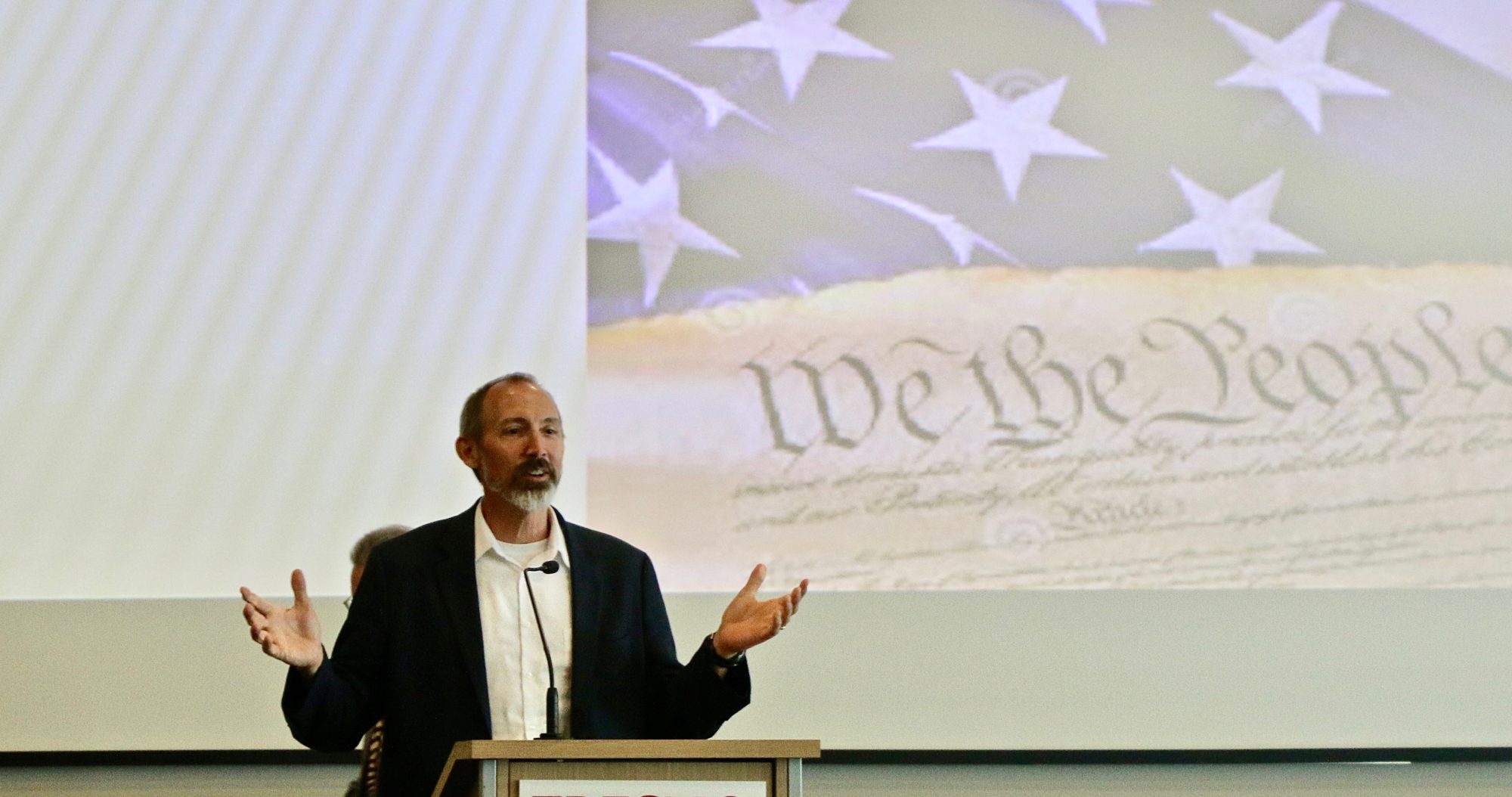
Voting is a leap of faith

Voting is a little like a leap of faith

Fresno Bee, November 5, 2016


Your vote does not count for much. In the U.S., there are about 150 million registered voters. You are only one among 18 million registered California voters. But there are good reasons to vote anyway. Voting allows you to express your values and participate in civic life.

Ron Hirschbein, a philosopher at Chico State, wrote a book in the 1990s, “Voting Rites,” that considers the metaphysics of voting. I spoke with him the other day. Hirschbein says, “The cruel mathematics of mass society destroys the narcissistic belief that your vote matters.”

The large numbers involved make it unlikely that your vote will change the world in your favor. If you view your vote as an instrument serving your self-interest, then voting is a waste of time.

But voting is not merely an instrumental activity. It is also a meaningful social ritual. Voting has symbolic and expressive value. It is a participatory social act. This year you can help elect the first female president or a billionaire outsider. You can also write in “none of the above.”

Your vote is meaningful to you, even if it does very little to change the aggregate vote count. It is an expression of your hopes and your values. And it matters to you, even if your vote is merely a drop in the bucket.

audienceConsider this analogy. After a concert, people applaud. Your claps only make a miniscule contribution. No one would miss your clapping if you chose not to applaud. But you would miss out on the opportunity to participate in the process. Applauding is a symbolic and expressive gesture, done in solidarity with the audience and in support of the musicians.

Voting is similar. We demonstrate solidarity with other citizens by voting. And we express a kind of faith in the political show.

Admittedly, there are good reasons to be skeptical of all of this. Citizen solidarity may seem absurd in a divided nation. Many people fear that the political show is a rigged carnival game. Monolithic parties, political dynasties, insider trading, gerrymandering and big money all serve to undermine our faith in democracy.

To vote is to say, “Despite all of this, I assert my constitutional right to participate in self-governance.” This is an expressive act and a leap of faith.

Faith – religious, civic or otherwise – is belief in the absence of evidence. In social contexts, faith performs an important conjuring act. Political societies only exist so long as citizens believe in them. Teams, social clubs, businesses, and nations fall apart when we lose faith.

Maybe we are heading in that direction. In 2012, just over half of eligible voters voted. U.S. voter turnout rates trail behind the rest of the world. Maybe Americans are simply giving up on the charade, refusing to applaud this tired old show.

Social life is an elaborate ritual that requires willingness to play along. Ghosts and witches are fantasy, but we carve our jack-o-lanterns anyway. It’s all phony. But when we play along, Halloween exists.

SOCIAL LIFE IS AN ELABORATE RITUAL THAT REQUIRES WILLINGNESS TO PLAY ALONG. 

Weddings, funerals and graduations are games and shows that require voluntary suspension of disbelief. The ceremonies are formulaic and often lack depth. But we play along, enjoying the process and the result.

It may seem disenchanting to admit all of this, but grown-ups know that social rituals involve make-believe. Acknowledging this creates deeper understanding of social life and a more realistic assessment of our place within the social universe.

No individual matters all that much to history or society. But we create the shared social world by our individual deeds and commitments. Understanding this gives us the freedom to invest our spiritual energy wisely and appropriately.

This is ultimately a question of existential philosophy. You truly are a grain of sand. But so what? The beach is beautiful, and we find meaning in participating in things that are larger than ourselves.

Democracy is created by the faith of individuals who vote and thereby participate in the life of the country. One vote does not matter in a country of hundreds of millions. But if that one vote is yours, it matters to you. And democracy only exists when we believe that despite evidence to the contrary, our votes really do matter.

Read more here: http://www.fresnobee.com/living/liv-columns-blogs/andrew-fiala/article112552757.html#storylink=cpy

Marijuana Morality

Proposition 64: Discerning the pros and cons of legalized marijuana

Fresno Bee, October 28, 2016

There are difficult questions to confront in thinking about Proposition 64. If the polls are right, the pot proposition will likely pass. And if it passes, we will need to think carefully about the morality of marijuana.

Libertarians argue that adults should be free to get high. Gary Johnson, the Libertarian presidential candidate, has long advocated marijuana reform.

Others oppose intoxication on principle. This view is often based in religion. Mormons, Mennonites and Muslims – as well as Buddhists and Baptists – generally oppose alcohol and other intoxicants. Religious folks tend to think that drug-induced rapture is a false idol leading to immoral behavior.

But some traditions do use drugs to achieve ecstasy and insight. An ancient proverb states “in vino veritas,” in wine there is truth. Uninhibited drunks may speak the truth and some find enlightenment in their cups.

William James, the great American philosopher, explained, “Sobriety diminishes, discriminates and says no; drunkenness expands, unites and says yes. It is, in fact, the great exciter of the Yes function in man. … It makes him, for the moment, one with truth.”

James described the “ontological intuition” disclosed by various drugs. That’s fancy language for the sense of wonder and harmony that some drugs elicit. Marijuana often has been associated with spirituality and higher consciousness – by Rastafarians, Indian mystics, Sufis and hippies.

SOBER THOUGHT AND RATIONAL DISCERNMENT ARE IMPORTANT GOODS – OFTEN IN SHORT SUPPLY.
BUT MAN DOES NOT LIVE BY SOBRIETY ALONE. WE ALSO NEED ESCAPES AND RELAXATIONS.

Puritanical types argue that chemical nirvana is cheap and phony. It is debatable whether any drug can put you in touch with God. But there is no denying that human beings pursue altered states of consciousness.

Sober thought and rational discernment are important goods – often in short supply. But man does not live by sobriety alone. We also need escapes and relaxations.

In our culture, alcohol is the drug of choice. A glass of wine at dinner is part of haute cuisine. Art and music often are enjoyed with wine or a cocktail. And beer goes with sports. Libertarians argue for expanding our choices.

But the freedom to alter consciousness runs up against our responsibility to others. Do we want stoned parents – or drunk parents, for that matter – raising children? Impaired driving is an important concern. Drunken drivers kill about 28 people per day. Marijuana legalization likely will increase traffic fatalities.

7ac6746876d20bac10c7ec9c5c7b510d664e5843e8d57a14e4a2f2751c0a1440The National Organization for the Reform of Marijuana Laws offers a different opinion. NORML suggests that stoned drivers are aware of their impairment and slow down, focusing more on driving. They claim that drunken drivers are more reckless than stoned drivers.

This is an unlikely story. And even if it is true, legal pot will cause traffic snarls as would-be Cheeches and Chongs creep along in the fast lane. There is no denying that stoned drivers will cause accidents.

A Libertarian will reply that despite drunken driving, alcohol remains legal. From this point of view, what is needed is regulation and education, not prohibition. Self-driving cars and better public transportation also would help.

IF MARIJUANA BECOMES LEGAL IN CALIFORNIA, AS IS LIKELY,
IT IS STILL WORTH ASKING WHETHER DECENT AND RESPONSIBLE PEOPLE SHOULD PARTAKE.
WE WILL NEED SOCIAL NORMS TO GUIDE APPROPRIATE POT BEHAVIOR – A GUIDEBOOK OF MARIJUANA MANNERS.

If marijuana becomes legal in California, as is likely, it is still worth asking whether decent and responsible people should partake. We will need social norms to guide appropriate pot behavior – a guidebook of marijuana manners.

Our culture – our economy, our educational system and our democratic process – is based upon the presumption of sobriety and rationality. Intoxicated workers, teachers and voters are dangerous. If weed is legalized, decent people should only use it in moderation and at appropriate times.

We have a system of social norms governing alcohol. The cocktail hour begins only after work. Responsible drinkers drink moderately, imbibing one or two drinks a day – and not every day. They recognize that alcoholism is a risk. And they understand that drunken driving is wrong.

We do not have a similar system of social norms governing pot use. Stoner culture is often excessive and irresponsible. Snoop Dogg is not a role model.

If pot is legalized, we will need moral guidance on basic questions of where, when and how much. Moderate marijuana use has not been addressed in the mainstream. If Propositon 64 passes, we will need someone other than Cheech, Chong or Snoop to give us advice.

This is probably a lot for a stoned voter to keep in mind. And that may be a reason for further skepticism about whether legalizing pot is good for our democracy.

Read more here: http://www.fresnobee.com/living/liv-columns-blogs/andrew-fiala/article111071077.html#storylink=cpy

Bob Dylan’s Nobel Prize

Dylan’s best lyrics cause us to think twice and to sit and wonder why

Fresno Bee, October 22, 2016

Some wonder whether Bob Dylan deserves a Nobel Prize. Folk music and rock ’n’ roll are not literature. But if art is supposed to change the world, Dylan’s songs are worth more than any novel. He is the voice of the 1960s counterculture. His songs inspired the Byrds, the Grateful Dead and Jimi Hendrix.

Dylan’s art is iconoclastic. In “Maggie’s Farm,” Dylan complained, “I try my best to be just like I am; But everybody wants you to be just like them.”

This may explain Dylan’s public silence about the Nobel Prize. As Dylan once sang, “sometimes the silence can be like thunder.” I appreciate Dylan’s reticence. There is something disheartening about imagining Dylan in a tuxedo, schmoozing the Swedish nobility. What does Stockholm have to do with Woodstock?

This is not the only controversial Nobel Prize. When President Barack Obama won the Peace Prize in 2009, critics complained that he didn’t deserve it. Henry Kissinger’s 1973 Peace Prize and Yassar Arafat’s 1994 Peace Prize were lampooned and criticized.

And so it goes in politics, as in art. Genius lies in the eyes of the beholder. One man’s hero is another man’s knave. Judgments about art and politics involve tastes and preferences. One man’s bread and butter is another woman’s basket of deplorables.

Great artists shape our desires. No one is born savoring Dylan’s gravelly whine. Artistic genius gives us a taste for something we didn’t know we loved.

Great art also provides a consolation and escape. Dylan asked Mr. Tambourine Man to take him on a trip upon a magic swirling ship so he could “forget about today until tomorrow.” But while most pop music is merely escapist, Dylan’s lyrics are also deep, dank and dark. They linger on desolation row where the world is often tangled up and blue. Or, as he sings, “people are crazy and times are strange.”

dylan_2-large_transnpv-grdd2fqt8qdeuhlgxtagb_9g0xd2tfdgchktxvwDylan is a master of partial perspectives and disjointed imagery. He channels chaos and dislocation. “Something is happening but you don’t know what it is, Mr. Jones,” he sings. “How many times must a man look up before he can see the sky?” Dylan asks. But the answer is left blowing in the wind.

In Dylan’s universe, thieves and hobos hold on, while time moves like a jet plane. They knock on heaven’s door as storm clouds gather. For a moment, they see a light come shining and are released, finding temporary shelter from the storm. But as Dylan warns, “whatever you wish to keep, you better grab it fast.” He intones, “It’s not dark yet, but it’s getting there.”

Dylan’s songs are ironic and often playful. He sang, “There are many here among us who feel that life is but a joke.” The biggest joke is on the masters of war – and maybe also literary snobs – who criticize what they don’t understand.

Dylan’s enigmatic lyrics have literary merit, even if some of his songs are trite (“Lay, Lady, Lay” comes to mind). In some of his best lyrics, he criticizes formal, stuffy art, singing, “Inside the museums, infinity goes up on trial.” He continues, “Mona Lisa must have had the highway blues. You can tell by the way she smiles.” Like Mona Lisa’s smile, Dylan’s best lyrics cause us to think twice and to sit and wonder why.

NOVELISTS USE WRITTEN WORDS. SONGWRITERS ADD MUSIC.
REGARDLESS OF THE GENRE, THE TASK IS TO SHED LIGHT.

Dylan hints that the poet’s task is as a mirror to the world. In “Hard Rain Gonna Fall” he explains, “I’ll tell it and think it and speak it and breathe it; And reflect it from the mountain so all souls can see it.” Artists reflect the wonder and horror of the world.

Novelists use written words. Songwriters add music. Regardless of the genre, the task is to shed light.

But to reflect the world, the artist must stand outside of it. In 1964, as Dylan was starting out, the philosopher Jean-Paul Sartre refused the Nobel Prize. Sartre explained, “The writer must refuse to let himself be transformed into an institution.”

Dylan’s reticence inspires a comparison with Sartre. The world seduces the artist, luring him back to work on Maggie’s Farm. But artists venture off the farm. They lead us on with enigmatic words and pregnant silences, trying to get to heaven before they close the door.

Read more here: http://www.fresnobee.com/living/liv-columns-blogs/andrew-fiala/article109544782.html#storylink=cpy

Masculinity, Sex, and Shame

Trump scandal demonstrates men need to grow up

Fresno Bee, October 15, 2016


We’ve been through this before with Bill Clinton, Bill Cosby, Anthony Weiner, Roger Ailes and others. Is anyone surprised that Donald Trump is joining the bi-partisan rogue’s gallery of creeps and philanderers?

This is a culture of ubiquitous pornography. Erectile dysfunction commercials flood the airwaves. Date rape is a problem on college campuses.

The dots are easy to connect, and the solution is clear: Men need to grow up and behave themselves.

Mature men build sincere and lasting relationships with women. Moral men don’t brag about sexual misbehavior, cheat on their wives or grab women’s crotches. Moral men have a sense of decorum. They understand the importance of promising fidelity. They know how to control themselves. And they don’t enable other men to do shameful things.

When Donald Trump bragged about grabbing women’s genitals, Billy Bush egged him on. Howard Stern is another enabler. On Stern’s program, Trump bragged about sexual stuff, including walking in on nude women at beauty pageants he ran. Trump’s defenders imply that this is normal “locker room talk” and boys-being-boys behavior.

Maybe it is normal in the locker room at the Playboy mansion. But even then, so what? Bad deeds are not excusable simply because a lot of jerks do it. And in the real world, young men don’t get a free pass on groping girls or gawking at nude beauty queens.

Moral men outgrow naughty sex talk. Mature adults don’t brag about their sexual lives. Sex is fun. But it is a private pleasure of shared intimacy. Adults keep these things to themselves.

It is shameful to brag about something that should remain private. People should feel ashamed to do private things in public. That missing sense of decorum is part of what is troubling about Bill Clinton’s Oval Office escapades and Anthony Weiner’s shameless selfies.

Aristotle suggested that the best people would do nothing to be ashamed of. But since no one is perfect, the next best thing is to feel shame when you do something shameful. The worst possibility is to lack a sense of shame.

ARISTOTLE SUGGESTED THAT THE BEST PEOPLE WOULD DO NOTHING TO BE ASHAMED OF.
BUT SINCE NO ONE IS PERFECT, THE NEXT BEST THING IS TO FEEL SHAME WHEN YOU DO SOMETHING SHAMEFUL. THE WORST POSSIBILITY IS TO LACK A SENSE OF SHAME.

Without shame there is no room for remorse, regret or moral growth. Shameless people don’t feel guilty. They view fidelity and other moral constraints as external impositions. Rather than holding themselves accountable, the shameless blame others when they get caught.

Sometimes shame can be pathological. Some prudish people cannot enjoy sex or the other pleasures of the body. The sexual liberation movement of the Playboy generation broke free of pathological shame. Hurray for birth control, female orgasms and healthy sexuality. But the pendulum has swung too far toward shamelessness.

Like shame, privacy is another value that has been warped by a pornographic culture in which sex is constantly on display. Like shame, privacy can be excessive. Sometimes privacy can be used to hide terrible things. Absurd claims about privacy in the family were once used to shield investigations into domestic abuse.

But a proper sense of privacy is an important moral achievement. The ability to control your body until you find a private place to fulfill its needs is the first step in human development. Privacy provides a refuge in which spiritual development occurs. Privacy allows us the freedom to explore ideas and create intimate relationships.

Our capacity for reflection, choice and control is the source of human liberty, rationality and moral development. Animals excrete and copulate without shame in public. Human beings control our animal urges and do these things in private. Our sense of shame and our sense of privacy provide the key to human dignity.

Shameless behavior and public lewdness expose a significant character flaw. Shameless philanderers lack self-control. They lie, cheat and manipulate. It is difficult to trust a man who can’t keep his pants or his mouth zipped.

At a recent lecture at Fresno State, historian Doris Kearns Goodwin pointed out that past presidents had sexual affairs. Back then, the media respected their privacy. Those were the bad old days, when privacy also protected men who beat their wives.

It is better that misogyny and infidelity are out of the closet. But it would be even better if men respected women, politicians kept their pants on, and everyone kept their hands to themselves.

Read more here: http://www.fresnobee.com/living/liv-columns-blogs/andrew-fiala/article108256852.html#storylink=cpy

Trust, Faith, and Democracy

Storm of political mistrust shakes our belief in democracy

Fresno Bee, October 8, 2016

A recent poll conducted by The Associated Press and the NORC Center for Public Affairs Research found that only four in 10 Americans “have a lot of confidence” that votes will be accurately counted this year. One-third of Americans have “little or no confidence” in this year’s vote count.

The skeptics are often supporters of Donald Trump. According to AP, “Half the people who have a favorable opinion of the Republican nominee say they have little to no confidence in the integrity of the vote count.”

Trump has asked his supporters to monitor the polls. His campaign website calls for poll monitors with the following headline: “Help Me Stop Crooked Hillary From Rigging This Election!”

In response, Democrats warn that Trump poll monitors could intimidate voters. Democrats also worry about other restrictions on voting rights. And back in the Bush era, some Democrats suggested that votes were not fairly counted in places like Florida and Ohio. Some Democrats claim George W. Bush was illegitimately installed in 2000 by a politicized U.S. Supreme Court.

We seem to be in the middle of a perfect storm of political mistrust. If we are not careful, this storm can swamp our democracy.

In the words of Trump

One solution is for us to better understand the duties of fiduciary ethics. This idea was invoked recently by Donald Trump himself. In response to reports about his taxes he explained that he has “a fiduciary responsibility to pay no more taxes than is legally required.”

Trump-haters may be surprised that Trump could use such a big word. But he is right that fiduciaries should faithfully manage other people’s investments, maximizing profit and minimizing expenses.

The word, fiduciary, is rooted in the Latin word for “faith,” which is fides. We confide in fiduciaries because we have confidence that they won’t betray our faith in them.

A fiduciary should set self-interest aside and act in the best interest of the beneficiary. A fiduciary should be loyal to the client and care for the client’s well-being. A fiduciary should disclose conflicts of interest and not extract unfair compensation.

When fiduciary responsibilities are violated, scandals erupt. Wells Fargo violated its fiduciary obligation by creating millions of bogus accounts. The feds are looking into Wells Fargo’s breach of its fiduciary duty. A class-action lawsuit claims that the bank violated its fiduciary obligation.

Fiduciary relationships create special obligations. In most cases the fiduciary has more power and knowledge than the client. With that edge, the fiduciary could easily take advantage. Ethical and legal guidelines prevent the fiduciary from misusing power.

screen-shot-2016-10-16-at-7-58-45-amLike banks and financial advisers, lawyers and doctors have fiduciary responsibilities. We hire lawyers or doctors because we lack expertise and experience. But an average person often has no way of knowing whether a lawyer is taking advantage. Nor can an average patient know whether a doctor prescribes unnecessary treatments to enrich himself. We trust doctors and lawyers to care for our interests.

At the highest level, governments have fiduciary obligations. We trust that the government is acting to defend our interests. Governmental agents should not seek to enrich themselves or take advantage of their position. Bribery, misappropriation of funds, and similar offenses violate fiduciary duty.

Keeping the faith

Breaches in governmental ethics are especially serious because they undermine public confidence in the system. Voting irregularities, lying, nepotism, and other corruption causes us to lose faith in the system.

The Roman philosopher Cicero warned that society breaks down when the guardians of political life only care for themselves or their own party, while neglecting the good of the people. John Locke, the early modern English philosopher, went further. He suggested that when a government fails to live up to its fiduciary responsibility, a revolution could be justified. The American colonists followed Locke’s advice.

Which brings us back to that worrying AP-NORC poll. Our system is in serious trouble if we do not trust the most basic component of democracy – the voting process. It is also in trouble if we don’t trust the character of our leaders.

Without faith in fiduciaries and in the integrity of the system, society cannot function. Let’s hope that we survive the election-year hurricane, that we can rebuild bulwarks of good faith, and rediscover a reason to believe in our democracy.

Read more here: http://www.fresnobee.com/living/liv-columns-blogs/andrew-fiala/article106599897.html#storylink=cpy