Wrong to Bomb Cultural Targets: Trump Threatens War Crimes against Iran

Fresno Bee, January 12, 2020

It is good that tensions with Iran have cooled for the moment. But the heated rhetoric of the past week shows a moral deficit in our thinking about war.

The president threatened to destroy cultural targets in Iran if it retaliated for the assassination of Iranian Gen. Qassem Soleimani. President Trump threatened, in his words, “disproportionate” violence in response to Iranian retaliation. He explained, “They’re allowed to kill our people. They’re allowed to torture and maim our people. They’re allowed to use roadside bombs and blow up our people. And we’re not allowed to touch their cultural sites? It doesn’t work that way.”

But morality does indeed work that way. The enemy is not “allowed” to do these things. We should rightly condemn them for it. And we must understand that it is immoral to return evil for evil.

Proportionality is key. The law of retaliation says you may demand eye for eye, and life for life. But justice says you can cannot demand more. To threaten disproportionate violence and escalation is immoral.

A higher, more humane morality goes beyond retaliation. Humanitarian morality calls upon us to give mercy to our enemies with the goal of restoring peace.

So-called “realists” reject this. They say anything goes in war, so long as it is effective and you can get away with it. But the “just war theory” developed over the past millennia, which calls for moral restraint in war.

The just war theory has roots in ancient Greek, Roman, and Christian sources. These ideas are woven into contemporary international treaties and conventions governing the laws of war. These ideas were used by Americans to prosecute war crimes after the Second World War. Until recently, the United States was a leading proponent of these ideas.

The just war theory prohibits disproportionate violence. It seeks to avoid the escalation of tit-for-tat reprisals. It prohibits torture and abuse of prisoners. It rejects deliberate attacks on innocent civilians and on cultural heritage sites.

Realists reject all of this. They see war as a matter of power. If you win, you do what you want. And if you lose, well, judgment does not matter to the dead.

The realist view of war is immoral and too narrow. All wars end. Soldiers return to civilian life. Communities are rebuilt. And history will render judgment after war.

Thousands of years ago, the Greek historian Polybius condemned the wanton destruction of temples and statues in a war led by Philip V. The historian said this was how frenzied tyrants fight. Good men do not make war with the goal of destruction and annihilation, he said. Rather, good men wage war in order to reform evil and create justice. Tyrants are ruthless and cruel. Good rulers earn people’s love with humanity and beneficence.

Future historians will judge our country’s actions as either tyrannical or benevolent. But judgment also occurs in the short-term among soldiers and those who love them. When soldiers are asked to behave immorally, they suffer from moral injury.

The soldiers who would be asked to carry out immoral orders are our students, friends, and loved ones. These are human beings with consciences. It would be wrong to ask them to violate morality by delivering disproportional harm or by destroying cultural heritage sites. Soldiers come home from war. We should want them to come home whole and morally intact.

It would, of course, be better if there were no wars at all. But an important step in the direction of peace is to understand the need for moral restraint in war. As Augustine said in a passage quoted with approval by Thomas Aquinas, “we go to war that we may have peace. Be peaceful, therefore, in warring, so that you may vanquish those whom you war against, and bring them to the prosperity of peace.”

Moral restraint in war helps to create a just and lasting peace. Cruelty creates hatred, enmity, and escalating violence. Tyrants ignore this to their peril. So let’s encourage our leaders to learn the lessons of the just war theory. And let’s hope they cherish the moral integrity of the soldiers they command and that they consider the judgment that history will render.
Seeking wisdom in dark times

Fresno Bee, January 5, 2020

This past year, things got foggy. We were confused by fake news and conspiracy theories. We had a hard time seeing beyond partisan division. A kind of spiritual darkness – racism, hate, greed, and anger – lurked in the shadows. Let’s hope that in 2020, we can see more clearly and spread more light.

The goal of the Western philosophical tradition is enlightenment. Immanuel Kant, the great German thinker, said that we should “dare to be wise.” Enlightenment requires us to have the courage to think for ourselves.

Enlightenment is not simply another word for knowledge. Knowledge grew in amazing ways during the past decade. But it is not clear that we are more enlightened.

We have probed into deep space and into the subatomic realm. We know how to edit DNA and make clones. We have discovered planets orbiting distant suns. Human spacecraft visited Pluto and left the solar system. We have learned more about evolution and the history of life. We also understand the perilous impact of human development on the climate and our planet’s ecosystem.

SEEKING WISDOM

But what good is all of this knowledge without a moral compass and an engaged wisdom? Wisdom situates knowledge within a larger context. Ethical insight leads us to do good with our knowledge.

Philosophers have long worried about knowledge that lacks ethics and wisdom. Bertrand Russell, one of the great philosophers of the 20th century, warned that knowledge without “comprehensive vision” is dangerous. Knowledge of atomic energy created the threat of nuclear weapons. Knowledge of power and propaganda creates the threat of authoritarian politics.

Russell defined wisdom as emancipation from the tyranny of here and now. This gives us a clue about how wisdom is to be found. To be wise is to look up, look around, and look within.

For two and a half millennia, philosophers have called upon us to seek wisdom by seeing things more clearly. Plato suggested that most people are slaves to darkness. We sit in dark caves, he said, looking at flickering images. These images confuse us about reality. We don’t know how to distinguish right from wrong or how to live well. If we could leave the darkness of the cave and see the light, Plato said, we would be good and happy, just and wise.

Plato knew nothing of television, the internet, virtual reality and artificial intelligence. But what he said about life in the cave of ignorance is appropriate to our century. We passively consume images. Our thumbs move across screens. Our eyes flit across the page. Algorithms collect data about us, generating more images for us to consume. Our minds are washed by waves of infotainment. Our bodies grow soft. Confined within silos of information, the human spirit becomes warped. And the social world grows more divided.

One crucial solution is to clean the lenses of perception by learning to think critically about the images that surround us. But clear vision is useless if we look in the wrong direction. Sharp-sighted sociopaths and keen-eyed kleptocrats are very good at manipulating images and seeing how to hurt and take advantage.

We also need to look in the right direction. We need to look up from our screens and take a look around. Most importantly we need to look within. It is self-knowledge that helps us see how bias, prejudice and self-interest cloud good judgment and narrow our point of view.

JESUS’ PARABLE OF THE GOOD SAMARITAN

Narrowed vision is a common human problem. A hint about this is found in Jesus’ parable of the Good Samaritan. Several people walked past a needy man. Either they looked at him but did not see him, or they saw him but quickly looked away. The hero of the story saw the man’s need. He did not look away. And he took action to make things better.

That’s what enlightened insight looks like. Clear vision helps us see reality as it is. But wisdom should also lead to action. To be wise is to see things clearly, to see them wholly, and to see what needs to be done.

So let’s seize the new year as an opportunity to gain wisdom and seek enlightenment. This is a challenge for this year, this decade, and for a lifetime.

The Tough and the Tender-Hearted: Trump, Jesus, and Socrates

Fresno Bee, December 22, 2020

President Trump has a steely spine. He is feisty and pugnacious. Some people admire him for his toughness. But toughness is not the only thing that matters. There is also a need for a more tender-hearted morality.

Trump is a paradigmatic tough guy. The title of Trump’s 2011 book is “Time to Get Tough.” He explained that to fix America “we’ve got to be smart and get tough.” Earlier this year Trump bragged that all of the tough guys are on his side: the police, the military, and the bikers. And in a famous tweet from 2105 he said, “When somebody challenges you unfairly, fight back, be brutal, be tough, don’t take it. It is always important to WIN!”

Trump’s recent letter to House Speaker Nancy Pelosi is a great example of how tough guys operate. A softer man would have apologized, resigned, or attempted to negotiate a compromise. But Trump expressed no remorse or interest in reconciliation. Indeed, he touted his toughness in the letter, saying “I have been far tougher on Russia than President Obama ever even thought to be.”

The letter is scathing and belligerent. He accuses the Democrats of staging a partisan coup. He says the Democrats view democracy as their enemy and are “declaring open war on American Democracy.” He even suggests that Pelosi has weaponized religion, suggesting that she prays for his demise.

Some people admire truculent tough guys. Pop culture is full of them. Americans love movies about cowboys, soldiers, gangsters and cops. We like Robert De Niro, Clint Eastwood and Samuel L. Jackson.

History is also full of tough guys. Plato described a tough guy named Thrasymachus, whose name literally means “bold fighter.” Thrasymachus defined morality simply as helping friends and harming enemies.

That’s how tough guys view the world: divided between friends and enemies. They reward loyalty and show no mercy to their rivals. For tough guys, the essence of morality is power, since power allows you to help your friends and punish your enemies.

The tough world view is self-reinforcing. You assume that your enemies are waiting to pounce and that your allies may sell you out. The solution is to be relentless toward friends and enemies alike. But that causes friction and animosity, which increases the need for further toughness.

In a tough world, even loyal comrades are temporary. The assumption is that people only do favors looking for something in return. This is a world of cronies and accomplices, vendettas and possible violence. It is the world we see in Shakespeare and Sophocles, as well as in Hollywood.

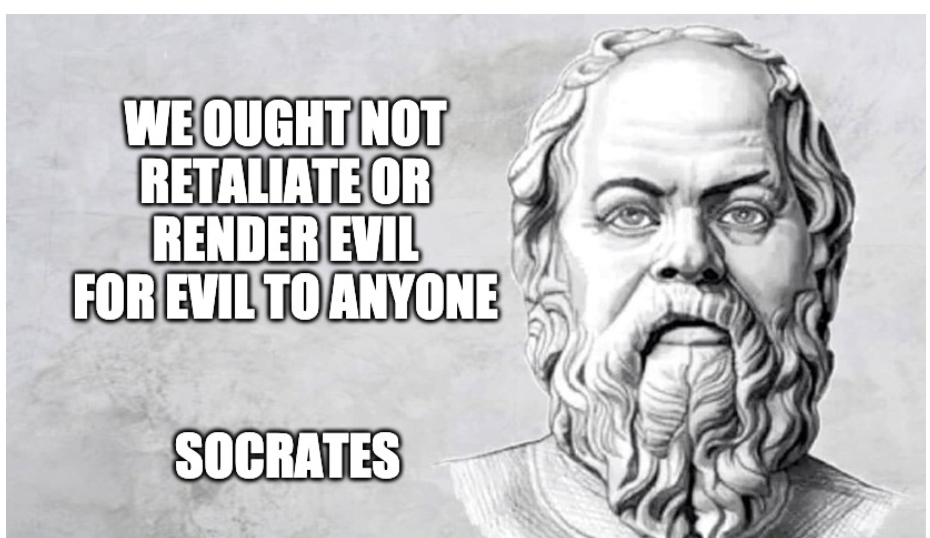
Philosophy and religion provide a critique of toughness. A more tender-hearted morality is espoused by Socrates, who argued against Thrasymachus’s hard-hearted worldview. Socrates said, “we ought not retaliate or render evil for evil to anyone.”

Jesus said something similar. But Jesus went a step further in his advocacy of love. Not only are we to love our neighbors, we are even supposed to love our enemies.

Tender-hearted morality looks beyond the distinction between friend and enemy. It judges things impartially. It sees dignity and worth in all persons. It respects everyone equally. It forgives and shows mercy. It wants to transform enmity into community.

Tender-hearted morality elevates love above power. It thinks that gentle kindness is superior to tough-minded ferocity. Instead of seeking favors, soft hearts give without expectation of payback. Instead of a loyalty and revenge, tenderness calls for hospitality and compassion.

Tough guys will see tenderness as foolish. Softness shows weakness and vulnerability. In a tough world, enemies will exploit weakness. Those enemies must be defeated. And the cronies and accomplices must be kept loyal. The tough cannot yield. They cannot admit wrongdoing. They cannot offer mercy or seek forgiveness.

The logic of toughness is understandable. But unyielding Scrooges and gritty Grinches inhabit a dark and lonely place. The antidote is to soften up your spine and open up your heart. The Christmas message calls us toward charity and joy. Instead of winning and fighting back, this is a time of giving and forgiving. It is a season that encourages us to set aside the love of power and recall the power of love.

Never too young to change the system, never too old to hope

Fresno Bee, December 15, 2020

The United Nations commemorated Human Rights Day on Dec. 10 with a focus on youth leadership and voice. The UN notes that young people have often been marginalized and ignored. But youth movements are also in the forefront of social change. The motto of this year’s UN’s Human Rights campaign is, “never too young to change the world.”

Youth power is on the rise. Students have taken to the streets in Hong Kong and in climate action strikes around the globe. A 34-year-old woman, Sanna Marin, became prime minister of Finland. And Time recognized 16-year-old climate activist Greta Thunberg as the magazine’s Person of the Year.

Our irascible president reacted to this last development with an insulting tweet directed at Thunberg. He said that Thunberg should work on her anger management issues and just chill out.

Grumpy old Scrooges have often told young people to chill out. They view youthful outrage as a pathetic phase. They mock youthful impatience to fix a broken world.

At the global climate change summit in Madrid, Thunberg said, “The change we need is not going to come from the people in power.” She said world leaders are betraying us by failing the fix the climate crisis.

Young people have often accused their elders of betrayal. The youth refuses to accept a broken system. They won’t tolerate the hypocrisies of business as usual.

Old folks view all of this as naïve. When you grow up, they say, you will grow out of your idealism. But young people don’t know any better. They don’t know enough, yet, to doubt their dreams.

This self-righteous enthusiasm typically fades over time. We mellow with age. Experience shows us patterns that repeat themselves. Those patterns become ruts, familiar and confining. You grow weary of struggle. You prefer stability. You become skeptical of revolution.

REVOLUTION IS JUST AROUND THE CORNER

For the youth, however, things look different. The audacity of youth is hopeful, creative and in love with the possible. Each moment is a new opportunity. The patterns are not familiar. There are no ruts to fall into. Revolution is waiting just around the corner.

These are stereotypes, of course. Some oldsters are radical and hopeful. And some youngsters are cynical. There is nothing sadder, I think, than a young person without hope. And there is something inspiring about old folks who encourage the youth to dream.

Consider Socrates. He was accused of corrupting the youth. He was executed at age 72 for daring to encourage the youth to think for themselves – about politics, religion, and the meaning of life. More recently, at age 79, the French philosopher Alan Badiou wrote a book explaining his desire to “corrupt the youth” by turning them away from a typical life spent in endless pursuit of power, money and gratification.

Badiou calls on us to live “a true life.” That would be a life of wisdom that is deeply critical of the hypocrisies of the status quo. To corrupt the youth is to help them become authentic. This means, “to try to ensure that young people don’t go down the paths already mapped out, that they are not condemned to obey social customs, that they can create something new.”

This “something new” is the key to hope. We don’t know what the youth will give birth to. Hope embraces an unknown future, betting that whatever comes tomorrow will be better than today. This is the attitude of youth: a reckless embrace of the future that is not cowed by convention.

Philosophy is not alone in embracing the audacity of youth. The message of youth power is appropriate at Christmas. Christianity began as a youth movement. Mary was a teenage mother, after all. And Jesus was only 33 when he was crucified. It was the old establishment that left Mary out in the cold and rejected the gospel of love.

So let’s hear it for corrupting the youth and empowering them to change the system. The system is broken. Its old cronies are bitter Scrooges and angry Trumps. But something beautiful and different is waiting to be born, if we let it. You are never too young to change the world. And you are never too old to hope.

Impeachment and Enlightenment Democracy

Fresno Bee, December 8, 2020

In this winter of discontent we discover that democracy contains a dark side. We should lower our expectations without giving up hope.

The president suggests that Democrats do not love our country. The Democrats claim the president betrayed his oath of office. Americans are so divided about impeachment that it often seems that we live in different universes.

But this is to be expected. Free people will diverge. Liberty leads to discord and disagreement. We even disagree about what counts as reasonable. The challenge is to accept this, the cold shadow of democracy, without giving in to cynicism.

The ideal version of enlightened democracy is sunny and enlightened. It imagines virtuous citizens meeting together in public to deliberate and reach reasonable consensus. The losing party would graciously concede, while admitting that the process was fair and their opponents were worthy.

Enlightened democracy is republican in the classic sense, where a republic is a government based on the public good (in Latin, the “res publica”). Thomas Paine explained, for example, “Republican government is no other than government established and conducted for the interest of the public.”

The enlightenment dream is of public-spirited and rational citizens sharing a common understanding of the good of the community. They would have faith in the intelligence and good will of their opponents.

A phrase from Thomas Jefferson explains the genteel dream of enlightened deliberation. In a letter to John Adams, Jefferson describes the two of them as “rational friends” despite their deep disagreements. Jefferson said, “you and I differ; but we differ as rational friends, using the free exercise of our own reason, and mutually indulging its errors.”

In these winter months, Americans no longer view one another as “rational friends.” We appear to lack a common vision of the good life. We believe in different facts. We suspect treasonous malice in the other. And we disagree about what is reasonable. This makes public deliberation impossible.

The impeachment hearings are sterile debates, not collegial deliberations. The participants in these “hearings” do not listen. Instead, they talk past each other. Each side has already decided what it believes. There is no effort to find common ground. And each side blames the other for being irrational and partisan.

We are witnessing what is sometimes called “agonistic” democracy. This is democracy as strife, struggle, and conflict (in Greek, “agon” means competition). Agonistic democracy is not about building rational friendship — it is about defeating political foes. The focus is on gaining partisan advantage. The goal is to build power, not to achieve rational consensus.

Agonistic democracy is full of dirty tricks and Machiavellian maneuvers. Fallacious arguments are made. Facts are ignored. And reason is left out in the cold.

President Trump is a master of this game. But he did not invent it. It is an old game familiar to Socrates, Shakespeare, and to the founders.

James Madison warned that people can be “blinded by prejudice” and “corrupted by flattery.” We are prone to error, delusion, and the tyranny of the passions. The system of checks and balances seeks to mitigate the damage caused by the “violence of faction,” which is the “mortal disease” that destroys democracy.

The partisanship in D.C. can leave us disillusioned and cynical. Cynics give up on the dream of rational friendship and public deliberation. When we succumb to cynicism, we sink further into the abyss of Machiavellianism, with violence lurking around the corner as the irrational nadir of a world gone mad in pursuit of power.

Madison’s remedy is the checks and balances of the Constitution. But we also need hope that this dark winter too shall pass. History moves in waves. There are moments of cold-hearted darkness. But the spring will come again — so long as we don’t burn the bridges that can lead us back to rational friendship.

In the same letter that Jefferson wrote to Adams, he noted that he and Adams were both too old to change their opinions. It may be too late for friendship to bloom in the winter years of the Trump-Pelosi generation. But the younger generation can do better. Let’s teach the youth to be better: to be more rational, more republican, and more friendly.