Vigilance, Patience and Hope: The Drive Toward Enlightenment

Fresno Bee, December 27, 2020

On the longest night of the year, we drove through the fog looking for starlight. Other people had the same idea of driving uphill to see the conjunction of Jupiter and Saturn. In a parking lot in Prather, carloads of masked stargazers emerged from the fog and looked toward the heavens, seeking the Christmas star.

We are all looking for inspiration these days. If you rise above the fog, there are wonders to be found.

The last time the planets lined up like this was 800 years ago. The stars move at their own pace. We must learn to wait and keep our eyes open. The philosopher Marcus Aurelius said that stargazing washes away the filth of the earth. The cosmos teaches patience and perseverance.

This was a star-crossed year. Disease killed people and jobs. Our democracy teetered on the brink of disaster. Let’s drink a toast to all we’ve lost and endured. Let’s also learn from the light that shined in the darkness. If there is wisdom in the gloom, it comes from the values of the Enlightenment. It was science and law that prevented 2020 from being darker than it was.

When the Black Death hit Europe in the Dark Ages, astrologers blamed it on a triple conjunction of Jupiter, Saturn, and Mars. We know much more today about the stars and about disease. We know how to prevent contagion and predict the weather. We peer into the molecular basis of life and into the depths of space. We build vaccines and satellites. Let’s give thanks to the scientists who shed light.

One of the wonders of 2020 was the growth of virtual reality. Satellites, computers, and cell phones kept us connected in the gloom. Without these technologies, social distancing would have been impossible. Let’s give a shout out to the wizards of Silicon Valley.

Telecommunication transformed the field of education. Difficulties remain, including educational inequity and a digital divide. But students are learning in ways that could not have been imagined last year. Hurray for the educators — and the students and parents — who pioneered a new model of teaching and learning.

Our civic values were challenged in unprecedented ways. The year began with impeachment. It ended with outrageous falsehoods about a stolen election. This was a year of protests and anger. We are more polarized than ever. Racial animosity afflicts us. There is corruption in the halls of power.

But citizens enlightened ourselves about history and the Constitution. And ethical professionals held back the darkness. Lawyers and judges remained committed to their code of ethics. Soldiers, cops, and firefighters did their duty. Business leaders supported justice and the common good. Nameless bureaucrats served with honor and integrity. Enlightenment depends upon the good work of citizens and civil servants.

As this pestilential year comes to a close, what should we resolve for the future?

I propose we need to affirm the value of vigilance. “Eternal vigilance is the price of liberty,” they say. This is common sense for those who drive through fog. We must be mindful and alert. Watchful care is the key to enlightenment.

Vigilance is the moral of Albert Camus’s novel, “The Plague.” That book is an allegory about the plague of totalitarianism in the 20th century. Camus noted that plagues stimulate enlightenment by opening our eyes. We must learn “a vigilance that must never falter.” The good man, Camus said, “is the man who has the fewest lapses of attention.”

The stewards of civilization must be watchful, as we drive toward the light. New diseases are waiting to infect us. A random sneeze can start a pandemic. Tyrants and crooks wait to take advantage. Indifference leads to disaster.

Enlightenment is not something that just happens. Our scientific and technological prowess is the result of centuries of cultural evolution. Our legal system has a similar heritage. And the work of education is never done.

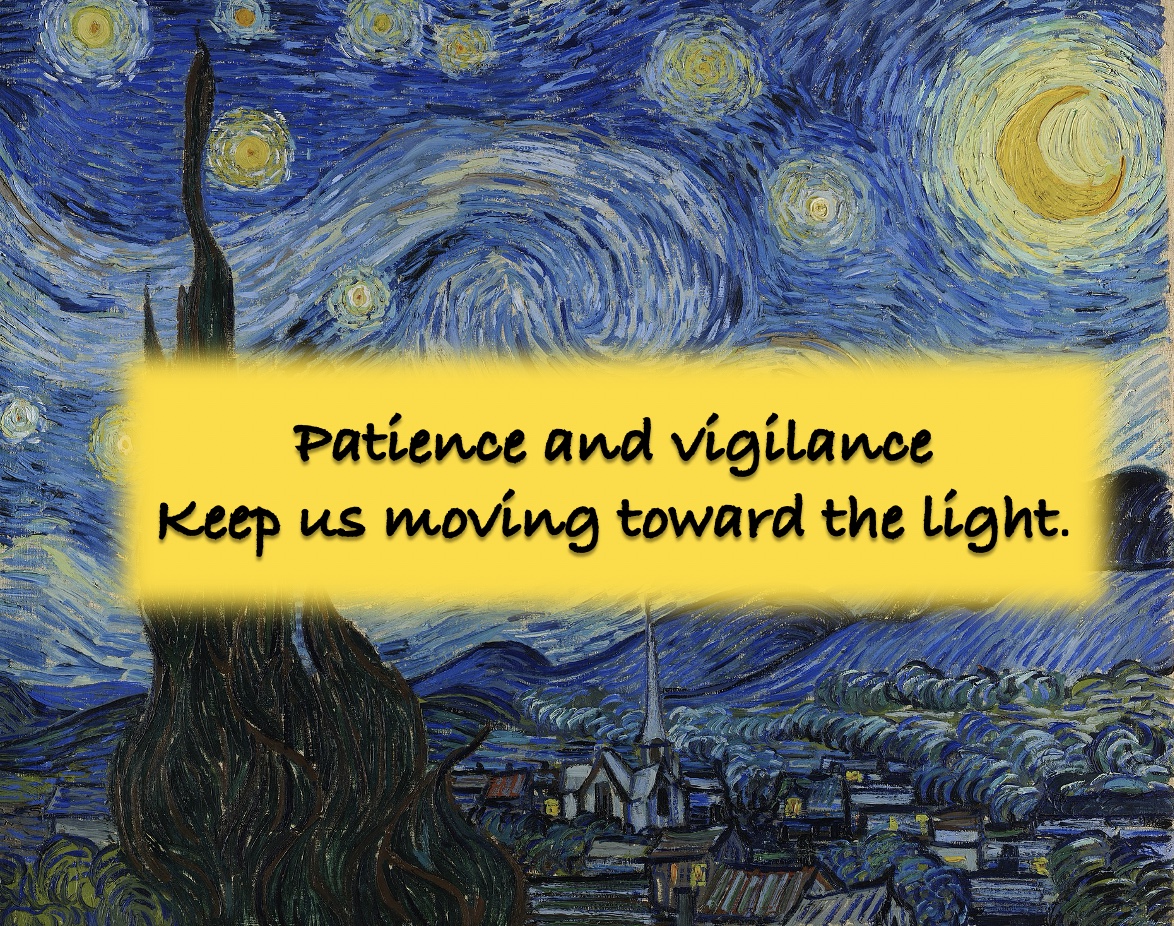
On sunny days, it’s easy to let your guard down. When the fog comes, it is easy to lose hope. But there are stars above the haze. Good and decent people live nearby. Science and reason provide hope in the darkness. Patience and vigilance keep us moving toward the light.
This is Not the Worst Year Ever

Time magazine declared 2020 “the worst year ever.”  That’s obviously not true.  In the 1850’s, millions were held in slavery.  In the 1860’s, over 600,000 Americans died in the war that freed those slaves.  One hundred years ago, the Spanish flu killed 675,000 Americans, while women struggled to gain the right to vote.  Our current troubles are minor in comparison.   

Time magazine’s hyperbolic headline can be forgiven as a ploy to sell magazines.  But people succumb to hyperbole.  We tend to magnify present suffering.  And that can impede critical thinking.   

History is not one story, it is many.  When historians look back on 2020, they will see failure that caused unnecessary suffering.  But they will also witness ingenuity that mitigated harm.  We should learn from our successes—and from our failures. 

Some of what we suffered in 2020 was the result of human greed, ignorance, and pride.  The Covid-19 death toll was made worse by selfishness, ignorance, and lack of leadership.  The fires in California were the terrifying result of human-caused climate change.  The social divisions and racial tensions of 2020 are the result of systematic stupidity and political polarization. 

But human intelligence prevented things from being even worse.  Health care systems evolved.  A vaccine was developed.  There were government bailouts.  School teachers invented online learning.  Firefighters demonstrated heroism.  And Americans educated themselves about racism and the American Constitution. 

Life includes both tragedy and triumph.  We fail.  We suffer.  We learn.  And we grow.

Resilience is a process of growth and development.  Resilient people generally avoid absolutism and hyperbole, which cause despair.  Defeatism undermines the spirit of invention, discovery, and growth. 

Consider a recent essay by Chris Hedges on cultural despair.  Hedges warns that despair can fuel the wish for magical solutions that can turn into fascism.  I’m sympathetic to his critique.  But Hedges’ assessment is itself dispiriting.  Hedges gives voice to despair.  And this leads him to conclude that reform is impossible.  He concludes that we are faced with a choice between tyranny and revolution. 

Hedges’ dilemma is typical of despair.  We tend to dwell on the darkness without noticing the light.  But history is more complicated than a stark choice between tyranny and revolution.  And there is no such thing as “the worst year ever.” 

Evaluation is relative and evolving.  Some people fell in love in 2020.  Others died.  Some families had children.  Some experienced divorce.  Some people began new careers.  Others lost jobs.  Art was created and scientific discoveries were made.  But businesses failed and crimes were committee.  For some people, 2020 was a great year.  For others, it was miserable. 

And yes, there was Donald Trump.  But there were also movements of social protest.  The Constitution was tested.  But the system worked.  Polarization increased.  But decent people sought common ground.

We must resist oversimplifying when we judge.  These are not the best of times.  Nor are they the worst of times.

Some new age advocates of mindfulness celebrate “non-judgmental awareness.”  There is value in this.  But non-judgmental presence is only a tool and a mood.  We need to judge things.  Judging helps us learn, invent, and improve.  But we need to be judicious in judging—moderate and prudent. 

We can learn a lot from acceptance and gratitude.  The mind can be sharpened by quietness and presence.  Thinking and learning require judgment and discrimination.  If we practice pure acceptance, we will never learn anything. 

If we are overly judgmental and hyperbolic in our judgments, we will also fail to learn.  We have to see what works—and what doesn’t.  We must also remain open to the new and the different.  We must be creative and inventive in our response to the world.

To say that this was the worst year ever is a kind of cop out.  It is a shoulder shrug and a sigh.  Shrugs and sighs are OK—for a moment.  Then it’s time to roll up our sleeves and get back to work.  Instead of dwelling on what went wrong, let’s learn from our mistakes.  We can also learn from our successes.  And with some luck and a lot of labor, the next year may be better than the last.

Democracy is like Santa Claus. It only exists if we believe it does.

Fresno Bee, December 13, 2020

Democracy is like Santa Claus. It only exists if we believe it does. Many Americans would like to say, “Yes Virginia, there was a legitimate election.” But the Scrooges are saying, “Bah, humbug.”

A number of Americans believe that the election was stolen. One poll reports that half of Republicans believe Trump “rightfully won” the election. Another poll found that 62% of Republicans say it’s “very likely” that the election was stolen by Democrats.

This means that when Joe Biden is inaugurated, many will view him as a shopping mall Santa, sitting on a throne of lies.

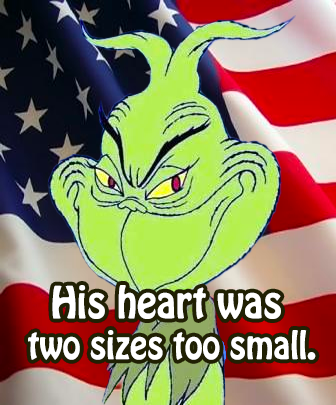
We are at a dangerous crossroads. If what the president says is true, the Democrats have stolen our republic. If what the president says if false, then he is the Grinch hijacking our democracy.

It is difficult to tell how serious this is. It is one thing to say you don’t believe in Santa. It is another thing to stop celebrating Christmas.

We’ll see how this cookie crumbles after the Electoral College votes and someone is inaugurated. Will the nonbelievers choose to act on their disbelief? If so, let’s hope that their actions are nonviolent. To protest non-violently is the nonbelievers right, grounded in the First Amendment. But violence is extra-constitutional and revolutionary.

Nonbelievers might stop paying taxes, for example. Of course, tax resisters will be prosecuted. But that is the point. Nonviolent protesters go to jail to protest a corrupt system.

I am not advocating this. I happen to believe the state election officials, the courts, and other experts who concluded that the election was legitimate. But this whole system is based upon faith.

Like Christmas, democracy is a ritual and a pageant. At some point we make a leap of faith and choose to play along. People have a right to stop playing along. But there are consequences.

One famous defense of playing along begins by saying, “Yes, Virginia, there is a Santa Claus.” Francis P. Church said that Virginia and her 8-year-old friends had been “affected by the skepticism of a skeptical age.” He defended the importance of “childlike faith” in magic, poetry, fantasy and romance.

Government also involves fantasy and faith. A flag is a piece of cloth. A law is merely words on a page. These things come alive when we believe in them.

Francis Church wrote that the best things are those we cannot see. He spoke of Santa Claus as a metaphor for the hidden wonders of the world — for love and beauty, meaning and transcendence.

He could as well have been talking about democracy. Like Christmas, democracy exists in the minds of men and women. It only exists when we play along. When people stop playing along, the fantasy ends. If enough people stop playing along, the whole thing collapses.

Perhaps skepticism is warranted in this skeptical age. We know that there really is no Santa Claus. And as the partisans squabble, it is increasingly difficult to believe in the idea of America. Maybe it is time to wake up from the dream of e pluribus unum.

But it’s worth asking what we would wake up to, if we stopped playing along. If we give up on the dream of democracy, what would replace it? If we stop believing in America, then what?

Christmas is a good time to think about what we believe.

Do we believe in country more than party?

Do we have faith in democracy or not?

Christmas is also a time of transformation.

After the Grinch stole Christmas, he was surprised. The Grinch thought that if he stole the tree and the presents, the Whos of Whoville would have nothing to celebrate. But they came together and sang anyway. And the Grinch’s heart grew.

The Grinch learned that Christmas doesn’t come from a store. He learned that Christmas “means a little bit more.”

When we wake up from this nightmare winter, will we learn something similar?

The future looks bleak. But this is also a season of hope.

So let’s hope that if there are protests, they remain nonviolent.

Let’s hope that we can sing in harmony again.

And let’s hope that the Scrooges and Grinches will decide to play along.

Horseshit and the Human Condition

Why do snake-oil salesmen and con men succeed?

Because human beings have a great appetite for horseshit. 

Horseshit is a term that I learned from my grandfather, who was one of the world’s great artists of profanity.  My grandfather taught me a lot of interesting things, for example, that H. was Jesus’s middle name.  Like other men of his generation, grandpa distinguished horseshit from ordinary bullshit.

Kurt Vonnegut said that we prefer useful and comforting horseshit.  Hemingway defined horseshit as abstract, metaphysical nonsense.  Jack Kerouac warned that the world was trying to drown us in horseshit.

The philosopher Harry Frankfurt described bullshit as speech divorced from truth.  Horseshit is like bullshit.  But while bullshit entertains, horseshit seduces. 

A story about the fish that got away is bullshit.  A conspiracy theory is horseshit. 

Horseshit tantalizes.  It promises false nourishment.  It’s dangerous because it’s trying to sell you something.

I used to hike with my dogs on a horse trail.  They couldn’t resist the stench of fresh manure.  They would gobble it up by the mouthful.  And then they would vomit.

Human beings are similar.  We swarm to warm piles of nonsense and gorge on garbage. We humans are not typically interested in truth.  We prefer ideas that flatter and gratify.  We want to be titillated and entertained.  Truth is boring.  We prefer strong and spicy narratives.   

Malicious agents know how to manipulate this.  They spread horseshit.  And we buy it.

As my grandfather used to say, there are more horse’s asses than horses.

All of this helps explain the ordure oozing out of the White House.  Courts and election officials have repeatedly confirmed the validity of the 2020 election.  But Presidential power burnishes bullshit with the sheen of authority.  Prominent Republicans refuse to point out that the emperor’s new clothes are stained with runny hair dye. 

My grandfather would have asked a simple question about all of this.  Which is more likely—that there is a vast secret conspiracy to steal an election in “the U.S. of A.” (I can hear him adding “for chrissake”…) or that Trump is spreading horseshit?    

Horseshit is not unique to the Trump Era.  In 2004, Ralph Keyes published a book called “The Post-Truth Era.” Keyes pointed out that George W. Bush lied and manipulated the truth about the Iraq war.  But before Bush, Clinton lied, as did Nixon.  And so on—back to Caesar and Pericles.

In a recent op-ed, Nicholas Goldberg reminds us that lying is part of the arsenal of authoritarianism.  He cites George Orwell and Hannah Arendt to make his point.  But horseshit is as old as Plato. 

Plato did not like the bullshit stories of Greek religion.  He thought those myths taught the wrong lessons to the gullible masses.  Plato suggested that the philosopher-king should create new myths to manipulate the masses into buying his utopian scheme.  Thus Plato suggested replacing ordinary bullshit with tyrannical horseshit. 

Bullshit and horseshit have existed since human beings began talking.  Hunter-gatherers told bullshit stories around the campfire.  That is how art and religion were born.  Bullshit became horseshit when the shamans began profiting off those stories. 

Horseshit is meant to manipulate.  The bullshit artist is a lightweight in comparison to the horseshit hawker.  The bullshit artist is a good-natured raconteur.  But the horseshit vendor takes advantage.  Bullshit is playful and light.  But horseshit is denser and tastier.  It often even seduces those who sell it into believing that the manure they are spreading is true.

At some point reality bites back.  But often it is too late.  When your dog gorges on manure, he’ll eventually vomit.  But it is better to avoid the binge and the purge. 

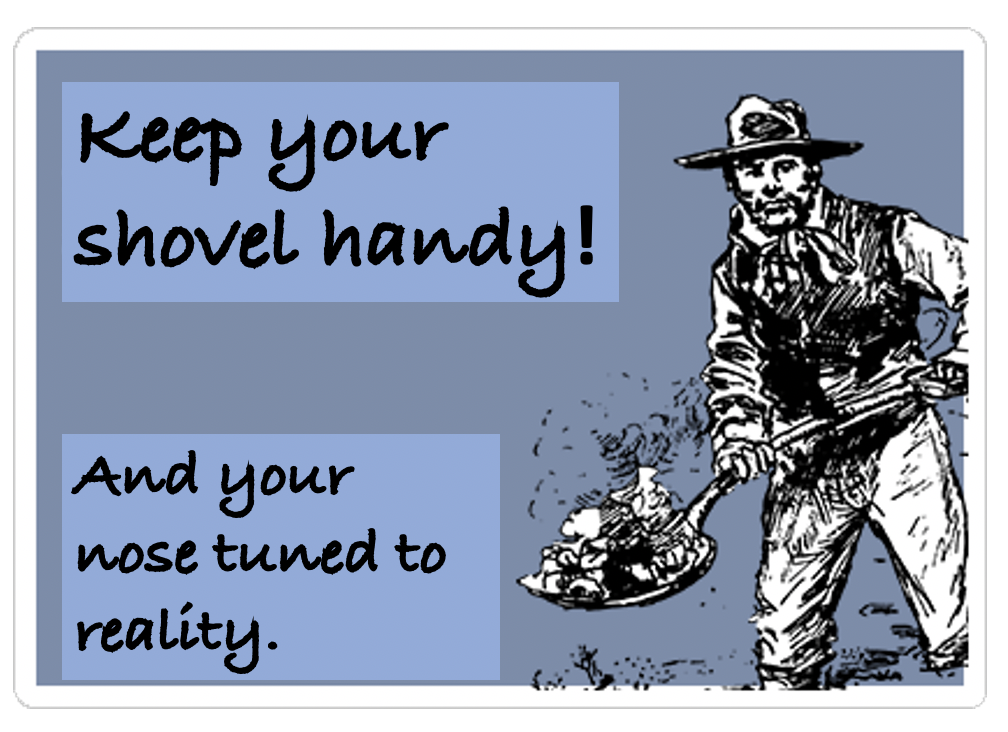
The cure for all of this is fresh air and a good shovel. 

To see beyond the horseshit, Kerouac climbed a mountain. There is wisdom in taking a moment to rise above the stench. 

But you don’t need a mountain top to climb above the horseshit.  You only need self-control and a skeptical spirit, critical thinking and the scientific method.  Political checks and balances also help.

Stay focused on what is true.  Attune your nose to reality.  Feed your soul on nourishing ideas.  And don’t let anyone sell you a load of manure.

Responsibility and Fanaticism

Fresno Bee, November 29, 2020

Last week, Bishop Joseph Brennan of the Diocese of Fresno gave an ethical warning about COVID-19 vaccines. In a video message, he said that if a vaccine were “developed with material from stem cells that were derived from a baby that was aborted, or material that was cast off from artificial insemination of a human embryo, that’s morally unacceptable.”

The bishop warned that the Pfizer vaccine may be morally suspect. In response to Bishop Brennan’s warning — and a similar warning from Texas Bishop Joseph Strickland — the U.S. Conference of Catholic Bishops clarified that the Pfizer vaccine is not connected with embryonic stem cell research.

This controversy is an example of how moral conflict unfolds. It is important to get the facts right. But we disagree about fundamental values. We also disagree about the nature of moral responsibility.

The bishop begins with an assumption that most people would accept. He said that we should “always and only pursue vaccines that are ethical.” But we disagree about what counts as ethical.

Pro-life Catholics see embryonic stem cell research as unethical. Other people deny that human embryos are persons and do not see a problem with stem cell research. Others may argue that if a vaccine can save thousands of lives, it is a good thing, even if it is derived from a questionable source.

And what about individual responsibility? The bishop has a demanding sense of responsibility. If a vaccine has immoral sources, he says, we ought not use it — no matter how far away in the causal chain those immoral sources are, and no matter how beneficial the vaccine.

The bishop suggested a fascinating analogy with recent anti-racist arguments. Some anti-racists argue that since the U.S. was founded on the sin of slavery, Americans remain responsible for this today. The bishop suggested that biomedical research that is founded on the sin of abortion has a similar moral taint.

The idea seems to be that moral identity is structured by choices made within a history that is beyond our control. This is related to the activist’s slogan that silence is complicity. It is not enough to avoid actively doing evil, you must also free yourself of the moral taint of history and institutions.

This heroic moral standard has been applied in a variety of other cases by uncompromising activists.

Animal welfare activists argue that our fast food economy is based on industrialized cruelty to animals. They demand that we become vegetarian.

Anti-poverty activists argue that global capitalism is based upon systematic exploitation of the poor. They argue we should give surplus wealth to the poor.

Anti-war activists argue that the American way of life is based upon militarism and conquest. They refuse to pay taxes that support the war system.

Anti-abortion activists claim that abortion contaminates sex education and women’s liberation. They refuse to support women’s health care that includes abortion.

And so on.

Heroic responsibility asks us to take action to stand up for our values. There is something noble about this. We admire uncompromising souls who live a life based on principle.

But moral heroism is often in the eye of the beholder. The heroes we admire are those we agree with. Those who cling to other values, we call zealots and fanatics. Of course, the moral hero wears those accusations as a badge of honor.

All of this shows us the difficulty of living a good life. We disagree about basic principles. We disagree about the facts. We disagree about who has a responsibility to act and about how much each of us should sacrifice.

Realizing the depth of moral conflict can make us humbler. The moral life includes complexities, uncertainties and disagreements. We should be cautious as we proceed. But humility does not let us off the moral hook. It is difficult to be good. But that does not mean we should give up trying.

There is no ethics vaccine. There is only the preventative soul care of moral education. To live a good life requires the hard work of thinking. Get the facts. Question your values. Understand the systems, histories and institutions that you inhabit. And try to be a hero without becoming a fanatic.