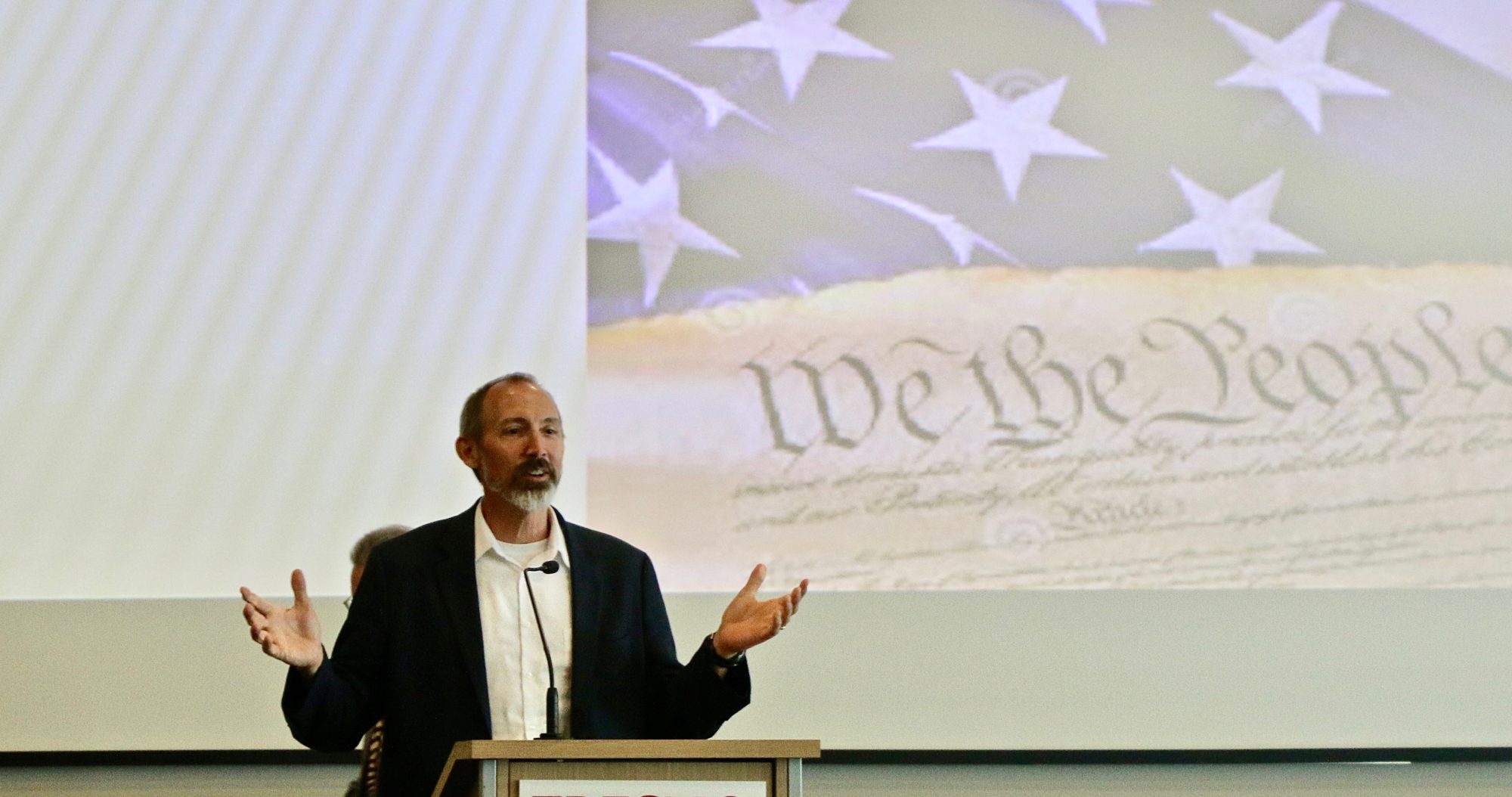
Secular Freedom and Respect For Marriage: Why the Culture Wars are Getting Old

Fresno Bee, December 4, 2022

As the Respect for Marriage Act passed the Senate, the culture wars resurfaced. This law will guarantee that same-sex marriages and interracial marriages are respected. In response to the Senate vote, President Biden said, “love is love, and Americans should have the right to marry the person they love.”

I agree that this is good news for love. But didn’t we already resolve this issue? Well, the Supreme Court threw things into disarray with its Dobbs decision earlier this year, which called into question the idea of a “right to privacy.”

And while Biden praised the legislation, not everyone agreed. One commentator, R.R. Reno, editor of the conservative Christian magazine First Things, said that what he calls “the Rainbow Reich” was trying to radically restructure society. He said that the ruling elites are “determined to drive our country into a ditch.”

Albert Mohler, the president of the Southern Baptist Theological Seminary, responded by saying that the Senate had “voted to redefine marriage, weaken society’s fundamental covenant, and threaten the religious freedom of Americans who, by religious conviction, cannot join in the legislation’s revolt against marriage and family.” He saw this legislation as a sign of “civilization crumbling.”

This hyperbolic language prompts a big sigh. When a civilization crumbles, you might expect marauding enemies. But letting people who love each other get married hardly seems to qualify as the end of civilization. This culture war re-run is a dud. It’s worth noting that 12 Republicans voted for the legislation. And those who opposed it seem like Scrooge at Christmas.

Biden himself was once opposed to gay marriage. He voted in favor of the Defense of Marriage Act in the 1990s. But society evolves and attitudes change.

Indeed, there is a growing acceptance of marriage equality. According a recent Pew Center survey, most Americans (61%) think it is good that same-sex marriage is legal. This opinion is more prevalent among the young: 75% of 18-to-29-year-olds are OK with same-sex marriage. For those over 65, that number drops to 50%.

The culture wars are getting old because they are being fought by older people. Young folks are ready to move on. And the warnings of the apocalypse fail to resonate.

But catastrophe is a handy rhetorical tool. Donald Trump is a practiced doomsayer. When he announced he was running for president again last month, he said that the Southern border had been “erased” and that the country was being “invaded.” He said, “The blood-soaked streets of our once great cities are cesspools of violent crimes.”

The merchants of doom hope to draw attention to the product they are selling by proclaiming that the end is nigh. In order for your party to save the world, the world must first need saving. Political and religious rhetoric are often infused with the rhythm and rhyme of doomsaying and messianism.

If you thought that things were going OK, why would you need a politician to save you? And if you were content with life and unafraid of death, what appeal would there be in religion?

The idea that life is pretty good and that there is nothing to fear in death can be traced back to the teachings of the Greek philosopher Epicurus. The followers of Epicurus believed that happiness was easily obtained. They advised people to stay out of politics. And they basically ignored religion. The problem is that politicians and religious zealots have a knack for making us feel bad. A modern Epicurean might add that today’s media can add to our anxiety by amplifying the prophets of doom.

Epicureanism teaches us to stop listening to the prophets of doom. We should focus on easily obtained pleasures. We should mind our own business and leave other people alone to love and live as they want. It’s not true that civilization is crumbling.

Secular systems make life better for everyone because they allow us to enjoy the freedom to live how we want. Things are better today than in former years, when interracial marriage was illegal and when gay people lived in the closet. And if the doomsayers keep preaching about the decline of civilization, they may soon find themselves talking to empty churches.

Read more at: https://www.fresnobee.com/opinion/readers-opinion/article269497617.html#storylink=cpy

Civility and the heckler’s veto: Why yelling is a waste of breath

Reading Time: 4 minutes

Civility may seem like a quaint throwback in our current political era. But it is an essential value for those who esteem rationality and nonviolence. Incivility lies on a violent continuum that includes bullying, harassment, and the heckler’s veto. Civility is one of the peaceful virtues, connected with hospitality, generosity, and a spirit of open inquiry.

Disruptive boors make life miserable. This includes activists who exercise the heckler’s veto and undermine public events. In responding to challenges of civility and the heckler’s veto, universities, such as the UC Hastings Law School, are changing their policies to prevent hecklers from silencing speakers. Nadine Strossen, an ACLU attorney, has argued that there is no right to heckle, since it violates the rights of the speaker and the audience. And some commentary is questioning the very notion of free speech. Free speech is a wonderful thing. But it ought to be guided by the virtue of civility.

The pyrrhic victory of the heckler’s veto

A heckler’s veto occurs when a heckler prevents a speaker from making their point. This has become a recurrent problem on college campuses. I witnessed it recently, at an event I helped organize.

As our invited speaker gave her lecture, a heckler shouted and made her way to the front of the room. The speaker tried to be polite and responsive. She even invited the heckler onto the stage. The heckler continued to yell from the stage, preventing the speaker from being heard. The audience turned against the heckler, booing and jeering. And the event was ruined.

In one sense, the heckler won. The speaker was not able to make her point. We might even think that hecklers have a kind of courage. Heckling may be inspired by a vision of civil disobedience or an anarchist ideal of direct action.

But in another sense, the heckler lost. The crowd turned against the heckler. And the audience became even more supportive of the silenced speaker. After the event, most people praised the speaker for her civility and patience. No one praised the heckler. The heckler’s veto results in a pyrrhic victory similar to the Streisand effect. Heckling tends to direct sympathetic attention to the speaker who has been vetoed.

Politics, power, and persuasion

Protesters have employed the heckler’s veto from both the left and the right. Activists on each side feel that they are justified in disrupting speakers they disagree with. But each side ought to consider what things would look like if the shoe were on the other foot.

In the background is a waste of time and energy—of event organizers and audience members hoping to learn something. The audience might even have learned that they disagree with the speaker. But heckling prevents that from happening. And shouting does nothing to change people’s minds. When a speaker is prevented from speaking, the underlying arguments remain unaddressed.

Heckling does violence to the marketplace of ideas. The remedy for speech with which you disagree is better speech. If someone makes a bad argument, respond with a good one. If someone states a falsehood, correct it. Heckling does not show what is wrong with a speaker’s argument; nor does it offer counter-evidence or present truths that could expose a lie.

Heckling—like harassment, bullying, and more overt forms of violence—can serve a political purpose, if we understand politics as the mere assertion of power. The heckler wins in a short-term struggle for power by silencing speech. Terrorism and other forms of violence do the same thing. But in the long run, politics is not only about power. It is also about justification and rational persuasion. Democratic deliberation aims to build consensus through dialogue and critical discussion. For this to work, we need to hear bad arguments as well as good ones.

The nonviolence of civility

In his Autobiography, Gandhi explained, “Experience has taught me that civility is the most difficult part of satyagraha. Civility does not here mean the mere outward gentleness of speech, cultivated for the occasion, but an inborn gentleness and desire to do the opponent good.” The term that Gandhi uses here, satyagraha is the heart of his nonviolent activism. The term can be translated as “truth force.”

With this in mind, we can understand Gandhi’s point about civility. In the long run, the truth is the most powerful political weapon. And it is good for everyone. When bad ideas and lies are exposed, people change their minds. In order to expose fallacious arguments those arguments need to be heard—and responded to civilly, rationally, and nonviolently.

Gandhi’s nonviolent strategy is not focused on quick victories in the short term. Rather, it is aimed at a long run transformation of ideas and institutions. Civility is essential for this process because it is a pre-condition for critical thinking.

The heckler’s zealotry and patient secular hope

Gandhi’s theory is guided by religious faith. Can we adapt this idea for a secular world?

Secular systems are intimately connected to the ideal of democratic deliberation and the value of tolerance. Tolerant principles of freedom of speech allow dumb ideas to be expressed. Such principles may seem to permit heckling. But heckling is not wise. And it is rude to speakers and audience members.

The secular hope is that good arguments will triumph over fallacious ones. But this is a slow process that relies upon the hard work of human reason. Arguments and persuasion take time to develop. And sometimes bad actors and ignorant folks say stupid things. It may take a long time to disabuse people of dumb ideas. And some people may never be persuaded.

Hecklers and other activists are impatient. The heckler’s zealotry is understandable. They want change to happen quickly. And they do not want to hear from those they disagree with. In exercising a heckler’s veto, zealous activists may succeed in effecting a quick change. But this does nothing to advance the long-term effort at persuasion. The art of persuasion is patient, farsighted, and nonviolent. Heckling, bullying, and harassment can have an effect on bodies, events, and institutions. But they have little effect on hearts and minds.

How old is too old? The promise and perils of gerontocracy

Fresno Bee, Nov. 27, 2022

Is Joe Biden getting too old to be president? There is wisdom in a gracious exit

How old is too old? After Nancy Pelosi announced she was stepping down, at age 82, as the leader of House Democrats, people wondered whether President Biden should follow her lead. Biden turned 80 this week. He is the oldest president we’ve ever had. If he runs for re-election, he would be 86 at the end of a second term.

Some pundits asked whether Biden’s age would affect his ability to do the job. It is natural to wonder about the vitality of octogenarians. We should also consider the question of fairness and the importance of generational shifts. It is wise for older folks to prepare to pass the torch.

There is some truth to the claim that age is just a number. Some 90-year-olds are healthy, smart and engaged. Aging is a matter of probabilities. The odds stack up against us as the years pass. Good genes and good habits can change those odds. There is no on/off switch that suddenly clicks at 80. But vision, hearing, mobility and memory do tend to decline over time.

And yet, there is also some truth to the idea that we gain wisdom as we age. This is not true of everyone. But we can learn from experience. The passage of time provides a sense of perspective and proportion. What appears as a novel crisis for a 20-year-old is “more of the same” for someone who is 80.

Most traditions imagine that wisdom and old age are connected. Plato suggested that as the burning desires of youth are quenched, the mind is set free to focus on higher things. Confucius said something similar. According to Confucius, it is not until we reach 70 that virtue and desire come together. The sages of the ancient world were old folks with a faraway look in their eyes.

Some cultures also value “gerontocracy,” which is a fancy word for rule by elders. This may work well, if our elders are wise and civic-minded. But gerontocracy may also create a system in which crabby old geezers cling to power, refusing to make way for new ideas.

Aristotle was critical of gerontocracy for that reason. He criticized the idea of lifetime tenure for judges, for example. He said, “there is old age of mind as well as of body.” He suggested that some people may be too old to judge wisely. A

nd what about fairness? If one generation dominates leadership positions, is that fair to those in other generations? When Nancy Pelosi announced she was stepping down, she said, “the hour has come for a new generation to lead.”

This is a nice way of putting it. There comes a time, when elders need to make way for the next generation. There is no alarm clock that tells us when that moment has arrived. But it is wise to keep the succession process in mind and to plan for passing the torch.

One rationale for this generational hand-off has to do with creativity and innovation. Human beings are creatures of habit. We tend to prefer the stability of well-worn ruts. But in politics, business, and art, those ruts can become quagmires. Organizations need fresh ideas and new blood.

And what about the ambitions of those who are waiting in the wings? The understudies need their chance to shine. But when the old guard hogs the limelight, the back-ups never get to learn how to play the lead.

This applies to all fields of human endeavor, including sports. In the NFL, the generation of Aaron Rodgers and Tom Brady is ending. It’s sad to watch former heroes fall into mediocrity. And the second stringers need playing time in order to get good at the game.

Of course, we understand why Brady, Rodgers, Pelosi, and Biden want to stay in the game. It’s fun to play. And they have talents they want to share. There is also a crew of agents and sycophants who have vested interests in keeping the old guard in place.

But as Ecclesiastes puts it, “for everything there is a season.” It is wise to make a graceful early exit than to linger too long at the party, while clinging to fading glory.

Read more at: https://www.fresnobee.com/opinion/readers-opinion/article269144787.html#storylink=cpy

Could the rise of the nonreligious defuse the population bomb?

Reading Time: 4 minutes

Fifty-four years ago, in 1968, American biologist Paul Ehrlich warned that a human “population bomb” threatened global catastrophe. The world’s population at the time was 3.54 billion.

On November 15, 2022, the UN estimate of Earth’s human population flew past eight billion.

This “population bomb” is only partly to blame for climate change and other unfolding catastrophes. We might be able to sustain a population of eight billion if each of us consumed and polluted less, especially the affluent hyper-consumers of the developed world. But it would also help if there were fewer of us consuming and polluting.

But where did all of these people come from—and how might we slow that growth?

There is a strong argument to be made that religious belief and practice are a major part of the problem, and that increasing secularism could be part of the solution.

When pro-natal ideology meets modern technology

There is a variety of contributing causes to the explosion of human population during the past few centuries, the most obvious being the Industrial Revolution, the Green Revolution in agriculture, and related revolutions in medicine and healthcare. These innovations have made it possible to produce more children who survive long enough to produce more children of their own.

But reproduction is not merely a biological fact. It is also influenced by cultural, social, and psychological factors. The problem is that the new technologies of modernity arrived in a world that is structured by pre-modern worldviews that are pro-natal. Pro-natal ideologies worked well enough in previous millennia when child mortality and death were more common. But as we’ve developed better medicine and agriculture, pro-natal ideas no longer make sense.

On average, religious people have more children

The most obvious sources of pro-natal ideology are religious. Let’s put this bluntly: Religious people have more babies. This is especially true for orthodox or fundamentalist versions of religion, which tend to have a pro-natal ideology.

This point was made over 10 years ago by UK professor Eric Kaufmann in the book Shall the Religious Inherit the Earth? I discussed it in my own work a couple of years after that.

While the religiously unaffiliated worldwide have an average of 1.6 children per woman, Christians average 2.6 children and Muslims 2.9 children worldwide. Some smaller religious groups outstrip even these, such as US Mormons at 3.4 children per woman.

The basic pro-natal idea in the Abrahamic faiths can be traced to God’s command to Noah after the flood: “be fruitful and multiply.”

The pro-natal orientation of religion was confirmed by a recent report by Lyman Stone in Christianity Today that indicates fertility rates are higher among those who regularly attend religious services. Stone published a related report for the conservative Institute for Family Studies where he argues that even though religious women have more children, the rapid growth of secularism in the United States means that the US population will decline.

Stone notes correctly that nonreligious women have fewer children and that conservative religious women tend to have more children than women who are members of more liberal faiths.

Stone seems to want the general population to continue to grow, but his apparent central purpose is to sound the alarm of religious decline. One solution, he concludes, is for religious congregations to encourage women to have more children.

External messaging of this kind can actually have a noticeable effect: Research at Cornell University in 2021 found that even living in a secular country reduces the birth rate and family size of religious believers in that country.

Liberal religion and non-religion may slow reproduction

The empowerment of women is key to addressing the ecological crisis and the population boom. Women with education, contraception, and meaningful careers tend to have fewer children. Traditional patriarchal religious beliefs tend to keep women subordinated and confined to domestic life. That’s why liberating religion from patriarchy may be one way to slow population growth.

Among the most important factors here is the liberation of sexuality from reproduction. The human sex drive is powerful. But religions that are opposed to contraception actively refuse to restrain reproduction in other ways as well.

Furthermore, as secularism grows, it is worth reconsidering more broadly the pro-natal worldview. In a world of eight billion people (and counting), it is simply reckless to listen to the command to go forth and multiply. The Biblical basis for this idea ought to be critiqued. There was no flood, and humanity did not develop from Noah’s seed. Rather, we evolved as one species among many. Our big brains and upright posture allowed us to develop technologies, social systems, and ideologies that led us to conquer the earth.

The time has come to apply new technologies, social systems, and ideologies to help us avoid ecological collapse.

We already have the main technological tool we need: contraception. Now it’s time for social systems and ideologies to catch up, and for human beings to choose to have fewer children.

Population decrease is not misanthropic

The goal should not be active depopulation. Some radical ecological theories see human population as a plague or cancer. Such a misanthropic approach may lead to so-called eco-fascism, a movement that can also be connected to white supremacy. Racist misanthropes encourage the elimination of undesirable others.

We already have the main technological tool we need: contraception. Now it’s time for social systems and ideologies to catch up, and for human beings to choose to have fewer children.

But we can reduce human population without being inhumane or by eliminating actual humans. Rather, we can slow population growth by encouraging responsible reproduction.

Critics of such a policy might call it “anti-natal” and try to link it to some radical authoritarian program such as China’s former “one child” policy. But it would be wrong to force people to stop having children, nor should we be opposed to children and birth. Children are wonderful, and birthing is a mysterious joy. We need new generations to provide new ideas, productivity, and social support.

Life beyond reproduction

But there is more to life than having children. Robust forms of feminism and humanism remind us of this. Women should be free to become artists and scientists, teachers and lawyers—or to have children if they want to. But women’s opportunities are constrained by pro-natal, patriarchal ideologies. And traditional religion often forecloses other non-family-oriented opportunities to find meaning and purpose.

RELATED: You don’t have to ‘be fruitful and multiply’: More Americans having just one child

Humanists need to continue to critique pro-natal and patriarchal forms of religion while reminding people that there is life beyond reproduction. But this critique should not focus on blame and guilt. A grumpy ecologist may wag their finger and say that it is irresponsible to have more than two children per couple. But scolding and blaming are not as useful as focusing on the positives of reduced fertility.

Children are great, but so too is life in a family with fewer kids or none. And in the long run, fewer children means a better life for each of them.

The crisis of democracy: on remaining vigilant without freaking out

Reading Time: 4 minutes

The fiery rhetoric of the campaign trail might make you might think American democracy has failed or is failing. There is declining trust in government, elections, and in democracy itself. And some people are freaking out. This is a crisis of democracy.

But there is no such thing as a stable, happily-ever-after version of democracy. Democracy is always in crisis. Understanding the nature of the democratic beast can help you keep focus, despite warnings of impending doom. Here are a few thoughts about how to remain vigilant without freaking out.

Avoid the rhetorical doom spiral

The Left suggest that we are facing a democratic crisis of unprecedented proportions. President Biden gave a passionate speech on November 3, where he said, “democracy itself” is at stake in the mid-term election. Former President Obama warned in a speech in Arizona on the same day that if Republicans win in Arizona, democracy in Arizona “may not survive.” Obama added, “That’s not an exaggeration. That’s a fact.”

The Right paints a similarly gloomy picture. Former President Trump said, on the day before Halloween, “Our Country is Rigged, Crooked, and Evil.” Meanwhile, according to a Washington Post survey, a number of Republican candidates for governor and senator have already decided that the 2022 elections may be rigged, refusing to say that they would accept the result. These are the folks that Biden and Obama are warning about.

This kind of polarizing doom spiral has led people to talk about “civil war.” A new study from Notre Dame University reports, “Slightly more than half of Republicans (51.5 percent), over a third of Democrats (35.1 percent) and nearly a quarter of independents (23 percent) believe the United States is on the brink of a new civil war.” And some delusional people have already acted violently. The gloomy rhetoric can increase the likelihood of political violence, which can, in turn, increase our feeling of doom.

Remember things could be worse

The actual American Civil War brought terrible destruction, with as many as 750,000 fatalities. A hundred years later, the 1960’s was a decade of political violence. And until that decade, our country’s racial inequities existed in obvious tension with the lofty rhetoric of our founding ideals. For women, non-whites, and LGBTQ people, the 2020’s are better than the 1920’s or 1820’s.

And other democracies don’t inspire much confidence. The U.K. has had an embarrassing year. Israel seems to be in perpetual crisis. Italian democracy is a punch line. And in Japan, the former prime minister, Shinzo Abe, was murdered.

Things could get worse here. But they are better now than they were. Our democracy has matured and expanded. But democracies are unstable. And there is no cure for this instability other than the patient work of democratic citizenship. It also helps to tune out the doomsayers and polarizing rhetoric that breeds over-reaction.

Recognize the boredom of diminishing returns

When you note that things are better today, it is surprising that trust in the country and faith in democracy is eroding. One problem is that some people don’t like these improvements. White supremacists are not happy to have been displaced (or as they might put it, “replaced”). 

But American crankiness extends beyond the fringe. Some of it has to do with a more general sense of dread about climate change and pandemic disease. The iPhone era has also left us disconnected and distracted. And traditional religion no longer unites us with a common source of meaning and community.

I also suspect that we are suffering from a psychological problem related to the so-called hedonic treadmill. As we pursue happiness, we don’t seem to make progress. But that’s because our sense of progress is calibrated to a basic “set point” in the happiness thermostat.

Democratic progress is inspiring when it first occurs. But the joy of success soon fades, as we become used to a new normal. The excitement of change soon gives way to the grumpy boredom of the status quo.

It is a thrill to witness key moments of democratic enlightenment. The fall of the Berlin Wall was a time to celebrate. But after the Wall came down, the thrill of progress became the hard work of reunification. Incremental change from a new set point of democracy can appear paltry and sad, as the law of diminishing returns undermines the feeling of progress. So, we become bored and apathetic.

Beware the rabble-rousers

And when things are going well, some moron will organize a witch hunt. And then we’ve got a new crisis of democracy.

The average American voter is mostly indifferent to politics. We’re busy with our own lives. We don’t trust the system or the politicians. We are turned off by polarization. And, as mentioned, we are living in a much better time in terms of human rights.

To get our attention, the politicos crank up the volume, thinking that fear and polarization will get us going. These rabble-rousers use hyperbole and vitriol, while playing on our emotions.

Among the most effective rabble-rousers is former-President Trump. He’s got a knack for seeing witch hunts. And he leads them against those bogeys who supposedly stole the last election. Of course, this provides a great opportunity for the opposing party to use Trump as a foil in order to do a little rabble-rousing of their own.

None of this bodes well for critical thinking or for reasonable political engagement.

Relearn the wisdom of the Constitutional

Plato saw this coming. He warned that the mob would fall prey to the emotional outbursts of a tyrant. He suggested that the cure was a philosopher-king who might save us from ourselves. The American Founders suggested another more democratic solution, which is a written constitution with a separation of powers and regular elections. That stabilizing system was designed to keep the rabble-rousers in check and to prevent the masses from becoming a mob.

The Constitution was not perfect in its conception (it allowed slavery, for example). But it has been improved. And it worked to prevent President Trump from remaining in power, after he lost the previous election. One hopes that it will continue to function. But it will only do so, if “we, the people,” understand it and defend it. The American Constitutional system won’t last forever. Nothing does. But so far, it seems to be doing its job. And it is unlikely that it will fail during this election cycle.