
Humility and Autonomy in the Moral Life

Fresno Bee, October 29, 2023

The moral life unfolds between humility and autonomy. Should we view ourselves as limited dependent beings, who must accept our mortality and fragility? Or should we view human beings as free agents, who can and should take control of our own destiny?

Pope Francis directed our attention to humility in his recent discussion of the climate crisis called “Laudate Deum.” The pope says, “Let us stop thinking of human beings as autonomous, omnipotent and limitless, and begin to think of ourselves differently, in a humbler but more fruitful way.”

Francis is worried about humanity’s arrogant and rapacious relationship to the natural world. Our lack of humility can be applied to a number of contemporary moral problems. Arrogant self-assertion is imposing, cranky and violent. A lack of humility leads to hatred, intolerance, and war. It may explain a general erosion of sexual restraint that occurs when people view other people’s bodies as playgrounds for exploitation. It can explain consumer debt, drug use and other problems of self-restraint.

The pope warns us not to view ourselves as limitless or omnipotent. But we want to do whatever we want, whenever we want to. In doing so, we ignore the suffering we cause to others — and to ourselves. And we cut ourselves off from transcendent sources of meaning. Francis suggests that pride prevents us from finding God in the wonder of creation.

Human hubris has often been viewed as a moral and spiritual problem. Immoderate self-assertion has been criticized by other religious and spiritual traditions. Buddhists warn, for example, that desire and egocentric attachment cause suffering. The basic idea is that arrogance and self-importance get in the way of compassion and enlightenment.

But humility is not the only thing that matters in a meaningful life. A different approach focuses on the importance of autonomy, self-respect and a celebration of human power. Humility can become passive. It can leave systems of injustice in place, while deferring to the status quo. The celebration of autonomy, pride and ambition was behind the American revolution, as the revolutionaries basically said, “We’re not going to take it anymore.”

This kind of assertiveness inspires abused wives to leave their husbands. It encourages oppressed people to flee or fight back. Pride is connected to ambition. It is what causes inventors, artists and entrepreneurs to jump out of bed in the morning and get to work.

Autonomy is fundamental to a number of moral systems, ancient and modern. Defenders of human rights emphasize human freedom, creativity and self-determination. Autonomy is also linked to self-control. The ancient Stoic philosophers claimed that we have the capacity to control our emotions, our thoughts and our behavior. The world may cause us pain and suffering. But the Stoic philosophers claimed we could retreat to the “inner citadel” of the self, where self-mastery always remains possible.

Autonomy is about self-rule or self-government. This is a central idea for modern moral thinking, which encourages us to be self-governing. The great German philosopher Immanuel Kant said we have to have the courage to take control of our own lives. His motto was “sapere aude,” which means dare to be wise.

It is too easy to let others tell you what to think, what to believe, and what to do. But enlightenment demands that we figure things out for ourselves. Kant explained that we should obey moral laws not because they are given to us by some external authority. Rather, we need to obey moral laws which we give to ourselves.

Autonomy is an exciting value that is connected to pride, ambition and a creative and revolutionary spirit. But autonomy alone is insufficient. As Francis warns, there is a risk that in pursuing autonomy we will come to think that we are omnipotent and limitless. Of course, we are not. Human beings are fragile and fallible. We make mistakes. We depend on others. We suffer and die.

The resources of this world are not limitless. We are not omnipotent. We should respect our limits. But ambition and pride are sources of innovation and progress. The great challenge of human life is to weave humility and autonomy together in a way that encourages compassion and innovation, love and ambition, self-restraint and pride.

Read more at: https://www.fresnobee.com/opinion/readers-opinion/article281098058.html#storylink=cpy
Ethics Lessons: Learning and Improving

October is global ethics month, at least according to the Carnegie Council for Ethics in International Affairs. The Carnegie Council has also declared the third Wednesday of October as Global Ethics Day. This October is busy for me in terms of public presentations on ethics. This month, I’ll be talking ethics with economic development professionals, folks working in healthcare, and educational leaders. I’ll also be speaking in Tennessee and Ohio on the ethics of war, and about ethical issues in political life.

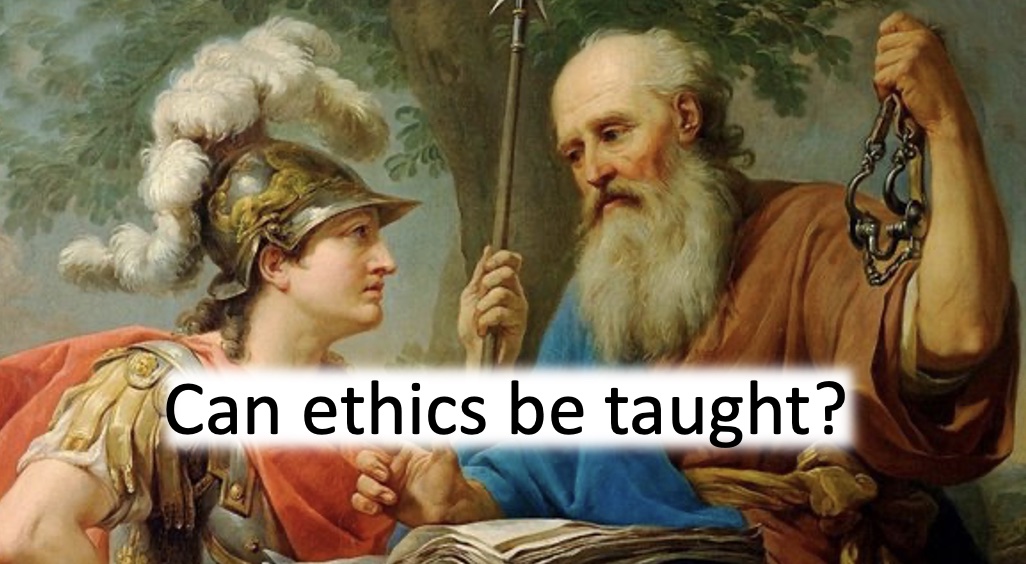
As I’m reflecting on the common thread of these presentations, a few things come to mind. First, ethics matters for all human beings. It is especially important for professionals. Second, there are unavoidable moral conflicts. But there is also general consensus about what it takes to be good and to do good work. Finally, ethics can be taught and trained. We are not born knowing the difference between right and wrong. Rather, we learn this from mentors and role models. And even though we begin as novices in living well, we can improve. Let’s consider each of these points in turn.

Ethics matters for everyone including professionals

Human beings mostly want to be good, to do good, and to live good lives. There are some bad actors in the world: criminals and sociopaths exist. And some people may get a thrill out of being notorious, or have a strange admiration for bad guys (as I discussed recently). But for the most part, human beings want to be known for being good. And most people seem to understand that happiness depends in part on virtue.

This is especially true in specialized fields and in the professions. Consider sports as an obvious example. Athletic endeavors have standards of excellence and rules that must be followed. If you value the sport, you ought to want to play by the rules. A person who “wins” a 100-meter race by tripping an opponent has not really won. Cheating defeats the very idea of winning and of excellence in an endeavor.

Now consider the ethical codes, rules, and standards of excellence that govern doctors, lawyers, journalists, artists, and other professionals including soldiers. These ethical ideals define what it means to be a good doctor, lawyer, and so on. To be an excellent member of a professional community, you have to do the right thing.

This is also true in families, friendships, and in life in general. A good mother, father, brother, or friend is honest, kind, courageous, and respectful. Ethics matters in our relationships. It also helps define your identity: what you are known for, and who you are. Some of this is specific to professional roles. But much of what counts as ethical is found in widespread and common ideas about human flourishing and excellence.

Moral conflicts exist but there is also broad general consensus

This broad consensus about ethics is found in typical lists of key virtues, characteristics, and behaviors of good people. Around the world it is widely held that good people are fair, truthful, and compassionate. Different cultures and traditions may emphasize different sorts of virtues, or connect them in different ways. But there is no culture or tradition that says that murder is noble, that we should break our promises, or that cowards are admirable.

This is not to deny that there are conflicts and that some values are relative to culture and history. There are genuine dilemmas in ethics such as the conflict between justice and mercy. Proponents of retributive justice think that justice requires “eye for eye” retaliation. Others call for forgiveness, mercy, and compassion. This is a genuine conflict.

But here is also consensus in addition to conflict. The challenging nature of ethical dilemmas may be why people often spend more time talking about conflicts than about consensus. It is a bit boring to say that everyone values honesty. It is more provocative to think about cases when honesty may not be the best policy—for example, in cases involving spies or when authorities lie to people for their own good.

We can learn to be ethical

Finally, let’s note that we are not born knowing how to be good. I tend to be sympathetic to the idea that human babies are born with a tendency toward prosocial behavior, and maybe even an innate sense of compassion and fairness. But those innate tendencies must be nurtured and developed. Ethical behavior among adults is learned behavior. As Aristotle suggested character is “second nature.”

Goodness is developed by emulating role models. It is further developed by “direct instruction”: by some code or teacher literally explaining to us the difference between right and wrong. We also need coaches and mentors, who encourage us and offer criticism. It helps to have structures of accountability (including rewards and punishments). And we need positive peer pressure: good friends help us be better.

Training and mentorship are also important in professional life. Professional organizations help cultivate good behavior by instructing, coaching, and reminding. They hold individuals accountable, reward good behavior, and punish the bad. Good organizations often have codes, training programs, and systems that reinforce values and ideals. All of that is important for what is called “professionalization,” which is the process by which people come to identify with the values of professional life.

The Value of Ethics Month

With all of that on the table, let me conclude by suggesting why it is useful to have a month and a day dedicated to ethics. It is easy to get lazy and take your eye off the ball. But if you want to live well, you need reminders and admonitions. We often take virtue and character for granted and simply assume that people will figure this out for themselves. Some folks may also think that some people are just good by nature, and others are irredeemably corrupt. But the truth is that we can improve. Reminders help, as do mentors and role models. It also helps to set aside some time—a month, a day, or an hour—to think critically and explicitly about ethics.  

Just War, Pacifism, and the Abolition of War

Fresno Bee, Oct 15, 2023

As war and terrorism rear their ugly heads, it’s useful to recall basic moral arguments about war and peace. The just-war theory teaches that it is wrong to deliberately target noncombatants. So, the Hamas attacks that assassinated and kidnapped Israeli civilians are wrong.

The just-war theory allows for targeted retaliation in response to aggression. But it does not allow indiscriminate violence. So, if Israel responds indiscriminately, it also is wrong to do so.

Critics may suggest that the just-war theory is a feckless attempt to regulate the inherent brutality of war. So-called “realists” say that moral judgment does not apply in war, where the goal is attaining supremacy. Realists maintain that power trumps morality and anything goes in pursuit of victory, including terrorism and terror bombing.

The just-war theory rejects this. It demands that violence be limited to legitimate targets and minimized by rules of proportionality. These limits aim to prevent escalation and atrocity.

But what does a military force do when responding to those who do not play by moral rules? Some militants and militaries ignore moral limits. They employ terror tactics and commit war crimes, as Russia has in Ukraine. It is tempting to respond in kind. But tit-for-tat retaliation is wrong. An atrocity committed as retaliation for an atrocity still remains an atrocity. And retaliatory violence tends to provoke further atrocity.

Pacifists have often pointed out that the logic of war tends toward escalation and depravity. Pacifists argue that few, if any, actual wars live up to the standards of the just-war theory. Pacifists also suggest that nonviolence can be effective.

The critics of war also argue that war should be abolished. In 1950s, at the dawn of the nuclear age, Albert Einstein said, “the only solution is to abolish both war and the threat of war.” Pope Francis reiterated this idea last year, saying, “The moment has come to abolish war, to erase it from human history before it erases human history.”

War abolition may seem a naïve goal at present. And it is not clear how nonviolence can effectively stop terrorists and criminal armies. The realists will say that in a world at war, the only thing that matters is supremacy. The just-war theorists worry that realism is a recipe for moral disaster. And the pacifists complain that it is all a kind of madness.

To cure that madness, pacifists call for radical change. War abolition would require the construction of just and equitable global systems. More fundamentally, it would require a change of human consciousness such that terrorism and war are simply unimaginable.

Abolishing war would be like abolishing slavery. It would require the evolution of our economic, cultural, and political systems. The analogy with slavery reminds us that brutal systems can be abolished. But it also reminds us of the extent of the challenge. Slavery existed in human culture for millennia. In America it took a terrible Civil War to abolish it. War has a seemingly more permanent hold on the human spirit. War will not be abolished simply because Einstein or the pope wishes it were so.

And yet, the pacifists argue that this is what we must work toward. In his argument against war, Pope Francis said, “War is a cancer that feeds on itself.” Cancer provides another useful analogy. Cancer is avoided by preventative health care, including fundamental changes in lifestyle. By the time chemotherapy is needed, it’s already too late. The same is true of war. To abolish the cancer of war, we need the preventative measures of justice, equity and love. By the time the bombs are flying, it’s already too late.

The just-war theory is a guide for present emergencies. This theory condemns terrorism and war crimes. It allows for limited and targeted responses to aggression. But history shows that war fighting often exceeds those limits. So, the just-war theory is not the end of the story. We must also continue to imagine a better future.

In the long run, we must find nonviolent ways to prevent atrocity and reduce animosity. We must cultivate global justice and a sense of our common humanity so that terrorism and war become unimaginable.

Read more at: https://www.fresnobee.com/opinion/readers-opinion/article280473439.html#storylink=cpy

Donald Trump and the Cult of the Rebel

Fresno Bee, Oct. 1, 2023

It’s worth asking why Donald Trump remains popular. He’s been indicted for crimes including a scheme to subvert the 2020 election. A court ruled that he committed sexual assault. He paid off a porn star. His language and demeanor are divisive. If you want a soft and sympathetic character, don’t look to Trump. But if you like rebels, Trump is your man.

You would think that all of these accusations would disqualify Trump from the political stage. But the former president is so popular among Republicans that he didn’t bother to show up to the Republican debate this past week. As the underdogs searched for the limelight in Simi Valley, Trump’s shadow eclipsed the headlines.

This past week, a court ruled that Trump’s business was liable for massive fraud. Other headlines reported that Trump suggested that the outgoing chairman of the Joint Chiefs of Staff, Gen. Mark Miley, should be executed. The Wall Street Journal editorial board used words like “lunacy” and “unhinged” to describe Trump’s rants.

But people still love Trump. Republican voters appear to think that the indictments are unjustified political persecution. They see Trump as a martyr who is being attacked by a corrupt federal bureaucracy. From this standpoint, it is the cops, the courts, and the generals who are the bad guys.

If we push a bit deeper, we stumble upon a strange theme in American culture: the cult of the rebel. Americans idolize rebels and vigilantes, bad guys and martyrs. We tend to view those in authority as self-righteous hypocrites who abuse their power. And we cheer on those who throw mud at the stiffs in uniform.

We might trace the cult of the rebel all the way back to Jesus and Socrates, rebel martyrs who questioned authority. But this is also uniquely American. The founding of the country was revolutionary. The founders heroically pledged their “sacred honor” to the rebellion of 1776. In 1787, Thomas Jefferson said, “a little rebellion now and then is a good thing.” He described rebellion as “a medicine necessary for the sound health of government.”

Rebels and outlaws are icons of American culture. Criminals like Billy the Kid and Al Capone are favorite fixtures of Americana. Pop culture often portrays bad guys and gangsters as heroic figures who have no choice but to use violence to defend their sacred honor. There is a whole genre of heroic vigilantes, including Batman and Spiderman.

The cult of the rebel implies that for good to be done, good guys have to go rogue and break the law. Instead of obedience and conformity, rebel culture values honor, pride and self-assertion. This is a bipartisan tendency. Leftists wear Che Guevara T-shirts, and right-wingers view the Jan. 6 rebels as patriotic heroes. Rebels on the left and the right think the establishment, the system, or “the swamp,” is made up of biased bureaucrats who are venal and corrupt.

This cult of the rebel is part of the dysfunctional attitude of what I have called elsewhere the moronic mob. The unthinking mob wants heroes and villains, spectacles and melodrama. It is fun to cheer on the rebels in “Star Wars” as they battle the empire. We rally with Neo as he fights the Matrix. And we sing along with the hippies, punk rockers, gangster rappers, and outlaw country stars who celebrate sticking it to the man.

This is all, of course, childish and dangerous. Rebellion is rarely justified and often unpredictable. Vigilantes end up in jail. Modern societies cannot function without widespread commitment to the rule of law. And most cops, lawyers, judges, and bureaucrats are decent folks trying to do their jobs.

But the story of decent people operating within the rule of law is boring. Reform is slow, incremental, and tedious. Rebels spice things up. And the mob is always hungry for what is spicy and spectacular. But ordinary social and political life is rarely spectacular or spicy.

Even if he outrages you, Trump isn’t boring. I personally think that boring would be nice for a change. But we are unlikely to be bored as the next presidential election unfolds. The cult of the rebel runs too deep. And we, the people, seem too fascinated by the spectacle to look away.

Read more at: https://www.fresnobee.com/opinion/readers-opinion/article279879484.html#storylink=cpy

Climate change, spiritual development, and the gates of hell

Fresno Bee, September 24, 2023

Climate change forces Americans to reconsider profit, greed, power and truth.

This past week, the Secretary General of the UN, António Guterres, described the climate emergency with apocalyptic language. He said, “Humanity has opened the gates of hell.” He called for quick action to avoid the climate inferno.

This call to action is not directed primarily at individuals like you and me. Individuals can drive less, for example. Or you could eat less meat. But the climate-friendly choices of individuals are less important than institutional and systemic change. To close the gates of hell, nations, states and corporations need to be transformed.

One interesting step occurred in California this past week. The state sued five major oil companies, claiming these firms lied about the climate impact of their products. The lawsuit alleges that the oil companies encouraged “disinformation and denialism” about the link between fossil fuels and climate change. This included a deliberate effort to “discredit” the scientific consensus about that link.

Gov. Gavin Newsom said, “For more than 50 years, Big Oil has been lying to us — covering up the fact that they’ve long known how dangerous the fossil fuels they produce are for our planet.” Attorney General Rob Bonta said, “Oil and gas companies have privately known the truth for decades — that the burning of fossil fuels leads to climate change — but have fed us lies and mistruths to further their record-breaking profits at the expense of our environment.”

Activists have called out this bad behavior for a long time. But the California lawsuit puts teeth behind the accusations by aiming to punish the oil companies. The proceeds of any settlement will establish a fund that would be used to respond to climate emergencies and to pay for mitigation and adaptation efforts. All of this is occurring at a time when gas prices are high, cars are expensive, and auto workers are on strike.

Could this be the beginning of a radical shift in the fossil fuel infrastructure? Maybe. But while lawsuits aimed at corporations could be part of the solution, the long-term solution must be cooperative rather than hostile. The oil companies should stop lying. But greed, power, and short-term self-interest are not easy to overcome. And so, while punishment and blame are on the table, the ultimate solution requires a change of culture and moral development.

Consider the moral and cultural shifts that have occurred in prior movements for social change. The abolition of slavery in the United States required a war. But that war was accompanied by a shift in moral thinking, which held that slavery was simply wrong. The movement for women’s rights required a struggle in the streets. That struggle was paralleled by a shift in our understanding of women and men. A similar process unfolded in the civil rights movement.

There is a chicken-or-egg question in these movements. Did the moral shift come first, or was it a result of struggle? There is no simple answer here. There are layers and phases and feedback loops in these cultural transformations. Antagonism is part of any struggle. But the long-term goal is moral development. Cultural shifts ask us to re-conceive our humanity, to reorder our priorities, and to respond in new ways to the world.

One hundred and fifty years after slavery was abolished, it is no longer imaginable that any human being would be enslaved. A hundred years after women gained the right to vote, it’s hard to imagine that anyone would have denied that right to half the population. That’s the kind of change that is needed to solve the climate crisis. We need to create a world in which it would be unimaginable for powerful corporations to lie and profit while spewing destructive chemicals into the atmosphere.

Secretary General Guterres said that we have opened the gates of hell. That’s a metaphor with religious resonance. It points toward the need for a spiritual solution to the climate crisis. To close the gates of hell, we need structural change, but also moral transformation. Lawsuits will help. But in the long run we need to change the way we think about profit, greed, power, and truth. In short, we need to rethink what we value, and we need to re-imagine the world we hope to leave to our grandchildren.

Read more at: https://www.fresnobee.com/opinion/readers-opinion/article279653924.html#storylink=cpy