Morality: worse or better?

Americans see nation’s morality as worse, but history shows otherwise

Fresno Bee, May 26, 2017

Americans believe that we are getting worse as a country. According to the Gallup Poll 81 percent of Americans rate our country’s values as “only fair” or “poor,” while 77 percent say morality is getting worse. Our view of ourselves has been “consistently negative” since Gallup started polling about this in 2002.

Gallup attributes this to ongoing culture wars. Conservatives don’t like gay marriage, abortion, and so on. Liberals don’t like Trump-era threats to abortion rights, transgender equality and other policies. Each side views the other as a sign of moral decline.

This negativity undermines norms of civility. In the middle of a moral disaster, extremism and incivility become normal. A Republican congressional candidate in Montana allegedly assaulted a reporter this week. And the California Democratic Party chanted “F— Donald Trump” with extended middle fingers.We seem to be in the middle of a rude race to the bottom.

THERE IS MUCH TO CELEBRATE IN 21ST CENTURY AMERICA:
SCIENCE, TECHNOLOGY AND HUMAN RIGHTS.

But are things really worse today? For millennia, prophets and philosophers have condemned their contemporaries. It seems that we have always been going to hell in a hand basket. And yet, we have also made progress.

There is much to celebrate in 21st century America: science, technology and human rights, to name a few. Consider this: despite the problem of fake news, the average citizen has more access to information now than Thomas Jefferson ever had. Would anyone really want to change places with someone from the 19th or 20th centuries?

On May 22, 1856, Preston Brooks, a Democratic congressman from South Carolina, nearly beat Sen. Charles Sumner, an abolitionist Republican from Massachusetts, to death with a cane in the Senate chamber. The cause of the dispute was slavery. Soon enough the Civil War killed over 600,000 Americans.

Would you trade now for then? Would you want to go back even a generation or two, to a world of unapologetic racism and sexism?

The long view of history does not support the claim that we are getting worse. But we modern people are never satisfied. We always want things to be better. We are thoughtful and self-critical. But this makes us feel inadequate and dissatisfied.

Discontent drives us forward. This is a world of upgrades and enhancements. We are never good enough. And we fear that things are getting worse.

Our low estimation of ourselves may offer a glimmer of hope, however. We might even claim that self-criticism is a sign of moral enlightenment.

Progress depends on moral critique. Modern people don’t rest on our laurels. We engage in constant self-criticism and we aspire to make continual progress. It would be odd for a modern civilization to say of itself: “Hey, we’ve made it to the promised land—it’s all good.”

THE CRITICAL SPIRIT IS A SOURCE OF SELF-IMPROVEMENT.
THE DOWNSIDE IS THAT THIS CAN MAKE US CENSORIOUS AND GRUMPY.

The critical spirit is a source of self-improvement. The downside is that this can make us censorious and grumpy. We are quick to judge others. Self-criticism is difficult. It is easier to see your neighbor’s faults than your own. But moral maturity demands that we scrutinize ourselves more than we do others.

The critical spirit can also leave us indifferent to our own successes. Complacency is viewed as a vice in the modern world. Complacent people think they have all of the answers. They believe that there is nothing left to learn and no need for improvement. They are comfortable and content.

Complacency is related to self-righteousness and self-satisfaction. Smug moralizers think they have all the answers. They quickly condemn others. But sanctimonious prigs often fail to look in the mirror or question their own values.

At issue here is a question of having the right amount of pride and humility. We ought to be proud of our accomplishments. But we should remain humble and admit that there is work to be done.

An old motto suggests that we ought to “comfort the afflicted and afflict the comfortable.” This is a strenuous call to action, which should cause us to strive for improvement. Unfortunately it can also leave us feeling dissatisfied and guilty. We could always be better at doing better.

So once you are through rolling your eyes at the decline of civility and our moral failings, roll up your sleeves and get to work. This world is only as good as we make it.

http://www.fresnobee.com/living/liv-columns-blogs/andrew-fiala/article152751389.html

Pride causes powerful to fall

What causes the powerful to come to ruin? In a word, pride

Fresno Bee, May 19, 2017

At a graduation speech this week at the U.S. Coast Guard Academy, President Trump warned, “the more righteous your fight, the more the opposition that you will face.” He advised, “Don’t give in, don’t back down.”

That is standard fare for graduation speeches. Indeed, unrelenting self-assertion helped President Trump get elected. Persistence and tenacity are virtues. But the same disposition can become the vice of obstinacy.

Much depends upon the righteousness of your cause. But in general, obstinate self-assertion brings the powerful to ruin. At least, that is the lesson of the great tragedies. The drama unfolding in Washington could be written by Sophocles or Shakespeare.

Political tragedy is a microcosm, a fascinating display of the common human affliction. We see our own foibles reflected in the flaws of the powerful. The perennial lesson is that we are all subject to tyrannical moods. We push more than we yield. And we arrogantly cling to our own ignorance.

OBSTINATE SELF-ASSERTION BRINGS THE POWERFUL TO RUIN.

The tragic chorus reminds us that human power is uncanny and strange. Our power creates the conditions for our own downfall. The more powerful we appear, the more blind and lame we become.

The problem is hubris, that fancy Greek word for arrogant pride. Hubris, the chorus explains, gives birth to tyrants. And tyrannical power begets hubris. Relentless pride, wanton ignorance, and unbridled ambition are the source of folly and crime. Shakespeare’s Macbeth warned, “vaulting ambition” overleaps itself. As the Bible put it, pride goeth before the fall.

Even a blind man can see that. In the Greek tragedies the blind prophet Tiresias makes the point. Everyone makes mistakes, he said. But good men yield when they are wrong. And they make amends.

The ancient tragedies also show that the cover-up is worse than the crime. A tyrant does not concede his failures. He never admits he is wrong. He lies and denies. And he blames the messenger for bad news.

The problem is power without restraint. As Lord Acton put it, “power corrupts and absolute power corrupts absolutely.” One solution is a system of legal checks and balances. The law can prevent abuses of power. But virtue requires self-restraint.

It also helps to reflect upon the nature of power and ambition. Shakespeare provides a clue, suggesting in Hamlet that the substance of ambition is the shadow of a dream. Power inflames desire and our sense of entitlement. The more we get, the more we want. But political power is ephemeral. It is nothing but the opinion of others.

The game of power requires a constant effort to keep the hot air blowing in your own preferred direction. And when the winds shift, as they always do, the tyrant rants and howls like old King Lear raving on the heath.

Pride makes us stubborn and irrational. The young prince in Antigone warned his father against being inflexible and unreasonable. He suggested that his father should relent—and listen and learn. King Creon, of course, ignores this advice. The family is destroyed. And the desolate king learns too late the lesson of moderation.

IT IS IN MODESTY, DECENCY, HARD WORK AND CARING RELATIONSHIPS THAT HAPPINESS IS FOUND.

Tragedies also show that wisdom can be found in unexpected places—in the voices of the powerless. Throughout Western literature, powerful men routinely ignore and degrade women. They do not listen to the blind or the young. In Shakespeare, the fool offers insight. In Greek tragedy, it is the chorus of the people who provide the voice of conscience.

Here, then, is a source of hope. Normal people—lowly, hard-working, ordinary people—possess a kind of wisdom and virtue that the powerful seem to lack. We, the people, can learn from observing the tempests of political life a lesson of how not to live. We ought to discover that “wisdom is the supreme part of happiness” as Sophocles explains. It is in modesty, decency, hard work, and caring relationships that happiness is found.

The powerful fret and strut for their hour upon the stage—and then are heard no more. What’s left is a tale seemingly told by an idiot, full of sound and fury, signifying nothing.

Those immortal lines are Shakespeare’s. His poetry has lingered, as have the works of Sophocles. And here is another source of hope. Empires rise and fall. But beauty and wisdom endure.

http://www.fresnobee.com/news/local/article151435597.html

Does lack of healthcare “kill”?

Jerry Springer offers a hurricane of hyperbole in health-care debate

Fresno Bee, May 12, 2017

The health-care debate has caused a hurricane of hyperbole and hyperventilation.

Jerry Springer, the talk show host, compared Trumpcare to 9/11, saying that the Republican health-care act “will end up killing many more Americans than Osama bin Laden ever did.” Bernie Sanders has warned, “36,000 will die yearly” as a result of repealing Obamacare. A Washington Post headline stated, “Repealing the Affordable Care Act will kill more than 43,000 people annually.”

The rhetoric on the other side is equally heated. An article in the conservative National Review estimated that in 2015 there were 80,000 more deaths under Obamacare. This story took off in far right corners of the Internet under the headline “Obamacare Kills People.”

Data referenced on this topic are complicated, to say the least. The deaths under Obamacare cited in the National Review are linked to a general decrease in life expectancy in 2015. To conclude that Obamacare caused that decline is problematic. To imply that Obamacare actively killed people is absurd.

KILLING USUALLY INVOLVES AN AGENT OR DIRECT CAUSE.
INSURANCE – OR ITS LACK – DOES NOT KILL PEOPLE. 

But it also problematic to say, as Idaho congressman Raúl Labrador did this week to a chorus of boos, “Nobody dies because they don’t have access to health care.” That seems obviously false. People do die when they lack health care. But that does not mean that they are actively killed.

Killing usually involves an agent or direct cause. A shark or a gunman can kill you. Health care may make death more or less likely. But insurance – or its lack – does not kill people. Rather, the underlying disease does the killing.

Complex debates in medical ethics focus on the difference between killing and letting die. At the end of life, it may be permissible to withhold or withdraw treatment and let someone die. But in the United States, we don’t permit actively killing people to put them out of their misery. Not everyone agrees about this. Some argue that active euthanasia is more humane than letting someone slowly die. Others argue that we should always make heroic efforts to preserve life.

Out intuitions about euthanasia may help us decide whether health insurance is a basic right or something extra or heroic.

If quality insurance is extra special but not required, then removing it is not morally problematic. We are not required to be nice to people. We are only required not to violate their rights. We are not required to keep people alive. We are only required not to kill them.

On the other hand, if we think that health care is a right, then it would be wrong not to provide it. If there is a right to health care, then removing it is like depriving someone of oxygen or water.

IN THE HEATED HEALTH-CARE DEBATE, THE IMPORTANT QUESTION IS
WHO – IF ANYONE – IS TO BLAME WHEN PEOPLE DIE FROM LACK OF HEALTH CARE.

Medical ethics also focus on the intentions behind our deeds. We ought to intend to benefit patients and fulfill their wishes. Killing becomes murder when there are malicious intentions.

So what are the intentions behind the health-care debate?

Liberals argue that Republicans intend to benefit the rich through tax cuts. But do Republicans actually intend to harm the poor? That is very unlikely. Republicans claim they want to benefit people and provide better care.

The question of intention is vexing. A person’s intentions are often unclear, even to themselves. We often have mixed motives. We can lie to ourselves. And as the proverb teaches, the road to hell is paved with good intentions.

In the heated health-care debate, the important question is who – if anyone – is to blame when people die from lack of health care. The related question is who – if anyone – has an obligation to save people from dying.

Liberals tend to think that society has an obligation to care for the sick. Conservatives tend to think that people should take care of themselves.

Now let’s return to Jerry Springer’s invidious comparison between Trumpcare and 9/11. More people may die without health care than were killed on 9/11. But that compares apples and oranges. Terrorists deliberately kill innocent people. Republican legislators do not have that intention.

Loose language and partisanship undermine critical thinking. Some provocateurs seem intent on killing rational debate with hyperbolic outbursts. The rest of us allow reasonable discussion to die when we fail to think critically and refuse to find common ground.

http://www.fresnobee.com/living/liv-columns-blogs/andrew-fiala/article150194067.html

Religion and Education

Are education and religious liberty mutually exclusive?

Fresno Bee, May 5, 2017

College education generally makes us less religious, according to a new study from the Pew Research Center. Educated Christians are more likely to go to church on a weekly basis than uneducated Christians. But college graduates are less likely to say religion is “very important” in their lives.

College graduates are also more likely to be atheists. Fifteen percent of those with advanced degrees do not believe in God, while only 6 percent of noncollege grads are atheists. Meanwhile, 42 percent of those without college education think that religious scriptures should be taken literally, compared with 14 percent of those with college degrees.

Science education make religious fundamentalism difficult to sustain. The Earth is a speck among hundreds of billions of stars. Our species evolved long after the dinosaurs went extinct. The land was once covered by ice powerful enough to carve out Yosemite Valley. None of this is recorded in ancient scriptures, which teach that the gods have a special interest in this planet and in human beings. 

HISTORY AND ANTHROPOLOGY ALSO CHALLENGE RELIGIOUS FUNDAMENTALISM.

Traditional accounts of the soul are also being explained away. Biomedical science locates consciousness in the brain. And evil is explained in neurological or psychological terms instead of as a matter of demonic possession.

History and anthropology also challenge religious fundamentalism. The ancient Chinese or the Aztecs never heard of the Christian scriptures. Nor do Christian scriptures mention these ancient civilizations. This makes simplistic declarations about God difficult to understand. When we say “In God We Trust” in our diverse world, which God are we are talking about: Jehovah, Allah, or Quetzalcoatl?

Even within the Christian tradition there are disputes about God and revelation. Mormons, who comprise about 2 percent of the American population, believe that the Book of Mormon is a holy Christian scripture. Other Christians claim this is false.

Scriptural interpretation has evolved over time. The book of Joshua explains that God held the sun still in the sky in order to allow Joshua’s troops to slaughter their enemies. But after Galileo debunked the geocentric model underlying this story, it has been subject to reinterpretation.

Others have questioned the morality of a God whose miraculous power is used to slaughter an enemy. Evolving moral standards have led many Christians to reinterpret scriptures that contain morally problematic passages about slavery, the subordination of women, homosexuality, polygamy, divorce, and so on.

Religious belief has often been flexible and subject to reformation and reinterpretation. Religions evolve to take in new information and reflect new norms. We make sense of ancient texts in light of modern ideas.

Atheists may view all of this as an argument against religion in general. And indeed, a quarter of Americans have left religion behind – either affirming atheism or simply giving up on organized religion.

But religions are persistent. The diversity and flexibility of religious belief is a key to this persistence. Religions that don’t adapt go the way of the dinosaur. No one worships Zeus or Quetzalcoatl any more. But Christianity thrives because of the variety of Christian denominations. There are over 200 different versions of Christianity in the US. You can pick an interpretation that suits your preferences.

LIBERTY ALSO ALLOWS PEOPLE TO CHANGE RELIGIONS.
INDEED, ABOUT A THIRD OF AMERICANS CHANGE THEIR RELIGIOUS AFFILIATION.

Religious liberty thus helps religion to persist. Liberty allows for innovation and development. Liberty also allows people to change religions. Indeed, about a third of Americans change their religious affiliation.

In the free marketplace of religious ideas, religions sell themselves to people and reflect changing tastes. Catholics no longer say Mass in Latin. Protestants have embraced pop music. And Western faiths have incorporated meditation, yoga and other spiritual practices from Eastern traditions.

In the modern democratic and capitalist world, we value educated and informed choice. We want informed consent in health care, in financial transactions and in elections. We should also value informed choice when it comes to declarations of faith. In a democratic culture, we ought to learn about other faiths and shop around. We also ought to leave each other alone to pursue the religious quest in our own way.

Things may have seemed simpler when a common piety was enforced on the uneducated masses. Freedom and science do undermine traditional religious conformity. But modern democratic people have faith in the power of education and religious liberty to make this a better world.

http://www.fresnobee.com/living/liv-columns-blogs/andrew-fiala/article148835959.html

Fake News and Media Literacy

It’s actually easy to tell real journalism from fake news. Here’s how

Fresno Bee, April 28, 2017

The fuss over fake news continues to unfold. In February President Trump accused The New York Times, NBC, ABC, CBS, and CNN of being fake news and the enemy of the American people. This week he said the “fake media” were falsely reporting that he had changed his position on the Mexican border wall. He also explained away recent reports about his low approval ratings as “fake news.”

President Trump seems to think that stories he doesn’t like are phony. But truth is independent of our desires. Not liking something does not make it false.

Journalists – like everyone else – have biases and opinions. But there is an important difference between biased stories and bogus ones. Every story has an angle. But objective reporting rests firmly on the ground of facts. Legitimate news organizations avoid lies and fabrications.

The objective truthfulness of real news provides the template that fake news imitates. Fake news stories are counterfeit. They look like real news. They appear to provide objective facts. But they do not. Rather, they try to sell us something.

Infomercials are fake news. Internet “click bait” is fake news. Newspaper advertisements written to look like news reports are fake news. The tabloids lining the grocery store checkout are fake news. Political propaganda is fake news.

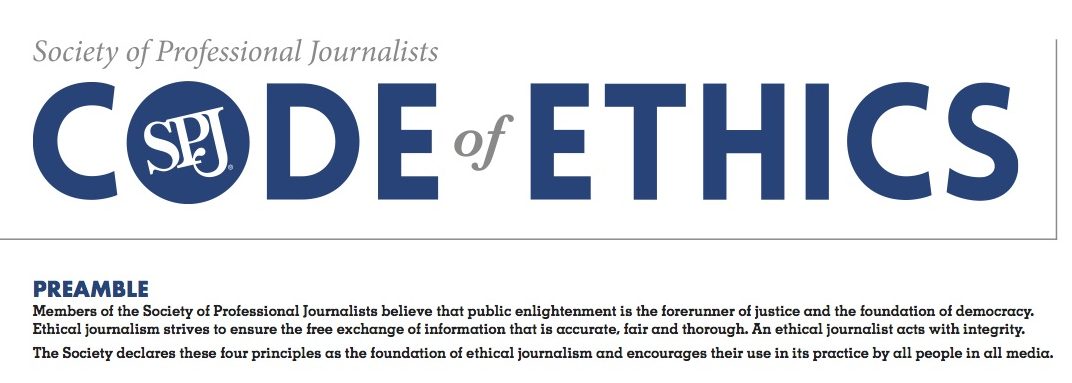
Professional journalists do not produce fake news. The journalist’s code of ethics has four guiding ideas. Seek truth. Minimize harm. Act independently. And be accountable and transparent.

Mainstream news organizations sometimes exaggerate with attention-grabbing headlines and titillating teasers. But real journalists want to get the facts right. When they get things wrong, they admit it – or get fired.

It is not always easy to differentiate fake news from real news. That’s why we need substantial training in media literacy. We need to teach kids how to read a newspaper and how to avoid being suckered by online click bait. Kids need to learn the difference between objective news reports, the opinion page, commercials and outright propaganda.

We all need to understand that YouTube and other Internet sources offer suggestions based upon what the computer thinks we want to see. Some tech firms are proposing a technological fix for this particular problem. Google and Facebook are working to combat fake news by changing how search and news notification functions work.

The technological fix is good. But the problem of sorting out fact from fiction will remain with us. Fake news is an ancient problem. Socrates was executed because false rumors were spread about him. Charlatans and quacks have always taken advantage of the gullible and the ignorant.

Wisdom teaches skepticism and self-restraint. A story that is too good to be true is likely not true. We are often beguiled by our biases. We want to believe things that flatter our egos and reinforce our deepest beliefs. Psychologists call this “confirmation bias.” But wanting something to be true does not make it so.

So while technological solutions can help reduce the proliferation of fake news, the real solution is critical thinking and self-examination.

The most obvious key is to seek out multiple sources of information. You should also compare what you read or hear against commonly held background knowledge. Critical media consumers also ask some of the following questions:

▪ Who is speaking, what is the source of their authority, and what biases do they have?

▪ Is the story trying to sell me something or advance an agenda?

▪ Who is the intended audience? What is included in the message or left out?

▪ How does this story connect to other things I already know?

▪ What more would I need to know to evaluate this properly?

These kinds of questions should guide our reading of books, our evaluation of scientific reports, and our understanding of speeches, sermons and sales pitches. The process of sifting and winnowing is liberating and edifying. Critical thinkers make informed decisions in all aspects of their lives.

Critical thinking is essential for citizens in a democracy. In order to effectively participate in the project of self-government, we need to be able to distinguish between the phony and the factual. Let’s hope that the fake-news furor stimulates a renewed commitment to media literacy, objective reporting, and basic common sense.

http://www.fresnobee.com/living/liv-columns-blogs/andrew-fiala/article147400744.html