Progress is possible and hope sheds light

Fresno Bee, July 19, 2020

This may seem an odd time to accentuate the positive. The nation is struggling with a pandemic, protests against racism, political dysfunction, and economic woes. Things could get worse. But when things look dark, it is important to take stock of progress that has occurred.

Science, economics, and the law have created improvements. There are many reasons to believe that things are better today — not perfect, but better.

Our lives are easier today thanks to technologies such as the internal combustion engine, refrigeration, telecommunication, personal computers, and the internet. There are downsides. Fossil fuel use causes climate change. And the Internet is awash in porn and fake news. But life is easier, healthier, and smarter thanks to applied science.

The coronavirus is scary. But experts are learning how to prevent and treat this disease. We’ve already eliminated smallpox, polio, cholera, and other devastating diseases. Many countries have made progress controlling COVID-19. The U.S. needs to get things under control. But medical science is better now than it was 100 years ago when the Spanish flu killed millions.

Protests against police brutality and racism indicate there is more work to be done. Terrorism and mass shootings cause anxiety. The U.S. exceeds other countries in gun violence. The U.S. imprisons more people than other countries. But crime is down from a high point in the 1990s and Americans are safer today than we were just a few decades ago.

The pandemic has exposed a digital divide in virtual learning. But a hundred years ago, girls and nonwhite people were woefully undereducated. Today we understand the ethical demand to provide quality education for all children. We teach science, math, and history to more kids in more sophisticated ways than in the one-room schoolhouses of yesteryear.

Wage gaps and wealth gaps remain. Rich people live longer and have more political power. But progress has been made for racial minorities, disabled people, homosexuals, women, and religious minorities since the 1950s when the Supreme Court abolished the farce of “separate but equal.” Things are not perfect. But discrimination is illegal and voting rights have been secured for members of previously excluded groups.

Threats to the American constitutional system exist, along with corruption in the halls of power. The free press has been attacked. Unjustified force has been employed against peaceful protesters. But the five freedoms of the First Amendment remain as beacons. The courts continue to defend our rights. And there is more vigorous political debate today than in previous decades.

Much of this debate overlooks the good news. The loudest voices on both sides of the political spectrum dwell on a sense of crisis. The conservative motto “Make America great again” begins with the premise that things have gotten worse. In response, progressives focus on remaining racism, sexism, and homophobia as well as Trumpian malfunction.

I’m not saying things are perfect today. There is substantial room for improvement. But hope for improvement depends upon the sense that progress has been made and can be made.

It is easy to lose sight of this. The news focuses on crime, disease, and corruption. Movies feature murder, malice, and mayhem. We like stories about bad guys and action heroes. A story about decent people who love their families and go to work every day would be boring.

Good news is also a political dud. Political energy grows from the sense of crisis that rallies the base. Change-makers are elected to shake things up. A campaign focused on moderate and incremental improvement would be uninspiring.

Incremental change is tedious. It takes persistent effort. The good it produces is slow in arriving and unexciting once it gets here. But lasting improvement occurs through painstaking effort.

In a crisis, despair can set in quickly. When things appear to be falling apart, it is easy to throw in the towel. That’s why it is important to recall the progress we have made. When we understand that smart, creative effort improves the world, it is easier to roll up our sleeves and get to work.

The world will never be perfect. But it won’t get better unless we believe that through our efforts it can be improved.
American Civilization and Its Discontents

Fresno Bee, July 4, 2020

Americans are dissatisfied, and that is good. Discontent is the lifeblood of democracy.

A recent poll from Politico concludes that 75% of Americans think the country is on the wrong track.  Another recent poll from the Pew Center found that only 17% of Americans are “proud” of the country.  When asked how they feel about the state of the country, 71% said “angry,” 66% said “fearful.”  Only 46% are “hopeful.”  Pew reports that only 12% of Americans say they are satisfied with the country.

These numbers indicate a low point for the American spirit.  But they also show that Americans are not stupid.  It is smart to be dissatisfied when there is a pandemic, economic collapse, confused leadership, and racial injustice.  It is surprising that anyone is satisfied with the country today.

The United States is a land of dissatisfaction.  People come here because they don’t like the old country.  The early Americans were not satisfied with British colonial rule.  The Civil War and the civil rights movement were expressions of deep dissatisfaction.  Donald Trump rode to power on a wave of discontent. 

And the waves roll on.  This nation is a changing multitude.  We have too much liberty to remain united for long.  America is anti-abortion protesters and Black Lives Matter marchers.  It is the anarchists of Seattle and the law and order crowd in Washington, DC.  Our divisions and our discontent are signs of the vitality of our democracy.  In a dull and dying country, no one has the energy to be fed up and people lack the right to express their unhappiness.  But in a vibrant and free country, the yearning for change is loud and proud.

Some dream of bland homogeneity.  They want an America that looks like what they see in the mirror.  They dream perhaps of resting in peace.  But life is a bubbling, boiling confusion.  There never was homogeneity on this vast continent.  The native tribes of pre-Columbian times were diverse.  For five hundred years, new generations of immigrants have brought different cultures, religions, and ideas.

The thing that unites us is our freedom to criticize and our right to think for ourselves.  Liberty creates difference.  The more freedom, the more divergence.  From creative liberty and diversity of experience emerges energy and enthusiasm.  Let’s embrace the fact that to be an American means to be cranky and critical, argumentative and evolving. 

The idea of productive discontent is central to the American myth.  The Fourth of July commemorates this process.  This nation was born out of the destruction of the old.  We celebrate it by blowing things up!  We hope that from the fireworks, something better will emerge.

The Declaration of Independence can be read as the expression of the complaints of a youthful spirit.  It’s timeless words about self-evident truths give way to an extended diatribe against old King George, who is described as a mean and tyrannical father figure.   

Thomas Jefferson was only 33 years old when he worked on the Declaration.  And while the Declaration described the King as an absolute tyrant seeking to impose an absolute despotism over the colonies, not everyone on the committee agreed.  John Adams was an older man.  He thought the accusation of tyranny was too personal and sounded like “scolding.” 

A decade later, Jefferson said, “I hold it that a little rebellion now and then is a good thing, and as necessary in the political world as storms in the physical.”  This physical analogy is enlightening.  Storm clouds build as the atmosphere heats up.  There is thunder and lightning, rain and hail.  But this clears the air and waters the crops. 

This idea, that a little rebellion is a good thing, seems uniquely American.  This is the spirit of youth and rock and roll.  It is the creative destruction of the capitalist economy.  It spurs innovation in technology and scientific revolutions. 

The simmering dissatisfaction of the present will boil over and give shape to something new.  Of course, there are dangers.  Lightning can kill and flash floods can wash away things we love.  But that’s life.  We never really rest in peace until the day is done or freedom is extinguished.  Liberty creates discontent.  But from dissatisfaction, creative innovation develops, as today’s storms nurture tomorrow’s fruit.

On Heritage and the Sequoia named Robert E. Lee

Fresno Bee, June 21, 2020

Most Americans are ready to bury symbols of white supremacy. Let’s be done, already, with Confederate flags and rebel generals. Does anyone really care anymore about Braxton Bragg, Henry Lewis Benning, or Robert E. Lee, some of the Confederate generals whose names are fixed to American military bases?

But the president has resisted calls to purge these names. He said, “We must build upon our heritage, not tear it down.”

When someone uses a collective pronoun, it’s worth asking who is included and excluded. What counts as “our” heritage?

Is Robert E. Lee really one of “us”? He picked the wrong side and lost. How odd that we continue to immortalize him, 150 years after the fall of Dixie.

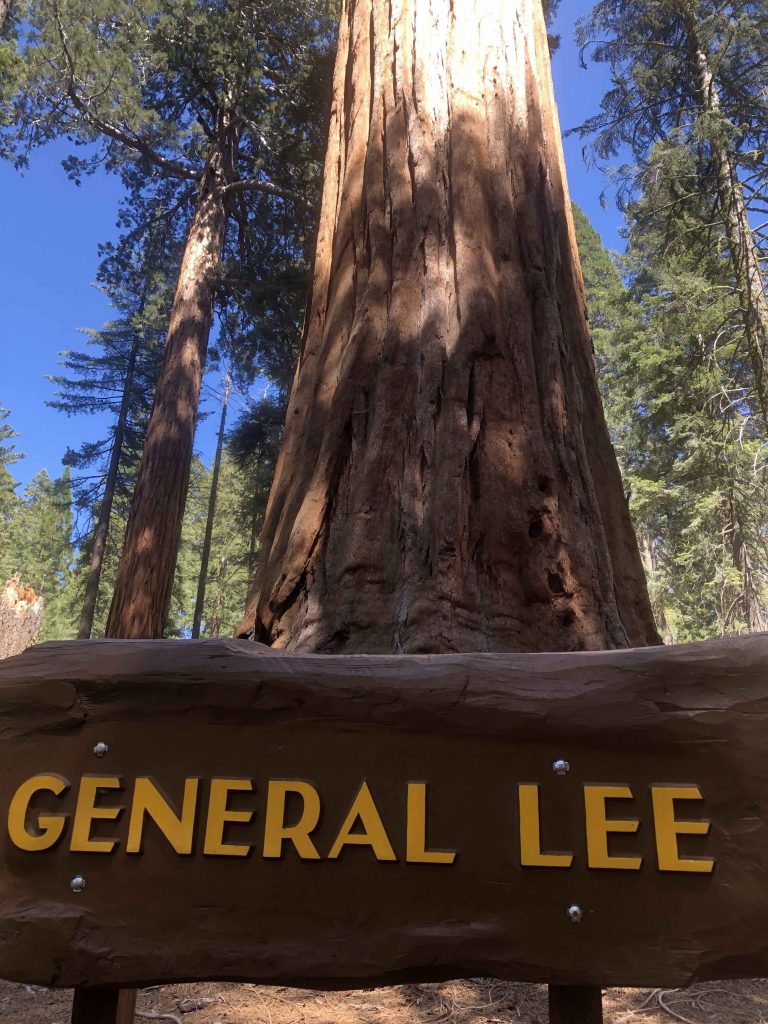
I thought about all of this while standing beneath two sequoia trees named for Robert E. Lee. The Robert E. Lee Tree is in Grant Grove up in Kings Canyon National Park. Down the road in Sequoia National Park stands the General Lee.

The General Lee is up the trail from the General Sherman Tree, the largest tree on Earth. The Sherman Tree is named for a victorious Union general. But this was not always its name. The utopian socialists of the Kaweah Colony originally called it Karl Marx.

General Lee
General Lee in Giant Forest, Sequoia National Park

The trees are indifferent to their names. They are thousands of years old. And unless we utterly destroy the ecosystem of the Sierra Nevada, these groves will endure long after the United States and its generals are forgotten.

The view from the sequoia groves is enlightening. These magnificent trees open a larger and more inclusive prospect. Our squabbles look absurd from the standpoint of millennia. The giant trees make racism and nationalism seem sadly short-sighted.

We are part of a system that exceeds the human imagination. Our true heritage includes the ancient sunlight trapped in the sequoia’s flesh. But the stories we tell remain narrow and cramped. And we seem incapable of telling the full tale of our heritage.

The U.S. is a nation conceived in liberty and dedicated to the idea that all persons are created equal. But Native Americans were dispossessed. Slaves were only counted as three-fifths of a person. Mormons were driven out of American states. California was taken away from Mexico. And Marxists lived in the Sierra Nevada.

Our story is complex and evolving. But often the idea of “our heritage” is used to invoke a mystical idea about identity and belonging, blood and soil. This simply does not work in a diverse nation of immigrants, some of whom came here as slaves.

Many people are fascinated by heritage. They get genetic tests and trace out family lineage. I suppose this is fun. But the heritage game is not fun for everyone. Many hyphenated Americans — Irish-Americans, Japanese-Americans, or Mexican-Americans — trace their lineage back to those who chose to come here from “the old country.” This story is not so pleasant for African-Americans.

Perhaps it is time to be done with the idea of heritage. The historian David Lowenthal argued over 20 years ago that heritage is a dangerous idea. Heritage is not history. It is, rather, a mythical and politicized interpretation of the past. It is a fable that resists critical analysis. Lowenthal explained, “heritage exaggerates and omits, candidly invents and frankly forgets, and thrives on ignorance and error.”

A walk among the sequoia offers a cure. The vantage point of millennia teaches that life is fragile and diverse. The ancient trees remind us to embrace as much of life as we can, while we can. Nothing lasts forever. Not even these giants.

Nor do the sequoia know hatred, resentment, or intolerance. These trees do not belong to a party or a people. They have welcomed birds and butterflies for 2,000 years. This is a symbol of something inclusive, lasting, and strong.

And if the Robert E. Lee trees are ever renamed — perhaps after Martin Luther King Jr. and Cesar Chavez, as I might suggest — the trees themselves will remain indifferent. Heroes and nations come and go. The natural world is more substantial than any human heritage. And history is more interesting than the myths we tell ourselves about who we are and where we came from.

Saying No to Racism, Brutality, and the Politics of Total Domination

Fresno Bee, June 7, 2020

Evil is contagious and brutality loves company. When George Floyd was killed, one of the officers involved should have said, “Stop it.” But peer pressure and the bandwagon can cause ordinary people to participate in terrible things. It is often easier to look away than to say, “This is wrong.”

So kudos to former Secretary of Defense, Gen. James Mattis and to Adm. Mike Mullen, former chairman of the Joint Chiefs of Staff, both of whom spoke out against abuses of power emanating from the White House. Critics may say that this is coming a bit late in the game. But better late than never.

The Rubicon was crossed this past week when the president threatened to deploy the military in pursuit of what he chillingly called “total domination.” The police and National Guard then used tear gas and grenades to drive peaceful protesters away from a church so Trump could pose with a Bible.

The president did not read the Bible at the church, of course. Nor did he cite an equally important document, the U.S. Constitution.

Each of the five freedoms of the First Amendment was under assault this week. The threat of total domination and police brutality undermines our freedom to assemble, protest, and petition. Journalists were shot at and arrested, in violation of freedom of the press. And then the president took a battering ram to the Jeffersonian wall of separation between church and state.

Our country needs a crash course in civics. You don’t hold a democracy together by domination. Nor do you unite a secular nation by brandishing a Bible. Cops and soldiers especially should read the Constitution with care. We consent to be governed because we believe that the institutions of government — including the military and police — exist to defend our rights.

That’s why police brutality is so appalling. When the police kill people in their custody, the social contract unravels. That’s also why efforts to create law and order through domination are un-American and counterproductive. Domination does not create consent, it breeds discontent.

The good news is that there are conscientious cops, soldiers and civil servants. Americans of all races volunteer to serve the public and protect the Constitution. Many public servants spoke out against the George Floyd killing and against racial injustice. Some even took a knee with protesters. And now Gen. Mattis and Adm. Mullen are reminding us of the need to reaffirm our commitment to the Constitution.

But this is not easy. Mullen’s statement opened a difficult can of worms. He said of the military, “They will obey lawful orders. But I am less confident in the soundness of the orders they will be given by this commander in chief.”

If a cop or solider were given an order to violate the rights of citizens, would he or she refuse? Conscientious disobedience is a deeply American idea. But it is a question that rightly provokes fear and trembling.

The nation began in disobedience to tyranny. Lieutenant-Colonel Thomas Howard, the Earl of Effingham, was a British officer who became a hero to early Americans after he resigned his commission rather than fight the colonists. Henry David Thoreau said that if the law causes you “to be an agent of injustice to another, then, I say, break the law.” Dr. Martin Luther King Jr. said, we have “a moral responsibility to disobey unjust laws.” And in 2003, President George W. Bush warned Iraqi soldiers that they would be prosecuted for war crimes and that it would be no defense to say, “I was just following orders.”

This lesson can also be learned from George Floyd’s killing. A uniform does not protect a person from moral condemnation or from legal prosecution. The cops involved were fired and arrested. It seems obvious in retrospect that one of them should have said, “Stop it. This is wrong.”

In the heat of the moment, peer pressure and the bandwagon often prevail. But once the heat has dissipated, the world will condemn those who condone cruelty. And history will eventually shine a more flattering light on those who have the moral courage to say to the creeping shadow of total domination, “Stop it, this is wrong.”

Singing the Blues in Difficult Times: Art and Creativity in the Pandemic

Fresno Bee, May 31, 2020

The pandemic has left people feeling numb, powerless, and hopeless. One recent article suggests that half of Americans have the blues. People are out of work and struggling to pay the rent. There is political animosity and racial tension.

Reopening things will get some folks back to work. But the economy is still a mess. Political nonsense continues to flow out of D.C. And a second wave of infections and shut-downs is waiting in the wings. We can’t go back to the carefree world we once knew.

This is a good time to turn to the blues, an art form full of nostalgia and despair. As John Lee Hooker sang, “Hard times are here to stay.” The world is out of joint. We dream of going home. But we can’t get there. So we sing.

Great songs, inspired novels, and new art will emerge from this crisis. Art grows from hard times.

The Great Depression gave birth to Steinbeck’s “The Grapes of Wrath,” for example. At one point in the story, poor folks chip in for a funeral for a child who died of malnourishment. Steinbeck then offers a simple prayer for the common man. “Pray God some day kind people won’t all be poor. Pray God some day a kid can eat.”

The Depression also inspired Langston Hughes’s dream of an America that didn’t exist. In the 1930s he wrote, “Out of the rack and ruin of our gangster death, the rape and rot of graft, and stealth, and lies, we, the people, must redeem the land, the mines, the plants, the rivers … and make America again.”

These artists confronted the bleakness of their time with a kind of hope. Rather than weep and wail, artists turn suffering into song. And you don’t have to be a genius to participate in the magic of art. Everyone can make lemons into lemonade. The creative urge is deeply human.

Consider the surge in baking that occurred during quarantine. Stores ran short on flour and yeast. Bread nourishes the body. But there is therapy in the culinary arts. Mixing, kneading, and waiting give shape to bread — and to poetry and life.

Life is made meaningful by creative activities. Joy is found in sharing this with others, telling stories, singing, laughing, crying, and eating together.

We sing, bake, and build because of an upsurge of energy. A kind of spiritual leavening occurs in the active and inspired mind, as ideas and emotions ferment and overflow. The vitality of the mind impels it to create and to communicate.

The philosopher Friedrich Nietzsche said that inspired spirits enrich the world out of their overflowing fullness. Art is the expression of will and energy. Suffering becomes meaningful when it is transformed into poetry, prayer and thought.

The blues tradition provides a great example. The blues grew out of the anguish of the African American experience. The novelist Ralph Ellison once explained that the blues express both the agony of life and a toughness of spirit. It offers no solutions or scapegoats. But it turns heartache into song. Ellison wrote, “The blues is an impulse to keep the painful details and episodes of a brutal experience alive in one’s aching consciousness, to finger its jagged grain, and to transcend it.”

When hard times become art, courage and resilience emerge. Langston Hughes described the blues as sadness hardened with laughter. This requires audacity and tenacity. There are tears and loss. But the artist responds with energy and gives birth to something new that is both melancholy and beautiful.

I don’t mean to suggest that everyone ought to become professional artists. Artists are going to be hard-pressed to make a living these days. But one cure for the pandemic blues is to find solace in creativity, whether baking, singing or writing.

Nor do I mean to say that art can solve our problems. We need scientists to find a vaccine. Economists must tackle unemployment. And psychologists are needed to treat clinical depression. Art does not solve problems. Rather, it helps us cope. Art kneads our pain and causes it to ferment and rise up. And somehow this transforms the deep and lowdown blues into food for the soul.