The Problem of Violence

Fresno Bee, September 21, 2025

Violence usually stems from the mistaken idea that human problems can be solved by inhumane means. This helps explain wars in Ukraine, Gaza, and elsewhere. It also explains why the “Department of War” is blowing up Venezuelan drug boats. Our cultural fascination with violence helps explain assassinations, school shootings and why the National Guard is deployed on city streets.

The prevailing presumption is that destructive force can quickly and easily make things better. History shows that this is false. And morality condemns the use of immoral means in pursuit of moral ends.

Despite ugly outbreaks, violence remains rare. We notice violence and war because they are aberrations that surprise and appall. And despite its persistence, we have become wise to war’s stupidity.

Scholars like John Mueller and Steven Pinker have argued that humanity is becoming more civilized. Husbands no longer beat their wives with impunity. We no longer celebrate dueling. Slavery is illegal, as is corporal punishment.

The civilizing process echoes the wisdom of advocates of nonviolence, like Martin Luther King Jr. In 1967, King warned against a “descending spiral” of violence. He said, “Through violence you may murder the liar, but you cannot murder the lie, nor establish the truth. Through violence you may murder the hater, but you do not murder hate. In fact, violence merely increases hate.”

Violence is not creative or constructive. It does not persuade the rational mind. Nor does it recognize the complexity of the human condition. Rather, it provokes anger, hatred and reprisals.

Violence offers deceptively simple solutions to complex human problems. If a mosquito bites you, you swat it. But humans are not mosquitoes. We are precious beings with intrinsic value. Violence is immoral because it treats human beings as vermin to be destroyed. Unlike the mosquito, human beings demand respect and recognition. That’s why violence provokes resentment, retaliation and escalation.

The human problems that provoke violence demand that we think, rather than swat. Killing people you disagree with does not destroy their ideas. Blowing up boats does not stop the demand for drugs. And war does not address the human desire for stability, sovereignty and respect.

Primitive cultures celebrate brash ferocity and the spectacle of violence. Warrior kings ruled ancient empires using gruesome punishments like crucifixion. We have evolved to be better than that. Unfortunately, contemporary pop culture remains fixated on violent drivel in the form of superheroes and superspies. Those who marinate in a culture of violence may think that killing enemies also eliminates enmity. But this is not true. Rather, harshness creates hostility and cruelty causes further carnage.

Human spiritual development aims beyond violence. We are thinking beings who respond to persuasive arguments. We demand recognition of our humanity. And we desire justice and love. Physical force does not address those fundamental features of our humanity.

Human problems are not easily solved. We are not widgets waiting to be manipulated. Nor are we herd animals whose behavior can be modified by the application of pleasure and pain. Rather, we are free and creative beings. Our rational minds discover mysteries and wonders. Our emotional lives include unexplainable moods, loyalties and affections. Our freedom inclines us to rebel. And our creative energies lead us to invent and discover.

No human thing is simple or complete. We are complex and changeable. Love, for example, is a lifelong challenge. Lust and sex are animal problems, whose solutions are physical and obvious. But human love is an elaborate dance that depends upon the deliberate choice to orient your life toward the well-being of another. The same complexity is found in the pursuit of justice, which requires much more than physical force.

For our culture to improve, we need to continually affirm the complexity of our humanity while rejecting the stupidity of violence. We need to recall that “returning violence for violence multiplies violence,” as King said. We should study the sages of nonviolence, including Jesus, who even encourages us to love our enemies.

That proposal will sound absurd in a world of vermin. To say that enemies are worthy of love only makes sense if those enemies are human beings like ourselves, possessing intrinsic value. For human persons, love, justice, and truth are more powerful than violence.

Read more at: https://www.fresnobee.com/opinion/readers-opinion/article312164049.html#storylink=cpy

Conspiracy Theories and Intellectual Black Holes

Fresno Bee, Sept. 7, 2025

Conspiracy theories are everywhere. Before Labor Day, the internet buzzed with the rumor that President Donald Trump was dead. He proved his existence by showing up at a press conference, where he called the rumor of his demise “fake news.”

Yet Trump has trafficked in fake news himself: At the end of May, the president shared a conspiracy theory on Truth Social claiming that former President Joe Biden had been executed in 2020 and replaced by a robotic clone.

One wonders why people get caught up in this nonsense. Perhaps we are bored, or maybe we are paranoid. But conspiracy theories have a strange pull upon us. We can be sucked into the orbit of what some philosophers call a “black hole” of knowledge and information.

The solution is simple: It involves critical thinking and calmness of soul. Stay calm, be smart and avoid intellectual black holes.

Conspiracy theories are the result of a process in which the search for meaning runs aground on a world that is often strange and inexplicable. Wishful thinking satisfies our desire for things to make sense. Communities of gullible people reinforce outlandish ideas. This process is aggravated by secrecy, distrust, isolation, polarization and suspicion.

When powerful forces act behind closed doors, we suspect conspiracy.

As alienation grows and cynicism spreads, it is natural to think that something sneaky is going on. This is exacerbated by an information ecosystem that is full of misinformation and nonsense, and it’s made worse by interested parties who profit by feeding our delusions.

Our innate curiosity and desire to make sense stimulates conspiratorial speculation. We want to know how and why things work. When the answers aren’t obvious, we invent them. When the facts displease us, we construct alternatives. The search for meaning can lead into internet rabbit holes.

No one is entirely immune to this process — we all long for explanations of the inexplicable. Wishful thinking feels good, and it’s fun to speculate about hidden forces guiding the world.

This is how superstition works. Fear of black cats and broken mirrors is similar to a fear of secret governmental forces. Those who see ghosts and demons will likely see other mysterious powers pulling political strings. The desire to explain suffering, evil and death leads people to postulate sin, karma and other magical mechanisms as drivers of the world.

But it is not true that everything happens for a reason — there are no masterminds pulling the strings. Human beings are usually more incompetent than omnipotent. The world is indifferent to our desire to make meaning. Sometimes things work out well, other times, they fall apart. Events occur without any explanation other than probability, coincidence and random chance.

The philosophical cure for conspiracies is well known, and involves wisdom and moderation. We need better thinking and greater emotional control. A soul in turmoil cannot think clearly, nor is it possible to see the truth when you are stuck in the orbit of a black hole of baloney.

It would be wonderful if we could create a society in which distrust, alienation, disinformation and polarization were not so pervasive. But that ideal is beyond our reach. Freedom of speech and of the press are important values, whose side-effects are rumors, gossip and nonsense.

The real solution is education: We can benefit from training in critical thinking and emotional regulation. In wondering whether some conspiracy is true, we need to ask ourselves what it would take to know it, and whether other explanations are more plausible.

We should also monitor our intake of information. Knowing that intellectual black holes exist can help us avoid them. It is useful to understand that interested parties prey upon gullible minds. In the end, we are each responsible for thinking better and for slowing the spread of hogwash that pollutes the information ecosystem.

Read more at: https://www.fresnobee.com/opinion/readers-opinion/article311973215.html#storylink=cpy

AI and Education: Wonder and the Desire to Learn

Fresno Bee, August 24, 2025

Education is useful in many ways: People need to learn to read and write, and we must also learn social and emotional skills that help us navigate the complexities of life. But education is also intrinsically valuable. It is a fundamental good for thinking beings.

We forget this in a world that views education as a mere means to obtaining a degree or credential, and the prestige that comes with them. When viewed in this way, cheating is tempting — a shortcut to the desired result. Today, the siren song of AI offers another way to avoid the hard work of learning.

Teachers and professors have always fretted about cheating. Now, artificial intelligence poses further challenges. AI can be a useful tool, but when it’s a substitute for genuine thought, it corrupts education.

It is important to prevent shortcuts to genuine thinking and learning. Cheating is wrong because it is dishonest. And it’s unfair to those who don’t do it. But the main problem is that the cheater has not learned anything.

Some discussions of this topic devolve into a cat-and-mouse game of detection and evasion. As teachers try to prevent unethical behavior, cheaters try to avoid getting caught. But this is not enough: Curiosity and wonder are not produced by obedient rule-following. The deeper problem is the general view of education as a mere means to some other end.

This instrumental view of education is typical in contemporary conversations about schools and universities, where folks talk about education in purely economic terms. This approach asks, what is the return on investment? Or, how does education contribute to economic growth?

Those are relevant questions. But the worth of education is not merely its cash value. More important is the way that education transmits culture and meaning. Education facilitates social and moral development. It leads young people to become decent adults and responsible citizens.

Education also directs our minds toward higher things, including the big questions of justice, beauty and truth. To be fully human is to learn to think critically about these perennial questions: What is good? What is beautiful? And what is true?

In wrestling with these questions, we also discover the power and joy of thought itself. Human beings have an innate desire to think and learn. We are curious beings, with brains that seek stimulation. We wonder about ourselves and the world around us. We explore and create. The love of learning makes us fully human.

An education that does not stimulate wonder is mere training — it may be fit for slaves and animals, but it’s not adequate to the nobility of the human spirit.

The sages of the world have noted that people are often as confused about the purpose of education as they are about the meaning of life. Business-minded folks think life is all about profit. Others focus on pleasure and amusement. But the sages suggest that the best life is spent cultivating the mind.

Aristotle celebrated “intellectual enjoyment in leisure.” An example he discusses is music: The music industry generates profits, and music can be pleasantly amusing. But the study of music leads to deeper things — music stimulates the mind and leads to fundamental questions about sound, ratio, creativity and the meaning of aesthetic experience.

The same expansive form of thinking occurs in the proper study of mathematics, literature, history, religion or science. These studies are useful for citizens and workers. But they are also valuable for their own sake, as sources of intellectual enjoyment.

And this is what cheaters and those who instrumentalize education misunderstand: The goal of education is education itself, not the outcome of a grade or a degree. Artificial intelligence is similarly confusing. Machines can quickly distill information. But the joy of thinking is only available to spiritual beings like ourselves. Human beings are driven to learn by our innate curiosity, our passionate creativity and our sense of wonder.

As we return to classrooms this fall, let’s recall the intrinsic value of thinking. Authentic and humane education should stimulate the human spirit. One might suppose that education satisfies a desire for knowledge. But the love of learning is never satisfied. Curiosity is open-ended and insatiable. Education does not merely shed light, it also kindles a fire.

Read more at: https://www.fresnobee.com/opinion/readers-opinion/article311796031.html#storylink=cpy

Truth Endures

Fresno Bee, August 11, 2025

In times like these, it is important to remember that truth endures. Despite lies and cover-ups, there are facts. Yes, there are secret files, information silos and political attacks on science and history. But truth persists despite the conspiratorial mania of the present moment.

As Winston Smith, the protagonist of George Orwell’s “1984,” put it, “If you clung to the truth even against the whole world, you were not mad.” It isn’t easy to cling to truth in a world where truth is assaulted and expertise is devalued. In this idiotic environment, bad news is dismissed as fake news and scientific reason is denigrated as ideological.

We might consider Robert F. Kennedy Jr.’s anti-vax obsession here. Or we could discuss the Trump administration’s attack on climate science.

A telling example is found in President Donald Trump’s firing of Erika McEntarfer, the head of the Bureau of Labor Statistics. Trump claimed she was a “Biden appointee” who “faked the jobs numbers before the election to try and boost Kamala’s chances of victory.” On Truth Social, Trump explained, “In my opinion, today’s Jobs Numbers were RIGGED in order to make the Republicans, and ME, look bad.”

In Trump’s telling, everything that makes him look bad — or that he does not like — is rigged, fake and even treasonous. Last month, Trump accused Barack Obama of “treason” for supposedly rigging elections in 2016 and in 2020. In May Trump said that members of the Biden administration committed “TREASON” (in typical Trumpian all-caps), as “treasonous thugs” supposedly took over Biden’s presidency as the former president’s capacities declined.

It is easy to ignore these scandalous charges since the Trumpian firehose of gibberish is constantly gushing. But if we take these charges seriously, they present us with a very ugly dilemma. Either one of America’s ruling parties is treasonous or the other is unhinged. If Trump’s accusations are true, the Democratic Party establishment should be arrested and imprisoned. If what Trump says is false, the Republican Party establishment is mired in conspiratorial claptrap.

Some folks may roll their eyes and try to ignore all of this. One way to preserve your sanity in the face of madness is to keep your head down. But indifference is a step away from complicity. Good, honest people cannot remain indifferent to the truth.

And at the end of the day, there are facts: Either the globe is warming or it isn’t. Either vaccines are safe and effective or they are not. Either the economy is waning or waxing. Scientific reasoning can deliver the truth. Political meddling muddies the water.

Philosophers have affirmed the value of truth for millennia. Plato said, “Truth is the beginning of every good thing.” To live well, Plato said, you must be a “partaker of the truth.” More recently, English philosopher Bernard Williams said that if we “lose sense of the value of truth… we may well lose everything.”

The partakers and defenders of truth are often lonely voices howling in the wilderness. This is especially true when indifference and complicity are common. And let’s face it, human beings are easily deceived. Naïve dupes happily succumb to deceptive appearances. Charlatans and con-men prey upon our credulity. And some people devote their entire lives to lies, or to lying.

To remedy this, society has developed resources to defend the truth. Oaths and rituals are designed to ensure truth-telling and promise-keeping. Our institutions celebrate the virtues of honesty and sincerity. Scholars enforce academic integrity. Legal systems require sworn testimony. We punish plagiarists, liars and perjurers.

But as Orwell warned, unscrupulous political powers can use these institutions and procedures in defense of lies. Power divorced from truth is dangerous. Despite attempting to cling to truth, Winston, the main character of Orwell’s novel, is eventually tortured and broken. He succumbs to the madness. He accepts whatever lie “the Ministry of Truth” proclaims. In the end, he learns to love Big Brother.

The moral of Orwell’s story is about the ongoing need for truth-telling, and courageous resistance to lies. This isn’t easy. History is littered with the broken bodies of those who dared to speak truth to power. But in the long run, the truth endures. And it is nobler to defend the truth than to acquiesce to a lie.

Read more at: https://www.fresnobee.com/opinion/readers-opinion/article311622581.html#storylink=cpy

The Secular Declaration of Independence

Fresno Bee, July 6, 2025

“Declaration of Independence was rooted in Enlightenment ideals, not divinity”

Some suggest that the U.S. is a Christian nation.  That claim often rests upon an interpretation of American history that misunderstands the Declaration of Independence.  For example, the Speaker of the House, Mike Johnson, said this week, that that the American Founders’ “creed” is stated in the Declaration.  Johnson believes that Thomas Jefferson was “divinely inspired” to write the Declaration.

Jefferson’s language is worth careful consideration as we celebrate the 249th anniversary of the signing of the Declaration.  The part of The Declaration that has been emphasized by Johnson and others is the following: “We hold these truths to be self-evident, that all men are created equal, that they are endowed by their creator with certain unalienable rights, that among these are life, liberty and the pursuit of happiness.” 

The Founders understood the world as coming from a creator.  They thought that human rights were found in the “laws of nature” and “nature’s God,” to quote another earlier passage from the Declaration. 

But Jesus is not mentioned here.  Nor is the Bible.  Indeed, Jefferson had a decidedly unorthodox understanding of Christianity.  Like Benjamin Franklin, Jefferson was a Deist who understood “nature’s God” as distinct from the God of the Bible.  He rejected the idea that the abstract “creator” could perform miracles.  Jefferson even revised the Bible to eliminate its miracles, including the resurrection of Christ.  Jefferson’s Unitarian colleague John Adams also doubted the divinity of Christ.  To suggest that these authors were inspired to create a Christian nation is simply false, as I discuss in my new book, Christian Nationalism and the Paradox of Secularism.

These Enlightenment-era thinkers were sympathetic to a rational, philosophical reconstruction of ancient revealed religions.  They also understood themselves as doing a very human thing by engaging in political struggle.  Just after that famous statement about the creator and our inalienable rights, the Declaration adds a second self-evident claim: “that to secure these rights, governments are instituted among men, deriving their just powers from the consent of the governed.”

The text says that governments are human constructions.  The legitimacy of governments depends upon democratic consent, not divinely ordination.  Building upon this point, the next self-evident truth of the Declaration is that there is a right to revolt against unjust government and to re-construct government according to our own best judgment. 

This makes the Declaration a secular or humanistic document.  Our rights may come from God, the creator, or the laws of nature.  But government is a human creation.  It is “we, the people” who create governments, and alter or abolish them.

This human process culminated in the creation of the U.S. Constitution.  The Constitution was a second attempt to create a government, which built upon the failure of the Articles of Confederation.  The Constitution was a negotiated document that included the notorious compromise that allowed slavery to exist.  Americans fought a Civil War to further clarify and improve the Constitution.  None of this indicates divine inspiration. 

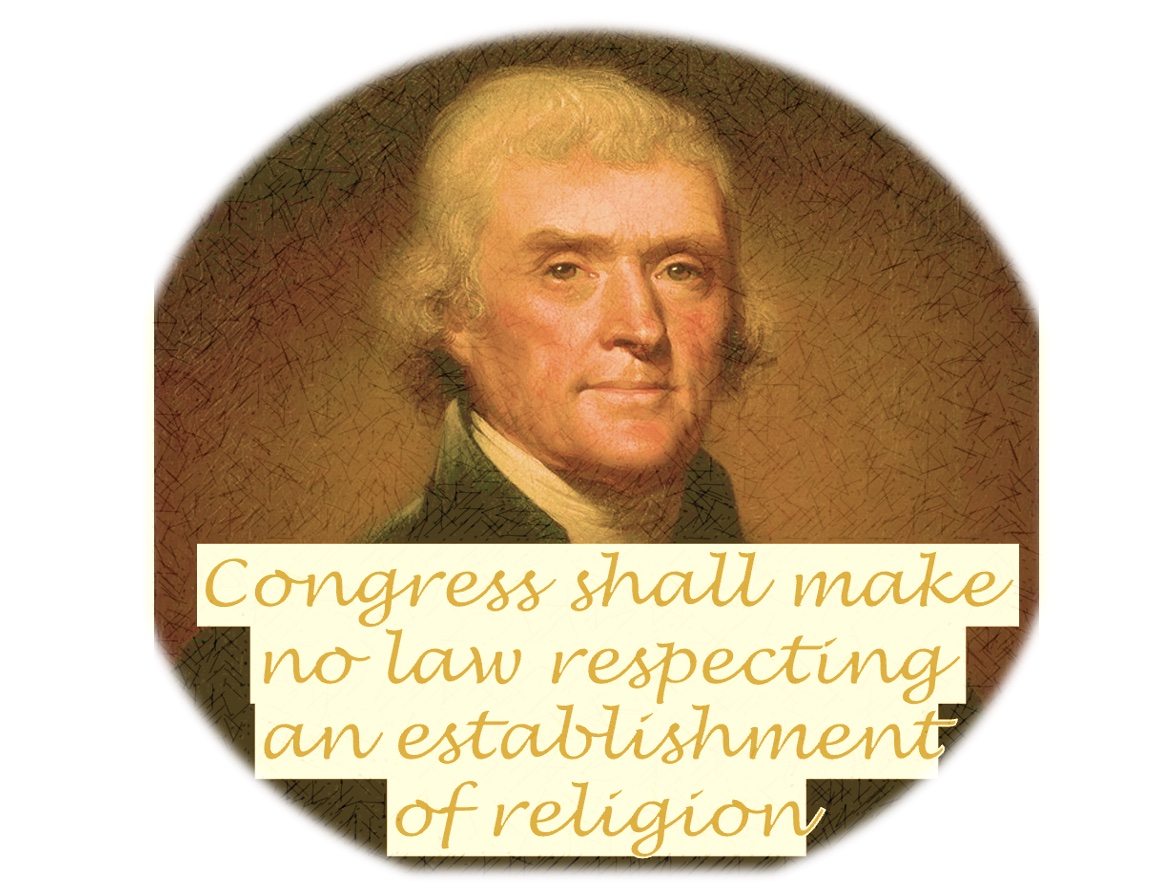
Indeed, the Constitution affirms a secular standpoint.  The only mention of religion in the Constitution itself occurs in Article 6, where religious tests for office are prohibited.  And the First Amendment clearly states, “Congress shall make no law respecting an establishment of religion, or prohibiting the free exercise thereof.”  This means you are free to worship (or not) according to your conscience, and the government is not allowed to erect an official state religion.

This is a radically modern idea that broke away from the traditional way of conceiving church and state.  In England and other European lands, church and state were combined, and often still are.  The King of England is the head of the Anglican church, for example.  In the United States there is no American church.  Nor does the President lead a religious institution. 

The fact that the authors of the Declaration were Deists and Unitarians reminds us why they wanted a new form of government.  In another time or in another country, those men would have been persecuted as heretics.  But they created a country where such persecution no longer occurs.  The legal framework they created was not the result of divine intervention.  Rather, it was the result of human beings daring to imagine a new form of government in which religious liberty was broad enough to include their own unorthodox beliefs.

Read more at: https://www.fresnobee.com/opinion/readers-opinion/article309937295.html#storylink=cpy