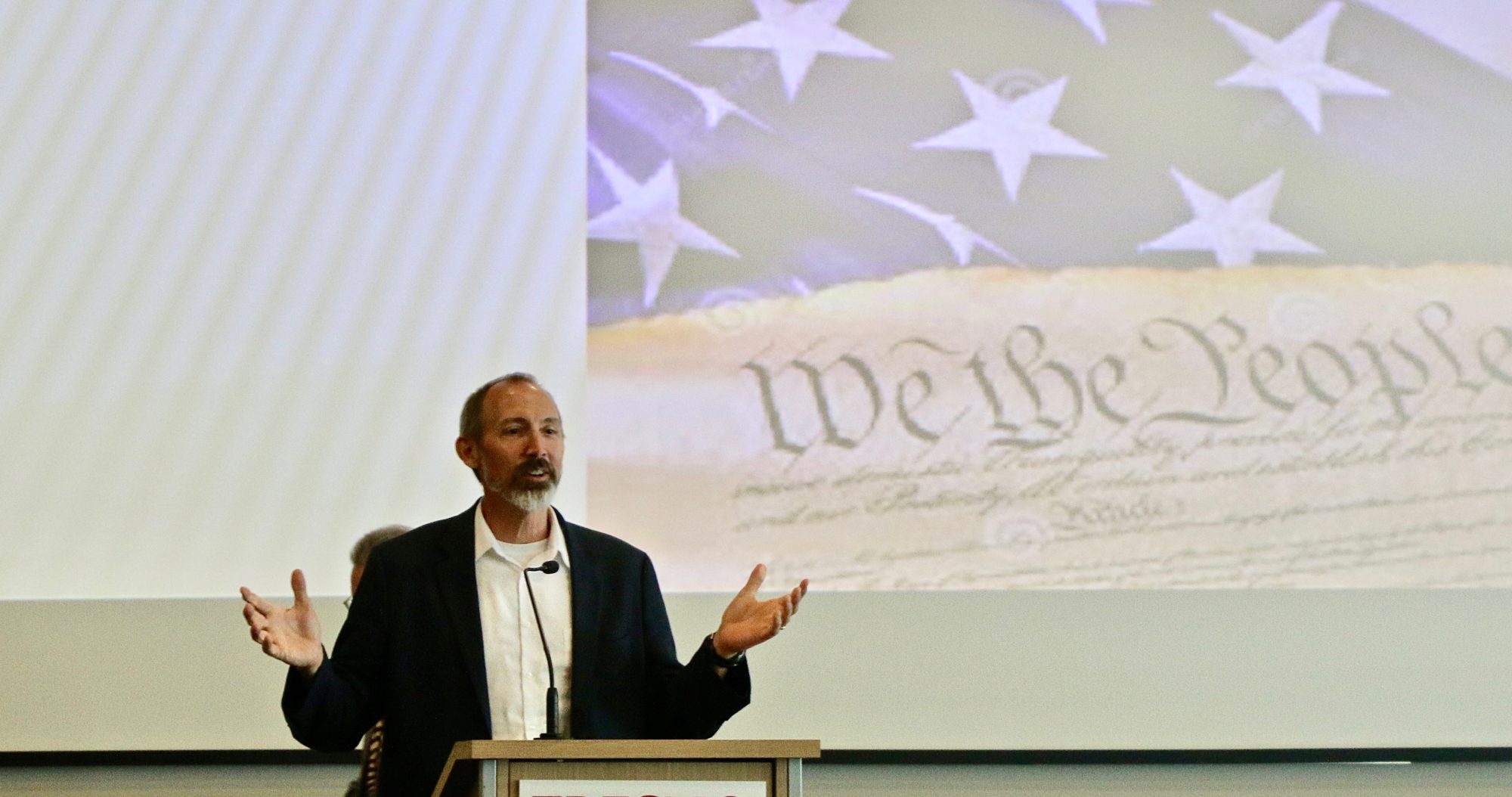
Author and Lecturer: Ethics, Religion, Political Philosophy
Author: Andrew Fiala
Andrew Fiala, Ph.D. is an expert on ethics and political philosophy. He is the author or editor of more than a dozen books and more than 50 scholarly articles. He has published hundreds of op-ed essays and newspaper columns. Fiala is Professor of Philosophy and Director of the Ethics Center at Fresno State. He gives frequent public lectures on topics related to ethics, ethical decision-making, ethical leadership, peace, politics, and religion.
Fiala is past President of Concerned Philosophers for Peace. He is an internationally respected expert on the philosophy of peace, nonviolence, and pacifism; and a strong advocate for civility, religious liberty, and freedom of thought.
Similar disputes play themselves out in a variety of contexts: Ebola quarantines, eminent domain, and the like. During the past half-century, exceptions have been carved out for individual conscience with regard to military service and a variety of other issues. Last year, the U.S. Supreme Court granted a corporation, Hobby Lobby, an exemption to federal insurance laws requiring contraception coverage, based upon a claim of conscience.
Society demands that individuals should serve the greater good and conform to the norms of social life. The risk of allowing conscientious refusal is significant, as we are seeing in the current measles outbreak. Those who are not vaccinated put themselves and others at risk.
Human beings are fundamentally conflicted. We are social animals. But we are also individual persons. Each of us views our own life as special, unique and infinitely valuable. And yet, each of us is merely a replaceable member of the herd, subject to biological forces that flow through our bodies and affect the whole.
Human life is fractured by this irreconcilable rift. Life is lived in the first-person: you are the hero of your own drama. And yet from the outside, each of us is merely a bit player in a much larger story. You will be entirely forgotten in four or five generations. And yet, this life is the only one you’ve got.
Your own death is one of the most important events in your biography — the final, defining moment of your life. But from the perspective of the species, your measly life is inconsequential. Nature will digest your flesh. The planet will not notice your departure. But for you and your loved ones, your departure to the undiscovered country will be an infinite loss.
Our heroes have often been conscientious refusers: Socrates, Jesus, Martin Luther King. But refusal antagonizes the herd. It is not surprising that these heroes were killed. Occasionally the moment is ripe for a refuser to make a difference, especially when the herd is obviously wrong. But most of the time, the tidal movements of society and nature sweep individuals along, and away.
Some individualists claim that individuals should never submit to society’s demands. On the other hand, collectivists claim that social welfare always trumps the right of conscience. At one end is lonely egoism. At the other end is totalitarianism.
Neither solution is acceptable for those of us committed to a democratic social life. Individuals should not lose themselves completely in the herd. Nor should we live in defiance of society. To be human is to suffer in the middle. The tragedy of being human is that we are pulled in multiple directions by opposing forces and conflicting duties.
Religion appears to offer one sort of resolution. An omnipotent God can hold all of this together in his benevolent hands. God is big enough to love each of us infinitely, while also understanding the substance of the common good. But the mystery of divine omnipotence gives us little to go on. We live this side of paradise, without access to divine omniscience.
Does God want us to vaccinate our children, to provide contraception, or to serve in the military? Religious people disagree about the answer to those questions. Every act of conscience is a leap of faith.
Another solution appeals to science. Scientists understand how vaccinations help prevent epidemics. But science can’t tell us how to live in the first-person or how to balance our values, duties, and commitments. Individuals must still interpret the data and apply it to their own lives.
There is no way around this dilemma. Claims of individual conscience can cause outbreaks of measles. But each measly individual also has a claim on infinite value. And a democratic society of conscientious individuals is as dangerous as it is inspiring.
Read more here: http://www.fresnobee.com/2015/02/06/4367159_fiala-on-ethics-when-conscience.html?rh=1#storylink=cpy
Imagine 100 people crowded into a warm room. Now put 25 or 50 more people in that space. Now imagine them all wanting to live and consume resources at the level that Americans enjoy. If the scientists are right, we are heading toward a hot and crowded future.
The good news is that by now nearly everyone admits that the climate is changing. President Barack Obama mentioned climate change in his State of the Union speech. Pope Francis will address the issue in an encyclical to be released this year. And the U.S. Senate voted 98-1 this week to affirm that climate change is real.
One obvious solution to both issues is birth control. Unfortunately, this solution is often taken off the table on moral grounds. The Pope, for example, opposes artificial birth control, advocating only natural methods for controlling sexual urges and channeling them properly within marriage.
Birth control is not the only solution. Another solution would be to reduce consumption. We could fit more people onto our crowded planet if each person consumed less. This is especially true if those of us in the developed world consumed a whole lot less. The earth could support a large human population if we all became vegetarians and lived much more simply.
But the difficulty of this solution is clear. The vegetarian option runs counter to our culture’s love of meat. And the idea of simplifying our needs runs counter to capitalism, which is based upon a model of continuous growth.
Carnivores, Catholics and capitalists do not appear to be inclined to change their thinking. We are creatures of habit, who remain committed to old ideas, even when they no longer make sense in present contexts.
We are also not very good at controlling our desires. Our inability to restrain ourselves helps explain a lot: from credit card debt to obesity and addiction. We readily sacrifice long-term goods for short-term pleasures. This explains why birth control — whether artificial or natural — fails. In the heat of the moment, passion undermines good judgment.
Good judgment also encounters resistance from strong cultural forces that are slow to change. When ideology is connected to self-interest, profit, and political gamesmanship, it is even more difficult to respond rationally.
The big question here is whether human beings are rational enough and virtuous enough to regulate our own behavior. Perhaps we are not much better than the rabbits of the Pope’s memorable analogy. Rabbits will continue to breed until they outstrip their food source, at which point the population declines. If human beings are like rabbits — unable to limit our reproductive or consumptive behavior — we may be doomed to a similar fate.
We often continue blithely along, ignoring reason and morality. We don’t change until we run out of money, until we are rushed to the emergency room, or until our addictions destroy our lives. We may be more like rabbits than we like to believe.
The ultimate solution is to stop hopping along the bunny trail. We should restrain our sexual activity, curtail consumption, avoid greed and profligacy, and live in balance with the world. Those are old moral ideas that make even more sense in light of the contemporary science of ecology. But these ideas will only prevail when we stop living like rabbits and start behaving like rational human beings.
Read more here: http://www.fresnobee.com/2015/01/23/4344634_ethics-looking-down-the-rabbit.html?rh=1#storylink=cpy
Boredom and loneliness are awful afflictions. Bored and lonely people bide their time in office cubicles and nursing homes. There have even been reports of people calling 911 simply to talk to someone. Boredom can lead people to kill time with dangerous and malicious activities. Loneliness easily becomes despair.
Love and responsibility provide a remedy. The cure for loneliness and boredom is found in ethical relations, in the cares, concerns and connections that make us fully human. We are curious social beings who need human connection and meaningful activity.
Consider, for a moment, an unfortunate inhabitant of a desert island. That lonely castaway would have no ethical obligations whatsoever. You can’t even be un-ethical on a desert island. To be a liar you need someone to talk to. You can’t cheat, steal, rape or murder when you are alone. Nor can you care, love, teach or learn. A moral life is a social life.
It is natural to dream of escaping from society. Adolescents long for a world without constraints. Busy adults occasionally dream of solitude and silence. But without a supporting social world to return to, solitary freedom becomes dreadful and desolate.
The horror of loneliness and boredom becomes clear when we recall that we use isolation and inaction to punish people — from kids on “time out” to criminals thrown into dungeons. Even dogs get bored and lonely when left home all day.
It is true that there is much to be learned from being alone and mindfully doing nothing. We can be refreshed by meditation, by silent retreats or by hiking alone in the woods. But solitude should properly inspire solicitude and renew our social lives. Voluntary seclusion is quite different from the loneliness and boredom of those who are abandoned and excluded.
Some people confuse freedom with happiness. We often celebrate the free, unencumbered individual — the carefree traveler who roams the world without loyalties, limits or cares. But freedom without responsibility is lonely. Friendships and families are destroyed by those who refuse to limit their freedom and commit to the constraints of social life.
Boredom is also the result of too much freedom. Boredom arises when we have too much time, too many choices, and not enough responsibility. Those who must balance a variety of social duties don’t have time to be bored. Duty and obligation may be irritating and difficult; but they rarely leave us bored.
It is true that we quickly tire of dull, repetitive drudgery. But the worst kind of boredom is experienced by those who have nothing to do and all day to do it. This is why unemployment is devitalizing. It is no surprise that those who are lonely and bored turn to drugs, alcohol or sexual promiscuity, looking for short-term fixes to their existential problem.
We also turn to the flickering images of the digital world for a substitute for social connection. Television and other media provide a surrogate social experience. Many of us know more about the characters in our favorite shows than we know about our neighbors. We may not feel lonely in the digital age. But watching other people — fictional people — live is a lonely substitute for actual social life.
The punishment of being expelled from Eden was the need to work for a living and raise children. The moral is this: when we are engaged in productive work and burdened with social responsibilities, there is no time for boredom or mischief.
If we do not want to be bored and alone, we must constrain our freedom by making commitments and taking on obligations. We are social animals who find meaning and purpose in responsibility, in caring for others, and in work. So the next time you feel bored or lonely, make a commitment, take on a burden or create a social obligation. A good way to start would be to turn off the TV and reach out to someone who is as lonely and bored as you are.
Read more here: http://www.fresnobee.com/2015/01/09/4322697_ethics-fight-boredom-and-loneliness.html?rh=1#storylink=cpy
You’ve seen T-shirts, posters, and even band-aids emblazoned with peace signs, hearts, and smiley faces. Bumper-sticker wisdom, building upon the idealism of the 1960s, affirms what we might call ‘the hippy trinity’: peace, love, and happiness. We suspect that if we were more peaceful and loving, we would be happier. And if we were happy, it would be easier to love others and live in peace with them. One source for this idea may be the Apostle Paul, who said in his New Testament letter to the Galatians that the fruits of the Spirit include love, joy, and peace. A more contemporary source is the blues and hip-hop artist G. Love. One lyric from his song ‘Peace, Love, and Happiness’ is:
“I got no time to worry
About troubles or misgivings
You got to let it flow, let yourself go
‘Cause if you’re hating, then you sure ain’t living
Give me some Peace, Love, and Happiness”
The Beatles made it simpler, asserting that “love is all you need.” John Lennon asked that we “give peace a chance.” Pharell Williams more recently sang that “happiness is the truth.”
Unfortunately, pop poetry can only take us so far. The optimism of San Francisco’s Summer of Love runs aground on the wisdom of Athens, Jerusalem, and Bodh Gaya (where the Buddha is said to have obtained Enlightenment). The world’s major philosophical and religious traditions tell us that life remains tragic and difficult, and that peace, love, and happiness are never easily found. Peace, love, and happiness are also in conflict with other values, such as self-sufficiency, liberty, and justice. Smiles and hugs cannot end war, eliminate religious and ethnic conflict, nor cure psychopathology. Most of the world’s traditions therefore admit that the goal of uniting peace, love, and happiness creates a difficult and chronic, even eternal, project.
One difficulty, perhaps impossible to surmount, is the fact that the conjunction of peace, love, and happiness contains internal contradictions. Consider the fact that love may require violence: love may oblige me to fight to defend my loved ones. Indeed, love of country or of God may inspire war. Love may also lead to unhappiness: for instance, the lover suffers when the beloved dies. To love is to open oneself to grief and loss. And love easily becomes jealous and vengeful. It is no wonder that the Stoics advised equanimity and emotional self-control rather than passionate love. Tranquility is not easily cultivated when love inflames the heart.
Peace may also result in unhappiness. Those who are defeated by cruel oppressors may lay down their arms. But forced submission creates an unhappy peace that conflicts with the value of liberty. Even apart from the ‘peace’ of the pacified slave, there is no denying that peace is often achieved by sacrificing other important values. We may choose to give up on legitimate claims for justice, reparation, or respect in the name of peace. Moreover, Nietzsche argued that peace was merely the pallid dream of the mediocre, while powerful men were inspired by danger, adventure, and war.
Happiness is also complicated. A certain sort of happiness develops from the single-minded pursuit of one’s aims. The creative joy of the artist, inventor, or genius often comes at the expense of those she loves. Although Aristotle thought that happiness included social virtues, he also believed that self-reliant contemplation was the highest form of happiness. The self-reliant individual finds happiness alone: he loves the truth, but does not necessarily love other human beings. And for some people, happiness is linked to competition, victory, and domination. We know for example that victory and domination give men a satisfying boost of testosterone. One source of war, conflict, murder, and misery, is the ugly fact that violence makes some people happy.
Acknowledging Suffering
Buddha at Bodh Gaya
To resolve these difficulties we need to think deeply and clearly about the meaning of peace, love, and happiness. It may seem mean-spirited to spoil the buzz of the blissfully smiling hippy dreamer whistling Bobby McFerrin’s ‘Don’t Worry, Be Happy’. Life is hard, and if people find peace, love, and happiness in a song or a slogan, we ought not begrudge them their slice of heaven. But the demands of ethics should make it difficult to smile in a world of pain and injustice. Common sense reminds us that blissful moments do not last long, and a bit of reflection reminds us that our happiness to an extent rests upon the backs of those who slave in fields and sweatshops. Is anyone entitled to peace, love, and happiness in a world in which children are raped, where slavery continues, and where species go extinct at the hands of humanity?
The problem of the suffering of others is a central concern for both theists and Buddhists. Leszek Kolakowski once asked in an essay, ‘Is God Happy?’ He pointed out that a just and loving God must be incredibly sad to see the suffering of humanity. Kolakowski also argues that the Buddha would be deeply unhappy to know that most of the world remains bound to the wheel of suffering. However, contemporary Western images of Buddhism often portray it as providing a personal path to peace, love, and happiness. For example, Mathieu Ricard, a Buddhist monk of French origin, is touted as the world’s happiest man, and his books are marketed in such a way that they appear to provide a recipe for personal happiness and peace. Ricard himself, however, makes it clear that the key to happiness is practice, discipline, and compassionate concern for the suffering of others. We shouldn’t forget that Buddhism begins with the assumption that life is suffering! Or consider another popular Buddhist author, Thich Nhat Hanh. As Hanh explains, “the mind of love brings peace, joy, and happiness to ourselves and others” (Wisdom from Peace Is Every Step, 2005). This sounds simple, but it takes years of training to develop a mind of love, inner peace, and joyful compassion. Buddhist practice is not merely selfish navel-gazing. Indeed, it can lead to anguished engagement with an oppressive and violent world – as witnessed by the monks who immolate themselves in protest against repressive regimes in Tibet and elsewhere. The fact that a religion of peace, love, and happiness leads to suicidal protest in the face of oppression gives much food for thought.
Christianity provides a similar source of contemplation. The turmoil, sadness, suffering and cruelty of the cross are an essential part of the Christian story. We noted already that Paul imagined the unity of peace, love, and happiness in the life of the Spirit; but like Jesus himself, Paul was arrested and executed.
For Christians, peace, love, and happiness are ultimately found far beyond the tumult of earthly life, death, and politics. Saint Augustine argued in his book The City of God (426) that happiness and peace cannot be found in this life. He contrasts Christian wisdom with that of the earlier Greek philosophers, the Epicureans, Stoics, and Cynics, who maintained that happiness could be produced in this life by philosophical reflection. Augustine claimed that worldly happiness was insufficient, and that eternal happiness, lasting peace, and true love were only possible in union with God, only fully achievable in the afterlife. For Christians, the path to peace, love, and happiness passes through and beyond this world of wickedness, sin, and suffering.
Is A World Of Peace, Love & Happiness Possible?
The Greeks criticized by Augustine thought otherwise. Epicurus (341-270 BC), for example, taught that a simple life, withdrawn from the tumult of politics, and spent in the company of loving friends, could be peaceful and happy. Epicurus also maintained that to enjoy peace and happiness you must cultivate justice, since injustice produces social conflict. But, Epicurus added, if you want to be happy and find peace, you should avoid political life and its stressful and dangerous entanglements.
There are clear Epicurean elements in the hippy dream – especially in the idea that simple living apart from the mainstream is the key to peace, love, and happiness. The problem, however, is that Epicureans can be accused of free-riding. Is it right to retreat to your garden while the outside world is plagued by war, hate, and sorrow?
In response to this problem, the Stoics maintained that we have a duty to serve society. So Stoics sacrifice their own peace, love, and happiness for the good of the many. For instance, the Stoic Marcus Aurelius, Roman Emperor from 161-180 AD, would have preferred to stay home with his loved ones and develop himself as a philosopher, but his political obligations led him to sacrifice his health and tranquility for the good of Rome.
Building upon the political perspective, we might note – as Steven Pinker has argued recently in his book,The Better Angels of our Nature (2011) – that peace, love, and happiness are the result of civilizing processes, including military and police power. In other words, Westerners can enjoy peace, love, and happiness because our borders are secure, our homes are comfortable, our economies run smoothly, and our institutions are stable. Sadly, the same cannot be said for many others across the globe.
The peace, love, and happiness celebrated in counter-cultural songs and bumper-stickers may rest upon European and American military, economic, and social power. Nonetheless, many advocates of the peace-love-happiness trinity are critical of police power, military force, and obedience and conformity. Some argue that the structures of imperialistic and militaristic civilization are internally contradictory – that they create the very ills they claim to solve. So peace is undermined by preparation for war. Love is destroyed by oppressive hierarchies. Happiness is subverted by the demands of work, conformity, and bureaucracy. But it may be that military power, obedience, hierarchy, and conformity are essential for peace, love, and happiness. It may be that best place to find peace, love, and happiness is in Epicurean gardens nestled safely in the heartland of an empire.
These and other disquieting thoughts arise when we begin thinking about peace, love, and happiness. While a simplistic faith or naïve fantasy can satisfy some, the moment you begin thinking, you wonder whether the beautiful dream of peace, love, and happiness is ever a real possibility for fragile, mortal, thinking beings who live in a cruel and tragic world. It might therefore be that those who philosophize recognize that peace, love, and happiness are nearly impossible to achieve. And yet one can’t help but imagine that John Lennon was on to something when he sang of his dream of “living life in peace”:
“You may say I’m a dreamer
But I’m not the only one
I hope someday you’ll join us
And the world will be as one.”
As the calendar turns, it is natural to take stock of our lives. Reflecting on the past year and making New Year’s resolutions is a philosophical activity. The ancient philosophers also made lists and resolutions as part of the effort to live mindfully.
Stoic Philosopher Epictetus
The key to a philosophical life is to try to see things as they actually are. We are often deceived by idealism, ideology and emotion. Our hopes lead us astray. Our fears disempower us. And our fantasies confuse us. The solution is to get in touch with reality.
Consider diet — a typical focus of New Year’s resolutions. We fantasize about food and drink, as if a cocktail or a bag of chips has the magic power to produce happiness. A philosophical diet focuses on the reality of eating and drinking. These are merely biological functions, not fantastic cures for spiritual poverty.
Or consider what we learn from typical year-end lists. These lists show us, as they do every year, that human beings are mortal and imperfect. Some people died. Others were born. Heroes inspired us. But violence and war continue to exist.
For every genius, there are a hundred fools — for every murderer, a hundred lovers. Human nature is neither perfectible nor unredeemable. Optimists don’t like to hear the bad news. Pessimists are unable to see the good. But the truth is in the middle.
We live in a changing world. Our characters are not fixed. We make progress and improve. We backslide and degenerate. Life is a project to be lived. That’s why resolutions are useful: they remind us of who we want to be.
It’s a shame that we waste our resolutions on trivial stuff such as losing weight or making money. It would be better to resolve to be more caring, more intelligent, more courageous, more just and more mindful.
Here are a few reminders and resolutions distilled from the teachings of the ancient philosophers. If it is not right, don’t do it. If it is not true, don’t say it. Do nothing inconsiderately. Remember that no evil lasts forever, including pain. Understand that nothing is entirely in your own control, even your own emotions. Acknowledge that everyone, including you, eventually dies. Bear in mind that you have no power over what other people say or do. Understand that human beings share much in common. And see that we all benefit from compassion and justice.
The ancient philosophers emphasized taking active steps to improve life. Those who wait for the world to change may wait forever. The Roman philosopher Seneca once explained that the problem is not that life is too short but that we waste too much of it. Life is long enough and rich enough, if you make a constant effort to live it well.
Of course, not everything works out for the best. Sometimes tragedy occurs. And sometimes we make mistakes. But we cannot give up because of tragedy or fret over our mistakes. Strength, courage, resilience and tenacity are required at all times.
The key is to accept the things we cannot change and focus our effort on the things we can improve. Another Roman philosopher, Epictetus, said that we should stop wishing that things would happen as we want them to happen and learn to accept the world as it does happen. This is a useful strategy, when things don’t go right. But resigning yourself to fate does not mean giving up on the effort to live as well as you can in the life that fate has given you.
The world won’t change until you make it change. And you won’t become better until you put forth the effort. Wisdom, courage, and intelligence are needed to negotiate a world in which every noble and beautiful thing will eventually fade. Enjoy the good things while they last. Grit your teeth through the bad times. And keep yourself open to opportunities for improvement.
The philosophical approach is demanding. There are no quick fixes or super-human saviors here. This is your life, the philosophers teach, your one and only chance to live well. Each new year — each new moment — is a chance to excel. What you do with that opportunity is entirely up to you
Read more here: http://www.fresnobee.com/2014/12/26/4301690_take-a-chance-with-this-years.html?rh=1#storylink=cpy