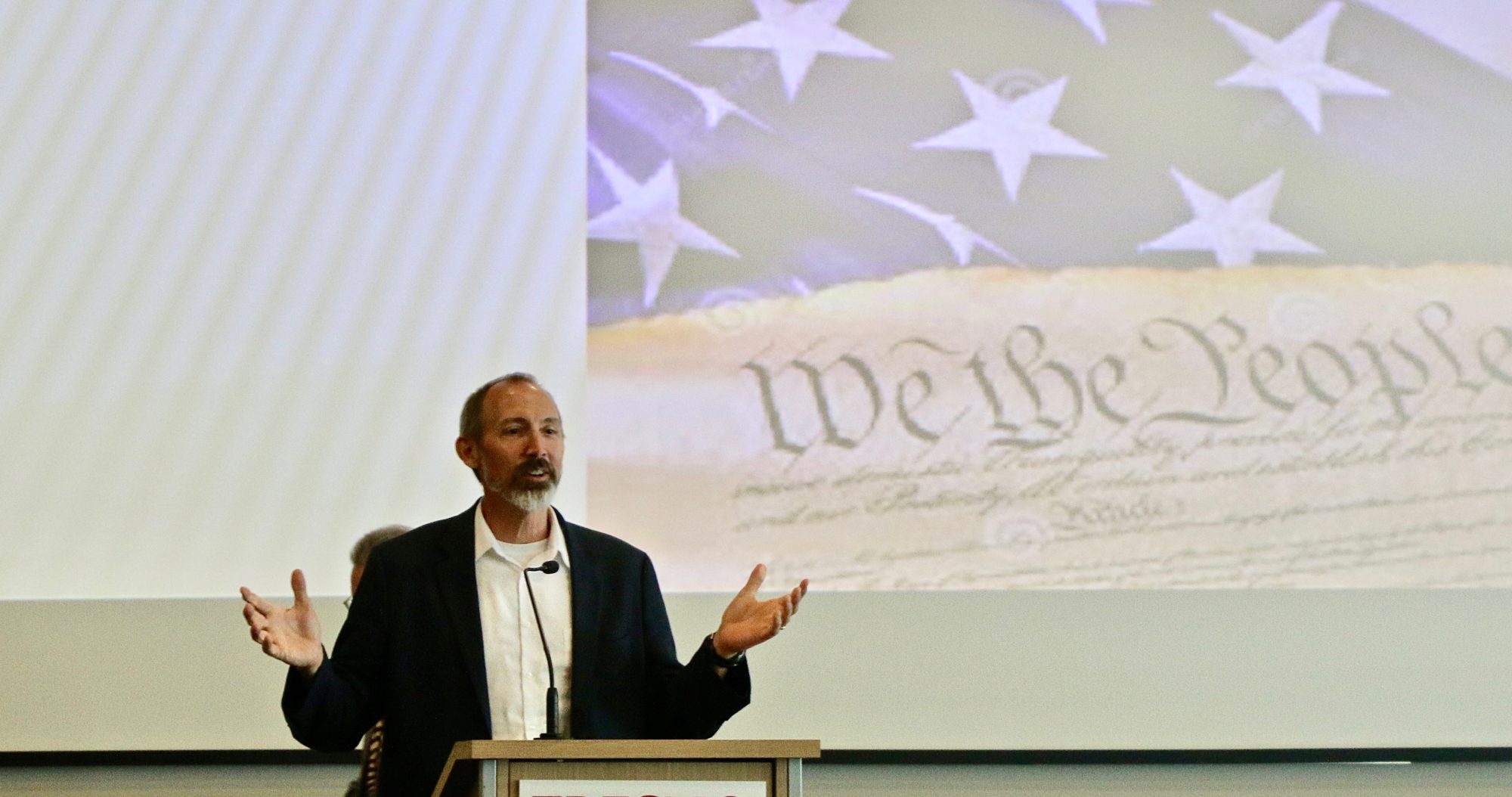
Good Citizenship Takes Commitment

Citizenship and The Constitution

Fresno Bee, September 4, 2015


No one is born a citizen. Our Constitution allows so-called “birthright citizenship.” But no one is born understanding the Constitution. Real citizenship requires active commitment to the values of the community.

That’s why civic education is important. Some states have instituted mandatory civics test, requiring high school students to score 60% on the U.S. Citizenship test, the same score required for immigrants to qualify for U.S. citizenship.

In California, State Superintendent of Schools Tom Torlakson and Chief Justice of the California Supreme Court Tani Cantil-Sakauye are leading a new civic education initiative. The chief justice explains, “The strength of our democratic institutions relies on the public’s understanding of those institutions.” Civic Education Partnerships have been created in six counties, including Fresno.

Of course, knowledge about the Constitution is not sufficient. Citizenship is deeper than factual knowledge. It includes a set of values and active commitments. Can those values and commitments be created by education?

I talked about this with John Minkler, a retired educator who is one of the leaders in Fresno County’s Civic Education Partnership. Minkler’s passion for civics is evident from a bumper sticker on his car that reads, “E Pluribus Unum.” Minkler points out that we carry this motto in our pockets every day. Take a look at your coins. They proclaim, E Pluribus Unum – “out of many, one.”

This is the basic idea behind the social contract: we join together to form a community. Individuals reap benefits from belonging to the community. We also have obligations to participate in the life of the community.

Minkler worries, however, that the social contract has eroded. One problem is materialistic individualism. We are often more focused on self-interest than the common good. A related problem is an educational system that focuses on test results and obedience rather than engaged citizenship.

Many have become disillusioned with political life. Young people are especially cynical. Studies show that millennials are less politically aware and committed than older adults. They vote less and don’t trust the political system.

Critical scrutiny of our system is wise. Democratic government requires vigilant citizens. But cynical disengagement is self-defeating. If you believe you can’t change things, then you will not work to change them. And then – lo and behold – things don’t change!

Minkler explains that citizenship develops from involvement in the community, which teaches that individual commitment matters. Minkler has long been an advocate of service-learning. He says that service-learning helps disengaged kids develop the spark of citizenship, as they discover that their effort and commitment actually matters.

Teachers and schools already have a difficult task of developing college- and career-ready graduates. Creating good citizens is yet another difficult task. We can’t expect the schools to do this alone. That’s why the idea of a Civic Education Partnership is important. In Fresno County, the Civic Education Partnership includes educational leaders, business and community leaders, as well as members of the legal profession.

To support this effort, the Ethics Center at Fresno State is co-sponsoring a Constitution Day event at Fresno State on Sept. 17. In case you forgot, Sept. 17 is the anniversary of the signing of the Constitution. Around the country, that day is celebrated as Constitution and Citizenship Day.

The event at Fresno State will focus on the question of how civic education connects youths to our constitutional system. Speakers will include former Assemblyman Juan Arambula, Fresno City Council Member Esmeralda Soria, Lorenzo Rios, CEO of Clovis Veterans Memorial District, Justice Rosendo Peña, Jr. from the California Fifth District Court of Appeal, Deborah Nankivell, CEO of the Fresno Business Council, and Minkler.

Citizenship involves understanding the Constitution and the basic principles of democratic government. It also requires commitment and engagement. Communities are not abstract ideas created on paper documents. They are living entities in which diverse individuals work together within a framework of common values. No community is perfect. But communities are improved when citizens understand their rights and responsibilities, and when individuals actively participate in the shared life of “we, the people.”

Read more here: http://www.fresnobee.com/living/article34140597.html#storylink=cpy

A Philosopher’s Back To School Advice

Advice for making the most out of school

Fresno Bee, August 21, 2015

  • Back-to-school is a time to reflect on education
  • Philosophical advice to students emphasizes curiosity, courage and compassion
  • Education requires effort, virtue and a passion for wisdom and justice


To my sons and my students, as we head off to school, here’s a philosopher’s perspective on education.

No one can learn on your behalf. Learning is an activity. It requires effort. You must actively seek the light.

Intelligence, virtue, and happiness are not genetic. No one is born smart, kind, or happy. Everyone has the potential to improve – or to fail. But improvement is up to you. Be systematic in your studies. Cultivate a disciplined work ethic. And nurture your passion for learning.

Develop curiosity, courage, and compassion. Curiosity opens the door to new ideas. Courage follows those ideas. Compassion allows you to understand why others choose differently.

Education is supposed to be difficult. It is easy to fill your cup with trivial knowledge. But opening your mind to the ocean of wisdom is a lifelong task.

Listen carefully and question everything, including your need for certainty. Don’t believe everything you read or hear. Test dogma and inquire into common sense. Distrust those who want blind obedience. Ignore those who offer cheap grace and easy enlightenment.

Challenge authority; but remember that rebellion and doubt are tools, not destinations. Cynics are unhappy and friendless. Healthy skepticism is modest. It must be balanced with a sustained commitment to what is true and good.

Find mentors – teachers, coaches, and friends – who inspire you. The best teachers and coaches encourage without indoctrinating. They increase vitality by arousing our thirst for excellence.

Teachers are not entertainers or playmates. They criticize and evaluate. It’s not easy to receive criticism. But criticism helps us improve. Learn from your failures and work harder next time.

Be proud of your accomplishments. But don’t rest on your laurels. Celebrate what you’ve achieved today. Tomorrow there will be new challenges.

Cheer for other people’s success. Friendly competition invigorates. It makes everyone better.

Choose your friends wisely. Find friends who are smarter and more virtuous than you are. Good friends energize and uplift. They support your best efforts and console you when you fail.

Bad friends undermine you and reinforce bad habits. Avoid them. But be gentle with bad people. Some are wicked. But most are misguided and unhappy. Be prudent about social relations. But never lose faith in humanity.

Avoid gossip, rudeness, and disrespect. Be careful and courteous when asserting your own opinions. Think before you speak. But always say what’s on your mind. Avoid know-it-alls; and don’t become one. Remember: no one – not even you – can possibly know it all.

There are no shortcuts for learning to live well. Cheats and liars occasionally succeed. But they cannot succeed forever, since they lack what they pretend to have.

There are no “do-overs” in life. Misdeeds can never be undone. Happiness depends on knowing that that you deserve to be happy. A clear conscience is a necessary condition for a happy life.

Of course you will make mistakes. We all do. Forgive others and forgive yourself. But hold yourself to a higher standard. You are, after all, in control of your own life.

You are not, however, in control other people’s behavior. Help when called upon. But allow others to live as they see fit.

You will be homesick at times. Nothing good lasts forever. You will eventually say good-bye to everyone you love. Grief is a part of life. It is relieved by doing good works, making new friends, and rebuilding what is lost.

Find a cause worthy of your loyalty and stick with. A meaningful life is thick with loyalties and commitments.

Fight against injustice. But avoid rage, which burns without building. Justice also requires kindness, patience, and a creative imagination.

Educational institutions can alienate and frustrate. Bureaucratic authority is often ridiculous. But you are a person, not a number. Don’t become a cog. Demand respect and give it to others.

Life is more important than school. Don’t neglect your health. Exercise and eat well. Make time for love, leisure, and laughter. Create spaces of solitude and seek out spiritual experience.

And remember that education is a privilege. Some people don’t have the chance to go to school. Show gratitude for this opportunity by filling your cup, opening your mind, and creating a good life. And share what you’ve learned with others who are seeking the light.

Read more here: http://www.fresnobee.com/living/religion/article31837581.html#storylink=cpy


Reflecting on border walls

What kind of message would an American border wall send to the world?

Fresno Bee, August 7, 2015

  • Donald Trump’s border wall is a bad idea
  • Border walls are symbolic of inequality
  • The Berlin Wall fell under its own oppressive weight

It is sad that we are still talking about building walls. Donald Trump wants to build a wall along the southern border of the United States. The world’s borders are becoming more fortified and more difficult to cross. Israel has constructed a massive border wall. Hungary and Saudi Arabia are reportedly working on walls of their own.

This week I am touring Berlin, where the ghost of the Berlin Wall haunts the city. Cobblestones mark its former path. A few remnants are on display for curious visitors.

Checkpoint Charlie and the other infamous icons of the Cold War are tourist attractions. Young people take selfies in places that were once sites of oppression and brutality. Berlin is a wonderful reminder of the absurdity of walls.

East Germany constructed the Berlin Wall in the 1960s in order to prevent citizens from fleeing to the freedom of the West. In 1987, Ronald Reagan came to Berlin and famously said, “Mr. Gorbachev, tear down this wall.” Reagan asserted that peace and prosperity require open gates.

In 1989, a nonviolent revolution occurred, and the Wall fell. Those were hopeful times. A peaceful Germany was reunified with a reunited Berlin as its capital. Berlin is now alive with energy. Reagan was right: when walls are dismantled, peace and prosperity follow.

But we keep building walls. And people keep banging on the ramparts. Thousands have drowned in the Mediterranean in search of a better life in Europe. On the southern border to the U.S., hundreds have died in the deserts.

Inequality across borders explains all of this. People from impoverished and unstable places want to escape their misery. They will scale walls, brave deserts and swim the seas in order to find opportunity.

Unequal opportunity explains the direction of the flow of people. In Germany, Easterners fled west in search of liberty and prosperity. No one scaled the Wall to go East. Today, no one flees Europe or North America to get to Central America or the Middle East. Inequality is at the root of the immigration issue.

The history of divided Berlin reminds us that a wall is a blunt solution for a deep social and political problem. A wall cannot remedy injustice or end inequality. A wall is not as strong as a good idea. And a wall cannot create unity, friendship or lasting peace.

We place too much faith in walls. We tend to think that “good fences make good neighbors.” That proverb was made famous by Robert Frost in a poem called “Mending Wall.” But Frost is often misquoted. His poem refutes the idea that a good wall can make us good neighbors.

In the poem, Frost explains that his neighbor keeps insisting that good fences make good neighbors. But the poet is not persuaded. The urge to build a wall seems un-neighborly and inhumane. Frost says, “Before I built a wall I’d ask to know what I was walling in or walling out, and to whom I was like to give offense.”

Frost reminds us that building a wall is a symbolic act. What kind of message did the Berlin Wall send to the world? What kind of message would an American border wall send to the world?

Frost’s poem concludes, “Something there is that doesn’t love a wall, that wants it down.” When Reagan told Gorbachev to tear down the Berlin Wall, he was channeling Robert Frost.

The desire to build a wall is understandable. Walls are cheap and easy to build in comparison with the difficulty of creating justice. But walls often indicate a poverty of ideas. The Berlin Wall went up because the East German government was based upon a bad idea.

A wall along the U.S.-Mexican border would be built on another bad idea. We permit goods and capital to move freely across borders. But we prevent human laborers from following suit. That’s an unstable system.

At Checkpoint Charlie, tourists from across the globe celebrate the fall of an oppressive wall and a bad idea. This vibrant corner of reunified Berlin shows that peace and prosperity develop from open borders. The human spirit cannot be confined by barbed wire and concrete. And bad ideas eventually collapse under their own oppressive weight.

Read more here: http://www.fresnobee.com/living/article30395943.html#storylink=cpy


Space exploration, religion, and ethics

Exploration of outer space prompts philosophical reflection

Fresno Bee, July 24, 2015

  • Pluto’s icy world reminds us of earth’s fragility
  • Search for alien life creates complex problems for religion and ethics
  • Are are we conquerors or compassionate collaborators?

Nostalgia, Gay Marriage, and the Confederate Flag

Nostalgia a poor guide for morality as understanding of justice evolves

Fresno Bee, July 10, 2015

  • Gay marriage and the Confederate flag prompt reflection on historical progress
  • The sense of moral decline is misplaced
  • Let’s celebrate civility and rational discourse

d6af3df478bb4f439581a80d5d541c36-843fe42fa3174b008d1aeb7eb6abf6f2-0A June Gallup poll found that 72% of Americans believe that our morals are “getting worse.” Similar majorities have complained about moral decay every year since Gallup began asking the question in 2002. Another recent poll by the Wall Street Journalconfirmed that a majority of Americans are worried about “moral decline.”

Moral declinism — to coin a phrase for the sense of moral decadence — has a long history. The ancient Jewish prophets warned of moral decay. The Greeks accused Socrates of corrupting the youth. Ancient Chinese philosophers imagined a lost era of true men and virtuous kings.

Change is often greeted with skepticism and nostalgia. We have a tendency to view the past through rose-colored glasses. We pine for the supposed simplicity of the family home. We are homesick for a mythical time when things were purer, easier and better.

Nostalgia is, however, a poor guide for morality. There is no perfect past this side of Eden. Indeed, many are happy to leave the past behind, especially when the past includes injustice and oppression.

Consider the demise of the Confederate flag. Some Southerners may be nostalgic for the antebellum South. But most Americans understand the rebel flag as a sign of an oppressive history and view its fall as a progressive development.

Or consider the gay marriage debate. Some, like the Rev. Franklin Graham, have described acceptance of homosexuality as a sign of “the moral decline we are seeing manifest daily around us.” But for homosexuals, these are times of moral progress.

The Supreme Court’s decision to legalize gay marriage explained that the institution of marriage “has evolved over time.” It argues that we must learn from history, “without allowing the past alone to rule the present.”

Opponents reject the idea that marriage can or should evolve. Chief Justice Roberts argued in his dissent that marriage “has formed the basis of human society for millennia.” Justice Alito added, in his dissent, that gay marriage is “contrary to long-established tradition.”

But tradition is not a sufficient guide to morality. The mere fact that something is old does not mean that it is good. Slavery is as old as the Bible. Its longevity is no justification.

The same point can be made with regard to new developments. New things are not better simply because of their novelty.

The key to moral progress is independent moral judgment based upon respect for human dignity. And the best method of making progress is dignified and rational critique. We reconstruct our values by trying to understand what matters and why.

Human beings are not perfectly wise, and human institutions are not perfectly just. We evaluate and improve things by criticizing them. Enlightened social progress results from reasonable civil discourse. Genuine moral progress must be grounded in good arguments that every citizen can understand.

Claims about a culture in decline are dangerous when they fuel the fires of social conflict. Indeed, some have warned about a newly emerging “culture war.” But the war metaphor is not helpful. Fundamentalists in some parts of the world take up arms to stifle dissent and preserve irrational traditions. Value conflicts can quickly escalate and become bloody.

We should reject the notion that Americans engage in culture wars. We argue and debate — and obey the rule of law, which allows us to agree to disagree. Moral argument is complicated and difficult. And some will be unhappy as change occurs. But in our system, social change happens without recourse to the blunt instruments of violence and war.

Instead of lamenting moral decline, let’s rejoice at the role of rational argumentation in American public life. Since the bloody civil war of the 1860s, moral development in the U.S. has happened in the courts, in Congress and through nonviolent civil disobedience. That’s moral progress.

We should, however, worry about a decline in civility and rational deliberation. Internet subcultures are filled with hateful speech — and terrible arguments. Some malicious morons turn hate speech into murder. Other citizens simply tune out. The solution to that problem is obvious. We have to teach our children to be more reasonable. And we should celebrate the fact that rational argument and civil discourse still guide our public life.

Read more here: http://www.fresnobee.com/living/religion/article26922784.html#storylink=cpy