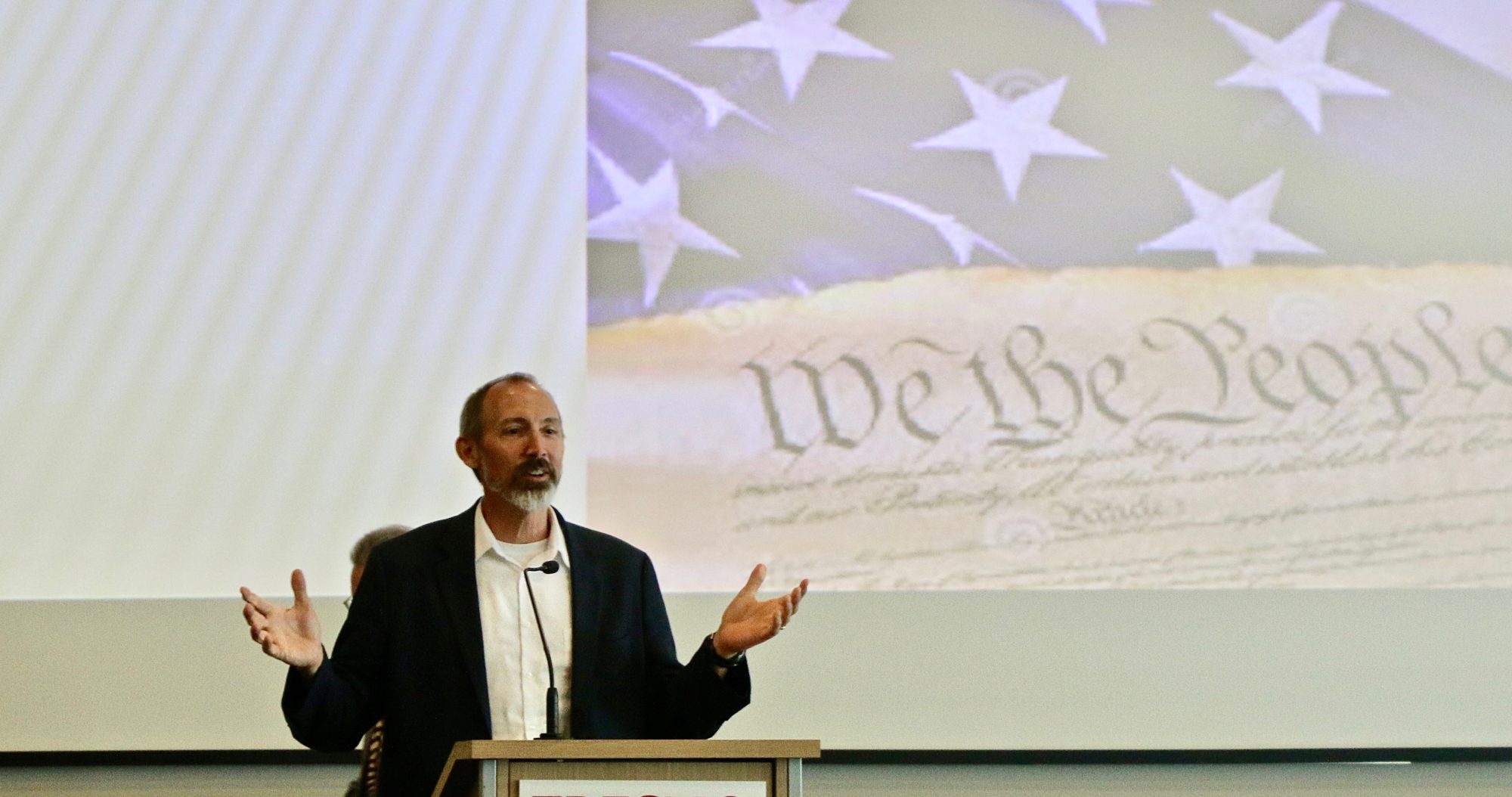
Celebrating the Virtue of Secularism

Is secularism a danger or an opportunity?

Fresno Bee, May 28, 2016

  • Secularism allows religious and nonreligious people to coexist
  • Science, reason and secularism foster innovation and technology
  • Secularism and godless communism are not the same thing

Nonbelievers are coming out of the closet. The number of admitted atheists and agnostics in the U.S. has nearly doubled in recent years – from 4 percent of the population in 2007 to 7 percent in 2014. Roughly one-fourth of Americans do not have a religious affiliation. In England, non-religious folk now outnumber Christians.

This is seen as a sign of a robust secular system in which nonbelievers are free to express themselves. But some view secularism as a danger. The Rev. Franklin Graham recently complained, “Secularism and communism are one and the same. Secularism is godless. Secularism is taking over our country.” Pope Francis has warned that secularism “has produced a growing deterioration of ethics, a weakening of the sense of personal and collective sin, and a steady increase in relativism.”

Franklin Graham-Prayer RallySecularism is not relativism. Secularism is a political system grounded on basic principles of liberty and toleration. These principles allow for a free choice of religious belief – or disbelief. But secular principles are not weak or relative. Secular political life rests upon fundamental claims about the human right to freedom of conscience.

Graham is right that secularism has taken over our country. Secularism became the law of the land when the First Amendment was ratified in 1791. In the subsequent two centuries, we have worked out the details of a political system in which the law states, “Congress shall make no law respecting an establishment of religion, or prohibiting the free exercise thereof.”

Graham is wrong to suggest that secularism is necessarily godless or to equate it with communism. Communist governments sought to eradicate religion. But our secular system protects the freedom to worship God, so long as religion does not become entangled with political power.

SECULARISM … CELEBRATES THE FACT THAT IN A FREE SOCIETY
THE FAITHFUL AND THE FAITHLESS CAN WORK TOGETHER.

God-fearing people should support secularism, since secularism allows them to pursue their faith in their own way. Public religious power is curtailed in our system. But individual citizens are free to practice any faith they want – or no faith at all.

NDR_slide2016-2Robust secularism does allow non-religious people to be more vocal. Rationalists and agnostics are finding their voices. One example was the recent call for a “National Day of Reason” on May 5. The Day of Reason idea was initiated by a congressman from Silicon Valley, Rep. Mike Honda, as a response to the National Day of Prayer. In defense of the idea, Honda explained that the success of Silicon Valley was based on “the scientific method and the application of reason.”

Honda has a point. The innovative spirit and technological prowess of Silicon Valley is related to our secular system. Many of the scientists and engineers in Silicon Valley are immigrants who come from diverse religious traditions but who share the common language of science. It is difficult to imagine the same sort of entrepreneurial efflorescence and technological prowess developing in non-secular nations such as Saudi Arabia.

Atheists are more vocal under robust secularism. They are displaying growing social power. An atheist donor gave the University of Miami a $2.2 million endowment for the study of atheism, humanism and secular ethics. The donor, Louis J. Appignani, stated that he wanted to “eliminate discrimination against atheists.”

OUR SECULAR SYSTEM PROTECTS THE FREEDOM TO WORSHIP GOD,
SO LONG AS RELIGION DOES NOT BECOME ENTANGLED WITH POLITICAL POWER.

That’s an important cause in a country where several states have constitutional language preventing atheists from holding office. For example, the Constitution of Tennessee stipulates, “No person who denies the being of God, or a future state of rewards and punishment, shall hold any office in the civil department of this state.” Laws like this remain on the books in Tennessee and seven other states, even though the U.S. Supreme Court ruled over 50 years ago that such laws violate the secular spirit of the Constitution.

Atheists obviously benefit from an inclusive secular society. But the same is true for a wide variety of faiths that have been discriminated against in the past and which suffer discrimination today.

Secularism is opposed to discrimination. It allows for the peaceful coexistence of diverse religious and non-religious people. The fear that secularism is relativist or communistic is misplaced. Secularism rests on the bedrock of liberty. It permits religion and non-religion to flourish. And it celebrates the fact that in a free society the faithful and the faithless can work together, as they do in places like Silicon Valley.

Read more here: http://www.fresnobee.com/living/liv-columns-blogs/andrew-fiala/article80280257.html#storylink=cpy

Enlightenment Values and Education

Ignorance is Not a Virtue

Fresno Bee, May 20, 2016

  • Ignorance, enlightenment are political issues
  • American universities are committed to enlightenment values
  • Democracies flourish when citizens are enlightened

Obama at Rutgers graduation- Ignorance is not a virtuePresident Barack Obama defended Enlightenment values recently in a commencement address at Rutgers University. Obama described the American founders as Enlightenment thinkers who opposed “superstition and sectarianism.” He concluded, “In politics and in life, ignorance is not a virtue.”

This caused a minor flurry of commentary. Many took this to be an attack on Donald Trump, which it probably was. Trump tweeted that it was Obama who was ignorant. And so it goes in an era when even university commencements are politicized.

But universities are not politically neutral. They are bastions of enlightenment. They proclaim enlightenment values in their Latin mottos. The Rutgers motto says, “Sun of righteousness shine upon the West.” Fresno State’s motto says, “Receive the light and give it forth.” The University of California’s motto is “Let there be light.”

WE CURE OUR MORAL BLINDNESS THROUGH FREE INQUIRY AND RATIONAL ARGUMENT.

The enlightenment ideal is politically progressive. Defenders of the enlightenment believe that knowledge makes the world better. And they know that knowledge rests upon freedom of thought.

The great Enlightenment thinkers were liberals in the broad historical sense of the term. They advocated liberty, equality and justice – and in some cases, political revolution.

Enlightenment thinkers believed that tyranny and injustice could be overcome when the light of reason is allowed to shine. Thomas Jefferson wrote, “Enlighten the people generally, and tyranny and oppression will vanish like evil spirits at the dawn of day.”

The German philosopher Immanuel Kant used a Latin phrase as the motto of enlightenment: sapere aude. This is a command: “dare to know!” Enlightenment rests upon a set of such imperatives. Speak truth to power. Be audacious in pursuit of wisdom. Follow the light, wherever it leads.

Some critics claim that this is a bunch of Eurocentric nonsense. They reject Enlightenment values as the oppressive ideology of colonizers and slaveholders. It is true that the heroes of the Enlightenment were white European men. They were wrong about a lot of things, including slavery.

We all have blind spots. But enlightenment provides a solution. Enlightenment requires self-criticism. We cure our moral blindness through free inquiry and rational argument.

Other critics reject reason as a solution to the human problem. Some believe that faith and feeling are more important than argument and inquiry. Others fear that liberal education is irreligious indoctrination. Some even think that science is an ideological temptation.

But blind faith is willful ignorance. Good ideas do not need protection from criticism. Rational critique strengthens good ideas and helps us avoid bad ones.

Martin Luther King once said, “Nothing in the world is more dangerous than sincere ignorance and conscientious stupidity.” Immoral people often plead ignorance, when they are caught doing something wrong. Others turn a blind eye to injustice.

Voluntary ignorance is negligent and recklessly indifferent. Knowledge generates responsibility. Mature people accept the obligations that knowledge creates. Moral people also shine a light on their failures. They admit their mistakes and work to correct them.

Some people are proud of their prejudices. Others wear bigotry as a badge of honor. The ignoramus relishes his own stupidity.

Such bovine complacency is the opposite of enlightenment. Conformity and obedience are easy. But cud-chewing contentment is beneath the dignity of human being. And docile herds are susceptible to the whims of the demagogues. Fanatics manipulate superstition, while tyrants prey upon a compliant populace.

CUD-CHEWING CONTENTMENT IS BENEATH THE DIGNITY OF HUMAN BEING.

Enlightenment is not easy. It is hard to think for yourself. Some claim that ignorance is bliss. But ignorance is not bliss – it is merely the path of least resistance.

To claim that ignorance is bliss is to deny our innate inquisitiveness. We are born ignorant. But we have a thirst for knowledge.

Education feeds off of curiosity. It questions everything and stimulates further inquiry. A good education arouses our mental energies. A great education leaves us with burning questions.

Laziness, cowardice and self-interest occasionally get in the way. It is easy to rest comfortably in our misconceptions. No one is completely wise or perfectly moral. Dark spots of ignorance remain within each of us. But the solution is obvious: more enlightenment and less stupidity.

Our schools and universities are a product of the Enlightenment, as is our republic. Democracies flourish under conditions of enlightenment. They falter when ignorance grows. They thrive when citizens dare to be wise.

Read more here: http://www.fresnobee.com/living/liv-columns-blogs/andrew-fiala/article78862672.html#storylink=cpy

Nobody for President

Nobody for president? Anti-establishment votes winning the day

Fresno Bee, May 14, 2016

  • Republicans are discovering the wisdom of George Carlin and the counterculture
  • Cynicism is a common thread in American politics
  • Voting is difficult when our choices are limited

Henry Ford told his customers they could have a car painted in any color, so long as it was black. That’s a Hobson’s choice. It’s a joke, not a choice.

Something similar is confronting California Republicans. They can choose any candidate they want, provided his name is Donald Trump. Our late primary means that Californians are stuck with a Hobson’s choice.

Some Republicans are fed up. Jeb Bush said he won’t vote for Donald Trump or for Hillary Clinton. The whole Bush family is planning to boycott the Republican convention. And Mitt Romney has said he will not vote for Clinton or Trump.

Romney explained, “I wish we had better choices, and I keep hoping that somehow things will get better, and I just don’t see an easy answer from where we are now.”

Obit CarlinMany of us wish we had better choices. For long decades, we’ve wished for better choices all the way back to when Romney and the Bushes were running things.

Most of us showed up to the polls and cast our ballots anyway, naively thinking that this is what citizenship required.

But a growing number of Americans are taking the advice of the late comedian George Carlin. Carlin proudly proclaimed that he never voted. He described voting as a meaningless exercise in self-gratification. He said he would rather get his jollies doing something more productive.

Carlin would have loved the irony of Romney and the Bushes ending up in his camp. He famously declared, “They call it the American dream because you have to be asleep to believe it.”

That sort of cynicism is now mainstream. Republican lions are echoing the sentiments of the radicals they would have once disparaged. This election is creating some very strange bedfellows.

Cynics and anti-establishment types have long argued that voting is a mug’s game. A hundred years ago, the anarchist Emma Goldman suggested that if voting changed anything they wouldn’t let us do it. Radicals routinely complain that rich power brokers narrow the field for the masses before we get a ballot. This populist anti-establishment idea is exactly what has propelled Trump and Bernie Sanders into the limelight.

What is remarkable and appalling is the fact that a cynical anti-voting message is exploding in the heart of the establishment. This is a bad sign for the health of our democracy.

THERE IS SOMETHING SYMBOLIC ABOUT A VOTE FOR PRESIDENT. OUR LEADERS SHOULD ATTEND TO THIS SYMBOLISM. THE NEXT GENERATION OF VOTERS IS WATCHING.

Protest votes and abstentions have always existed. But it is ominous when leading politicians, including former presidents and presidential candidates, pick up their marbles and go home. What kind of a message does that send to young people who are being introduced to our democracy?

Young people have often embraced the anti-establishment idea of a protest vote. The icon of Mad Magazine, Alfred E. Neuman, was a protest, write-in candidate in the 1950s and ’60s. In the ’70s, a psychedelic clown from the Bay Area named Wavy Gravy led a campaign to elect “Nobody for President.”

The Nobody for President campaign continues in 2016 with a website that explains its goal. “If a majority of people voted for ‘None of the Above’ rather than ‘voting for the lesser of two evils,’ it might force a situation where Americans would have to find someone competent to lead them.”

The fact that Wavy Gravy and Mitt Romney have stumbled upon a similar idea is enough to make you fear the second coming of George Carlin. These may be the last days of a once-great democracy.

But this side of the apocalypse, the lesser-of-two-evils argument, is worth considering. Is Clinton really worse than Trump? A non-vote could end up getting Trump elected. Are Bush and Romney willing to tolerate that?

A common cliché says that if you don’t vote, you don’t have the right to complain. Carlin claimed the opposite. He said that voters have no right to complain. His cheeky point was that by voting you endorse the process and shouldn’t complain about its outcome.

I doubt that anyone will stop complaining anytime soon. Democracy is more than voting – complaining is part of it, as is comedy. But there is something symbolic about a vote for president. Our leaders should attend to this symbolism. The next generation of voters is watching.

Read more here: http://www.fresnobee.com/living/liv-columns-blogs/andrew-fiala/article77421877.html#storylink=cpy

David Brooks and the Younger Generation

David Brooks, Rory Appleton remind us to celebrate generations

Fresno Bee, May 7, 2016

It’s tough to be young. In a recent column, Rory Appleton asks us to ease up on criticizing youths. He’s right. Rents are rising and job prospects are limited. Political dysfunction, terrorism and ecological disaster haunt the world that our youths will inherit. Meanwhile, we elders gripe and grumble about their music, technology, fashion and work ethic.

The older generation can’t – or won’t – understand the culture and attitudes of the young. Nor can we seem to get out of their way. Or keep our mouths shut.

Old folks have always lamented the moral failings of the young. Plato criticized Athenian youths. Seneca complained that Roman youths failed to restrain their impulses.

Each generation also regrets its own adolescent indiscretions. The 25th Psalm begs, “do not remember the sins of my youth.” Augustine rued the restless turbulence of his own unbridled youth. We project our regrets onto our children, hoping they will not make the same mistakes we have made.

Brooks_New-articleInlineI have been thinking about this while reading David Brooks’ new book, “The Road to Character.” Brooks is a New York Times columnist and PBS regular. He will speak at Fresno State on May 10. His book outlines a path to moral maturity while providing critical insight into American culture.

Brooks is nostalgic for a time when people were more interested in their souls than their résumés. He thinks that fawning parents have spoiled today’s children by incessantly telling their kids how “special” they are. He laments a narcissistic culture in which shallow self-esteem floats free of depth of character. And he dwells upon the idea that virtue must be built with great effort from the crooked timber of the human spirit.

I don’t agree with everything he suggests. But Brooks does offer perennial wisdom about a meaningful life. Work hard. Don’t crumble with adversity. Find a calling. Devote yourself to others. Be modest and disciplined. Find redemptive assistance from outside yourself. Accept the gifts of grace with gratitude and humility.

Maturity is the final step on the road to character. Brooks explains, “a mature person possesses a settled unity of purpose. The mature person has moved from fragmentation to centeredness, has achieved a state in which the restlessness is over, the confusion about the meaning and purpose of life is calmed.”

I’ve been discussing the book with students. Some feel Brooks unfairly picks on their generation. And like Rory Appleton, they generally worry that moralistic old codgers don’t understand their plight.

TO YOUTHS, I OFFER THIS APOLOGY: WE PREACH BECAUSE WE LOVE YOU.

It’s never easy to be young. Nor is it easy for old people to stop pontificating. Old folks feel that we know something about life and its meaning. But we forget that life is an adventure to be lived.

We want to save our children from regret. But young life is impetuous, audacious and experimental. Dynamic young people run and leap down the road. Sometimes they stumble. But failure is part of the process.

Young people need to make their own mistakes. Regrets and failures provide the soil for success. Maturity is a great gift. But it only grows out of the school of hard knocks.

Of course, youths won’t heed our sage advice. Hindsight only develops after the voracious eyes of youth grow dim. And wise words from graybeards don’t resonate in young ears. To age with grace is to allow the young their day in the sun.

EACH GENERATION REGRETS ITS OWN ADOLESCENT INDISCRETIONS.

The fruits of each season are unique. An unbridled elder is an embarrassment. But a prematurely sober child is tragic.

The glory of youth is carefree enthusiasm and reckless abandon. The exuberant joy of innocent adolescents is something to savor. Too soon, life’s cruel necessities require sober maturity.

Mellow moderation grows from the scars and callouses of life. Eventually life demands discipline, humility and acceptance. But there is no need to rush on the road to maturity.

To youths, I offer this apology: We preach because we love you. We know the challenges you will face in the world we created. If we could spare you tears and regrets, we would. Take our advice when you are ready. And when we finally get out of your way, I hope you make us proud.

Read more here: http://www.fresnobee.com/living/liv-columns-blogs/andrew-fiala/article76068392.html#storylink=cpy

Restroom politics

We all need clean, well-lit place to heed call of nature

Fresno Bee, April 30, 2016

  • Transgender toilet issue points toward larger question of bathroom ethics
  • Equality, access, justice and basic hygiene are important issues
  • Recommendations for restroom reconstruction are considered