On Heritage and the Sequoia named Robert E. Lee

Fresno Bee, June 21, 2020

Most Americans are ready to bury symbols of white supremacy. Let’s be done, already, with Confederate flags and rebel generals. Does anyone really care anymore about Braxton Bragg, Henry Lewis Benning, or Robert E. Lee, some of the Confederate generals whose names are fixed to American military bases?

But the president has resisted calls to purge these names. He said, “We must build upon our heritage, not tear it down.”

When someone uses a collective pronoun, it’s worth asking who is included and excluded. What counts as “our” heritage?

Is Robert E. Lee really one of “us”? He picked the wrong side and lost. How odd that we continue to immortalize him, 150 years after the fall of Dixie.

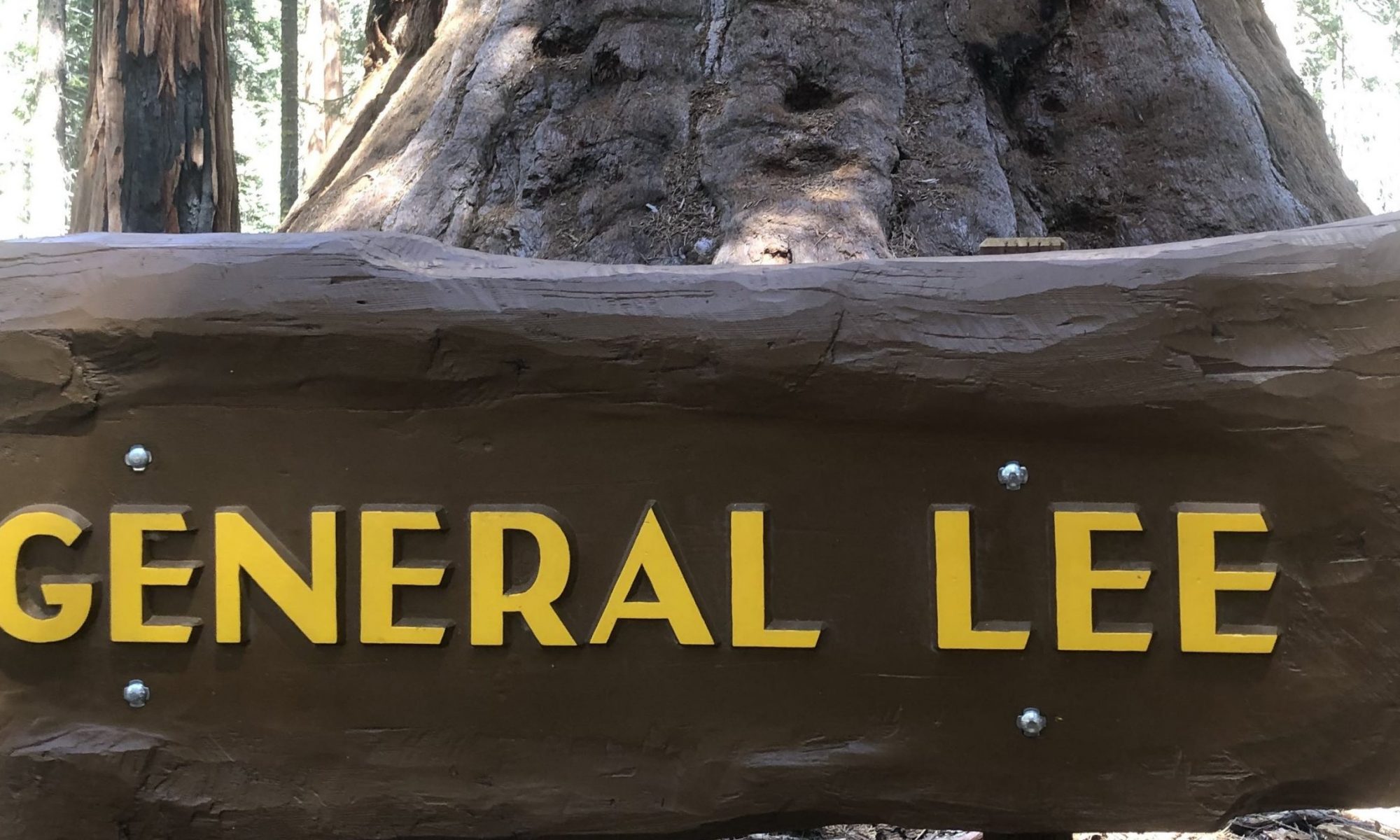
I thought about all of this while standing beneath two sequoia trees named for Robert E. Lee. The Robert E. Lee Tree is in Grant Grove up in Kings Canyon National Park. Down the road in Sequoia National Park stands the General Lee.

The General Lee is up the trail from the General Sherman Tree, the largest tree on Earth. The Sherman Tree is named for a victorious Union general. But this was not always its name. The utopian socialists of the Kaweah Colony originally called it Karl Marx.
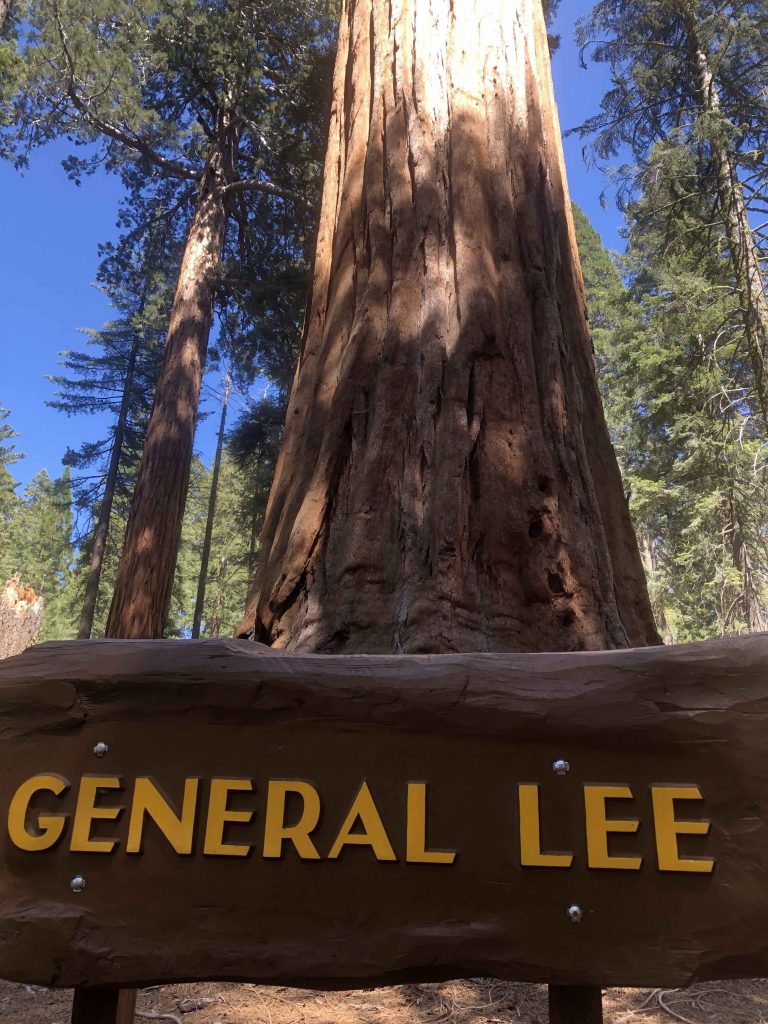
General Lee
General Lee in Giant Forest, Sequoia National Park

The trees are indifferent to their names. They are thousands of years old. And unless we utterly destroy the ecosystem of the Sierra Nevada, these groves will endure long after the United States and its generals are forgotten.

The view from the sequoia groves is enlightening. These magnificent trees open a larger and more inclusive prospect. Our squabbles look absurd from the standpoint of millennia. The giant trees make racism and nationalism seem sadly short-sighted.

We are part of a system that exceeds the human imagination. Our true heritage includes the ancient sunlight trapped in the sequoia’s flesh. But the stories we tell remain narrow and cramped. And we seem incapable of telling the full tale of our heritage.

The U.S. is a nation conceived in liberty and dedicated to the idea that all persons are created equal. But Native Americans were dispossessed. Slaves were only counted as three-fifths of a person. Mormons were driven out of American states. California was taken away from Mexico. And Marxists lived in the Sierra Nevada.

Our story is complex and evolving. But often the idea of “our heritage” is used to invoke a mystical idea about identity and belonging, blood and soil. This simply does not work in a diverse nation of immigrants, some of whom came here as slaves.

Many people are fascinated by heritage. They get genetic tests and trace out family lineage. I suppose this is fun. But the heritage game is not fun for everyone. Many hyphenated Americans — Irish-Americans, Japanese-Americans, or Mexican-Americans — trace their lineage back to those who chose to come here from “the old country.” This story is not so pleasant for African-Americans.

Perhaps it is time to be done with the idea of heritage. The historian David Lowenthal argued over 20 years ago that heritage is a dangerous idea. Heritage is not history. It is, rather, a mythical and politicized interpretation of the past. It is a fable that resists critical analysis. Lowenthal explained, “heritage exaggerates and omits, candidly invents and frankly forgets, and thrives on ignorance and error.”

A walk among the sequoia offers a cure. The vantage point of millennia teaches that life is fragile and diverse. The ancient trees remind us to embrace as much of life as we can, while we can. Nothing lasts forever. Not even these giants.

Nor do the sequoia know hatred, resentment, or intolerance. These trees do not belong to a party or a people. They have welcomed birds and butterflies for 2,000 years. This is a symbol of something inclusive, lasting, and strong.

And if the Robert E. Lee trees are ever renamed — perhaps after Martin Luther King Jr. and Cesar Chavez, as I might suggest — the trees themselves will remain indifferent. Heroes and nations come and go. The natural world is more substantial than any human heritage. And history is more interesting than the myths we tell ourselves about who we are and where we came from.

Oppose Fascism, Affirm Nonviolence

Defeat Fascism

This week the President falsely claimed that a 75-year-old peace activist who was shoved to the ground by cops “could be an ANTIFA provocateur.”  The man, Martin Gugino, hit his head on the pavement, drawing blood.  “Antifa,” in case you don’t know, is short for “anti-fascist.”

Even if he was a member of Antifa (he was not), such treatment by police is not deserved.  In the United States, people have the right to belong to political groups and to protest.  Membership in a group does not give the police permission to assault you. 

In fact, fascism occurs when there is a systematic use of the police to abuse members of certain groups.  This is wrong.  And in the United States it is illegal.  The cops who shoved Gugino have been charged with assault.  This shows that the U.S. is not a fascist country.  We prevent fascism by containing police brutality.

The fascists of the 20th Century like Mussolini and Hitler unleashed the police and para-military thugs on the people.  They used violence to consolidate power under a mythology of racial nationalism.

There have been warnings from mainstream thinkers such as former Secretary of State Madeleine Albright about the looming threat of fascism.  But so far, the United States is not fascist.  And I doubt that many Americans long for fascism to come to America.   

I’m not saying it couldn’t happen here.  But Americans are typically anti-fascist.  Americans fought against fascism in World War Two. We are generally outraged by racism. And police brutality is prosecuted. Witness the near universal condemnation of the police killing of George Floyd and the arrest of the cops involved.

Anti-fascism is woven into our traditions and culture.  Our founding myth tells a story of rebellion against tyranny in the name of liberty.  The Constitution prevents authoritarian consolidation of power.  And the Bill of Rights creates strong safeguards against fascism.  The First Amendment guarantees religious liberty, freedom of speech, the free press, and the right to assemble and petition the government.  Other Amendments limit the government’s ability to set up a police state.

It is true that there is a counter-narrative to the American myth.  Native Americans were slaughtered and dispossessed.  Africans were enslaved.  Minority groups were excluded and oppressed.  Thugs lynched Black Americans during the Jim Crow era.  Japanese Americans were rounded up and put in concentration camps during World War Two.  Discrimination and racism continue.

But we have made progress.  The slaves were freed.  Women were given the vote.  Jim Crow was dismantled.  And people continue to take to the streets to demand an end to racism, injustice, and police brutality.

One way to continue to make progress is to oppose fascism.  Americans ought to be anti-fascist.  This means we should be opposed to police brutality, racism, and ethnic nationalism.  To be anti-fascist is to be in favor of liberty and the right to speak, protest, and assemble.

Now let’s consider the question of Antifa, which has become a bogeyman for President Trump.  Antifa appears to be a loose collective of activists opposed to racists and neo-Nazis (see discussions here and here).  If Antifa is committed to violence, then its tactics should be rejected.  But a recent analysis from the Center for Strategic and International Studies concluded that there is no threat to American values posed by Antifa.  And Stanislav Vysotsky, the author of a new book about Antifa, concludes that Antifa is “a decentralized collection of individual activists who mostly use nonviolent methods to achieve their ends.”

This brings us back to Mr. Gugino, whom friends describe as a loving person committed to nonviolence.  Advocates of nonviolence have always been opposed to fascism.  Gandhi was a dedicated anti-fascist who described fascism as a doctrine of the “naked sword” that glorified war and violence. 

To be anti-fascist is be in favor of democracy and opposed to a cult of power, violence, and domination.  The best way to oppose fascism is to affirm nonviolence.  When nonviolent protesters such as Mr. Gugino are assaulted by police, the specter of fascism appears.  But when police brutality is prosecuted, this ghost is exorcised.

Saying No to Racism, Brutality, and the Politics of Total Domination

Fresno Bee, June 7, 2020

Evil is contagious and brutality loves company. When George Floyd was killed, one of the officers involved should have said, “Stop it.” But peer pressure and the bandwagon can cause ordinary people to participate in terrible things. It is often easier to look away than to say, “This is wrong.”

So kudos to former Secretary of Defense, Gen. James Mattis and to Adm. Mike Mullen, former chairman of the Joint Chiefs of Staff, both of whom spoke out against abuses of power emanating from the White House. Critics may say that this is coming a bit late in the game. But better late than never.

The Rubicon was crossed this past week when the president threatened to deploy the military in pursuit of what he chillingly called “total domination.” The police and National Guard then used tear gas and grenades to drive peaceful protesters away from a church so Trump could pose with a Bible.

The president did not read the Bible at the church, of course. Nor did he cite an equally important document, the U.S. Constitution.

Each of the five freedoms of the First Amendment was under assault this week. The threat of total domination and police brutality undermines our freedom to assemble, protest, and petition. Journalists were shot at and arrested, in violation of freedom of the press. And then the president took a battering ram to the Jeffersonian wall of separation between church and state.

Our country needs a crash course in civics. You don’t hold a democracy together by domination. Nor do you unite a secular nation by brandishing a Bible. Cops and soldiers especially should read the Constitution with care. We consent to be governed because we believe that the institutions of government — including the military and police — exist to defend our rights.

That’s why police brutality is so appalling. When the police kill people in their custody, the social contract unravels. That’s also why efforts to create law and order through domination are un-American and counterproductive. Domination does not create consent, it breeds discontent.

The good news is that there are conscientious cops, soldiers and civil servants. Americans of all races volunteer to serve the public and protect the Constitution. Many public servants spoke out against the George Floyd killing and against racial injustice. Some even took a knee with protesters. And now Gen. Mattis and Adm. Mullen are reminding us of the need to reaffirm our commitment to the Constitution.

But this is not easy. Mullen’s statement opened a difficult can of worms. He said of the military, “They will obey lawful orders. But I am less confident in the soundness of the orders they will be given by this commander in chief.”

If a cop or solider were given an order to violate the rights of citizens, would he or she refuse? Conscientious disobedience is a deeply American idea. But it is a question that rightly provokes fear and trembling.

The nation began in disobedience to tyranny. Lieutenant-Colonel Thomas Howard, the Earl of Effingham, was a British officer who became a hero to early Americans after he resigned his commission rather than fight the colonists. Henry David Thoreau said that if the law causes you “to be an agent of injustice to another, then, I say, break the law.” Dr. Martin Luther King Jr. said, we have “a moral responsibility to disobey unjust laws.” And in 2003, President George W. Bush warned Iraqi soldiers that they would be prosecuted for war crimes and that it would be no defense to say, “I was just following orders.”

This lesson can also be learned from George Floyd’s killing. A uniform does not protect a person from moral condemnation or from legal prosecution. The cops involved were fired and arrested. It seems obvious in retrospect that one of them should have said, “Stop it. This is wrong.”

In the heat of the moment, peer pressure and the bandwagon often prevail. But once the heat has dissipated, the world will condemn those who condone cruelty. And history will eventually shine a more flattering light on those who have the moral courage to say to the creeping shadow of total domination, “Stop it, this is wrong.”

Simplicity

Simplicity

Wisdom for tumultuous times

I am happy to announce the publication of my new book, Simplicity. It is available at Amazon.com in ebook (Kindle) or paperback (either with color photos or in black and white).

This is the first volume of a planned trilogy called The Three Mountains: Simplicity, Compassion, and Hope.

The book includes insights from the world’s wisdom traditions, along with photographs from my wandering in Yosemite, the Sierra Nevada, the Alps, and the Andes.

“Things change. They always have. They always will. One day we are born. We build, create, and dream. And then one day we die. For a short while, we are privileged to explore existence with grace, kindness, and fearless acceptance.”  
Excerpt from Simplicity

Available in Three Formats

Kindle Ebook

Color Paperback

Black and White

Singing the Blues in Difficult Times: Art and Creativity in the Pandemic

Fresno Bee, May 31, 2020

The pandemic has left people feeling numb, powerless, and hopeless. One recent article suggests that half of Americans have the blues. People are out of work and struggling to pay the rent. There is political animosity and racial tension.

Reopening things will get some folks back to work. But the economy is still a mess. Political nonsense continues to flow out of D.C. And a second wave of infections and shut-downs is waiting in the wings. We can’t go back to the carefree world we once knew.

This is a good time to turn to the blues, an art form full of nostalgia and despair. As John Lee Hooker sang, “Hard times are here to stay.” The world is out of joint. We dream of going home. But we can’t get there. So we sing.

Great songs, inspired novels, and new art will emerge from this crisis. Art grows from hard times.

The Great Depression gave birth to Steinbeck’s “The Grapes of Wrath,” for example. At one point in the story, poor folks chip in for a funeral for a child who died of malnourishment. Steinbeck then offers a simple prayer for the common man. “Pray God some day kind people won’t all be poor. Pray God some day a kid can eat.”

The Depression also inspired Langston Hughes’s dream of an America that didn’t exist. In the 1930s he wrote, “Out of the rack and ruin of our gangster death, the rape and rot of graft, and stealth, and lies, we, the people, must redeem the land, the mines, the plants, the rivers … and make America again.”

These artists confronted the bleakness of their time with a kind of hope. Rather than weep and wail, artists turn suffering into song. And you don’t have to be a genius to participate in the magic of art. Everyone can make lemons into lemonade. The creative urge is deeply human.

Consider the surge in baking that occurred during quarantine. Stores ran short on flour and yeast. Bread nourishes the body. But there is therapy in the culinary arts. Mixing, kneading, and waiting give shape to bread — and to poetry and life.

Life is made meaningful by creative activities. Joy is found in sharing this with others, telling stories, singing, laughing, crying, and eating together.

We sing, bake, and build because of an upsurge of energy. A kind of spiritual leavening occurs in the active and inspired mind, as ideas and emotions ferment and overflow. The vitality of the mind impels it to create and to communicate.

The philosopher Friedrich Nietzsche said that inspired spirits enrich the world out of their overflowing fullness. Art is the expression of will and energy. Suffering becomes meaningful when it is transformed into poetry, prayer and thought.

The blues tradition provides a great example. The blues grew out of the anguish of the African American experience. The novelist Ralph Ellison once explained that the blues express both the agony of life and a toughness of spirit. It offers no solutions or scapegoats. But it turns heartache into song. Ellison wrote, “The blues is an impulse to keep the painful details and episodes of a brutal experience alive in one’s aching consciousness, to finger its jagged grain, and to transcend it.”

When hard times become art, courage and resilience emerge. Langston Hughes described the blues as sadness hardened with laughter. This requires audacity and tenacity. There are tears and loss. But the artist responds with energy and gives birth to something new that is both melancholy and beautiful.

I don’t mean to suggest that everyone ought to become professional artists. Artists are going to be hard-pressed to make a living these days. But one cure for the pandemic blues is to find solace in creativity, whether baking, singing or writing.

Nor do I mean to say that art can solve our problems. We need scientists to find a vaccine. Economists must tackle unemployment. And psychologists are needed to treat clinical depression. Art does not solve problems. Rather, it helps us cope. Art kneads our pain and causes it to ferment and rise up. And somehow this transforms the deep and lowdown blues into food for the soul.