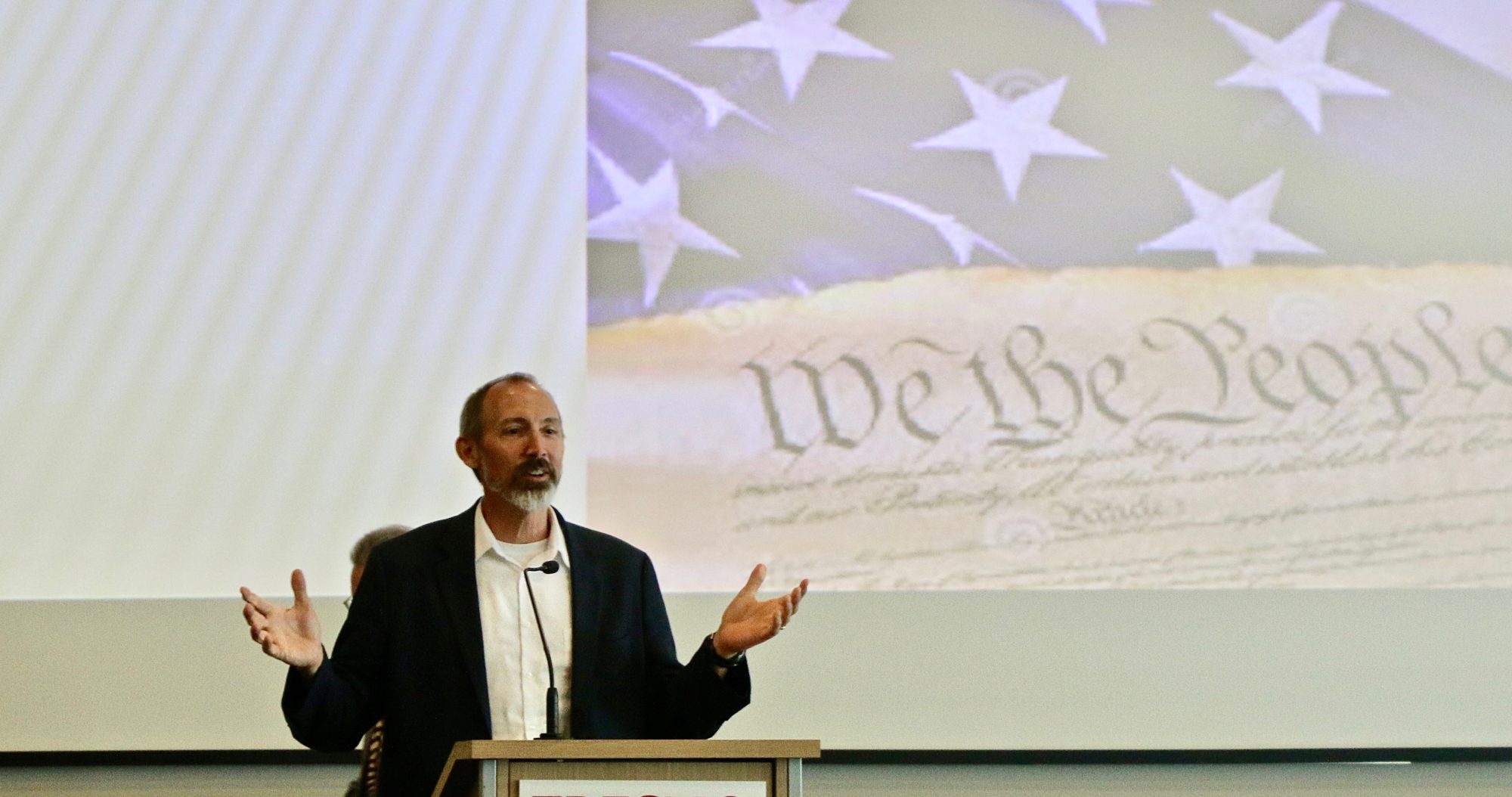
Nonviolence and The 2020 Election

Fresno Bee, November 1, 2020

recent survey concludes, “22% of Biden supporters and 16% of Trump supporters said they would engage in street protests or even violence if their preferred candidate loses.” The good news is that majorities on both sides say they are willing to abide by the election result. But it is appalling that significant numbers of Americans are willing to consider violence. Now is the time for a primer in democratic values, nonviolence, and the rule of law.

Not everyone loves democracy. H.L. Mencken suggested that democracy puts the monkeys in charge of the circus. But in the U.S., we trust the electoral system as a nonviolent mechanism for resolving disputes and transferring power.

The connection between nonviolence and electoral democracy runs deep. Violent movements tend to be secretive and authoritarian, while nonviolent movements are inclusive and transparent. Violence tends to destroy liberty, while nonviolence affirms it. Violence breeds reaction and animosity, while nonviolence creates solidarity that builds community.

The advocates of violence are impetuous and impatient. Violence is unpredictable. And it rarely works. Riots, assassinations, and civil wars do not produce good outcomes. Political violence provokes backlash. It risks collateral damage. It causes people to dig in their heels. And of course, it is illegal.

Faith in the rule of law is foundational. Thomas Paine explained that in “absolute governments” the tyrant is the law. But in America, he said, “the law is king.” Paine was a revolutionary. The American system did begin in violence. But it was violence directed against the lawlessness of British tyranny.

The aspiration of the American revolution was for a stable, public system of law that would replace the reckless will of the tyrant. James Madison and Alexander Hamilton explained that “mutable” government is “mischievous” and “calamitous.” Instability “poisons the blessings of liberty.” A stable constitutional order can “break and control the violence of faction.” The cure for instability and violence is representational government, regular elections and the rule of law.

This system channels animosity into productive activity. If you did not win this time, get better organized and run again. In the meantime, hundreds of nonviolent methods can be employed. This includes petitioning the government and speaking out in public, as well as strikes, boycotts, and civil disobedience. Nonviolence works when it is organized, strategic, creative, and tenacious. The American civil rights movement provides an example.

Nonviolence rests upon fidelity to law. The nonviolent protester is willing to go to jail to mount an internal challenge to the system. She does not seek to evade punishment or to create an alternative system out of the barrel of a gun. Instead she works to transform the system from within.

She also expresses solidarity with her co-citizens, including those with whom she disagrees. Violent law-breaking makes it impossible for arguments to be heard. It also puts co-citizens at risk. Nonviolence opens the door to reasonable discussion. It treats opponents as reasonable beings who can be persuaded. It seeks to convert rather than to coerce.

Ideally the bonds of friendship would hold us together despite our differences. But in this polarized era, it is hopeless to imagine that we could all be friends. We disagree about too much. That’s the reality of liberty. In a free country, we retain the right not to be friends. We are free to disagree, protest, whine, and complain.

But it is the constitutional system that guarantees our right to disagree. So when protests break out after the election, they ought to adhere to the basic principles of a system that allows us to assemble, to petition the government, and to speak freely.

Sometimes it does seem that the monkeys are running the circus. Our differences run deep. But we can find common ground in a shared commitment to liberty and the rule of law. Everyone involved in the electoral process has expressed an implicit faith in this system. To run for office is to agree to abide by the result of the election. To cast a ballot is to affirm that this is a legitimate process. And if you don’t like the result, you can pound your chest and howl and scream, as long as you do so nonviolently.
The Trump Prophecy and Related Absurdities

These are boom times for doomsday predictions.  Some folks view Trump as the Chosen One.   A survey from earlier this year found that 35 percent of Americans think we are entering the end times.  Only 37 percent disagree.  And this week, Pat Robertson predicted Trump would be reelected but that an asteroid would destroy the earth. 

These prophecies are laughable.  But people apparently believe this stuff.  So let’s take a critical look at Robertson’s prophecy in order to see why this kind of thing is nonsense.

The first problem is that while Robertson says Trump will win the election, he also encourages his viewers to vote.  But if God has revealed that Trump is going to win, then why bother to get out the vote?  The very idea of prophecy undermines free will and agency. 

After Trump is sworn in, Robertson says the country will be torn apart by civic unrest.  Robertson predicts five years of subsequent peace and final death by asteroid.  But don’t these predictions give us a reason not to vote for Trump?  Could we avert the unrest and the asteroid by voting for Biden? 

Proactive prevention is not on the prophet’s table.  Indeed, the prophets of doom seem to have a kind of malevolent hope (as I discussed in another column).  They appear to look forward to the chaos and to the end. 

Now let’s turn to the tortured Bible interpretation that grounds this prophecy.  Robertson cites snippets of text from Ezekiel, Isaiah, Thessalonians, and Matthew.  This textual cherry-picking is silly.  The prophecy jumps through the Bible, extracts a few ominous texts, and offers a wild and anachronistic interpretation.

If you study the Bible critically, this approach is absurd (see my What Would Jesus Really Do?).  Critical Bible study undermines the idea that there is a hidden message in the texts.  These texts were created by human beings.  They evolved over time in response to historical forces. 

Scholars suggest, for example, that Isaiah was written by more than one author (this may be true of Ezekiel as well).  These texts were written for an ancient Jewish audience during the period of Jewish exile in Babylon.  Paul’s letter to Thessalonians is written centuries later and addressed to a newly formed Christian church.  Matthew was written a generation later for an audience who had witnessed the destruction of the Jewish temple in Jerusalem. 

The meaning of these texts is grounded in these contexts.  It is absurd to believe that ancient authors wrote these texts as a warning to people in 2020.  If anything, we should heed Matthew’s warning against false prophets (Matthew 7:15) and Paul’s suggestion that we test prophecy and hold fast to the good (1 Thessalonians 5:21). 

And now, about that asteroid.  Ancient people feared objects being flung from the sky by angry gods.  But today, we know that there are no gods up there to do the flinging.  We understand that planets and space rocks orbit the sun at high speeds and sometimes cross paths.  We know that the universe is billions of years old.  Species have come and gone.  Some have been destroyed by asteroid impacts. 

But none of this was known to Ezekiel, Isaiah, Paul, or Jesus.  Nor did these ancient prophets know there were continents on the far side of the world.  So why should we believe that they made predictions about contemporary American life?

And why should we believe that God is the kind of being that gets angry and destroys His own creation?  The theological assumptions of prophetic Christianity turn God into a petulant bully. 

The theological critique of this kind of thing has been around for a long time.  One clear statement of the idea comes from Thomas Paine, whose thinking about religion and political life inspired the American Revolution.  Paine criticized “the prophecy-mongers.”  He said, “belief in a cruel God makes a cruel man.”

Of course, in the American system, people are free to believe what they want.  But critical thinkers are also free to criticize the absurdities of prophecy.  That’s the way enlightenment works.  It is a slow process of sifting and winnowing.  Enlightenment is not an asteroid that strikes like a thief in the night.  It is critical activity that requires daylight and human agency. 

Patient Advice for Living in Limbo

Fresno Bee, October 18, 2020

We are living in limbo. The pandemic rages on. The election hangs before us like a double-edged sword. We don’t know when or how this will end. We hold our breath, while COVID-19 haunts our dreams.

Election years typically end in limbo, with lame ducks and lost causes. This year, we have the added anxiety of a president claiming the election is rigged, while calling for his opponents to be jailed. The nation is worried about election unrest and violence.

Life in limbo is characterized by worry, impatience, dread, and despair. Picture the anxiety of waiting for the results of a cancer test. The answer comes as a relief, even if it is bad news. It is better to know than to wait.

Limbo is a haunted hovering. Time spent in limbo is nonlinear. Limbo is a gateway. But once we cross the threshold we get lost. The passage is obscured by spectral worries that cloud clear thought.

We get stuck in limbo, mulling things over. We brood and ruminate, fret and stew. But we make no progress. T.S. Eliot described this in Prufrock as a world of yellow fog and ether in which every moment contains a hundred indecisions, visions, and revisions. Such dithering frays the nerves and weakens the will.

The experience of limbo is not unique to the present moment. There is a general human tendency to waver and worry, defer and deflect. This is related to the difficulty we have in making commitments and saying good-bye.

Some people never really say “yes” or “no.” They duck the question and beat around the bush. But a firm “no” is a blessing in comparison to a vague deflection. A “yes” opens the door. A “no” closes one. But a “maybe” leaves us in limbo with the door ajar.

And when the party’s over, we stand in the doorway, making small talk in the dark. Perhaps we fear the solitude of the night. Phillip Marlowe said that “to say goodbye is to die a little.” A long goodbye is another kind of limbo.

The antidote is obvious. Breathe deeply and exorcise the ghosts. Take a stand. Close the door. Either turn back or go out and get moving. Remaining at the threshold won’t help you decide. Sure it’s wise to think things over. But deliberation is not avoidance. “Measure twice, cut once,” the saying goes. But after you’ve measured it’s time to cut. And once you begin, cut swiftly and true.

To procrastinate is to live on borrowed time. Eventually the bill comes due. A person can only wait so long. And then you are dead.

Virtue and happiness require action. Patience is crucial. Genuine patience is active and expectant, full of attention. Patience is not passivity, which deadens the mind. Patience is sustained energy directed toward the future.

The Roman poet Horace said that patience helps us endure what cannot be changed. Horace is also famous for saying “Seize the day” and “Dare to be wise.” He said a person who passively waits for wisdom is like an idiot standing beside a river, waiting for the water to stop before daring to cross. Life is short, Horace said, and we can’t trust tomorrow. So plunge on in.

To live is to get your feet wet. Sometimes the river knocks you off your feet. But it is better to swim than to wait. Those who dip their toes never leave the shore.

This may sound like a call for blind action — but it’s not. One of the dangers of limbo is that it can give way to the panicked urge to run and rage. As the tension builds, there is a risk of explosion. But blind action makes a splash without making a difference.

We need to be calm and patient. Worry changes nothing. Fight the urge to panic. This limbo won’t last forever. At some point the ether will wear off and the yellow fog will lift.

Patience is realistic and engaged. Rather than battling ghosts, roll up your sleeves. Rather than pausing at the doorway, get moving. Stay focused on kindness and courage. Stop holding your breath and saying maybe. There is work to be done.

Virtues and Vices of Online Learning

The idea of “reopening schools” is hopelessly politicized.  School are “open,” even though teaching and learning have moved online.  Unfortunately, school “reopening” is a political football.  There is a legitimate debate about school safety and the well-being of children, staff, and teachers.  But the political environment does not foster careful thinking about teaching and learning.

It is obvious that learning can happen online.  Americans learn online every day.  Youtube videos teach us how to do home improvements or how to play guitar.  Useful apps teach foreign languages.  Business training involves videos and interactive websites.

Some people don’t like this.  Some are nostalgic for the routine of sitting together in classrooms, hanging out and chatting in the halls.  Of course, not everyone is nostalgic for this.  Face-to-face schooling also includes loneliness, bullying, and stress.

Schools are not simply places for learning.  Public schooling is an essential part of the economy and the social safety net.  Schools allow parents to get to work.  They provide breakfast and lunch for poor children.  They are places of refuge for kids who need social and emotional support.  They are also connected to the rituals and routines of American life: football games and marching bands, holiday concerts, and so on.

But the traditional classroom is not essential for learning.  Learning is an individual activity which requires effort, concentration, discipline, and motivation.  John Dewey explained, “learning means something which the individual does when he studies.  It is an active, personally conducted affair.”  Social supports help.  But the learner must do the learning, alone with a book, a piece of music, or a math problem.

A recent article interviewed college students who complained about online learning.  One student said she lacked motivation.  Another said, “I just feel like I’m turning in work and not really learning anything.” 

Those same problems occur in the face-to-face environment.  Teachers have long complained about unmotivated students who go through the motions and don’t learn.  The issue of motivation and engagement is not an online problem.

The bigger problem is that schooling is viewed as a necessary evil and not as something valuable in itself.  Whether online or in person, if you don’t view value what you are learning, you will be unmotivated and disengaged. 

Working adults encounter the same problem when completing mandatory training courses.  Whether online or face-to-face, if you don’t want to be there, it is hard to learn.  On the other hand, if you are curious and interested, you will learn whether online or in person. 

For curious learners, online learning can be very effective.  One advantage of asynchronous courses is that you can rewind or fast-forward videos according to your own needs and interests.  This is much better than suffering through a boring lecture in a crowded classroom. 

Or consider the difference between in-person discussions and written discussion forums.  In-person discussions typically group students in a circle to encourage oral communication.  Skills of speaking and listening can be developed in this environment.  But often the circle is dominated by a few loud talkers, while other students sit passively. 

Online forums that encourage written communication are more inclusive of the quiet and reflective student.  The level of discourse in written discussion forums is typically much higher than in in-person discussion.  When students write online posts, they have more time to reflect. 

By now, our technologies are flexible. Oral discussion can occur online through programs like Zoom.  Written communication can be practiced in the classroom.  Both skills are important.  Each can be learned in either environment. 

At the end of the day, neither modality is inherently better or worse.  It all depends on the way the teacher structures the activity and on the motivation and curiosity of the student. 

Teachers and students still have a lot to learn about online education. As with most things, there are pros and cons, virtues and vices.

But online learning is not going away. And if we work at it (if we try to learn to do it better…) we will get better at it.  We won’t learn to improve if we keep complaining and waxing nostalgic for the old routine.  Nor does it help to let politics get in the way of thinking carefully about what it means to teach and to learn.

Don’t be a Donald!

Fresno Bee, October 4, 20202

The president is obnoxious. And our democracy is in disarray. The debate this week demonstrated that Trump is a boor. But this is not news. For nearly five years, I have been writing about Trump’s incivility.

So what have we learned during these years? Well, I hope that by observing Trump we learn how not to behave. The president’s behavior can be used to teach lessons in critical thinking and character. I imagine posters that say, “Don’t be a Donald!”

This is a time-honored method of moral instruction. Cato, a Roman soldier and senator, said, “wise men profit more from fools than fools from wise men.” Moral development is stimulated by scrutinizing bad behavior.

The lessons are simple. Don’t badger other people. Keep your mouth shut and allow others to speak. Ad hominem arguments are empty and irrelevant. Blustery bullying is mean. Lies, deflections, and hyperbole indicate a mind without clarity or depth.

These are ancient lessons. The Bible warns against false and foolish speech. It praises wisdom and righteous words, as well as kindness, patience, and golden silence. It is better, we learn, to remain quiet than to blow like the wind. The Bible points out the moral failure of selfish and incompetent leaders.

The ancient Greeks offered similar lessons. The Greek tragedies are object lessons in failures of character. The Greeks teach us to avoid hasty and loud speech, to cherish wisdom, and to persuade rather than overpower. They teach us not to mock another’s misfortune, to be merciful in our strength, and to seek tranquility through self-mastery and introspection. One of the seven sages of ancient Greece, Chilon, put it simply, “Let not your tongue outrun your thought. Control anger. Let no one see you in a hurry. Obey the laws. Be restful.”

These lessons are taught by observing bad rulers. Ahab and Oedipus were corrupt kings. They ignored moral restraint. Moral education uses ancient tragedy to teach us how not to behave.

But there is another side to the story. Even though the corrupt kings of the ancient world eventually fell, they still enjoyed the privilege of power. Here is a problem for parents and teachers today. The Trump method rejects restraint. But so far, this bad behavior has worked. If you act like Trump, you could become a billionaire and win the presidency.

Imagine if this lesson took root. Would teachers, coaches, and parents be interrupted and belittled by Trumpian children? Would a petulant child respond to a teacher’s admonishments by saying, “I’m just doing a Donald.” It’s possible to imagine bracelets and T-shirts emblazoned with “What Would Trump Do?” In a WWTD world, the bully rules the playground.

These comments about character and style have nothing to do with policy. Some people support Trump because he appoints conservative judges or because he cuts taxes. Reasonable people can disagree about policy. But the triumph of the Trumpian character is a menace to morality.

The ancient Greeks understood that obnoxious boors win elections by inflaming the passions of the people. That’s why Plato thought that democracy was a terrible idea. In the United States we think differently. Our democracy emerged out of the Enlightenment. The American experiment was a product of “the age of reason,” when public debate was supposed to be based on rational arguments and guided by norms of civility.

Safeguards are built into the system to limit the power of demagogues. The system of checks and balances does not, by the way, require debates, rallies, or tweeting. Maybe it’s time to return to a leaner version of democracy — one which does not give a platform to rude and obnoxious behavior.

One way to teach our children not to be like Trump is to stop watching him. This is generally good advice for dealing with rude and obnoxious colleagues and relatives. Leave the room and shut the door. Unfortunately, this isn’t so easy when the boor is the president.

So until Trump is finally shown the door, let’s use his bad behavior to teach our children how not to behave. Let’s teach them that rudeness is wrong. And even though Trump is currently king, it is wise to say, “Don’t be a Donald.”