Truth Endures

Fresno Bee, August 11, 2025

In times like these, it is important to remember that truth endures. Despite lies and cover-ups, there are facts. Yes, there are secret files, information silos and political attacks on science and history. But truth persists despite the conspiratorial mania of the present moment.

As Winston Smith, the protagonist of George Orwell’s “1984,” put it, “If you clung to the truth even against the whole world, you were not mad.” It isn’t easy to cling to truth in a world where truth is assaulted and expertise is devalued. In this idiotic environment, bad news is dismissed as fake news and scientific reason is denigrated as ideological.

We might consider Robert F. Kennedy Jr.’s anti-vax obsession here. Or we could discuss the Trump administration’s attack on climate science.

A telling example is found in President Donald Trump’s firing of Erika McEntarfer, the head of the Bureau of Labor Statistics. Trump claimed she was a “Biden appointee” who “faked the jobs numbers before the election to try and boost Kamala’s chances of victory.” On Truth Social, Trump explained, “In my opinion, today’s Jobs Numbers were RIGGED in order to make the Republicans, and ME, look bad.”

In Trump’s telling, everything that makes him look bad — or that he does not like — is rigged, fake and even treasonous. Last month, Trump accused Barack Obama of “treason” for supposedly rigging elections in 2016 and in 2020. In May Trump said that members of the Biden administration committed “TREASON” (in typical Trumpian all-caps), as “treasonous thugs” supposedly took over Biden’s presidency as the former president’s capacities declined.

It is easy to ignore these scandalous charges since the Trumpian firehose of gibberish is constantly gushing. But if we take these charges seriously, they present us with a very ugly dilemma. Either one of America’s ruling parties is treasonous or the other is unhinged. If Trump’s accusations are true, the Democratic Party establishment should be arrested and imprisoned. If what Trump says is false, the Republican Party establishment is mired in conspiratorial claptrap.

Some folks may roll their eyes and try to ignore all of this. One way to preserve your sanity in the face of madness is to keep your head down. But indifference is a step away from complicity. Good, honest people cannot remain indifferent to the truth.

And at the end of the day, there are facts: Either the globe is warming or it isn’t. Either vaccines are safe and effective or they are not. Either the economy is waning or waxing. Scientific reasoning can deliver the truth. Political meddling muddies the water.

Philosophers have affirmed the value of truth for millennia. Plato said, “Truth is the beginning of every good thing.” To live well, Plato said, you must be a “partaker of the truth.” More recently, English philosopher Bernard Williams said that if we “lose sense of the value of truth… we may well lose everything.”

The partakers and defenders of truth are often lonely voices howling in the wilderness. This is especially true when indifference and complicity are common. And let’s face it, human beings are easily deceived. Naïve dupes happily succumb to deceptive appearances. Charlatans and con-men prey upon our credulity. And some people devote their entire lives to lies, or to lying.

To remedy this, society has developed resources to defend the truth. Oaths and rituals are designed to ensure truth-telling and promise-keeping. Our institutions celebrate the virtues of honesty and sincerity. Scholars enforce academic integrity. Legal systems require sworn testimony. We punish plagiarists, liars and perjurers.

But as Orwell warned, unscrupulous political powers can use these institutions and procedures in defense of lies. Power divorced from truth is dangerous. Despite attempting to cling to truth, Winston, the main character of Orwell’s novel, is eventually tortured and broken. He succumbs to the madness. He accepts whatever lie “the Ministry of Truth” proclaims. In the end, he learns to love Big Brother.

The moral of Orwell’s story is about the ongoing need for truth-telling, and courageous resistance to lies. This isn’t easy. History is littered with the broken bodies of those who dared to speak truth to power. But in the long run, the truth endures. And it is nobler to defend the truth than to acquiesce to a lie.

Read more at: https://www.fresnobee.com/opinion/readers-opinion/article311622581.html#storylink=cpy
The Secular Declaration of Independence

Fresno Bee, July 6, 2025

“Declaration of Independence was rooted in Enlightenment ideals, not divinity”

Some suggest that the U.S. is a Christian nation.  That claim often rests upon an interpretation of American history that misunderstands the Declaration of Independence.  For example, the Speaker of the House, Mike Johnson, said this week, that that the American Founders’ “creed” is stated in the Declaration.  Johnson believes that Thomas Jefferson was “divinely inspired” to write the Declaration.

Jefferson’s language is worth careful consideration as we celebrate the 249th anniversary of the signing of the Declaration.  The part of The Declaration that has been emphasized by Johnson and others is the following: “We hold these truths to be self-evident, that all men are created equal, that they are endowed by their creator with certain unalienable rights, that among these are life, liberty and the pursuit of happiness.” 

The Founders understood the world as coming from a creator.  They thought that human rights were found in the “laws of nature” and “nature’s God,” to quote another earlier passage from the Declaration. 

But Jesus is not mentioned here.  Nor is the Bible.  Indeed, Jefferson had a decidedly unorthodox understanding of Christianity.  Like Benjamin Franklin, Jefferson was a Deist who understood “nature’s God” as distinct from the God of the Bible.  He rejected the idea that the abstract “creator” could perform miracles.  Jefferson even revised the Bible to eliminate its miracles, including the resurrection of Christ.  Jefferson’s Unitarian colleague John Adams also doubted the divinity of Christ.  To suggest that these authors were inspired to create a Christian nation is simply false, as I discuss in my new book, Christian Nationalism and the Paradox of Secularism.

These Enlightenment-era thinkers were sympathetic to a rational, philosophical reconstruction of ancient revealed religions.  They also understood themselves as doing a very human thing by engaging in political struggle.  Just after that famous statement about the creator and our inalienable rights, the Declaration adds a second self-evident claim: “that to secure these rights, governments are instituted among men, deriving their just powers from the consent of the governed.”

The text says that governments are human constructions.  The legitimacy of governments depends upon democratic consent, not divinely ordination.  Building upon this point, the next self-evident truth of the Declaration is that there is a right to revolt against unjust government and to re-construct government according to our own best judgment. 

This makes the Declaration a secular or humanistic document.  Our rights may come from God, the creator, or the laws of nature.  But government is a human creation.  It is “we, the people” who create governments, and alter or abolish them.

This human process culminated in the creation of the U.S. Constitution.  The Constitution was a second attempt to create a government, which built upon the failure of the Articles of Confederation.  The Constitution was a negotiated document that included the notorious compromise that allowed slavery to exist.  Americans fought a Civil War to further clarify and improve the Constitution.  None of this indicates divine inspiration. 

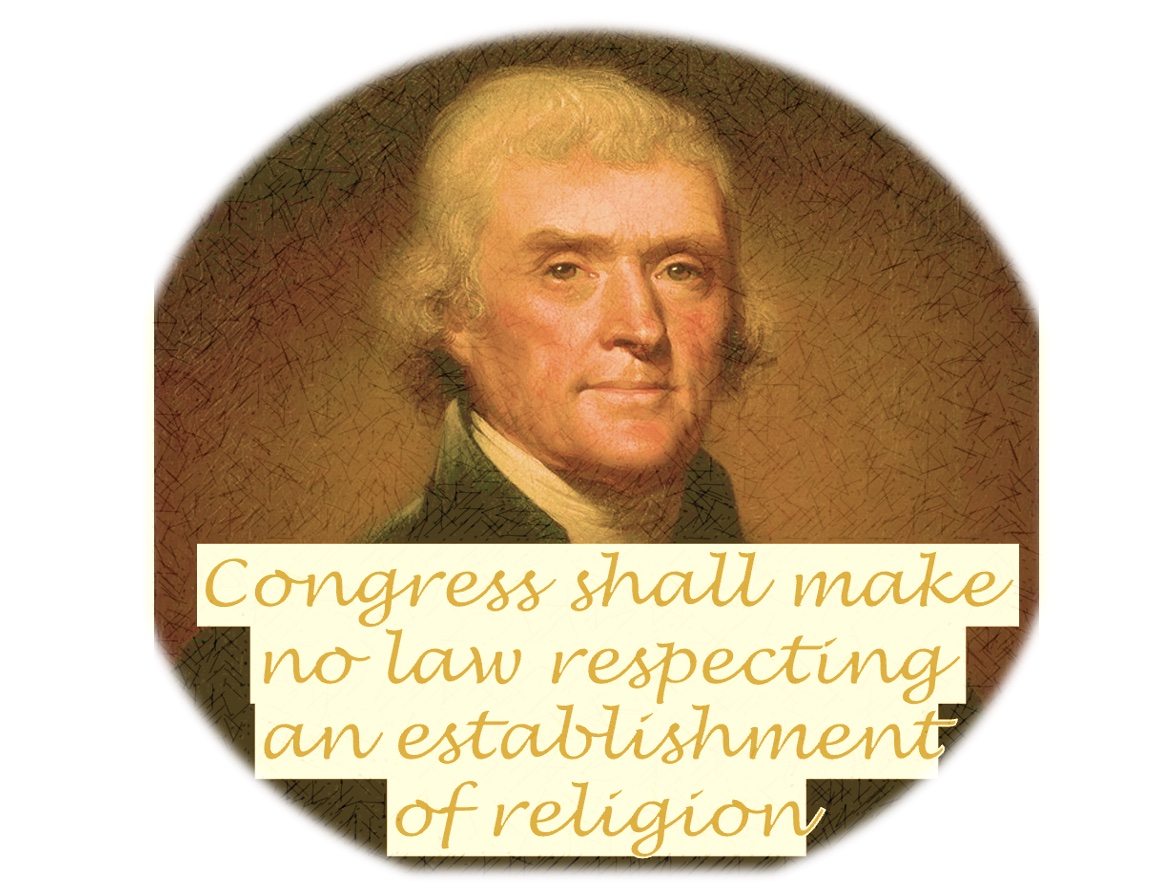
Indeed, the Constitution affirms a secular standpoint.  The only mention of religion in the Constitution itself occurs in Article 6, where religious tests for office are prohibited.  And the First Amendment clearly states, “Congress shall make no law respecting an establishment of religion, or prohibiting the free exercise thereof.”  This means you are free to worship (or not) according to your conscience, and the government is not allowed to erect an official state religion.

This is a radically modern idea that broke away from the traditional way of conceiving church and state.  In England and other European lands, church and state were combined, and often still are.  The King of England is the head of the Anglican church, for example.  In the United States there is no American church.  Nor does the President lead a religious institution. 

The fact that the authors of the Declaration were Deists and Unitarians reminds us why they wanted a new form of government.  In another time or in another country, those men would have been persecuted as heretics.  But they created a country where such persecution no longer occurs.  The legal framework they created was not the result of divine intervention.  Rather, it was the result of human beings daring to imagine a new form of government in which religious liberty was broad enough to include their own unorthodox beliefs.

Read more at: https://www.fresnobee.com/opinion/readers-opinion/article309937295.html#storylink=cpy

Against Warmongering

Fresno Bee, June 23, 2025

The warmongers are at it again: Bombs are falling on foreign cities; politicians are being assassinated; tanks are paraded through Washington; and troops are “liberating” Los Angeles.

“Game on,” Senator Lindsey Graham said, cheering the prospect of going “all-in” against Iran. Warmongers see a world of enemies engaged in constant battle. They imagine it is easy to achieve “unconditional surrender,” to quote President Donald Trump’s ultimatum to Iran.

The militaristic mindset explains the Trumpian call to “liberate” Los Angeles from “the socialists,” as Homeland Security Secretary Kristi Noem put it last week. As troops were deployed to L.A., the president told the soldiers under his command at Fort Bragg, North Carolina that the riots in Los Angeles were an assault on “national sovereignty.”

This aggressive language is a prelude to moral disaster. Moral judgment about the use of force requires careful deliberation informed by the wisdom of the world’s traditions, most of which teach us to turn the other cheek and love our enemies. If violence is ever justified, it should emerge as a last resort from out of a background commitment to nonviolence.

But that’s not how warmongering works. Rather than making arguments grounded in patience, love and justice, the warmonger rants and raves. And, indeed, that is the way war works. Violence is dumb, inarticulate and morally mute. It kills and disables. But it makes no arguments — it does not convert or convince, it only destroys.

Violence is seductive because it is spectacular. It is quick, loud, decisive and even fun. Bullies and abusers enjoy what they do. Otherwise, they wouldn’t do it. Some sinister part of human nature likes to blow stuff up. Sigmund Freud called this the death drive. He saw a key challenge of psychological development as learning to transform cruelty into something better. Civilization develops as we learn to sublimate aggression.

Moral development should lead beyond cruelty, rage and revenge. Retributivism is a step in that direction: Rather than simply lashing out in blind fury, retributive justice tells us to apply violence in measured doses according to the old recipe of an eye for an eye, or a life for a life. The retributive scheme is meant to moderate rage. It sets a limit on violence.

It was in response to the old law of “eye-for-an-eye” justice that Jesus said we should turn the other cheek and love our enemies. Christian pacifism emerged in the ancient world following this ideal. But some Christians argued that there was a right to kill in self-defense — and especially in defense of others. The “just war theory” developed, allowing defensive war as a reluctant last resort. The elaborate edifice of the just war theory aims to limit warfare and minimize bloodshed in pursuit of just causes.

In my own scholarship on this topic, I have argued that just war is much easier to describe in theory than to carry out in practice. The “fog of war” makes it difficult to master events, to predict outcomes and to ensure compliance with moral principles. Another problem is “the just war myth,” a wishful idealism that thinks it is easy to fight a just war, and that “the good guys” win because they are good.

The warmongers ignore these difficulties. They are “all-in” on war. Perhaps they think war is like a movie or a video game where widows and orphans never appear on screen. Or perhaps they are really just cruel and aggressive.

In reality, very few wars live up to the moral ideal. Good people die. Bad guys sometimes win. Atrocities are committed. And noble soldiers suffer post-traumatic stress disorder and moral injury.

Our culture inclines us to ignore all of this. Parades do not show off the injuries or the trauma. Films and video games make violence seem exciting. And warmongering makes war appear easy to justify.

As soldiers deploy on American streets and bombs rain down on foreign cities, we need to think more carefully about the justification of war. We also need to listen carefully to the critics of war, whose voices are often drowned out by the warmonger’s ranting. Cruelty and war are ancient maladies. But the argument against violence is as old as Jesus who advised us to love our enemies and turn the other cheek.

Read more at: https://www.fresnobee.com/opinion/readers-opinion/article309092545.html#storylink=cpy

Meaning, Nihilism, and Hope

Fresno Bee, May 25, 2025

Fertility clinic bombing in Palm Springs sheds light on nihilistic violence 

The bombing of a fertility clinic in Palm Springs last weekend points toward a dark philosophical dead-end. The alleged perpetrator seemed to have a misanthropic, anti-life worldview. According to a report by the LA Times, a website that may be linked to the bomber advocated for “sterilizing this planet of the disease of life.” A speaker there declared, “I’m angry that I exist.” The fertility clinic was likely targeted as a symbol of birth, life and hope.

The root problem here has been described as “anti-life nihilism.” A more familiar term may be pessimism. The 19th Century pessimist, Arthur Schopenhauer, said life was an “unprofitable episode disturbing the blessed calm of non-existence.” He suggested it would be a favor to the next generation to “spare it the burden of existence.”

It is easy to imagine this leading to violence. The Washington Post warns of a rash of nihilistic violence, claiming that “nihilistic extremists are often motivated by a philosophy that seeks to hasten the world’s downfall.” If you think existence is rotten, you may want to annihilate it all. Those who hate life may view life-affirming people with bitter animosity.

But nihilism is not necessarily violent. If life stinks, indifference is as likely as hatred. Disillusionment and despair often give birth to apathy and listlessness. If nothing matters, then why bother with anything?

Various solutions to nihilism have been proposed. Religion is an obvious one. The loving God of Christianity gives meaning and purpose to life despite suffering, sadness and death. In Buddhism, salvation is found in the insight that suffering is caused by attachment to the ever-changing world of experience.

A different approach can be found in art, science and humanism, rooted in ancient Greek philosophy. Greek philosophers argued that human virtue and wisdom were intrinsically valuable, despite the indifference of nature and the gods.

Modernity builds upon this. Scientific knowledge has value in itself. It is amazing to understand the immensity of the cosmos, the history of humanity or the inner workings of cells and atoms. The quest for knowledge makes life worth living. There is always something new to discover and more wisdom to be gleaned. The nihilist gives up on knowledge. One cure is to rediscover the joy of curiosity.

Art also has intrinsic value. We can delight in the music of Mozart, the lyrics of Bob Dylan or the architectural wonders of the world. We can also actively create art. The fun of drawing, singing or writing is freely available. A nihilist might complain that nothing human lasts. But the energy of the creative imagination is an antidote to that complaint.

We can also find value in friendship and love, as well as in natural beauty, physical pleasure or athletic achievement. Social life and purposeful activity provide deep wells of meaning. When nihilists reject life, they reject these basic goods. This indicates a broken spirit lacking in vision, compassion and ambition.

The great American philosopher William James offered a cure for pessimism in an essay entitled “Is Life Worth Living?” He said that pessimism results from too much thinking and not enough active responsibility. The gloomy, world-weary nihilist suffers from what James called “speculative melancholy.” The solution is to stop whining, get out in the world and get to work. We have a choice in the matter of meaning.

If life seems meaningless, remember that you are free to create something better. As James said, “Believe that life is worth living, and your belief will help create the fact.”

As we celebrate Memorial Day, we discover another remedy for nihilism. We can learn from the commitment of those who sacrifice their lives in service to others. We all die. But this gloomy fact need not undermine the will to live. Rather, faith in life is renewed by observing that the best lives are lived in uplifting others.

Pessimism and nihilism are perennial problems. They indicate a deep challenge for the human spirit. We are the only beings in the universe — as far as we know — who wonder whether life is worth living. If we understand our unique capacity to ask this question, we may also realize how wonderful it is to exist as beings who think, question and create.

Read more at: https://www.fresnobee.com/opinion/readers-opinion/article306995306.html#storylink=cpy

Motherhood and Choice: Keeping our Eyes Wide Open

Fresno Bee, May 11, 2025

Motherhood should be a choice…

Motherhood can be wonderful and joyous when it is freely chosen and fully supported. As we celebrate mothers, we should acknowledge that motherhood occurs in various ways in the modern world. We should also consider whether we want the government meddling with sex, reproduction and the family.

Such meddling is an old problem: Plato imagined the state controlling procreation — his goal was to produce better offspring through eugenic breeding of human beings. His student, Aristotle, suggested that deformed children should not be allowed to live and that abortion could be required in the interest of population control.

If those ancient proposals sound appalling to modern ears, that’s because we typically embrace sexual and reproductive freedom. We want to be able to choose who we have sex with, as well as whether and when we reproduce.

Freedom of choice for mothers is a relatively new development: For most of human history, motherhood was under patriarchal control. The innovations of the modern world have changed all of that.

During the past 200 years, the human population has boomed from 1 billion to 8 billion people. At the same time, sexual and reproductive freedom were unleashed. Better birth control technology allows for sex without reproduction. Liberal divorce laws, the demise of the stigma against unwed mothering and LGBTQ rights have changed the cultural paradigm.

We are still sorting out the implications of these changes. And the culture war about motherhood is not yet over.

The rapid increase in population has led some to worry about the carrying capacity of the earth. Those concerns are exacerbated by climate change, immigration crises and ongoing social and political turmoil. A growing population may make these things worse.

But some folks are now worrying about declining populations in developed countries such as the U.S. global population will likely continue to grow to above 10 billion people in the next 50 years. But in those parts of the world where sexual and procreative freedom are firmly established, birth rates are falling below replacement levels.

These declining birth rates have prompted the Trump administration to advance a pro-natal agenda. At the annual March for Life in January of this year, Vice President J.D. Vance said, “I want more babies in the United States of America.” At the same time, Vance criticized “a culture of radical individualism.”

Vance invokes a broad critique of those modern developments that include women’s liberation, the sexual revolution and abortion rights. He is concerned that people are enjoying their freedom while ignoring what he called “the joys of family life.”

The pro-natal agenda has led the Trump administration to consider policies to promote childbirth, including a $5,000 incentive for making babies. In support of the idea, one conservative commentator, Michael Knowles, has encouraged Americans to get busy making babies. In a YouTube video, Knowles said, “Close your eyes and think of America. Do your patriotic duty. Make America great again. You gotta have babies. OK? It’s your marital duty. It’s your patriotic duty…. Close your eyes and think of America, and maybe you get five thousand bucks.”

Critics have pointed out that $5,000 is hardly enough to support motherhood in an economy that includes high costs for health care, childcare and housing. Libertarians and feminists alike may also wonder whether it is a good idea to view procreation as a patriotic and marital duty.

We should be nervous when government officials start meddling with sex and the family. The government can offer incentives and support for families and children without becoming coercive, but the slippery slope of governmental coercion is an ancient problem we ought to avoid. And to suggest we close our eyes and make babies as a patriotic duty is truly bizarre.

If motherhood is an important good, it should be chosen with eyes wide open, for its own sake and not because of some political program. Vance is right about the joys of family life: Loving families are wonderful. But reproduction is not the only joy that matters. In a world with more than 8 billion people, it might be appropriate to have fewer kids. More importantly, in a free country, we must be allowed to pursue familial joy on our own terms.

Read more at: https://www.fresnobee.com/opinion/article305999296.html#storylink=cpy